Your phone lights up in the middle of the night. A brother, spouse, son, or friend says they’ve been arrested. The call is short, messy, and full of gaps. You hear the name of a jail, maybe a charge, maybe not. Then the line goes dead, and suddenly you’re searching for 24 Hour Bail Bonds Near Me because waiting until morning isn’t a real option.
That’s the moment this guide is for. You don’t need courtroom theory right now. You need to know what to gather, what a bondsman will ask, what bail costs in California, and what happens after payment is made. In Southern California, speed matters, but clear information matters just as much.
Table of Contents
- That 2 AM Call and What to Do First
- Making the Call What Information to Gather
- Understanding Bail Bond Costs in California
- The Bail Bond Process from Paperwork to Release
- After Release What Happens Next
- Why Local Expertise Matters in Southern California
That 2 AM Call and What to Do First
The first few minutes after an arrest call are usually the worst. People talk fast, names get misspelled, and nobody remembers the exact charge. Families often waste precious time calling three relatives, searching random jail pages, and waiting for someone else to take control.
Start simpler than that. Write down every detail you have, even if it seems incomplete. Full name. Date of birth. The jail or city. Anything said about the booking. Then call a licensed bondsman who answers right now, not when the office opens.

Jail intake and release don’t follow a normal workday. In many jurisdictions, bail can be posted 24 hours a day, 7 days a week, which is why bondsmen stay available overnight and on weekends, as noted by Bratten Bail Bonds on 24 hour bail availability.
Keep the first call focused
On that first call, the goal isn’t to tell the whole family story. The goal is to confirm where your loved one is, whether bail has been set, and what can happen next.
A calm agent will usually help you sort the problem into three parts:
- Location first: Which facility has the defendant.
- Status second: Whether booking is complete and bail is available.
- Action third: What documents and payment steps are needed to post.
Practical rule: The fastest families aren’t the ones who know the most. They’re the ones who can give clean, accurate information without guessing.
If you’re still trying to figure out where your loved one was taken, this guide on how to find an arrested loved one in Camarillo can help narrow that down before the paperwork starts.
In Southern California, especially across Ventura, Santa Barbara, and Los Angeles County, the difference between a smooth overnight release and a frustrating delay often comes down to what happens in the first half hour. Don’t wait for daylight if bail is available now.
Making the Call What Information to Gather
The fastest calls are the calls with clean facts.
At 2 AM, families often have pieces of the story from different people. One person has the jail name. Someone else has the date of birth. Another relative is sure about the charge, only to discover they were guessing. That is how an overnight release gets delayed before the paperwork even starts.
Licensed bail agencies can handle remote documents, e-signatures, and payment processing, but the first step is still basic intake. The key details are the defendant’s full legal name, date of birth, facility name, booking number, and charge or bond amount, as explained by Denver VIP Bonds in its guide to online bail bond processing.
Start with confirmed details
If you only know part of the information, call. A good bondsman can help verify the rest. Still, every wrong detail creates another round of checking with the jail, and that costs time.
Names cause problems more often than families expect. A nickname, a missed middle name, or the wrong birth date can point the search to the wrong person, especially in larger Southern California facilities. If you are not sure, say you are not sure. Guessing slows things down more than admitting you need help confirming something.
If you are upset, slow down and spell the name letter by letter. That one minute can save an hour.
Information to have in front of you
| Information Needed | Why It’s Important |
|---|---|
| Full legal name | Helps the bondsman identify the correct person in custody and avoid confusion with similar names |
| Date of birth | Confirms identity and helps separate common names in jail records |
| Facility name | Shows which jail, station, or detention center is holding the defendant |
| Booking number | Speeds up verification after intake is complete |
| Charge or bond amount | Helps determine whether bail is set and what approval steps may apply |
If you have a screenshot, booking sheet, or text message with any of this information, keep it open during the call. Do not rely on memory if you are tired or panicked.
Families also ask about cost during this call, which is fair. A quick review of how bail bond pricing works in Ventura and Santa Barbara County can help you understand what the agent is quoting and why.
What helps the call go faster
One person should handle the call if possible. That does not mean the rest of the family cannot help. It means one caller should collect the details and speak for the group so the information stays consistent.
Keep these points in mind:
- Do not guess at booking information. Wrong details send the search in the wrong direction.
- Do not pass the phone around. Multiple callers often give conflicting facts or different payment plans.
- Do not argue the arrest during intake. Release decisions turn on booking status, bail amount, indemnitor approval, and paperwork, not on whether the family believes the arrest was fair.
- Do ask what is missing. A good agent will tell you exactly what to text, email, or photograph next.
That last point matters. The best overnight calls are not long. They are organized. The family finds out what is missing, sends it over, and makes decisions quickly.
Understanding Bail Bond Costs in California
Money is where panic usually spikes. People hear a large bail amount and assume they need to produce the entire figure in cash before anything can happen. In most California bail bond cases, that isn’t how it works.
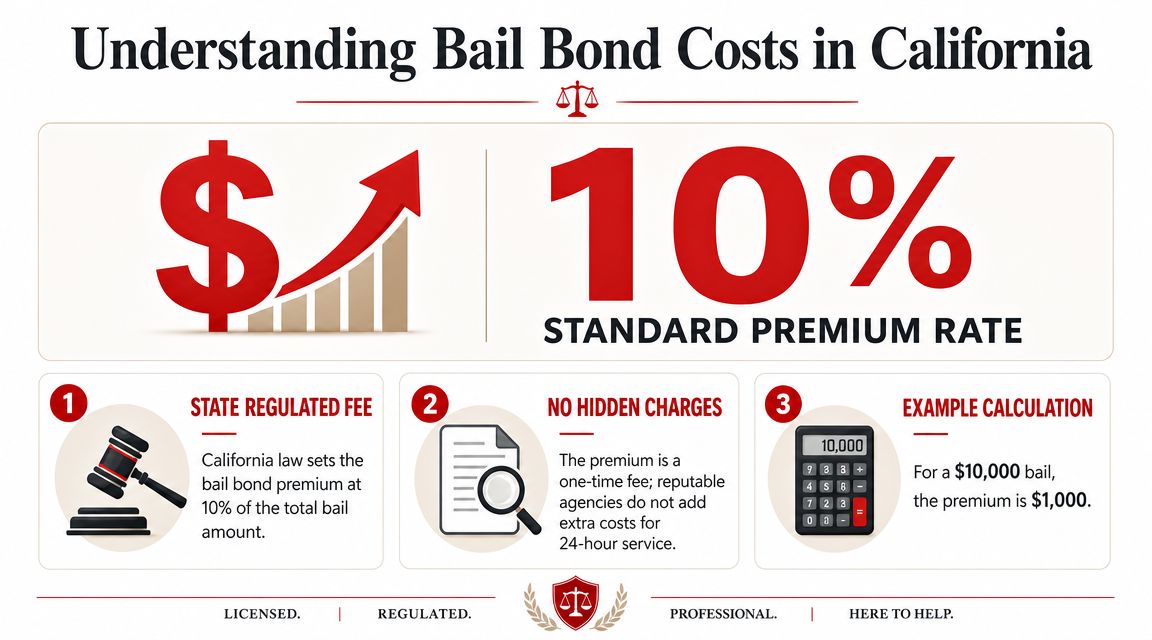
California is one of the clearest markets on pricing. The average bail amount is approximately $50,000, and the bond premium is typically 10% of the total bail by law, which means a $50,000 bail can result in a non-refundable premium of about $5,000, according to this California bail cost summary.
What the 10 percent premium means
That premium is the fee for the bond service. It is not refunded at the end of the case just because the defendant went to court and complied.
That’s the point many families miss in the middle of the night. They hear “bail” and “premium” as if they’re the same thing. They aren’t. The court sets bail. The bond premium is what you pay the bail agent to post the bond.
Here’s the clean way to view it:
- The bail amount is the full amount set on the case.
- The premium is the California bond fee, usually 10% of that amount.
- The premium is non-refundable once the bond is written.
If you want a county-specific breakdown, this page on how much bail costs in Ventura and Santa Barbara County gives useful local context.
When payment plans and collateral come up
A lot of families can manage the premium only if they’re given a payment plan. That’s common. It doesn’t change the legal premium structure, but it can change how the premium is paid over time for a qualified co-signer.
Collateral is a separate issue. It’s usually discussed on larger or higher-risk bonds, or when the agency needs added security before posting. That can involve property, a vehicle, or another approved asset, depending on the bond and the underwriting decision.
Ask three direct questions before signing anything: What do I owe tonight, what stays non-refundable, and under what conditions is collateral returned?
This is also where honesty matters. If the defendant has a history that affects risk, or if the co-signer’s finances are tight, say it early. Surprises don’t help anyone at the jail counter.
The Bail Bond Process from Paperwork to Release
Once the decision is made to move forward, the process becomes more mechanical. Families often expect a dramatic rush from the phone call to the jail doors opening. In reality, the release process has two different clocks. The bond agent’s clock, and the jail’s clock.
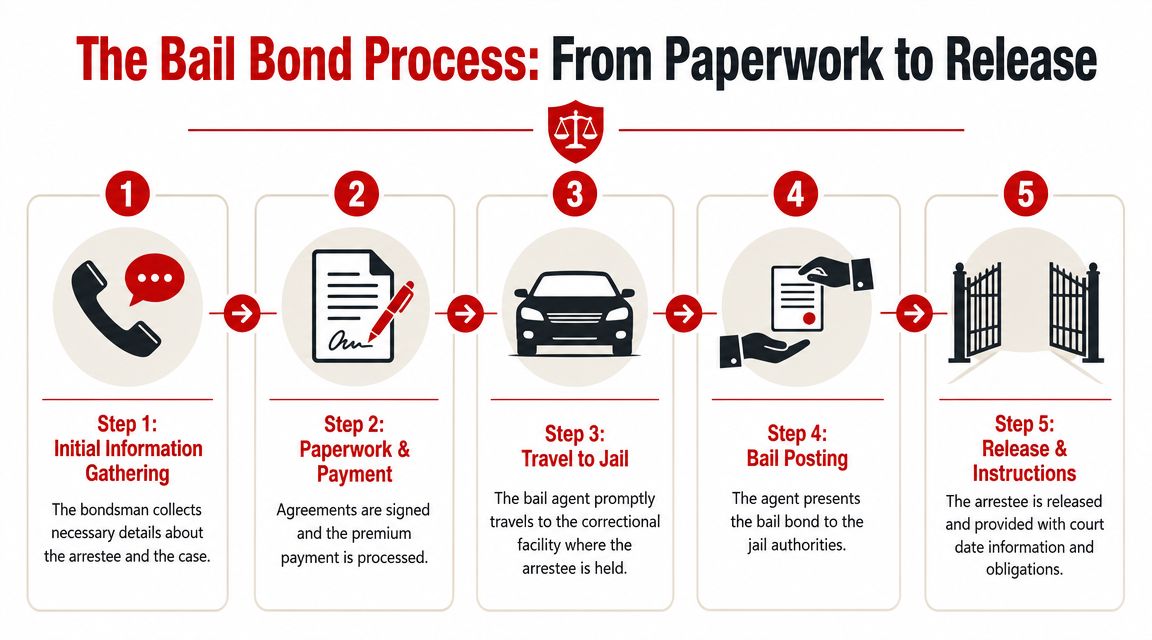
The standard workflow is straightforward: confirm the bond amount, complete the agreement, pay the premium, and have the agent post the bond. After that, the biggest delay is often the jail’s internal release queue, which can take several hours depending on the facility, as outlined by Shouse Law’s explanation of the bail process.
What happens after you say yes
From the family side, it may feel like not much is happening once forms are signed. On the bond side, several things are happening in order.
- Verification happens first. The agent confirms the booking, charge, and bond amount.
- The agreement gets signed. This can often be handled remotely with digital paperwork.
- Payment is arranged. The premium is processed and any collateral terms are documented if needed.
- The bond is posted. The agent delivers or files what the jail requires.
- Release processing begins. Jail staff handle the internal discharge steps.
A lot of frustration comes from confusing step four with step five. Bond posted doesn’t mean the person walks out immediately.
What actually slows release down
Some delays are preventable. Others are not.
The most common avoidable problems are incomplete identity details, unclear co-signer information, or missing documents tied to payment or collateral. The less avoidable problem is the jail’s own timing. Overnight staffing, internal counts, shift changes, and release volume can all slow discharge even after the bond is accepted.
Bond posting starts the release process. It doesn’t let anyone skip the jail’s line.
If you’re signing as indemnitor and want a plain-English explanation of your role before paperwork is finalized, this overview of how co-signing a bail bond works is worth reading.
The practical move after payment is simple. Keep your phone close, stay available for follow-up questions, and don’t drive to the jail expecting instant pickup unless the agent tells you release is active.
After Release What Happens Next
Getting someone out is the urgent part. It isn’t the final part. Once the defendant is released, the bond stays active until the case reaches the point where the court exonerates it.
That means the agreement still matters after everyone gets home. The co-signer’s responsibility didn’t end with the signature, and the defendant’s responsibility definitely didn’t end at the jail door.
The defendant’s job
The defendant must show up for every required court appearance and follow the conditions tied to release. Missing court is the problem that turns a stressful night into a much larger one.
Some families assume one missed date can be cleaned up casually. That’s a dangerous assumption. A failure to appear can put the bond at risk and create direct consequences for the person who signed for it.
If there’s any chance the person may qualify for release without a money bond in a future case, this explanation of what it means when a defendant is released on O.R. helps clarify the difference.
The co-signer’s responsibility
The co-signer, or indemnitor, takes on financial liability if the defendant fails to appear. That is the heart of the bond contract, and it’s why co-signer risk, repayment timing, and the terms for collateral return need to be clearly explained, as discussed by BailBusters in its consumer guide to co-signer liability.
For families, the practical responsibilities usually look like this:
- Stay reachable: If the agency needs to confirm a court date or contact the defendant, disappearing only makes things worse.
- Track court obligations: Put dates in your phone calendar immediately and verify them if anything changes.
- Protect collateral records: Keep copies of every signed document until the case is fully resolved and the bond is exonerated.
A good late-night call isn’t just about getting paperwork signed. It should leave the co-signer knowing exactly what can go wrong, and what needs to happen for the bond to end cleanly.
Why Local Expertise Matters in Southern California
The biggest difference between a smooth release and a drawn-out one usually isn’t motivation. It’s local knowledge. Southern California families are often dealing with multiple facilities, different intake procedures, and different release habits depending on where the arrest happened.
A bondsman who regularly works Ventura County, Santa Barbara County, and Los Angeles County understands the practical side of the job. Which facility tends to move faster after booking. Which one requires tighter verification. Which calls need to happen in what order. That kind of familiarity helps avoid preventable mistakes.
When families search for 24 Hour Bail Bonds Near Me, they’re usually looking for speed. They should also look for clarity. Ask whether the premium is explained plainly. Ask how remote paperwork works. Ask what the co-signer is agreeing to. Ask whether the person on the phone can tell you what happens after the bond is posted, not just before.
One useful local resource is this explanation of the benefits of hiring a trustworthy bail company like Bada Bing Bail Bonds, especially if you’re comparing agencies and want to know what questions to ask before choosing one.
At 2 AM, you don’t need a sales pitch. You need somebody who answers, verifies the booking, explains the numbers without games, and helps you make the next correct decision.
If your loved one is in custody in Ventura, Santa Barbara, Los Angeles, or nearby Southern California counties, Bada Bing Bail Bonds is available day or night to help you verify the booking, explain the California bail process, and start the release steps as quickly as the jail allows. Call when you’re ready, even if you only have part of the information and need help sorting out what to do first.
Written with Outrank tool