
A $50,000 surety bond in California generally requires a non-refundable 10% premium, or $5,000, paid to a licensed bail agent, rather than the full $50,000 cash amount demanded by the court. The surety company guarantees the court’s $50,000 obligation, while the family usually pays the premium and satisfies any underwriting conditions.
At two in the morning, most families aren’t comparing financial products. Someone has been arrested, the booking location may be unclear, and one person is trying to learn whether the court needs $50,000 in cash or whether a bond can secure release with less money upfront. In Ventura County, that confusion gets worse when the arrest happens in Oxnard, Thousand Oaks, Camarillo, or another city but the person is processed through a county facility.
A surety bond can bridge that gap. It doesn’t erase the court’s bail amount, and it isn’t a promise that release will happen immediately. It gives a licensed bail agent a way to post the court-required guarantee while the family pays the lawful premium and works through any co-signer, collateral, or payment conditions.
Table of Contents
- Late-Night Arrests and What a $50,000 Bond Costs Upfront
- How Surety Bond Premiums and Underwriting Work
- Navigating Collateral and Co-Signer Requirements
- Understanding the Ventura County Bail Schedule
- How Long Jail Processing and Release Takes in Ventura County
- Steps to Take Before Calling a 24-Hour Bondsman
Late-Night Arrests and What a $50,000 Bond Costs Upfront
At 2 a.m., the question is rarely abstract. A husband, wife, parent, or sibling is trying to figure out whether release will take $50,000 in cash tonight, or whether a bond can get the person out with less money upfront. In Ventura County, that pressure gets worse because the arrest location and the jail handling the booking are not always the same, and families lose time while they sort out where the person is being held.
For a $50,000 bond, the number most families focus on first is the premium. Under California’s filed rate system, a licensed bail agent generally charges 10% of the total bond, so the premium is $5,000. The California Department of Insurance’s bail bond guidance explains that the court sets the bail amount and licensed agents must use the surety company’s filed rates.
That money pays for the surety bond service. It is not a cash deposit posted with the court in the defendant’s name, and it does not reduce the court’s $50,000 exposure. The surety company guarantees that obligation to the court, while the family pays the premium and may also have to meet approved payment terms, co-signer requirements, or collateral conditions.
Ask for the full cost before you sign.
That means the premium, any permitted expense, the payment schedule, and what happens if the bond is forfeited. Families who skip that conversation usually get tripped up later, especially when they assumed the only hurdle was coming up with the $5,000.
Cash bail and a bond put pressure on a household in different ways. Cash bail can mean producing the full $50,000. A surety bond usually lowers the money needed upfront, but it adds underwriting conditions and paperwork, and it does not speed up the jail’s internal release process by itself. That distinction matters in Ventura County, because families often brace for the premium and are surprised by the booking, review, and release timeline that can still stretch for hours.
A quick explanation of the bail vs bond difference helps families make a cleaner decision under stress. A bond is a contract tied to court appearance and release conditions. It is not discounted bail, and it is not a guarantee that someone walks out right after the paperwork is signed.
What the premium covers
The agent’s work starts with verifying the booking, confirming the bail amount, preparing the bond package, and submitting it through the jail or court process. The family still has responsibilities after that. The defendant must appear in court, follow release terms, and stay in contact if something changes.
Before calling, gather the person’s full legal name, date of birth, arresting agency, booking status, and current facility. This practical arrest response guide covers the information that helps move the process faster.
One more point matters. A $50,000 figure at booking is not always the last word. Ventura County may start with the schedule amount, but a judge can later leave it in place, raise it, lower it, or add conditions, so verify the current amount before treating the premium or collateral terms as final.
How Surety Bond Premiums and Underwriting Work
At 2 AM, the math looks easy and the rest does not. On a $50,000 bond, families usually focus on the 10% premium, which comes to $5,000. What slows people down in Ventura County is everything wrapped around that number, the underwriting review, the paperwork, and the jail timeline that still follows after a bond is approved.
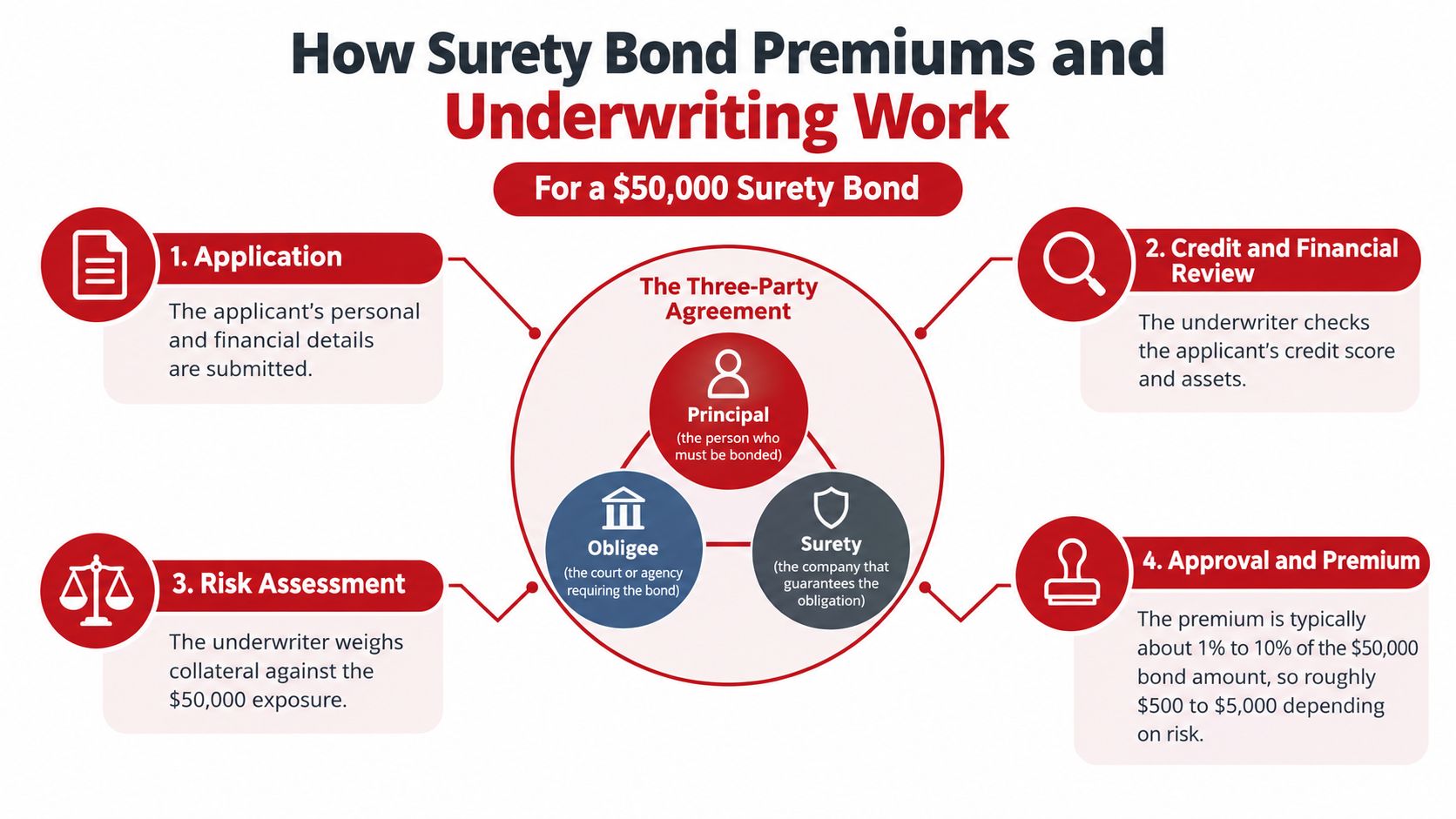
A surety bond involves three parties. The principal is usually the defendant. The obligee is the court or public authority requiring the bond. The surety is the company that backs the bond if the defendant fails to meet the court’s terms. The bail agent is the licensed person arranging that transaction on the surety’s behalf. This plain-English guide to bail agent bonds in New gives helpful background, but the signed California bond contract controls the actual terms.
The premium itself is straightforward. If bail is set at $50,000, the standard benchmark is $5,000. The agent does not set the court’s bail amount and cannot swap in a private number. Families sometimes expect room to bargain on the face amount. There usually is not. Questions are whether the surety will approve the file, who will sign, and whether collateral will be required.
Why approval can take longer than the arithmetic
Underwriting is where a late-night call becomes a real file. The surety is deciding whether the people signing the agreement can carry the risk and whether the defendant is likely to appear in court. A clean premium quote does not mean instant approval.
That review often includes:
- Identity and booking details, including the defendant’s legal name, location, and current charges.
- Community ties, such as residence history and reliable local contacts.
- Employment and finances, to show a co-signer can meet the agreement.
- Prior history, including missed court dates or other risk factors.
- Collateral, if the surety wants added security.
- Payment responsibility, including who is paying now and who remains on the hook later.
Families rarely expect how much this step matters to the clock. In practice, a bond can be priced quickly and still take time to clear because documents, signatures, ownership questions, and jail acceptance procedures all have to line up. That is why the 10% premium and the actual release timeline are two separate problems.
The wider pretrial system shows why this financial pressure hits so hard. The U.S. Commission on Civil Rights reported that the number of people detained pretrial increased by 433% between 1970 and 2015, and that more than 60% of defendants were detained pretrial because they couldn’t afford bail. The commission’s bail reform report discusses those trends and the effect of federal bail policy changes.
These figures are national context, not a prediction for any individual Ventura County case.
For a family trying to act fast, the better question is not only “What is 10% of $50,000?” It is “What does the surety need from us right now to post this bond without delay?” A practical explanation of bond pricing helps, but the signed agreement is what matters once underwriting starts.
Navigating Collateral and Co-Signer Requirements
Collateral protects the surety against a possible loss. It doesn’t automatically replace the premium. A family may pay the required premium and still need to pledge an asset or provide an indemnitor, depending on the surety’s underwriting decision.
Accepted collateral can include real property, vehicles, jewelry, or other assets the surety is willing to accept. The important issue isn’t just the asset’s estimated value. Ownership, existing liens, documentation, liquidity, and the legal terms of the pledge all matter.
Put the agreement in writing
Before transferring an asset or signing a lien document, ask the agent to identify:
- The legal owner of the collateral.
- The bond amount being secured.
- The premium and any approved charges.
- The lien or security interest being created.
- The person depositing the collateral.
- The documents required for release.
- The court event that ends the surety’s liability.
A written collateral receipt matters because memories become unreliable after a stressful arrest. The receipt should describe the asset precisely and show who delivered it. If real property is involved, the owner should understand the lien documents before signing and should obtain copies for personal records.
A co-signer or indemnitor takes a different kind of risk. That person may promise to pay amounts owed under the agreement and to help ensure the defendant appears in court. A co-signer should ask what happens after a missed appearance, who receives court notices, and whether the agreement imposes obligations beyond the initial premium.
Families seeking a plain-language explanation of the co-signer process should still treat the final written contract as controlling. General explanations can prepare you for questions, but they don’t replace reviewing the documents for this bond.
Know what releases the collateral
California’s collateral-return rule focuses on termination of the surety’s bond liability, not merely the family’s belief that the criminal case is finished. Under 10 CCR section 2088.2, collateral must be returned after an authorized order terminates liability, subject to the regulation’s treatment of unpaid premium or charges after exoneration.
That distinction prevents a common mistake. Case dismissal and bond exoneration aren’t interchangeable terms. A case may appear to be over while the surety still needs formal proof that its bond obligation has ended. The family should ask which court order or event triggers release and who is responsible for obtaining confirmation.
If the defendant appears as required and the court terminates the bond obligation, the security interest should end and the collateral should be returned under the applicable rule. If the bond remains liable, the collateral continues securing that exposure. Keep the receipt, contract, court orders, and return correspondence together until the asset is physically returned and any lien release is documented.
Understanding the Ventura County Bail Schedule
At 2 a.m., families usually hear one number first and assume the rest is straightforward. It rarely is. The Ventura County bail schedule gives a practical starting point, and Ventura County’s official 2024 bail schedule sets the presumptive amounts used before a judge reviews the case. For offenses that are not specifically listed, the Ventura County Superior Court bail schedule sets bail at $10,000 for felonies and $2,500 for other misdemeanors. A misdemeanor treated under Penal Code section 17(b) is set at one-half of the applicable felony bail. If someone is booked only on a warrant, bail is generally the warrant amount unless a judge orders something different.
That first number matters because it drives the bond discussion right away. On a $50,000 bail, families often focus on the premium and any collateral requirement. The operational problem is that the quoted amount still has to match the live booking, the warrant status, and any court hold before a bondsman can act on it.
Location adds another layer. An arrest in Ventura, Oxnard, Camarillo, Port Hueneme, Thousand Oaks, Santa Paula, Moorpark, Fillmore, or Ojai does not automatically tell you where the person is housed or what staff can confirm at that moment. The arresting agency, booking status, warrant information, and the applicable schedule all affect the answer you get on the phone.
Where booking information is handled
The Ventura County Sheriff’s Office lists three county jail facilities. Families looking for Ventura County Jail bail bonds should confirm the current facility instead of relying on the arrest city.
| Facility Name | Location | Primary Function |
|---|---|---|
| Main Jail | Ventura Government Center | County detention and booking operations |
| Todd Road Jail | Unincorporated area west of Santa Paula | County detention facility |
| East Valley Jail | Thousand Oaks | County detention facility |
The Sheriff’s detention services information identifies these facilities and notes that its jail dashboard is updated every 30 days with inmate population, custody duration, bookings, arrest charges, and housing information. That helps with orientation. It does not replace a live verification of booking and bond details through the proper channel.
A search for bail bonds Ventura, bail bonds Oxnard, or bail bonds Thousand Oaks should end with a verification call and a confirmed facility.
Why the amount can change
A bail schedule sets the default amount used at the start. It does not promise that the final amount will stay there. A judge can review the charges, circumstances, warrants, and release conditions, then leave the amount in place, change it, or impose another restriction that affects release.
Ask three direct questions. What amount is listed right now? Who set it? Has a judge already reviewed or changed it?
Those answers tell you whether a $50,000 surety bond is the correct next step, or whether the family is looking at a different court instruction than the one they heard during the first late-night call.
How Long Jail Processing and Release Takes in Ventura County
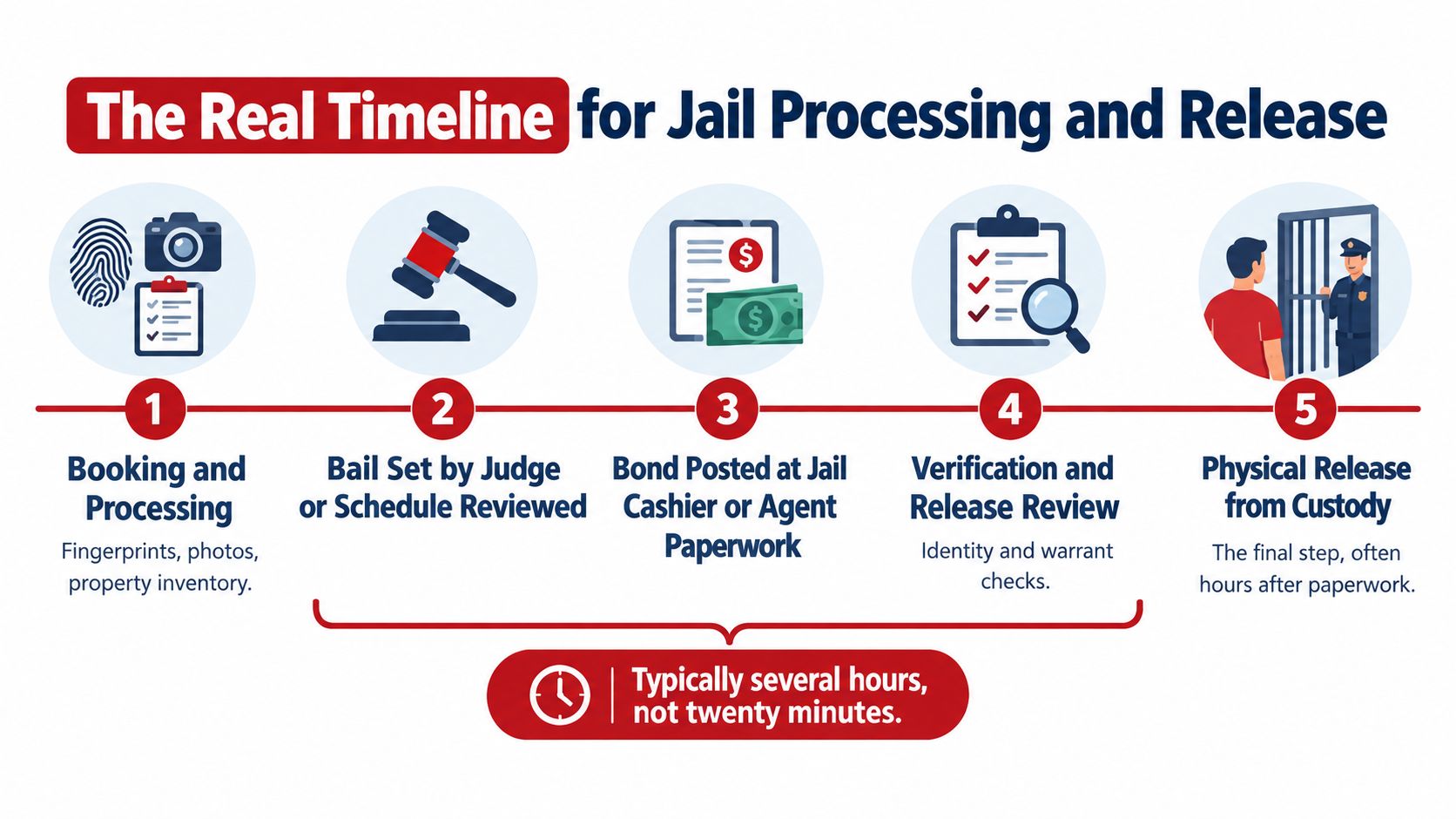
Families should plan for six to ten hours between booking and release, even after the bond is accepted. In Ventura County, the delay usually comes from jail procedure, not from the bondsman. The Ventura County detention inquiry says release processing often runs in that range, and it also notes that people in custody may make unlimited local calls to reach a lawyer, family, a bail bondsman, or others concerned about their welfare.
That timing catches families off guard. They hear that a $50,000 surety bond has been arranged, they budget for the premium and any collateral, and they expect pickup soon after. What usually follows is a slower chain inside the facility, booking, identity checks, property handling, bail confirmation, paperwork review, warrant checks, release approval, and then the physical move out of custody. An agent can get bond paperwork in quickly. The jail still controls the release queue.
Payment methods at the Victoria Avenue facility
The Sheriff’s official bail-posting instructions list the Pre-Trial Detention facility at 800 South Victoria Avenue in Ventura as a location that accepts bail payments. Accepted methods include:
- Exact cash: Cash for the full amount due.
- Cashier’s check: Payable to the Ventura County Superior Court.
- Bail bond: A bond arranged through a licensed surety provider.
- Card payment: Credit or debit card through GovPayNet online or by phone using PLC number 6404.
Those instructions also separate out-of-county matters. If the case belongs to another jurisdiction, the check must be payable to that jurisdiction. Confirm the payment method and the correct location before anyone gets in the car, especially if the arrest happened outside Ventura County or the booking involves a warrant from somewhere else.
Release can happen through cash bail, a bail bond, card payment, own-recognizance release, sentence completion, or transfer to another facility or program. The bond solves one part of the problem. It does not speed up every internal step.
Use this Ventura County release-time guide as a practical benchmark. Keep your phone close, line up transportation, and do not promise an exact pickup time until the facility or agent confirms the release has cleared.
Steps to Take Before Calling a 24-Hour Bondsman
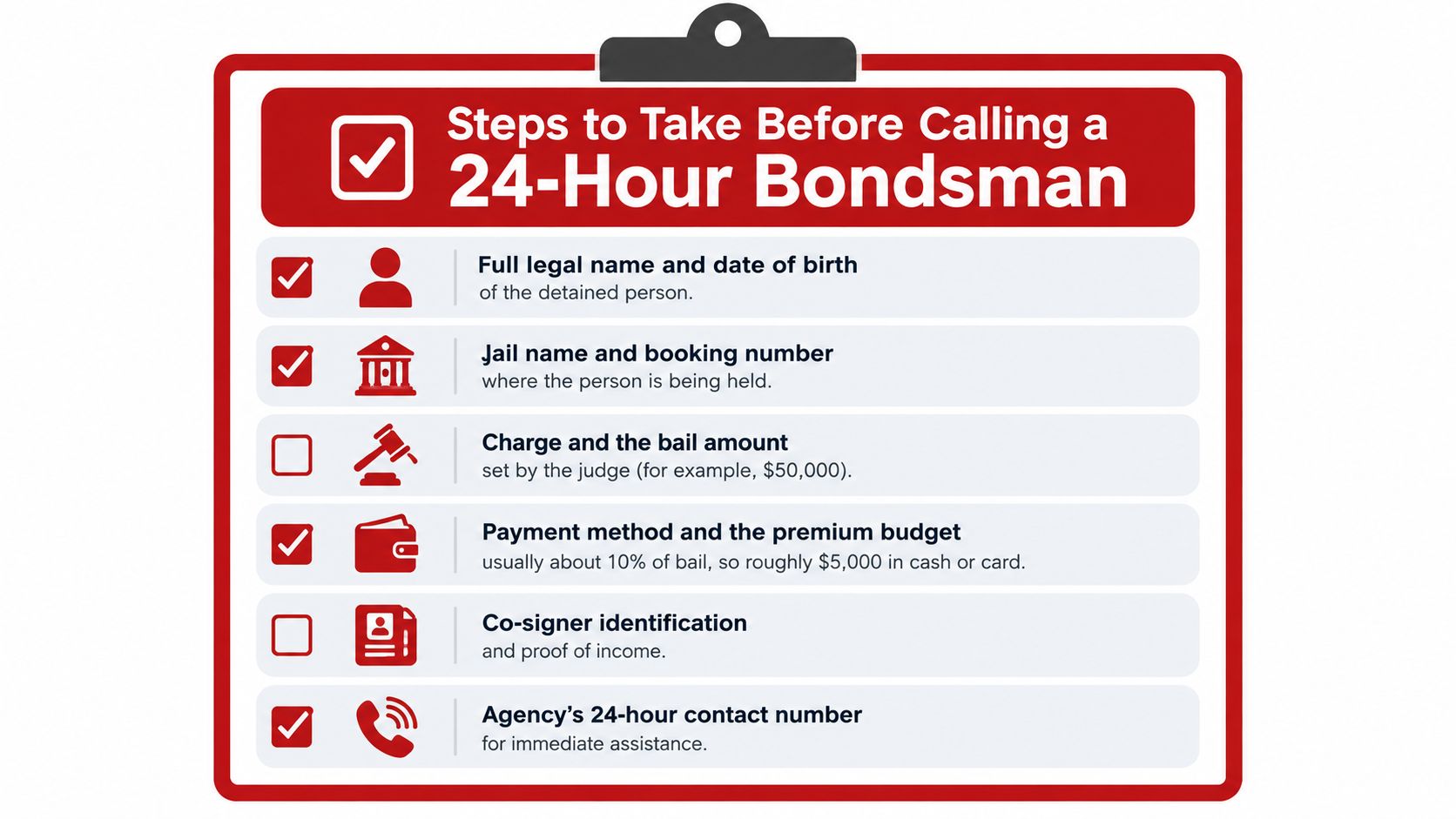
A late-night call moves faster when the caller has the basic facts in front of them. If you don’t know every detail, call anyway, but tell the agent what you know and what still needs verification.
Gather the booking details
Write down the defendant’s full legal name and date of birth. Nicknames can slow a search, especially when the booking record uses a middle name or a different spelling.
Find out the arresting agency, jail facility, booking number, charges, and current bail amount. Someone arrested in Santa Barbara may be held under different procedures from someone seeking bail bonds Ventura, even if the family lives nearby. The same caution applies to bail bonds Oxnard and bail bonds in Thousand Oaks.
Prepare for the financial questions
Have the proposed co-signer’s identification and financial information available. The agent may need to understand employment, residence, ownership of assets, and who will sign the indemnity agreement.
For a $50,000 California bail bond, keep the standard $5,000 premium benchmark in mind, but don’t assume the transaction ends there. Ask whether collateral is required, whether payment arrangements are available, what documentation is needed, and which charges are permitted under the contract and California rules.
A good intake call should answer these questions clearly:
- Current amount: Is the bond still $50,000?
- Premium: What is the exact lawful premium?
- Collateral: Is an asset required, and how will it be documented?
- Co-signer: Who must sign and what obligations apply?
- Release process: Which facility will receive the paperwork?
- Timing: What can the agent confirm, and what remains controlled by the jail?
After release, the defendant must attend every court date and follow all release conditions. Keep contact information current, respond to agent check-ins, and save every court notice. Bada Bing Bail Bonds offers 24-hour intake for Ventura County and surrounding areas, explains premium and collateral requirements, coordinates paperwork with jails, and provides court-date reminders and agent check-ins after release.
When a $50,000 bond is creating pressure at 2 AM, contact Bada Bing Bail Bonds to verify the booking, explain the California 10% premium, review co-signer or collateral options, and coordinate the next practical step with the appropriate Ventura County facility.