Understanding How Co-Signing (Indemnitor) a Bail Bond Works
When someone you care about is arrested in Ventura, Santa Barbara, or Orange County, one of the first questions a bail agent will ask is: who’s going to co-sign? That person — legally called the indemnitor, and commonly called a co-signer or guarantor — is the one taking on real financial responsibility for the bond. Not the criminal case itself, but the bond.
At Bada Bing Bail Bonds, we believe you should understand exactly what you’re agreeing to before you sign anything. This guide covers what co-signing actually involves, how the bail process works step by step, what happens if things go wrong, and what to expect at the specific jail or courthouse handling your case across Ventura, Santa Barbara, and Orange County.
What Does It Mean to Co-Sign a Bail Bond?
The Role You're Taking On
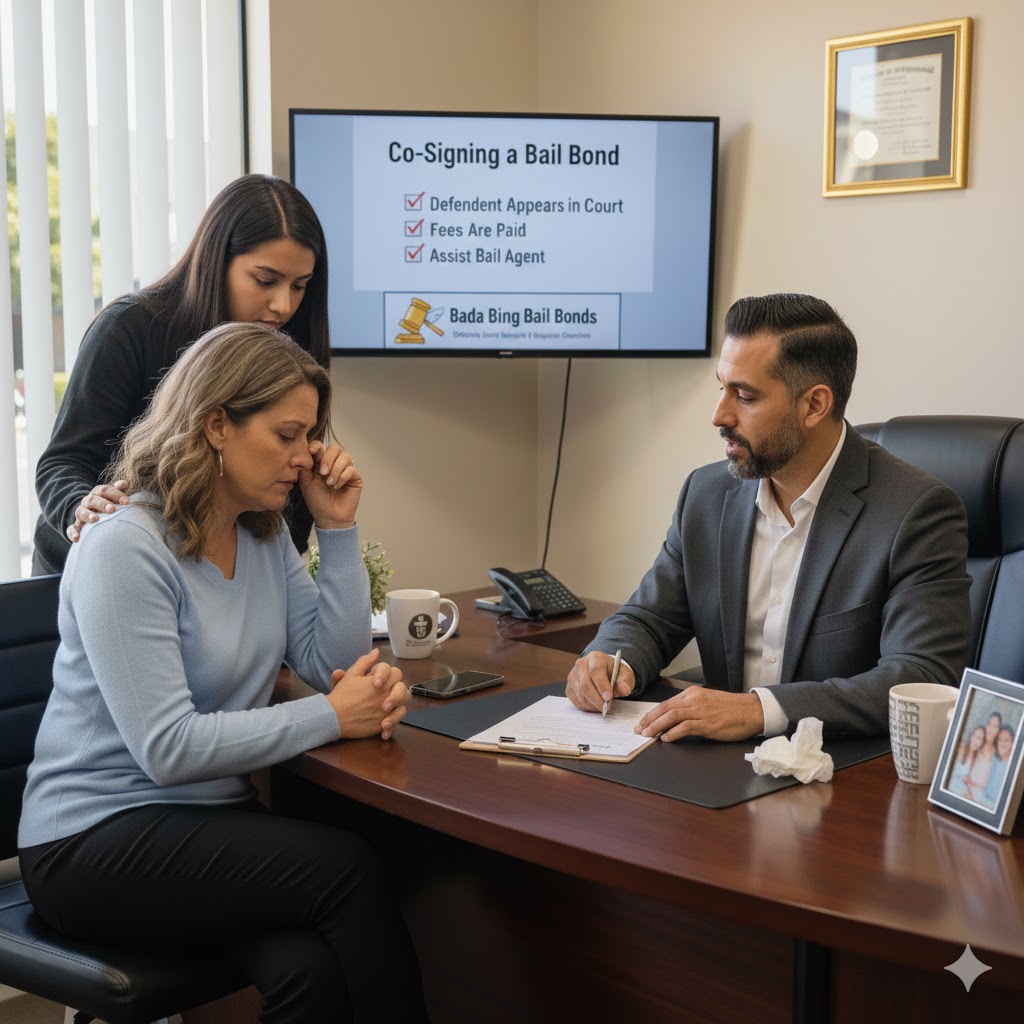
Co-signing a bail bond is a legal agreement where you accept financial responsibility for the defendant’s release. By signing, you’re guaranteeing the bail company that:
- The defendant will appear at every required court date. This is the core of the agreement — everything else follows from it.
- The bond premium and any fees will be paid in full. In California, this is set by law at 10% of the total bail amount, and it’s non-refundable regardless of the case outcome.
- You’ll cooperate with the bail company if the defendant becomes unreachable. If something goes wrong, you’re expected to help, not disappear.
In many higher-risk cases, a bail company legally cannot post a bond without a qualifying co-signer standing behind it — the defendant’s own promise to appear isn’t enough security on its own.
Important distinction: signing as indemnitor does not make you legally responsible for the defendant’s criminal case. You’re not the one being charged, and nothing about your signature affects the charges, the trial, or the sentence. Your obligation is strictly financial, tied to the bond.
The 6-Step California Bail Process (And Where Co-Signing Fits In)
Step by Step
Every bail bond in California follows the same basic sequence, whether the arrest happens in Ventura, Santa Barbara, or Orange County. Here’s exactly where the co-signer’s role begins.
Step 1 — Arrest and Booking The defendant is taken into custody and booked at the local jail. No co-signer is involved yet — this stage is entirely about processing and confirming charges.
Step 2 — Bail Is Set The court sets a bail amount based on the county’s bail schedule, the charges, and the defendant’s history. A judge may instead grant OR (Own Recognizance) release, meaning no bond — and no co-signer — is required at all.
Step 3 — Family Contacts a Bail Bond Company This is where the co-signer role begins. A family member or friend calls a licensed agent, who identifies who will sign as indemnitor and starts the paperwork specific to that jail.
Step 4 — Co-Signer Application and Approval The prospective co-signer provides valid ID, proof of income or employment, and any collateral required for the bond amount. The bail company reviews all of this before finalizing the contract.
Step 5 — Premium Is Paid and the Bond Is Posted The co-signer pays the 10% premium and signs the contract. The agent then posts the bond directly with the jail or court handling the case.
Step 6 — Defendant Is Released and Must Appear in Court Once processing is complete, the defendant is released. From here forward, the co-signer’s financial exposure is tied directly to the defendant making every court date.
Requirements to Be a Bail Bond Co-Signer
Who Qualifies
Every bail company sets its own exact standards, but most professional agents look for the same core qualifications:
✓ You Generally Qualify When…
- You’re at least 18 years old with valid, government-issued ID
- You have steady income or verifiable employment
- You have a stable residence and local ties to the community
- You’re able to provide collateral if the bond amount requires it
- You have a genuine relationship with the defendant — spouses, parents, and long-time friends are typically viewed as the strongest co-signers
✗ You May Not Qualify When…
- You have no verifiable income or employment history
- You have no local ties and the bail amount is significant
- You’re unwilling or unable to provide collateral for a larger bond
- You have a history of defaulting on prior bail obligations
What Happens If the Defendant Misses Court
What's at Stake
Day of Missed Appearance Bench Warrant Issued — Bail Forfeited The judge issues a bench warrant and the court declares the bond forfeited. The clerk begins preparing the Notice of Forfeiture.
Within the Appearance Period Co-Signer’s Financial Exposure Begins California law gives the bail company roughly 185 days to locate the defendant and return them to custody before the forfeiture becomes final. During this window, bail bond reassumption may still be possible, and it’s worth calling your agent immediately rather than waiting to see what happens.
If the Window Closes Full Forfeiture Judgment If the defendant isn’t located and returned in time, the co-signer can be held responsible for the full bail amount — not just the original premium — and any pledged collateral can be seized to cover the loss.
If the Case Resolves Normally Bond Exoneration Once the case concludes and the defendant has made every required appearance, the bond is exonerated, the co-signer’s obligation ends, and any collateral is returned.
Can You Be Removed as a Co-Signer?
Can You Get Out of It?
Yes, in some cases. If you no longer feel comfortable being responsible for the defendant — because they’re missing check-ins, showing signs of fleeing, or otherwise not taking the case seriously — you can ask the bail company about surrendering the bond. This typically means the defendant is taken back into custody, which releases you from further financial liability going forward, though you may still owe fees incurred up to that point.
This isn’t a decision to make lightly or in a panic. If you have real doubts about whether the defendant will follow through, it’s worth raising them with your agent before you sign, not after.
Co-Signing Requirements by County & Jail
The legal obligations of a co-signer come from California state law and don’t change from county to county — but the jail and courthouse handling your case does, and knowing the local process speeds everything up.
Ventura County Superior Court · Hall of Justice · Multiple Jail Facilities Cases at the Ventura County Superior Court, 800 S. Victoria Ave., Ventura, are processed for release through Ventura County Jail, Todd Road Jail in Santa Paula, East County Jail, or the Oxnard Police Department Jail. We serve the surrounding cities directly, including Ventura, Oxnard, Camarillo, Thousand Oaks, and Simi Valley.
Santa Barbara County Superior Court · SB Jail · North County Cases filed at the Santa Barbara Superior Court (1100 Anacapa St., Santa Barbara) or the North County Courthouse (312-B E. Cook St., Santa Maria) process releases through Santa Barbara County Jail in Goleta or the Northern Branch Jail in Santa Maria. We also serve Santa Barbara, Santa Maria, and Lompoc directly.
Orange County Central Justice Center · OC Jail System In-custody arraignments run through the Central Justice Center at 700 Civic Center Drive West, Santa Ana, with releases processed through the OC Central Men’s/Women’s Jail, Theo Lacy Facility, or James A. Musick Facility. We serve Anaheim, Santa Ana, and surrounding OC cities directly.
Co-Signing a Bail Bond — Everything You Need to Know
Frequently Asked Questions
What is the risk of co-signing a bail bond?
The primary risk is financial. If the defendant fails to appear in court and can’t be located, the co-signer is responsible for the full bail amount, the non-refundable premium, and any recovery costs if the defendant has to be tracked down.
Can a co-signer get their money back?
The 10% premium is non-refundable no matter the outcome. If you provided cash or property as collateral, that’s returned once the case is resolved and the bond is exonerated.
Does co-signing a bail bond affect your credit score?
Can I withdraw as a co-signer after the bond is posted?
How long is a co-signer responsible for a defendant?
Does it matter which jail the defendant is being held at?
Yes. Processing times and paperwork requirements vary by facility. Our agents work directly with jails across Ventura, Santa Barbara, and Orange County, which typically speeds up both approval and release.
Why Families Trust Bada Bing Bail Bonds
- Available 24/7 across Ventura, Santa Barbara, and Orange County.
- Total confidentiality and straightforward answers before you sign anything.
- Fast processing, often requiring little to no collateral for qualifying co-signers.
- Affordable payment plans, including 1% down and 3% down financing
(805) 910-9842 Start Application
Bada Bing Bail Bonds 56 E. Main St., Suite 108, Ventura, CA 93001 Available 24 Hours a Day, 7 Days a Week