When a loved one is arrested, the first question is always: “How much is bail?” In most cases, the answer is found in a bail schedule. Understanding how these schedules work can save you thousands of dollars and hours of jail time.
In this guide, we break down how bail schedules are set, the factors that influence bail amounts, and how to secure a fast release using a bail bondsman.
What is a Bail Schedule?
A bail schedule is a standardized list of preset bail amounts assigned to specific criminal charges within a jurisdiction. These schedules allow the court system to process defendants quickly without waiting for a formal bail hearing before a judge.
Commonly used for:
Misdemeanor charges (e.g., petty theft, simple assault)
Non-violent offenses
First-time arrests
Standard traffic violations or DUIs
SEO Pro Tip: Bail schedules vary by county. For example, a Los Angeles County bail schedule may differ significantly from an Orange County bail schedule for the same offense.
How the Bail Process Works After an Arrest
For those wondering how to get out of jail fast, the bail schedule is the key. Here is the step-by-step process:
Booking and Processing: The defendant is fingerprinted and their charges are entered into the system.
Charge Matching: The jailer matches the specific charge to the corresponding amount on the county bail schedule.
Bail Assignment: A dollar amount is set.
Release Options: You can pay the full amount (cash bail) or contact a bail bond agent to pay a small percentage (usually 10%) for immediate release.
4 Factors That Influence Bail Amounts
While the schedule provides a baseline, several variables determine the final cost of freedom:
1. Severity of the Crime: Felonies carry much higher bail amounts than misdemeanors.
2. Criminal History: Repeat offenders or those with a history of failure to appear (FTA) may face “enhanced” bail rates.
3. Public Safety Risk: If the court deems the defendant a danger to the community, bail may be increased or denied.
4. Local Jurisdictional Rules: Judges in different counties have the discretion to update schedules annually based on local crime trends.
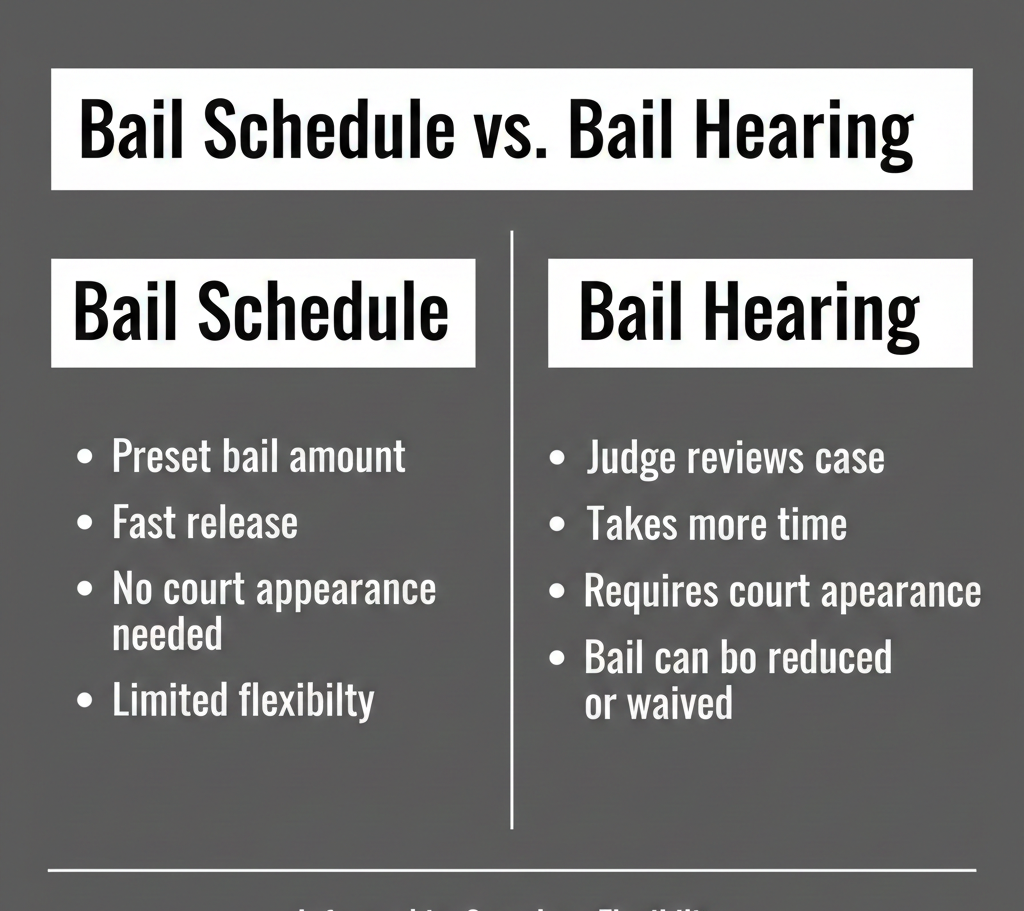
Bail Schedule vs. Bail Hearing: Which is Better?
| Feature | Bail Schedule | Bail Hearing |
| Speed | Instant / Same Day | 24–72 Hours |
| Cost | Fixed Preset Amount | Potential for Reduction |
| Flexibility | None | High (Judge’s Discretion) |
| Requirement | Payment of Scheduled Fee | Court Appearance |
Can a judge change the bail amount? Yes. During a bail reduction hearing, a defense attorney can argue for a lower amount or for the defendant to be released on Own Recognizance (OR).
How a Bail Bond Agent Lowers Your Costs
Most families cannot afford to pay $20,000 or $50,000 in cash upfront. A licensed bail bondsman provides a critical service by:
Reducing Upfront Costs: You typically only pay a non-refundable premium (usually 8-10%).
Providing Payment Plans: Many agencies offer zero-down or low-monthly-payment options.
Navigating the System: Agents handle the complex paperwork and coordinate directly with the jail to speed up the inmate release process.
Common Bail Schedule Myths
Myth: Bail schedules are permanent. Truth: They are reviewed and updated by judicial councils regularly.
Myth: You must pay in cash. Truth: You can use property, collateral, or a bail bond.
Myth: All crimes have a bail amount. Truth: Capital offenses or severe violent crimes often require a judge’s review and may be “no-bail” offenses.
Summary: Why You Need to Know the Schedule
Understanding the bail schedule in your area is the best way to reduce financial stress and ensure your loved one returns home quickly. If you are facing a high bail amount, your first call should be to a professional bail agent who knows the local court rules.
Don’t let a mistake ruin your family’s traditions. We are the most trusted bail bond agency in [Ventura], known for our fast, discrete, and professional service.
Call us today at [805-910-9842] for a free consultation. We’re open 24/7, including Christmas and New Year’s.
Frequently Asked Questions: Co-Signing Bail Bonds
Q: What is the risk of co-signing a bail bond? A: The primary risk is financial. If the defendant fails to appear in court and cannot be located, the co-signer is responsible for paying the full face value of the bail to the court. Additionally, the co-signer is responsible for the non-refundable bail premium and any recovery costs incurred if the defendant skips bail.
Q: Can a co-signer get their money back? A: The 10% premium paid to a bail agent is a non-refundable fee for the service of posting the bond. However, if you provided any cash or property as collateral, that will be returned to you once the defendant’s case is fully resolved and the bond is exonerated by the court.
Q: Does co-signing a bail bond affect your credit score? A: Simply signing a bail bond does not typically show up on your credit report or affect your score. However, if you fail to pay the agreed-upon premium or if the bond goes into forfeiture and the debt is sent to a collection agency, your credit score will be negatively impacted.
Q: Can I withdraw as a co-signer after the bond is posted? A: Yes. If you have reason to believe the defendant will not go to court or is engaging in illegal activity, you can request that the bail bonds company “surrender” the bond. This will return the defendant to custody and release you from future liability, though you may still be responsible for fees incurred up to that point.
Q: How long is a co-signer responsible for a defendant? A: A co-signer’s responsibility lasts for the duration of the legal case. Once the judge “exonerates” the bond (usually at sentencing or when charges are dropped), the financial obligation to the court ends.