The phone rings late. It’s a number you don’t know, and the voice on the other end says your husband, wife, son, daughter, or friend was arrested for DUI in Ventura, Los Angeles, or Santa Barbara County.
That call hits people the same way every time. Panic first. Questions second. Where are they? Can they get out tonight? How much is this going to cost? What am I supposed to do right now?
Take a breath. A DUI arrest is serious, but it’s also a process. Families get stuck when they assume everything should happen instantly, or they start calling random numbers without knowing what information the jail or bondsman needs. Across the country, there are about 731,000 people in local jails on a given day, and nearly two-thirds, or about 476,000, are being held pretrial and have not been convicted, according to a Civil Rights Corps fact sheet on money bail and pretrial detention. DUI arrests are a common way families first run into that system.
What matters right now is getting organized. If you’re still trying to figure out where your loved one was taken, start with this guide on how to find an arrested loved one in Camarillo and nearby areas. Once you know the jail and the booking status, the rest gets a lot clearer.
Table of Contents
- What to Do After a DUI Arrest in Southern California
- How a DUI Bail Bond Actually Works
- Understanding California DUI Bail Costs
- The DUI Release Timeline From Booking to Pickup
- Securing the Bond Payment Plans and Collateral Options
- Choosing the Right SoCal Bondsman for a DUI
- DUI Bail Bond FAQs and Your Next Steps
What to Do After a DUI Arrest in Southern California
The first few hours feel messy because they are. Someone gets arrested on suspicion of DUI, they’re transported, booked, searched, and processed, and the family is left trying to help with very little information.
Don’t waste time arguing over the phone about whether the arrest was fair. That conversation can wait. Right now, your job is to get the facts lined up so release can move as soon as the jail allows it.
Start with the basic facts
Write these down before you call anyone:
- Full legal name: Use the exact name on ID if you know it.
- Date of birth: Jails use it to confirm identity.
- Arrest location: Ventura, Oxnard, Camarillo, Santa Barbara, downtown LA, or wherever the stop happened.
- Approximate arrest time: This helps estimate where they are in the booking process.
- Known issues: Prior DUI, accident, injury, probation, warrant, or refusal allegations can change how the case is handled.
If you don’t have all of that, don’t freeze. A good agent can still start checking.
The fastest families aren’t the ones with perfect information. They’re the ones who stop guessing and start verifying.
What helps and what slows things down
Families usually help the process when they stay focused on booking status, bail amount, co-signer readiness, and payment options.
They slow it down when they assume the person can walk out the second money changes hands, or when multiple relatives call different agents and give conflicting information.
A practical order of operations looks like this:
- Confirm the jail and booking status
- Find out whether bail has been set
- Decide whether you’re paying cash to the court or using a bond
- Get one responsible co-signer ready
- Stay available for calls, signatures, and pickup
Keep your expectations realistic
A DUI arrest doesn’t always mean immediate release is available. Booking has to happen first. In some cases, a judge or the jail process has to catch up before the person can be released.
That doesn’t mean you’re powerless. It means the smart move is to work with the actual process instead of fighting the clock.
How a DUI Bail Bond Actually Works
A DUI bail bond is a way to get someone out without handing the court the full bail amount in cash. The family pays a licensed bail agent a premium, and the agent files a surety bond promising the court that the full bail is covered.
The Bureau of Justice Statistics explains that a surety bond typically requires a non-refundable fee of about 10% of the full bail amount, while the bondsman guarantees the full amount to the court through the BJS overview of bail bond types. In plain terms, you are paying for the release service and the financial guarantee behind it.
That distinction matters at 2 a.m. A lot of families hear the bail amount and assume they need that entire number in hand before their person can get out. In many Southern California DUI cases, they do not. They need the bond approved, the paperwork signed, and the jail to accept the bond.
Here’s the plain-English comparison.
| Feature | Paying Full Cash Bail | Using a DUI Bail Bond |
|---|---|---|
| Who posts the full bail amount | You or the family | The bond company |
| Upfront cost | The full bail amount | About 10% premium |
| Refund potential | Court-held cash may be refundable at case end if all appearances and conditions are met | Premium is a service fee and is generally non-refundable |
| Cash tied up | High | Lower upfront outlay |
| Best fit | Families with immediate access to the full amount | Families who need a faster, more manageable option |
If you want a county-specific breakdown of release procedures, this guide on how bail works in Ventura County gives a useful local overview.
Why families choose bonds in DUI cases
DUI bail often falls into a range that creates real pressure. The amount may be too much to pull from checking without wrecking the month, but still manageable through a bond.
That is the trade-off.
- Cash bail: More money up front, but the court may return it later if the case requirements are met.
- Surety bond: Less money up front, but the premium pays for the service and usually does not come back.
Practical rule: If posting full cash would wipe out rent money, payroll, savings, or emergency funds, a bond is usually the safer move.
What the bondsman does behind the scenes
A licensed agent verifies the booking, confirms the bail amount, prepares the bond, reviews the co-signer, and submits the paperwork the jail needs to release the defendant. Good agents also keep calling the jail until they get a straight answer on status, because release delays are common and families deserve real updates.
That work is where local experience shows up. A DUI release in Ventura County does not always move like one in downtown Los Angeles or Santa Barbara. Some jails process faster. Some hold people longer while booking catches up, blood alcohol paperwork is entered, or a watch commander signs off on release.
The bond gets the door open. It does not control every minute after the bond is posted.
That is why families should understand one more point right here. Release on a DUI bond usually comes with strings attached after the person walks out, including a court date, a duty to appear, and sometimes extra conditions tied to the arrest. The bond solves the custody problem first. It does not end the case.
Understanding California DUI Bail Costs
In California, the bond premium is the easy part to understand. The hard part for families is separating the bond cost from the bail amount set on the case.
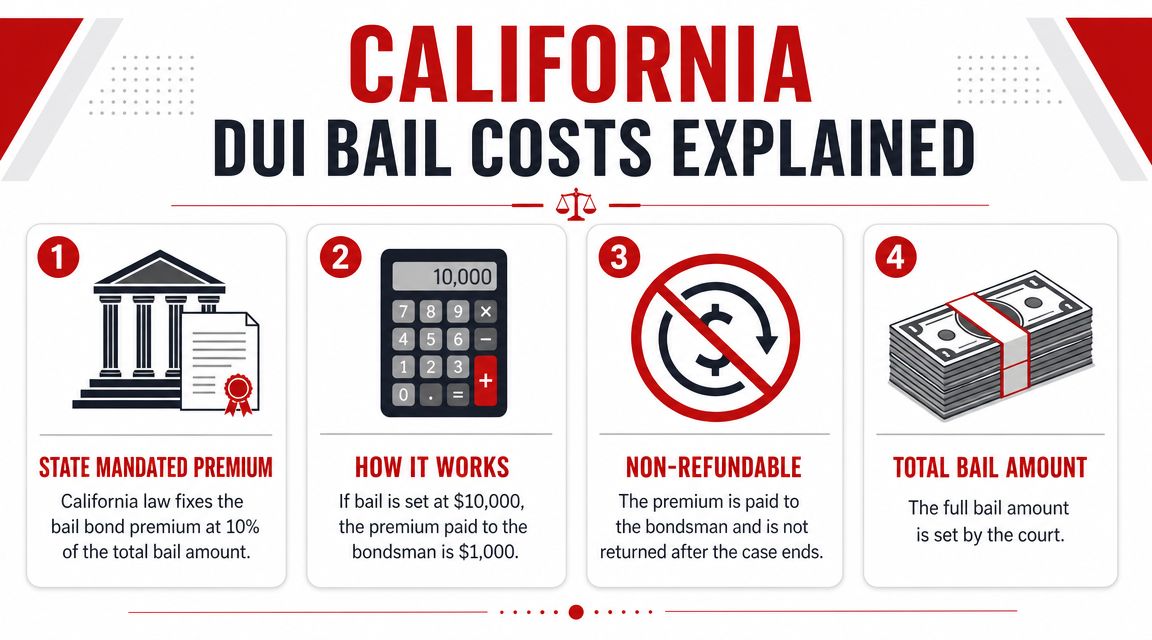
A licensed surety bond in California generally requires the defendant or co-signer to pay a nonrefundable premium equal to 10% of the total bail, and higher-risk DUI cases can require collateral or stronger co-signer support for fast approval, as noted in this discussion of DUI bail bond underwriting and premium structure.
What the premium means in real life
The premium is based on the total bail, not on what you wish the bail had been.
Using the standard surety structure described in the verified data:
- If bail is $5,000, the premium is about $500
- If bail is $10,000, the premium is about $1,000
Those examples line up with the standard commercial bail structure described in the verified data above. If you need a practical local overview, review this guide on how much bail can cost in Ventura and Santa Barbara County.
What can push the bail amount higher
People often get surprised. The premium rate may be straightforward, but the court’s bail amount can move depending on the facts of the arrest.
Common issues that can make a DUI case more difficult include:
- Prior DUI history: A repeat case raises concern.
- Accident allegations: Property damage changes the risk picture.
- Injury claims: If someone was hurt, the case gets more serious fast.
- Flight concerns: If the court thinks the person won’t return, release gets harder.
- Stronger underwriting concerns: A co-signer may need to provide more support.
None of that means release can’t happen. It means the bond company may ask better questions before approving the bond.
The mistake families make with cost
A lot of people focus only on the premium. That’s understandable, but it’s incomplete.
The total financial picture can include:
| Cost question | What to ask |
|---|---|
| Premium | Is the bond premium the standard California rate? |
| Collateral | Is collateral required because of risk factors on the case? |
| Co-signer duty | Who is taking responsibility if the defendant misses court? |
| Refundability | Are you clear that the premium is generally not returned? |
The cleanest conversation is the one where everyone knows what they’re paying for before signing anything.
The DUI Release Timeline From Booking to Pickup
This is the part families care about most. Not theory. Not legal jargon. Just one question. When are they getting out?
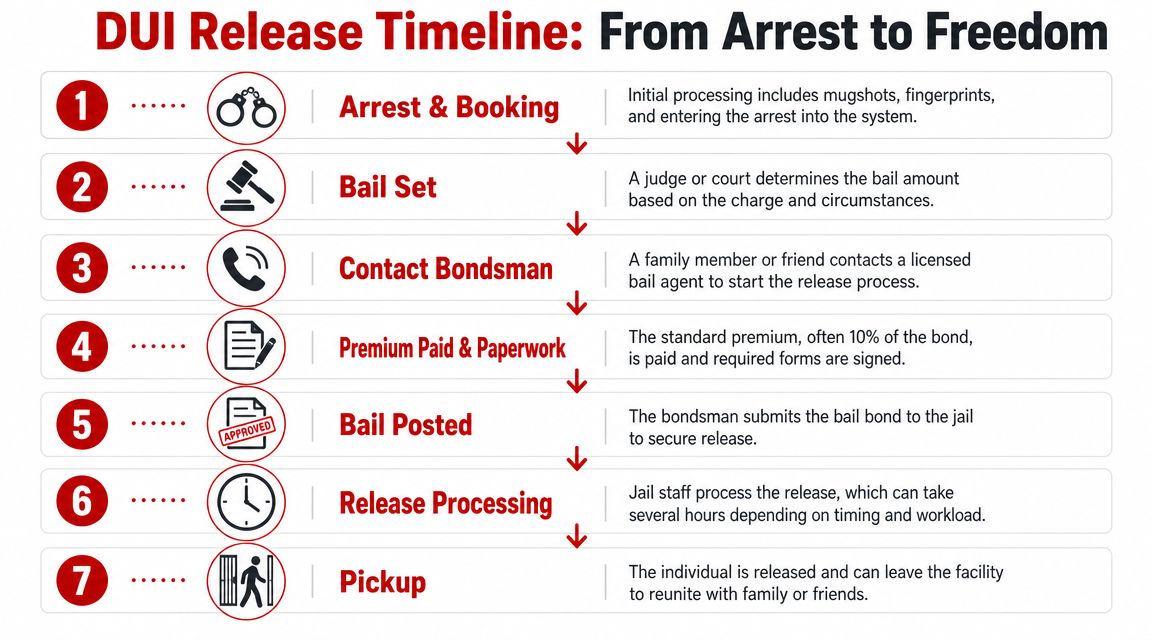
The hard truth is that paying for a bond does not mean the jail door opens right away. Many first-time callers assume bond payment instantly frees the person, but actual release can still take hours because it depends on jail workflow and county-specific processing, as explained in this guide on California DUI bail timing and jail release delays.
Step one through step three
The timeline usually starts with law enforcement, not with the bond.
-
Arrest and transport
The officer arrests the person and takes them to the appropriate jail or booking facility. -
Booking
The jail handles identification, paperwork, fingerprints, and internal processing. -
Bail determination
The amount may come from the local bail schedule or from a magistrate’s decision, depending on the facts and the county process.
At this point, families often feel stuck because they can’t force the jail to move faster. That’s normal.
Step four through step five
Once booking and bail information are available, the release side can start moving.
-
Contact a bondsman
You give the booking details, case basics, and co-signer information. -
Paperwork and premium
The co-signer signs the bond agreement and handles payment arrangements. If the case looks riskier, the company may require collateral or more documentation.
Local knowledge matters significantly. A bondsman who regularly works Ventura, Santa Barbara, and Los Angeles facilities can usually tell you whether the person is still in intake, whether the bond desk is moving, and what kind of delay is common at that facility.
A good agent can’t control the jail’s pace. They can tell you what stage the file is in and keep you from wasting hours on bad assumptions.
Step six through release
After the bond is posted, the jail still has work to do.
- Bond verification: The jail confirms the bond paperwork.
- Internal release processing: Staff check for holds, clear the file, and queue the person for release.
- Property return and discharge: The person gets processed out and eventually walks out.
This is the stretch that drives families crazy. They think, “We already paid. What’s the holdup?” Usually, the holdup is the jail itself. Staffing, shift changes, release volume, and internal procedures all affect timing.
What you should do while waiting
Don’t keep calling every few minutes asking if they’re out yet. That won’t speed up release.
Do this instead:
- Keep one phone available: The jail, agent, or released person may call.
- Get pickup ready: Bring ID, a charged phone, and know which facility entrance to use.
- Stay sober and calm: If your loved one walks out to chaos, that can create new problems.
- Ask about conditions: Release may come with rules that start immediately.
What actually works
The families who handle this best do three things well. They provide accurate information, respond quickly to paperwork requests, and stay realistic about jail processing.
What doesn’t work is arguing with staff, blaming the bondsman for booking delays, or assuming every county runs the same way. Southern California facilities don’t all move at the same pace, and anyone promising instant release is talking too big.
Securing the Bond Payment Plans and Collateral Options
A DUI arrest isn’t something budgeted for. The call comes in the middle of the night, and suddenly the family has to solve a time-sensitive money problem.
That’s why payment structure matters almost as much as the bond itself.
When payment plans make sense
A payment plan can help when the premium is manageable over time but hard to cover all at once. The right setup depends on the case, the co-signer, and the risk the bond company is taking.
Some agencies will want:
- Stable co-signer information: Employment, residence, and contact details matter.
- Clear case facts: Prior failures to appear or open issues make approvals tougher.
- Fast document turnaround: Delay often comes from missing signatures or missing ID.
If you’re comparing options, ask how the schedule works, what documents they need, and what happens if the defendant misses court. Keep the conversation practical.
When collateral enters the picture
Collateral usually comes up on larger bonds or riskier DUI cases. It’s there to protect the bond company if the defendant doesn’t appear and the company is exposed on the bond.
Collateral can take different forms depending on the agency’s underwriting. The key question isn’t just whether collateral is required. It’s whether you understand when it can be at risk and what has to happen for it to be released back.
A clear explanation of bail bond payment plans in Ventura County can help you prepare before you sign.
Don’t hand over collateral because you’re panicked. Hand it over only after you understand the co-signer’s responsibilities and the defendant’s court obligations.
What a responsible co-signer should ask
A co-signer is taking on real responsibility. Before signing, ask:
| Question | Why it matters |
|---|---|
| What exactly am I responsible for? | You need to know your legal and financial exposure. |
| What can trigger a problem on the bond? | Missed court and violations can create consequences fast. |
| When is collateral returned? | You should know the release process from day one. |
| Who will keep me informed? | Communication matters if court dates or problems come up. |
The right financial solution is the one the family can sustain without creating a second crisis at home.
Choosing the Right SoCal Bondsman for a DUI
Under pressure, people often pick the first number that answers. That’s understandable, but it’s not always smart.
A DUI bond agent should do more than quote a fee. A key issue in these cases is the release conditions that can affect driving, alcohol use, or travel, and a good bondsman should explain those obligations because the hidden cost isn’t just the premium. It’s the compliance burden that starts after release, as noted in this overview of what to know about DUI bail conditions and co-signer obligations.
Questions worth asking before you sign
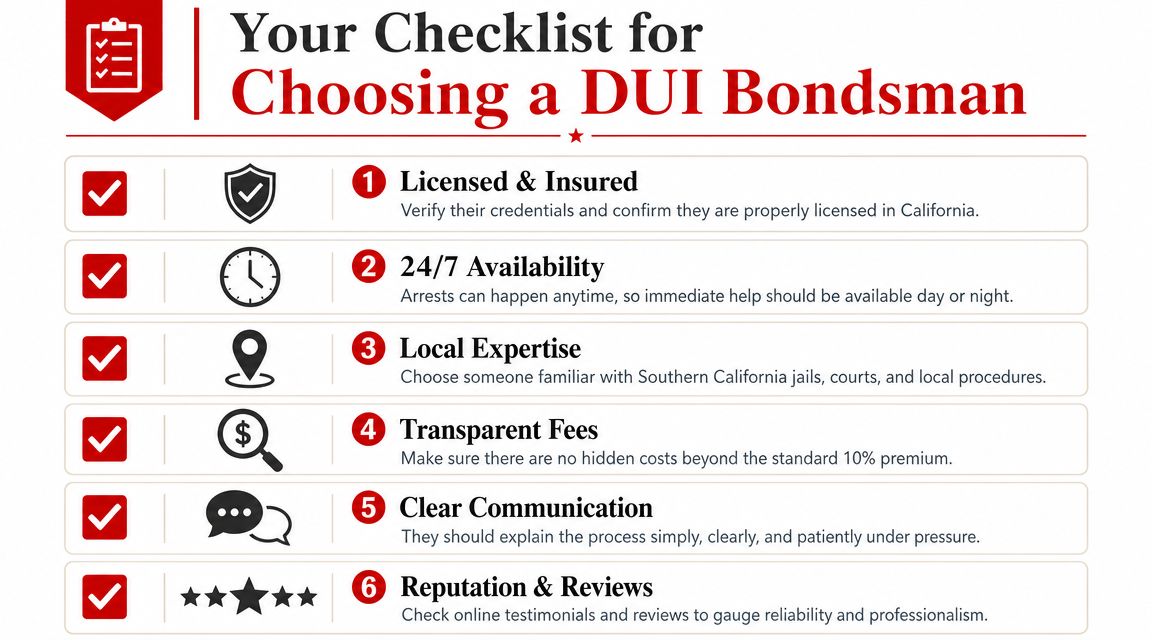
Use this as a fast checklist when you’re calling around:
- Are you licensed in California? If they dance around that question, move on.
- Will a live person handle this now? A call center script won’t help much at midnight.
- Do you know this jail and court system? Southern California is not one-size-fits-all.
- Will you explain the paperwork in plain English? If they rush you, expect trouble later.
- What happens after release? At this stage, many families get blindsided.
One local option families may compare is Bada Bing Bail Bonds and the qualities it highlights in a trustworthy bail company. The useful part isn’t the branding. It’s whether the agency can explain costs, co-signer duties, local jail timing, and post-release obligations clearly.
What to avoid
A few red flags show up over and over:
- Hidden-fee talk: In California, the premium structure should be clear.
- No discussion of court conditions: That means they’re focused only on the transaction.
- Vague answers about release timing: Honest agents will tell you the jail can still take time.
- Pressure without explanation: Fast is good. Blind is not.
The real test
The best test is simple. After a five-minute call, do you understand what happens next?
If you still don’t know who’s signing, what’s being paid, where the person is, or what could delay release, keep looking. In DUI cases, clarity is part of the service.
DUI Bail Bond FAQs and Your Next Steps
A few questions come up on almost every DUI bond call. Here are the short answers families usually need.
Is the bond premium refundable
Usually, no. The surety bond premium is generally a non-refundable fee for the service of posting the bond. That’s different from court-held cash bail, which may be refundable at the end if all appearances and conditions are satisfied.
What does a co-signer actually agree to
A co-signer takes responsibility under the bond agreement. That means the co-signer needs to understand the defendant’s court dates, release conditions, and the risk created if the defendant disappears or violates the agreement.
What if the DUI charge gets dismissed later
Dismissal doesn’t usually change the status of the premium already paid for the bond service. The fee is tied to the posting of the bond, not to the final outcome of the criminal case.
Can someone be released right after the bond is posted
Sometimes release happens fairly quickly. Sometimes it doesn’t. The jail still has to process the release, and that can take hours depending on workflow, staffing, and the facility.
Are there conditions after release
Yes, there can be. Depending on the case, the court may impose restrictions tied to alcohol use, driving, travel, classes, monitoring, or other compliance issues. The person getting out needs to follow those rules closely.
What should you do right now
Keep it simple:
- Confirm where the person is being held
- Get the booking details together
- Choose one co-signer
- Ask direct questions about cost, timing, and conditions
- Stay available until pickup is complete
You don’t need to know every legal detail tonight. You need accurate information, a workable release plan, and a clear head.
If you need help getting someone out after a DUI arrest in Ventura, Santa Barbara, Los Angeles, or nearby Southern California counties, contact Bada Bing Bail Bonds. They handle booking checks, explain the bail process in plain English, work through payment options and co-signer questions, and stay in touch through release and pickup so families know what’s happening next.