
The call usually comes at the worst time. Late at night. Early before work. In the middle of dinner. Someone you care about says they’ve been arrested in Anaheim, and the next few minutes feel scrambled. You’re trying to figure out where they are, what the charge means, whether they can get out tonight, and how much this is going to cost.
That panic is normal. The good news is that the process is more structured than it feels in the moment. There’s a path from arrest to release, and once you know the next step, the situation gets easier to manage. Anaheim sits inside a large California pretrial system where bail is a real financial pressure point. One California bail statistics source reports an average bail amount of $50,000, and says only about 60% of arrested people can afford to post bail on their own, leaving about 40% needing bond help to get out (California bail statistics).
If you’re dealing with Anaheim bail bonds right now, focus on speed, accuracy, and staying calm. Wrong names, missing booking details, or confusion about the jail can slow things down more than most families expect.
Table of Contents
- An Arrest in Anaheim What To Do First
- Gathering Critical Information for a Fast Release
- How Bail Bond Costs and Premiums Work in California
- Flexible Payment Plans and Collateral Options
- Navigating Anaheim Bail Timelines for Common Charges
- After The Release Ensuring Court Compliance and Support
An Arrest in Anaheim What To Do First
The first priority is simple. Slow the conversation down and get usable information.
When someone calls from custody, families often ask ten questions at once. That’s understandable, but it doesn’t help. Start with where they were arrested, whether they’ve been booked yet, and whether they were told they’re at the Anaheim Detention Facility or being held through the Orange County jail system. If they don’t know, that’s common.

Start With The Immediate Questions
Ask these first, in this order:
- What is your full legal name as it appears on your ID?
- What is your date of birth?
- Do you know the charge they mentioned?
- Have you been given a booking number?
- What facility said they have you?
That sequence matters. Families often fixate on the charge, but a release usually starts moving once the identity and custody details are verified correctly.
Practical rule: The fastest call is the one with complete information, not the one made in the first thirty seconds.
What Families Get Wrong Early
The biggest early mistake is arguing facts of the case over the phone. Don’t spend the first call trying to prove innocence, sort out who started what, or relive the arrest. Bail work is about release logistics first. The legal defense comes after.
Another common mistake is waiting around because someone says, “Maybe they’ll let me out soon.” Sometimes they will. Sometimes they won’t. Anaheim cases move through a real process, and if bail applies, action usually beats guessing. If you need a clearer breakdown of the immediate release steps, this guide on how to bail someone out fast is a useful companion.
Keep Your Loved One Focused
Tell the person in custody three things.
- Stay respectful: Jail staff control movement, access, and timing.
- Don’t discuss the facts on recorded lines: Those calls aren’t the place to explain the case.
- Memorize key details: Charge, booking number, and facility matter more than emotional retelling.
A calm family member can do a lot from the outside. A panicked one usually loses time. In Anaheim bail bonds, the first win is getting organized fast.
Gathering Critical Information for a Fast Release
If your phone rings at midnight and all you get is, “I’m in Anaheim, come get me,” the next ten minutes matter. A fast release usually starts with clean identification, the right facility, and a clear read on whether the charge has any built-in delay, especially with DUI cases or domestic violence arrests.
Families lose time in two places. They either start guessing, or they start telling the whole story of the arrest. Release work moves faster when the facts are simple and specific.
The Information That Matters
For Anaheim arrests, start by figuring out whether the person is still at the Anaheim Detention Facility for booking or has already been transferred into the Orange County Jail system. That one detail changes who has custody, where bail information appears, and how long the release process may take.
You do not need the full police narrative. You need the information that lets a bail agent verify custody and spot any likely roadblocks early.
| Information Needed | Why It Helps |
|---|---|
| Full legal name | Matches the jail record correctly |
| Date of birth | Confirms identity, especially with common names |
| Booking number, if available | Speeds up the custody search |
| Current facility or last known facility | Tells you whether to check Anaheim booking or Orange County custody records |
| Charge or suspected charge | Helps identify holds, bail schedule issues, or cooling-off periods |
| Bail amount, if known | Tells you whether bond paperwork can start right away |
| Court date, if assigned | Helps track the next deadline after release |
| Co-signer name and contact information | Lets bond paperwork move without extra callbacks |
A domestic violence arrest may involve a cooling-off period before release is allowed. A DUI arrest can also slow things down if the person is still being booked, waiting on testing, or held until the jail clears release conditions. Those are the kinds of details that matter in the first call.
Where Families Lose Time
Small errors create real delays. A nickname instead of a legal name can send the search in the wrong direction. A wrong birth date can make it look like the person is not in custody yet. Transfer timing causes problems too. Someone booked in Anaheim may not appear in the Orange County system right away.
Have the full name and date of birth written down before you call.
If you are still trying to pin down custody details, a related Los Angeles County inmate search guide shows the kind of identifiers that help narrow a jail search quickly, even though Anaheim cases usually run through local booking and Orange County custody channels.
What to Ask Right Away
A good call sounds calm and direct. Ask for facts in this order.
- Full legal name
- Date of birth
- Where they were taken, if known
- Booking number, if they have one
- Charge they heard from the officer or jail staff
- Whether anyone mentioned a hold, a no-bail status, or a wait before release
That last question matters more than families expect. If the arrest involves DUI, domestic violence, probation issues, or another agency hold, the timeline can change before any bond is posted.
A Fast Intake Call Helps the Release Timeline
When I talk to a family after an Anaheim arrest, I am listening for three things first. Can I verify who the person is. Can I confirm where they are. Is there anything about the charge that could stop an immediate release even if bail is available.
Once those answers are clear, the rest tends to move in order. Clean information gets the search done faster, helps avoid paperwork mistakes, and gives you a more honest timeline for release from the Anaheim Detention Facility or the Orange County Jail system.
How Bail Bond Costs and Premiums Work in California
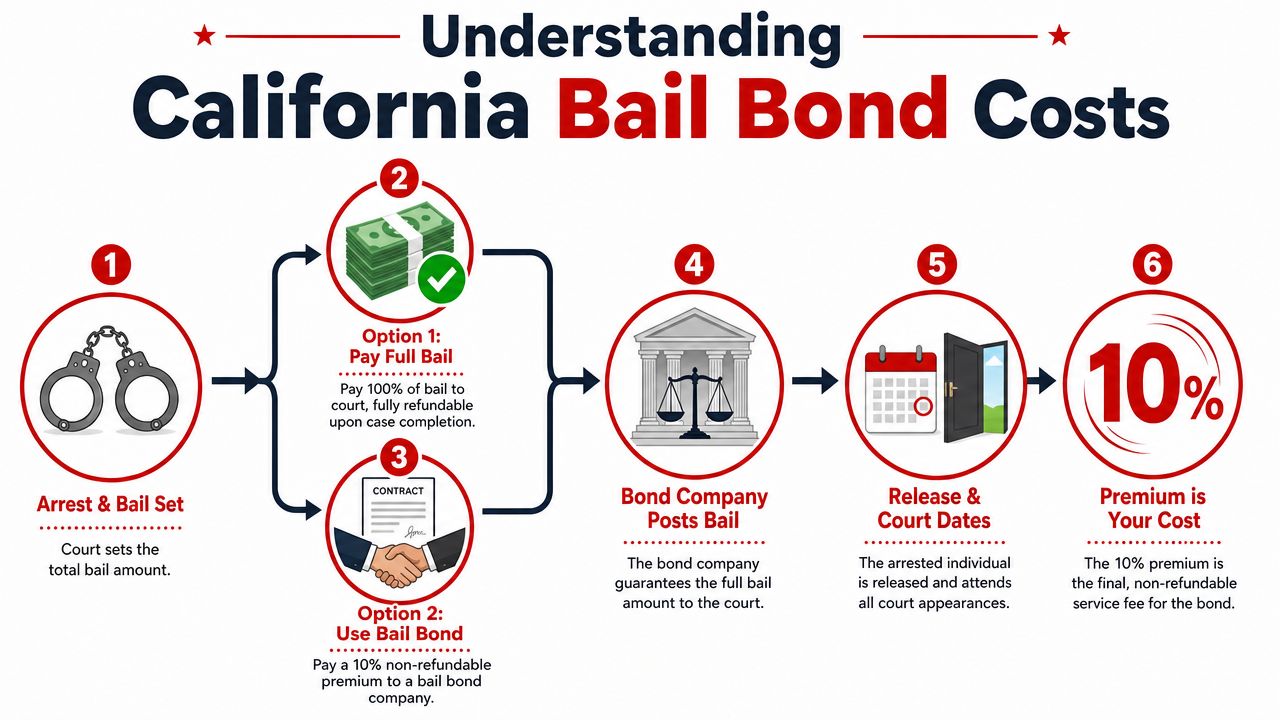
Most families ask the money question right away, and that makes sense. Bail numbers can look impossible at first glance. The key is understanding the difference between paying the full bail directly to the court and using a bail bond.
In California, the bail bond premium is legally set at 10% of the total bail amount. One Anaheim bail source also notes that this can drop to 8% when an attorney refers the defendant to the bondsman. The same source says paperwork and processing can often take about 30 minutes, and gives a clear example: a standard $50,000 bail means a $5,000 non-refundable premium under the usual 10% rule (Anaheim bail premium and processing details).
Full Bail Versus Bond
Here’s the simple version.
- Paying full bail to the court: You post the entire bail amount yourself.
- Using a bond: You pay the legally set premium, and the bond company guarantees the full bail amount to the court.
That’s why families searching for bail bonds Anaheim are often looking for affordability as much as speed. The bond exists to make release possible without having to produce the full bail amount in cash.
What The Premium Means
The premium is the cost of the bond service. It isn’t a deposit, and it isn’t returned at the end of the case. Families sometimes assume all bail-related payments come back later. That’s true for certain direct court bail situations, but not for the premium paid on a surety bond.
A good explanation of the broader California mechanics is in this guide on how bail bonds work in California.
Here’s a quick visual before the next point.
What Usually Helps The Process Move
Families get the best results when they ask direct questions:
- What is the exact bail amount
- Is the premium fixed by law in this case
- Are there any referral-related exceptions
- How soon can paperwork be completed
- Is there any hold that could delay release after posting
Those questions keep the conversation practical. In Anaheim bail bonds, cost stress is real, but confusion drops once the premium structure is explained in plain English.
Flexible Payment Plans and Collateral Options
The next question is usually, “What if I can’t come up with the premium all at once?” That’s where payment structure matters. Families often assume the answer is yes or no. In practice, there’s usually more room to work through the problem than people expect.
Some bonds are straightforward and low-friction. Others involve larger bail, prior missed appearances, or facts that make the bond riskier. When risk rises, the financial structure around the bond usually gets more careful.
How Families Usually Put A Bond Together
There isn’t one perfect setup. What works depends on the case, the co-signer, and the level of risk.
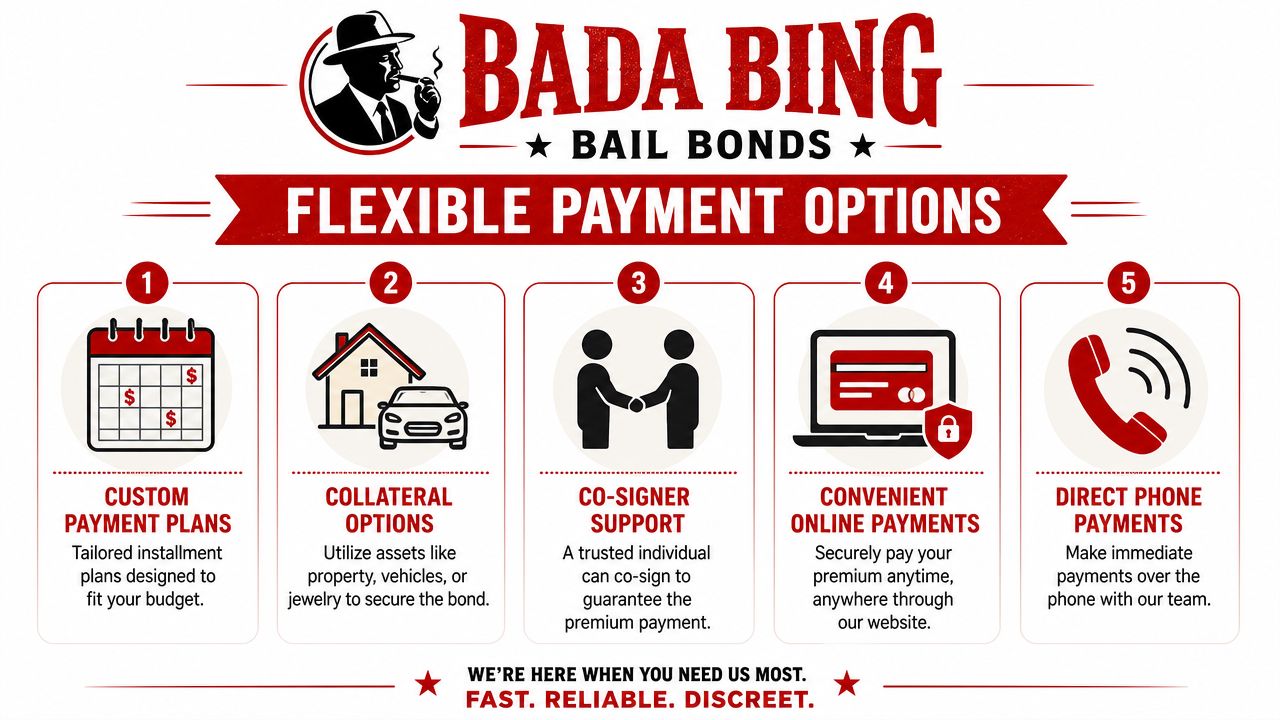
- Installments can help: Some families handle the premium through scheduled payments rather than one lump sum.
- A co-signer can strengthen the file: A financially stable relative or friend often helps when the person arranging release isn’t the defendant.
- Phone and online payments matter: Fast payment methods remove delays when time matters most.
If you’re comparing options, this page on bail bond payment options gives a useful overview of common ways these arrangements are handled.
When Collateral Enters The Conversation
Collateral tends to worry people because they hear the word and immediately think they’re about to lose a home or vehicle. That isn’t the right way to look at it. Collateral is a risk-control tool. It usually comes up in larger or higher-risk bonds, not every routine case.
Common examples can include property, vehicles, jewelry, or another asset with documented value. The exact item matters less than whether ownership can be shown clearly and whether the asset makes sense for the size and risk of the bond.
Collateral doesn’t mean a bond is impossible. It usually means the risk side of the file needs stronger backing.
What Works And What Doesn’t
What works is transparency. If the defendant has prior failures to appear, open warrants, unstable residence history, or facts that make the bond look shaky, say so up front. Hiding risk rarely helps.
What doesn’t work is rushing into paperwork with the wrong co-signer or promising payment terms that no one can realistically maintain. A bond should be structured in a way the family can realistically carry through to the end of the case.
Navigating Anaheim Bail Timelines for Common Charges
Your phone rings at 11:30 p.m. A family member was arrested in Anaheim, bail has been posted, and everyone assumes they will be out in an hour. Sometimes that happens. Often it does not.
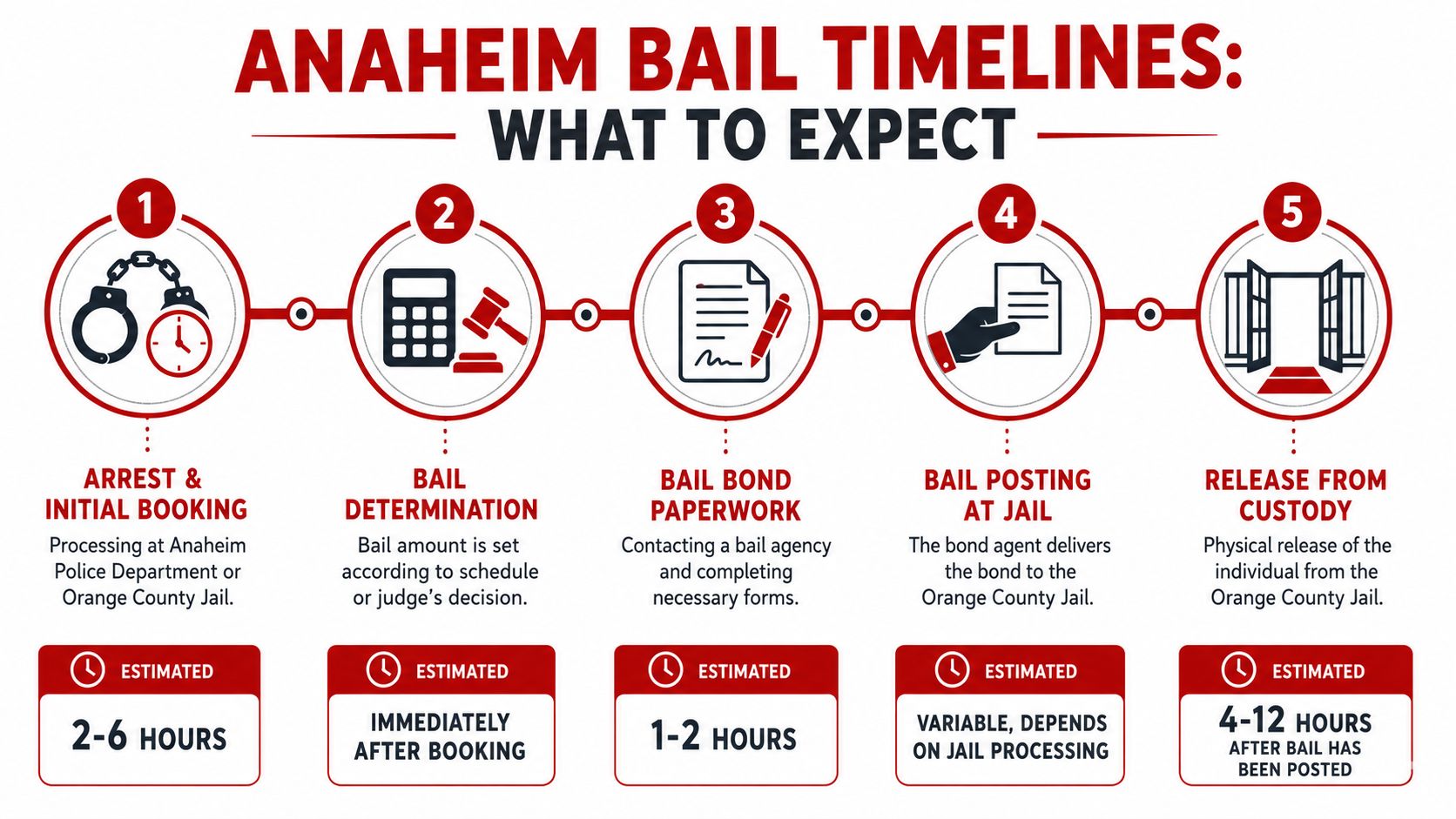
Release time depends on where the person is being held, whether booking is complete, and whether the charge brings extra release checks. In Anaheim, a person may start at the Anaheim Detention Facility and later move into the Orange County Jail system. That transfer alone can change the timeline and the pickup location.
Why Anaheim Releases Don’t All Move The Same
Families usually want one answer: “How long until release?” The honest answer is that the clock starts with custody processing, not with the moment you finish bond paperwork.
At the Anaheim Detention Facility, timing often turns on booking volume, medical screening, and whether the file is being reviewed before transfer or release. If the person has already been moved into Orange County Jail custody, the process can slow down because more than one department may touch the file before the person is cleared to walk out.
Shift changes matter. So do housing assignments, internal holds, and simple paperwork backlog. None of that means the bond failed. It means the release is still being processed.
Common Charge-Specific Delays
Some charges bring extra steps that families should expect from the start.
DUI arrests often involve release delays even after bond is posted. The jail may require additional internal clearance before releasing the person, especially if intoxication, medical review, or another hold is involved. If that is the issue in your case, this Anaheim DUI bail bond guide explains the kinds of release delays families run into.
Domestic violence arrests can also take longer than families expect. In real cases, people often refer to this as a cooling-off period. The practical point is simple. Bond paperwork may be done, but release can still wait on jail procedures or judicial conditions, and no-contact terms may apply immediately once the person is out.
Warrants, probation issues, or multiple cases are another common roadblock. One bondable case does not always clear the person for release if another agency hold, probation violation, or warrant is attached. That is one of the biggest reasons families hear “bond posted” but still do not get a release time.
What To Do Next While The Jail Processes Release
Use the waiting time well. Families who move fastest focus on the next concrete step instead of refreshing the phone every five minutes.
- Confirm the exact facility: Ask whether the person is still at Anaheim Detention Facility or has been transferred into Orange County Jail custody.
- Ask if any holds remain: DUI checks, probation holds, warrant issues, and domestic violence restrictions can all delay release.
- Get ready for pickup: Have transportation, ID, and a charged phone ready. Late-night releases are common.
- Tell the defendant not to promise contact that could violate conditions: This matters in domestic violence cases where contact restrictions may start immediately.
- Keep your phone on and answer unknown numbers: Jails, agents, and indemnitors do not always call from a recognizable line.
A missed court date after release can lead to bond trouble and a new warrant, so families should treat the paperwork seriously from day one, even while they are still waiting for the person to come out.
What Helps Most In Real Cases
Clear information speeds things up. Wrong assumptions slow families down.
The best calls usually come from someone who can calmly answer four questions: where the arrest happened, where the person is being held now, what the main charge is, and whether there are any known warrants or probation issues. With that, it becomes much easier to set realistic expectations.
The hardest part for families is the gap between “approved for release” and “physically released.” That gap is normal. If the bond is posted and the person is still in custody, the next move is not panic. The next move is confirming the facility, checking for holds, and waiting for custody staff to finish the release process.
After The Release Ensuring Court Compliance and Support
Once your loved one is out, the emergency phase ends, but the responsibility doesn’t. The case is still active. The person released on bond now has one job above all others. Show up to court every single time.
That sounds obvious, but such circumstances frequently lead to avoidable bond problems. People misread paperwork, forget dates, move without updating contact information, or assume a lawyer appearance means they don’t need to attend. Never make that assumption unless counsel has clearly handled it and the court permits it.
The First Week After Release
The smartest move is to get organized immediately.
- Put every court date in writing: Don’t trust memory.
- Save all paperwork together: Bond documents, booking information, and court notices should stay in one place.
- Follow release conditions exactly: No-contact orders, travel limits, or similar conditions aren’t suggestions.
If there was collateral attached to the bond, families should also keep copies of those documents and ask what the exoneration process will look like once the case is concluded.
How Bonds End Properly
A bond doesn’t stay open forever. It is exonerated when the court no longer requires it under the case process. Once the matter is resolved and the bond is discharged, any collateral tied to the bond can be returned according to the agreement and completion of the case obligations.
That’s why staying compliant is the cheapest path through the process. Missed appearances, ignored court notices, or broken release terms can turn a manageable case into a custody return, a warrant, and a fight over forfeiture.
Keep the paperwork. Keep the dates. Keep answering the phone. Most post-release problems start when people stop doing one of those three things.
Anaheim bail bonds are often remembered as a one-night crisis. In practice, the bond works best when the family treats it as a short-term legal commitment that needs attention all the way through the last court date.
If you need immediate help with a loved one in custody, Bada Bing Bail Bonds is available around the clock to explain the process clearly, verify booking details, and help move release forward without adding confusion. If you’re dealing with an Anaheim arrest and need a calm, fast answer right now, reach out and speak with a licensed agent.