A lot of families land here the same way. A certified letter shows up after a missed court date in Ventura, Oxnard, Camarillo, or Thousand Oaks. The wording is cold, legal, and hard to decode. What you care about is simpler: Did we just lose the bond, and what happens next?
If you’re trying to define bail forfeiture because someone you love missed court, you’re already in a time-sensitive situation. In Ventura County bail bonds cases, forfeiture isn’t just paperwork. It can affect warrants, jail status, collateral, and the co-signer’s finances fast.
Table of Contents
- That Sinking Feeling a Forfeiture Notice in the Mail
- What Bail Forfeiture Actually Means in California
- The 185 Day Forfeiture Clock in Ventura County
- The True Financial Cost to Co-Signers and Families
- Forfeiture vs Revocation and Exoneration Explained
- What to Do Immediately After a Forfeiture Notice
- Partnering with a Ventura Bail Bonds Expert
That Sinking Feeling a Forfeiture Notice in the Mail
The scene is usually the same. Someone in the family thought the court date had been changed, or they mixed up two dates, or panic made them avoid court altogether. Then the notice arrives, and suddenly everyone is asking the same question: are we now responsible for the full amount?
In practical terms, a forfeiture notice means the court is treating the missed appearance as a serious default. It often comes with a bench warrant problem for the defendant and a financial problem for the bond. For families dealing with bail bonds Ventura matters, this is the moment when confusion turns into urgency.
What families usually misunderstand first
A common assumption is that only the premium is at stake. In California, that premium is fixed by law at 10% and it’s non-refundable. But forfeiture is about the larger obligation behind the bond, not just the amount paid up front.
That disconnect is why forfeiture hits so hard. A co-signer may have thought they were helping someone get out of Ventura County Jail and back to work or home. Then one missed court date in Ventura Superior Court or a related courtroom setting can put the entire bond into play.
A forfeiture notice isn’t a bill you ignore until later. It’s a warning that the legal clock is already running.
The immediate issue behind the notice
At the center of almost every forfeiture is one thing: failure to appear. The defendant didn’t show for a required court date, and the court responded. That can happen in Ventura, Oxnard, Port Hueneme, Moorpark, Fillmore, Ojai, Santa Paula, or Santa Barbara just as quickly as anywhere else.
If you’re still trying to sort out whether the missed date was enough to trigger this process, start with Bada Bing’s Ventura court guide. It helps families understand how missed appearances turn into larger problems.
What matters right now
- Find the exact missed court date. Don’t rely on memory.
- Confirm the court and case status. Ventura County cases can move quickly once a warrant issues.
- Contact the bond company immediately. Silence makes the situation worse.
- Do not let the defendant disappear further. The longer they’re gone, the fewer practical options remain.
Families searching for fast bail bonds Ventura help are usually in crisis mode already. The best move is to stop guessing and start acting with the paperwork in hand.
What Bail Forfeiture Actually Means in California
To define bail forfeiture in plain English, it means the court declares the bail lost because the defendant failed to appear as required. Once that happens, the financial liability shifts to the surety on the bond. In a bail bond case, that’s the bail company.
California families often confuse the premium with the bond itself. They are not the same thing. The premium is the fee paid to get the bond posted. The bond is the full amount guaranteed to the court if the defendant doesn’t do what the court requires.
A simple way to think about it
Think of a bail bond like a very large guarantee. The premium is the price paid to put that guarantee in place. If the defendant appears in court as required, the surety’s risk ends when the case ends or the bond is otherwise resolved. If the defendant misses court, the guarantee is now in danger of being collected.
In California, the premium is fixed at exactly 10% of the total bail and is non-refundable. A $20,000 bail requires a $2,000 payment to post bond under California law, as explained in California’s Ventura County bail schedule overview.
What legally triggers forfeiture
The legal trigger is straightforward. Bail forfeiture is legally triggered when a defendant fails to appear without a sufficient excuse for a required court proceeding. This action requires the court to officially record the failure and declare the entire bail amount forfeited, which immediately shifts the financial liability to the surety or bail bond company, as described in New York CPL § 540.10.
That same real-world chain reaction is what families in Ventura County feel immediately. The defendant may now face a bench warrant. The bond company now has exposure on the full amount. The co-signer may be pulled into a financial recovery process if the problem isn’t fixed.
Practical rule: In a forfeiture, the court isn’t asking for another premium payment. It’s putting the full bond obligation at risk.
What doesn’t work
People often make the same mistakes after they learn what bail forfeiture means.
- Waiting for another notice: Courts and bond companies don’t treat delay as a strategy.
- Assuming a late appearance fixes everything automatically: It doesn’t.
- Treating this like simple bail jumping confusion: If you need a starting point on the missed appearance issue, read what to do if you miss court.
- Thinking the co-signer is protected because they weren’t the defendant: The paperwork usually says otherwise.
If you’re dealing with Ventura County Jail bail bonds, plain language matters. Forfeiture means the bond is in trouble, the warrant problem is active, and every day counts.
The 185 Day Forfeiture Clock in Ventura County
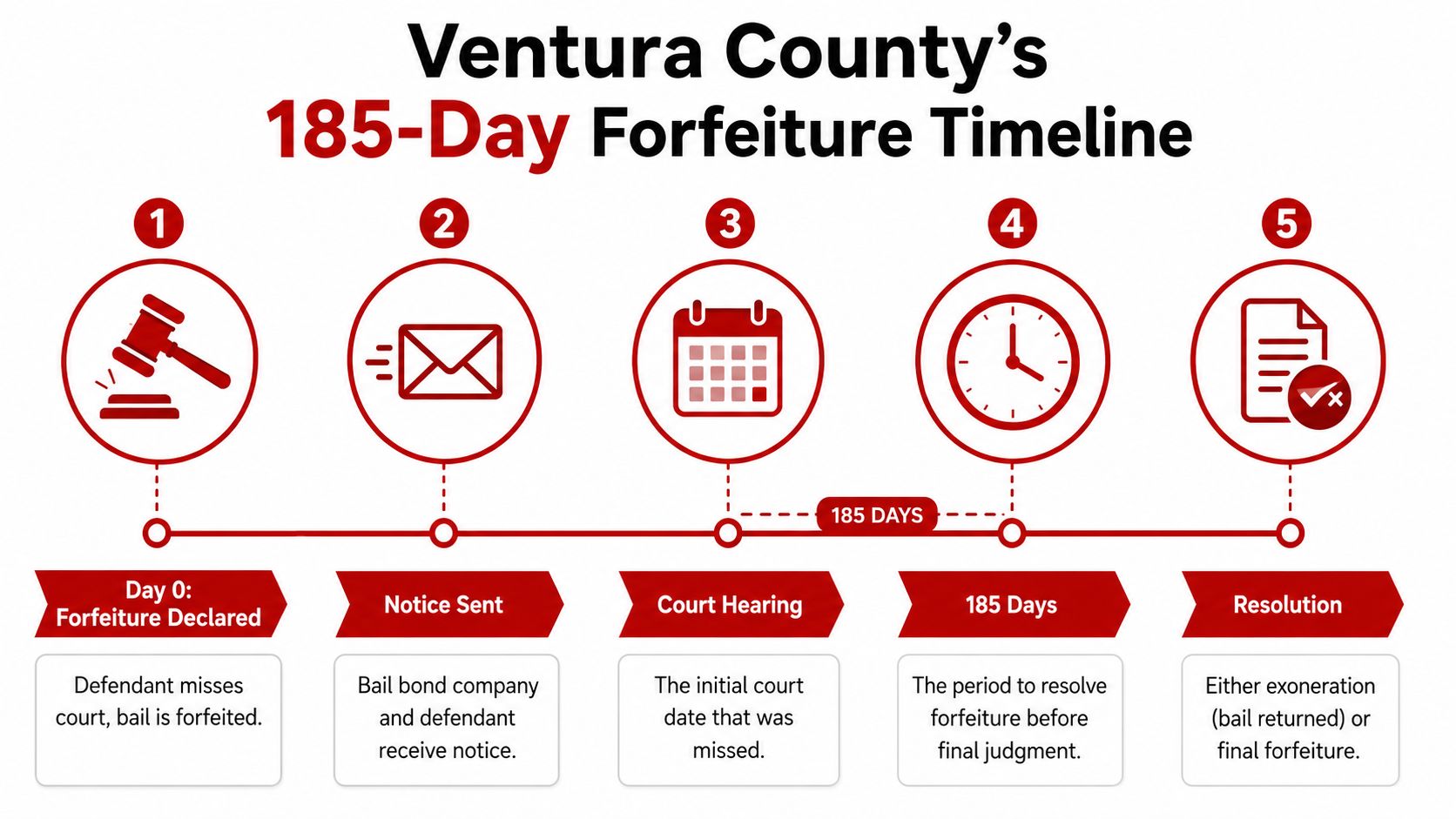
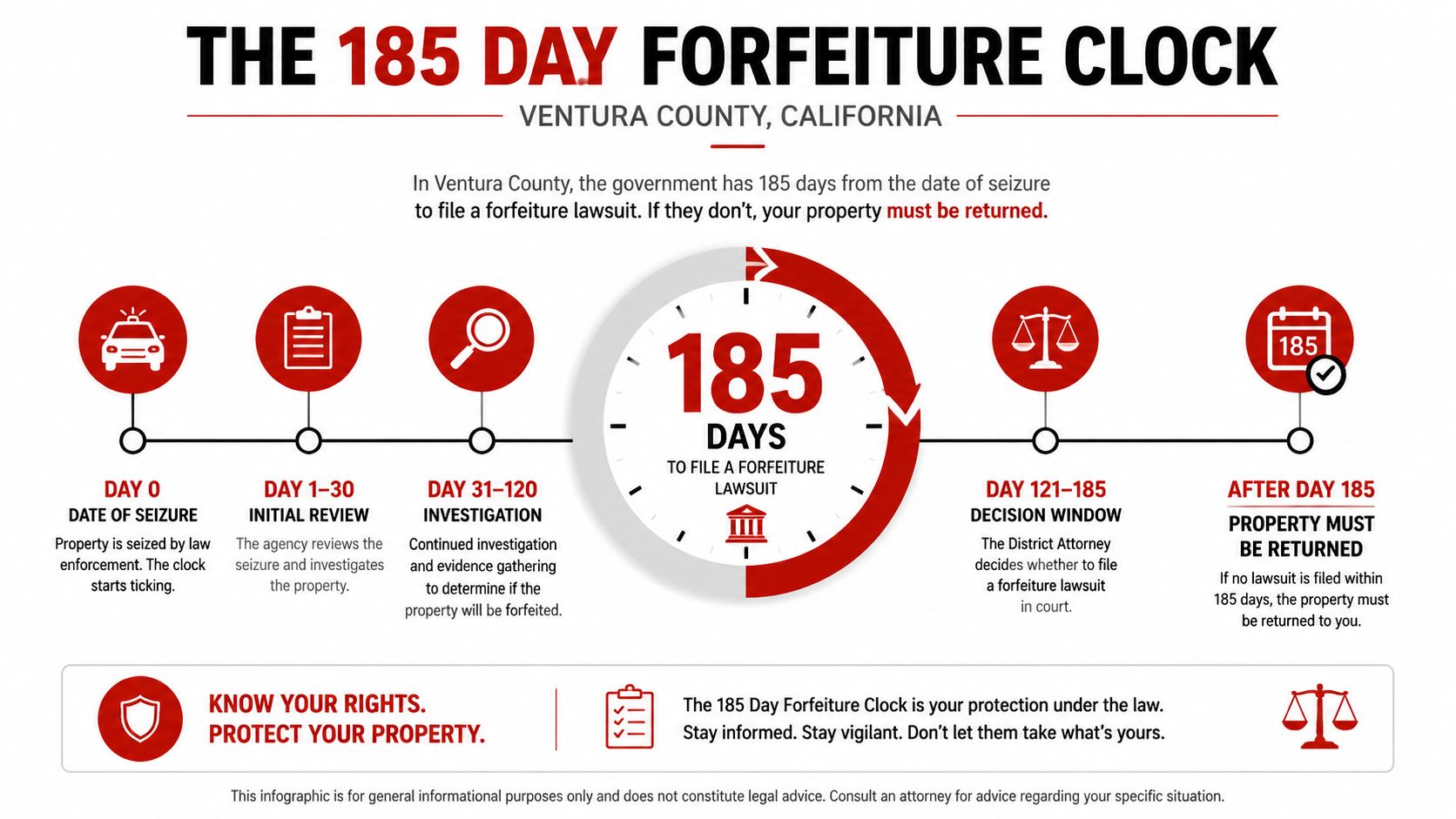
Once forfeiture is declared in a California surety case, the file enters a deadline-driven phase. In Ventura County, families often hear this described as the 185-day forfeiture clock. What matters most is that this isn’t open-ended. The bond company has a limited period to resolve the problem before the court moves toward judgment.
What happens after the court declares forfeiture
The first practical event is notice. The court sends notice of forfeiture, and that tells everyone the matter is now formal. From there, the focus shifts to whether the defendant can be surrendered back into custody or whether there is a legally valid basis to ask the court to set aside the forfeiture.
A broadly applicable rule in surety cases is this: when a surety bond is forfeited, the bail bond company becomes liable for the full bail amount. State laws provide a limited window, typically 30 to 180 days, for the company to file a motion for remission by returning the defendant to custody. Missing this deadline allows the court to seize the full bond value, as summarized in this explanation of bond forfeiture and remission.
How families should think about the clock
The bond company is not sitting around waiting for the court to decide what feels fair. The company is looking at a hard financial deadline. That changes how everyone acts.
Here is the practical sequence families in Ventura, Oxnard, Camarillo, and Thousand Oaks should expect:
- Court date is missed. The court declares forfeiture.
- Notice goes out. The defendant and surety learn the bond is in trouble.
- Search and surrender efforts begin. The goal is to return the defendant to custody within the allowed period.
- Court review happens if relief is sought. The surety may try to vacate, set aside, or obtain remission depending on the facts and timing.
- If the deadline passes unresolved, judgment follows. At that point the financial problem hardens.
What works and what fails
A family that responds quickly gives the bond the best chance of being salvaged. A family that hides information, delays contact, or helps the defendant stay out of sight usually makes the final result worse.
Short version:
| Situation | Likely Result |
|---|---|
| Defendant surrenders quickly | Better chance to limit damage |
| Family communicates early | More room to act |
| Defendant stays missing | Risk rises sharply |
| Deadline passes | Court can move to final collection |
The clock matters because once judgment enters, the conversation changes from problem-solving to debt recovery.
If you’re trying to arrange 24-hour bail bonds Ventura support after a missed appearance, the immediate issue is no longer just release. It’s also timing, court procedure, and whether the forfeiture can still be repaired. For local jail and release logistics, families often need 24-hour bail assistance in Ventura to understand where a surrender or rebooking may land.
Ventura County cases involve real local moving parts. Jail booking, courthouse scheduling, and transportation all affect the steps that can be taken before the forfeiture window closes.
The True Financial Cost to Co-Signers and Families
This is the part many families don’t hear clearly enough at the start. The co-signer’s risk doesn’t end with the premium. If the bond is forfeited and the company has to pay or pursue recovery, the co-signer can be exposed through collateral, lawsuits, and credit damage.
That isn’t scare language. It’s the practical side of the indemnity agreement most co-signers signed when they were trying to get a loved one out of jail.
How collateral can become the real fight
For larger or higher-risk bonds, agencies often require collateral. That may involve a vehicle title, real property paperwork, or another asset used to secure the surety’s risk. If forfeiture becomes final and the loss isn’t resolved, the agency can move to recover under the agreement.
Families often hear “you could lose the collateral” as a vague warning. In real life, that means the company may take steps to seize and liquidate the pledged asset to cover what it had to pay because the defendant didn’t appear.
The credit damage people don’t expect
One of the most overlooked consequences is what can happen after the company turns to the co-signer for repayment. Existing bail education materials rarely explain that if a bondsman sues a co-signer for a forfeited bond and the co-signer fails to pay, the debt can be reported to credit bureaus, potentially dropping a credit score by over 100 points, according to this discussion of bail forfeiture consequences.
That matters because credit damage doesn’t stay inside the criminal case. It can affect car loans, housing applications, refinancing, and everyday financial flexibility.
If you’re the co-signer, don’t tell yourself this is only the defendant’s problem. Once forfeiture turns into collection, your name matters a lot.
What the money problem really looks like
The financial structure is easy to misunderstand. In California, the premium is fixed by law at 10%, but the surety exposure is tied to the full bail amount. That’s why collateral and co-signer agreements exist in the first place.
A quick comparison helps:
| Payment or Risk | What it means |
|---|---|
| Premium | Non-refundable fee paid to post the bond |
| Full bond amount | The amount the surety can owe if forfeiture becomes final |
| Collateral | Asset pledged to protect the surety |
| Collection against co-signer | Recovery process if the company suffers loss |
If you’re trying to understand the up-front side of the deal, review California bail bond costs. But once forfeiture happens, you’re past basic pricing and into damage control.
What families should do before collateral is at risk
- Read the indemnity agreement again. It is often signed in a rush.
- Ask what asset is exposed. Don’t assume the paperwork is informal.
- Get honest about the defendant’s location. Protecting them briefly can cost the co-signer much more later.
- Track every court notice. Missing a second deadline makes everything harder.
Upon forfeiture proceedings, fast bail bonds Ventura marketing language stops mattering. Once forfeiture is in motion, the issue is legal exposure and financial recovery. Families need to think clearly, act quickly, and stop treating the co-signer as a bystander.
Forfeiture vs Revocation and Exoneration Explained
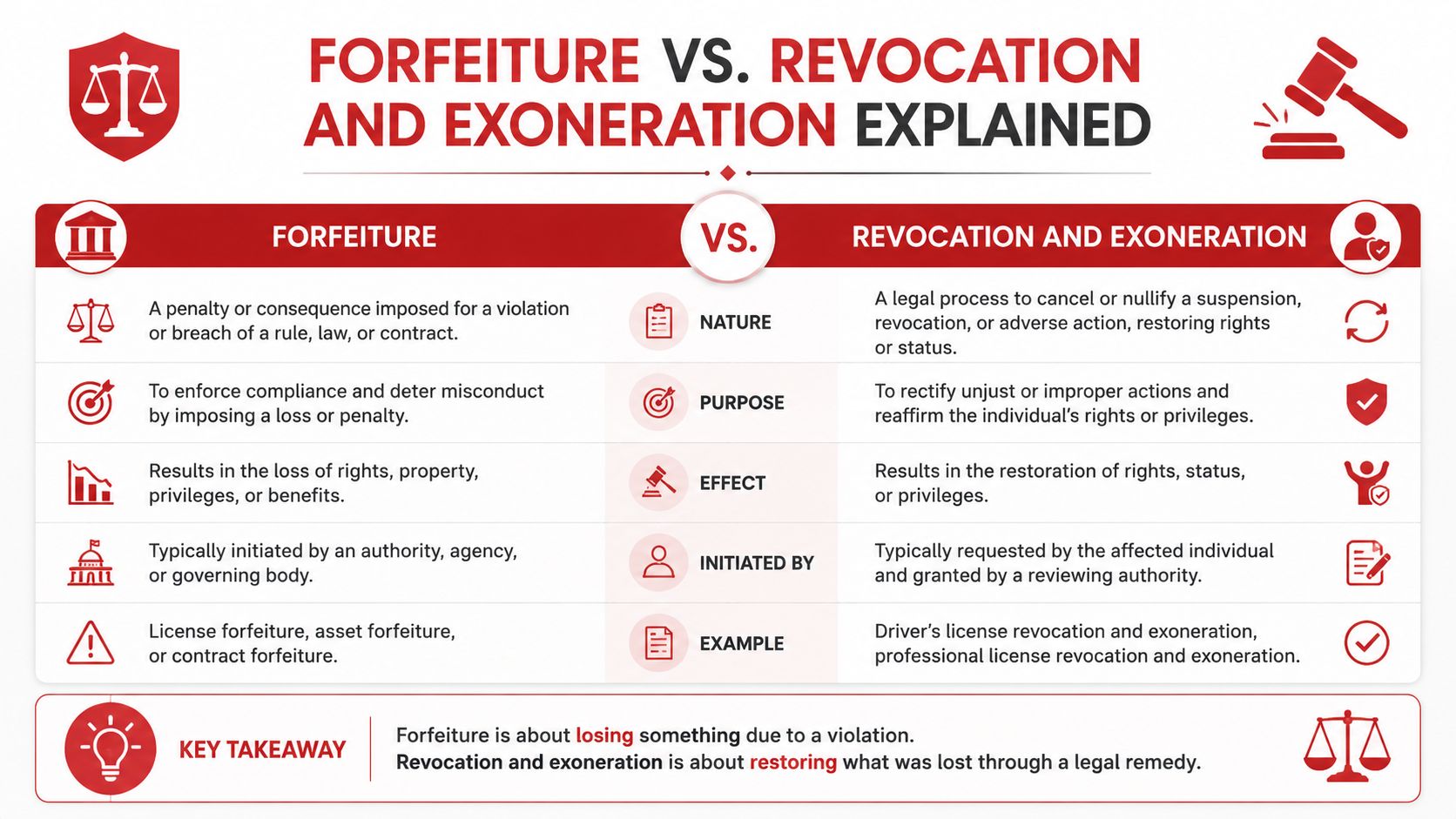
These three words get mixed together all the time. They are not interchangeable. If you use the wrong one when talking to a bondsman, lawyer, or court clerk, you can misunderstand your position fast.
Side by side meaning
| Term | What it means | What usually causes it |
|---|---|---|
| Forfeiture | The court declares the bond lost | The defendant misses a required appearance |
| Revocation | The bond is pulled back before a missed court date | Risk concerns, noncompliance, or co-signer issues |
| Exoneration | The bond obligation ends | The case concludes or the bond is otherwise discharged |
Forfeiture is the bad outcome families usually mean when they say “we lost the bond.” Revocation is different. That happens when the bond is canceled before the court declares forfeiture, often because the agency believes the defendant may run or the co-signer wants off the bond. Exoneration is the clean ending. It means the surety’s obligation is over.
Here is a short video that helps with the terminology:
Why this distinction matters financially
The surety model carries real risk. In California, where premiums are 10%, bond companies are estimated to forfeit approximately $172,278,810 to county courts annually due to defendants becoming long-term fugitives, according to this analysis of California forfeited bail totals.
That number explains why agencies care so much about compliance, check-ins, court reminders, surrender decisions, and collateral. When families ask why a bond company is being strict, this is the answer. The company collects a fraction up front but may be liable for the whole amount if the defendant vanishes.
Revocation can be preventive. Forfeiture is reactive. Exoneration is closure.
A practical way to identify your situation
Ask these three questions:
- Did the defendant already miss court? If yes, you’re likely dealing with forfeiture.
- Was the bond pulled before any missed hearing? That’s usually revocation.
- Is the case over and all bond obligations discharged? That’s exoneration.
For families dealing with Ventura County bail bonds, using the right word helps you get the right answer faster.
What to Do Immediately After a Forfeiture Notice
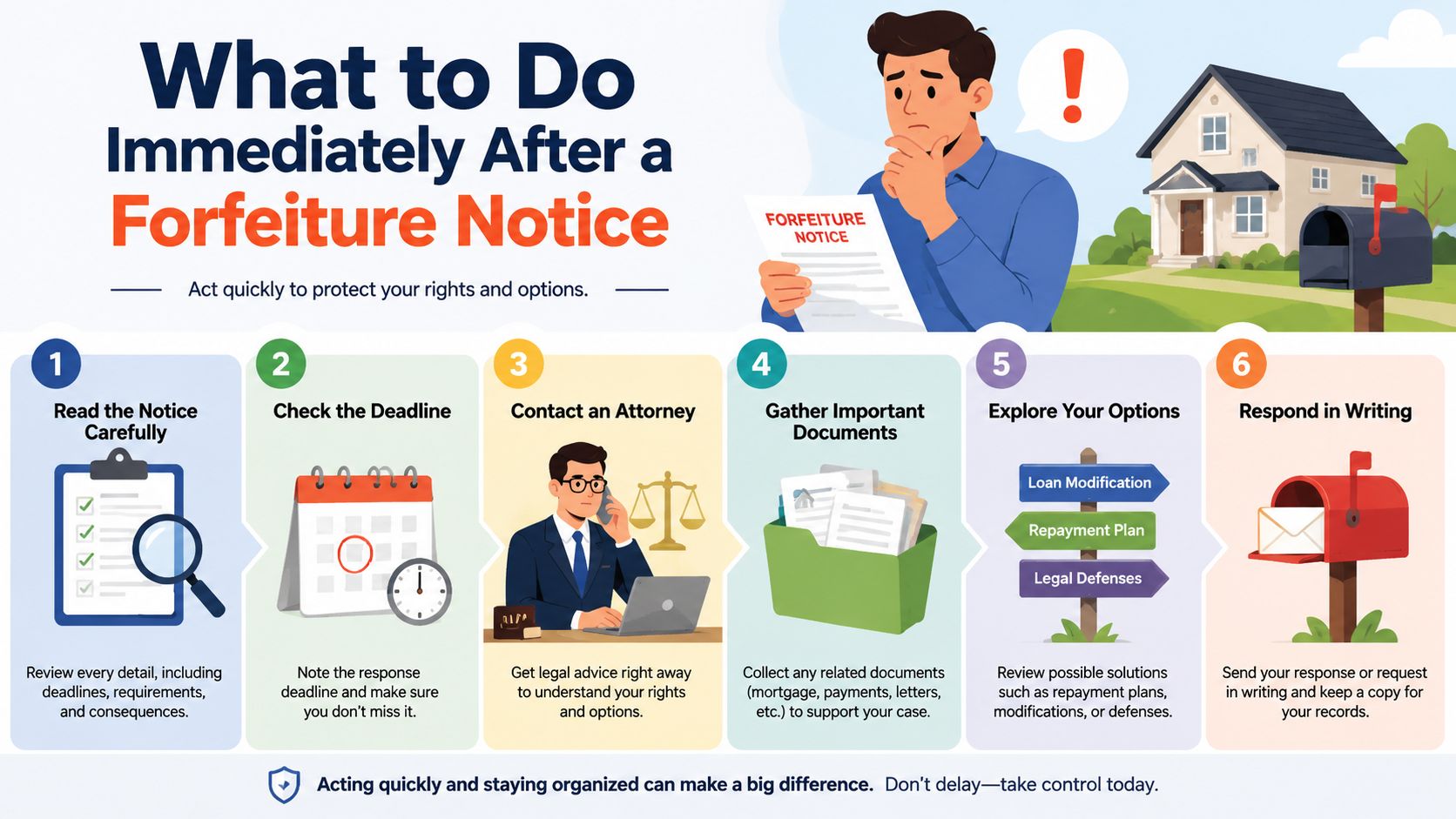
Once the notice arrives, the worst response is delay. Families sometimes freeze because they’re embarrassed, angry, or hoping the defendant will “handle it.” That usually burns valuable time.
What helps is direct action, with one goal in mind: reduce the damage before the forfeiture becomes final.
The first calls to make
Start with the bond company. Not tomorrow. Not after the weekend. Right away.
Then gather the basic facts in one place:
- Court paperwork: The notice, case number, and missed date
- Defendant status: Where they are, whether they’re willing to surrender, and whether there was a real excuse
- Medical or emergency records: If the absence may be explainable, documentation matters
- Co-signer paperwork: You need the signed agreement and collateral details
The options that may still be on the table
Not every forfeiture is handled the same way, but families generally have a short list of practical moves.
-
Get the defendant to surrender
This is often the cleanest move when the missed appearance can’t be justified. Delaying surrender usually makes every later step harder.
-
Work with the agent to locate the defendant
If the defendant has gone silent, the family still needs to communicate truthfully. Half-truths usually destroy trust at the exact moment cooperation matters most.
-
Prepare proof of a legitimate excuse
If there was hospitalization or another documented reason, the court may consider that. Unsupported stories don’t carry much weight.
-
Stop making the situation bigger
Don’t help the defendant hide. Don’t ignore mail. Don’t assume a new bond in another county makes the old problem disappear.
Why local experience matters
Forfeiture risk isn’t the same everywhere. Bail forfeiture rates vary significantly by jurisdiction, from as low as 3.7% in Washington to as high as 24% in Detroit, which shows how much local court and enforcement practices shape outcomes, as noted in this forfeiture rate chart.
That doesn’t mean Ventura County works like either of those places. It means local process matters. Ventura Superior Court procedure, jail intake realities, and how quickly a missed appearance turns into enforceable pressure all affect the practical response.
Don’t treat a Ventura County forfeiture like a generic internet legal problem. Local timing and local handling matter.
Common bail questions families ask in this moment
Can we just pay another premium and fix it
Usually, no. Forfeiture isn’t a simple reset fee situation.
If the defendant shows up later, does the problem disappear
Not automatically. Timing and court procedure matter.
Can the co-signer still lose collateral even if they did nothing wrong
Yes. The co-signer’s legal problem comes from the agreement they signed, not from committing the underlying offense.
Families dealing with a missed court date need action more than reassurance. Clear communication and immediate movement give you the best chance to contain the fallout.
Partnering with a Ventura Bail Bonds Expert
The best bail problems are the ones that never become forfeitures. That usually comes down to reminders, check-ins, clear expectations, and a defendant who understands that every court date matters. In Ventura County, that includes cases touching Ventura, Oxnard, Camarillo, Port Hueneme, Thousand Oaks, Santa Paula, Moorpark, Fillmore, Ojai, and Santa Barbara.
When forfeiture does happen, local knowledge becomes practical fast. You need someone who understands Ventura County Jail bail bonds, local release timing, and how California bail laws affect co-signers, collateral, and missed appearances. That matters whether you’re dealing with bail bonds Ventura needs after a new arrest or trying to contain damage from an old missed date.
What a good local agency actually helps with
A solid local agency doesn’t just post the bond and disappear. It helps families understand deadlines, paperwork, surrender options, and what not to do. That’s why people often search for 24-hour bail bonds Ventura or bail bonds near me in the first place. Speed matters, but clarity matters just as much.
For local service details, families can review Bail Bonds Ventura. The primary value of a local expert is that they understand the moving parts around Ventura County courts and jail logistics, not just the bond form itself.
If you’re dealing with a forfeiture scare, a notice in the mail, or a loved one who already missed court, don’t sit on it. The sooner the issue is addressed, the more options usually remain.
If you need immediate help with Ventura County bail bonds, missed court issues, or a forfeiture notice, contact Bada Bing Bail Bonds. Their licensed agents are available around the clock to explain your options, verify jail and court information, and help you move fast in Ventura, Oxnard, Camarillo, Port Hueneme, Thousand Oaks, Santa Paula, Moorpark, Fillmore, Ojai, and Santa Barbara.