
Yes, you can leave the state on bail, but only with explicit written permission from both the court and your bail bondsman. If you travel without that dual approval, you risk violating bail conditions, losing your release, and being taken back into custody.
That’s the part many people in Ventura County don’t hear clearly enough when panic sets in. A parent in Oxnard gets a call about a funeral in Arizona. Someone in Camarillo has a job obligation in Nevada. A family in Thousand Oaks already paid for bail and assumes travel is fine as long as the person comes back for court. That assumption is where people get into serious trouble.
In real life, can you leave the state on bail isn’t a yes-or-no street answer. It’s a process. If you’re on a Ventura County bail bond, your travel plans have to satisfy the court’s concerns and the bondsman’s contract. Miss either one, and the trip can turn into a bail violation.
This matters whether the case is tied to Ventura, Oxnard, Port Hueneme, Santa Paula, Moorpark, Fillmore, Ojai, or nearby Santa Barbara. It also matters whether you’re dealing with bail bonds Ventura families ask about every day, Ventura County Jail bail bonds after a late-night arrest, or fast bail bonds Ventura residents need when time is tight. If you’re still sorting out your Ventura County bail bond options, travel rules should be part of that conversation from the start.
Table of Contents
- The Urgent Question Can You Travel While on Bail
- Understanding California’s Legal Travel Restrictions
- How to Formally Request Permission to Leave the State
- Your Bail Bondsman’s Critical Role in Travel Plans
- Navigating Emergency Travel and Common Pitfalls
- The High Stakes of Unauthorized Travel What You Risk
The Urgent Question Can You Travel While on Bail
A lot of people ask this after release, not before. They’ve handled the booking, the calls, the co-signer paperwork, and the drive home from Ventura County Jail. Then real life hits. A relative gets sick out of state. Work calls. Kids are involved. Suddenly the question becomes immediate.
The answer is still the same. Travel while on bail is possible, but it’s formal, not casual. If you’re out on Ventura County bail bonds, you should assume that crossing state lines needs approval in writing, not a guess, not a phone conversation, and not silence from the court.
Why families get confused
People often think bail means one set of rules. It usually doesn’t. There’s the court order, and if a bondsman posted the bond, there’s also the private bond agreement. That’s why someone can believe they’re doing everything right and still trigger a violation.
Common situations that create confusion include:
- Family emergencies: A funeral, a parent in the hospital, or a child who needs care in another state.
- Job travel: Sales work, construction jobs, trucking routes, or last-minute meetings.
- Moved routines: Someone lives near Santa Barbara, works in Los Angeles, and assumes a short trip out of California won’t matter.
- First-time arrests: People using bail bonds Oxnard or bail bonds Ventura services for the first time often don’t realize how strict travel rules can be.
Practical rule: If you’re asking whether you need permission, you probably do.
What works and what doesn’t
What works is early communication, a defense lawyer who files the right paperwork, and written approval before departure. What doesn’t work is saying the trip is only for a day, assuming the judge would understand, or thinking your bondsman “won’t mind” if you come back quickly.
For families in Ventura, Oxnard, Camarillo, Moorpark, and Santa Paula, the safest approach is simple. Treat any out-of-state trip like a legal request that needs to be documented from the beginning.
Understanding California’s Legal Travel Restrictions
California treats out-of-state travel on bail as a serious issue because it raises the court’s concern about flight risk. Once someone crosses state lines, the court has less control and less certainty that person will appear when required. That’s why the rules tighten up quickly.
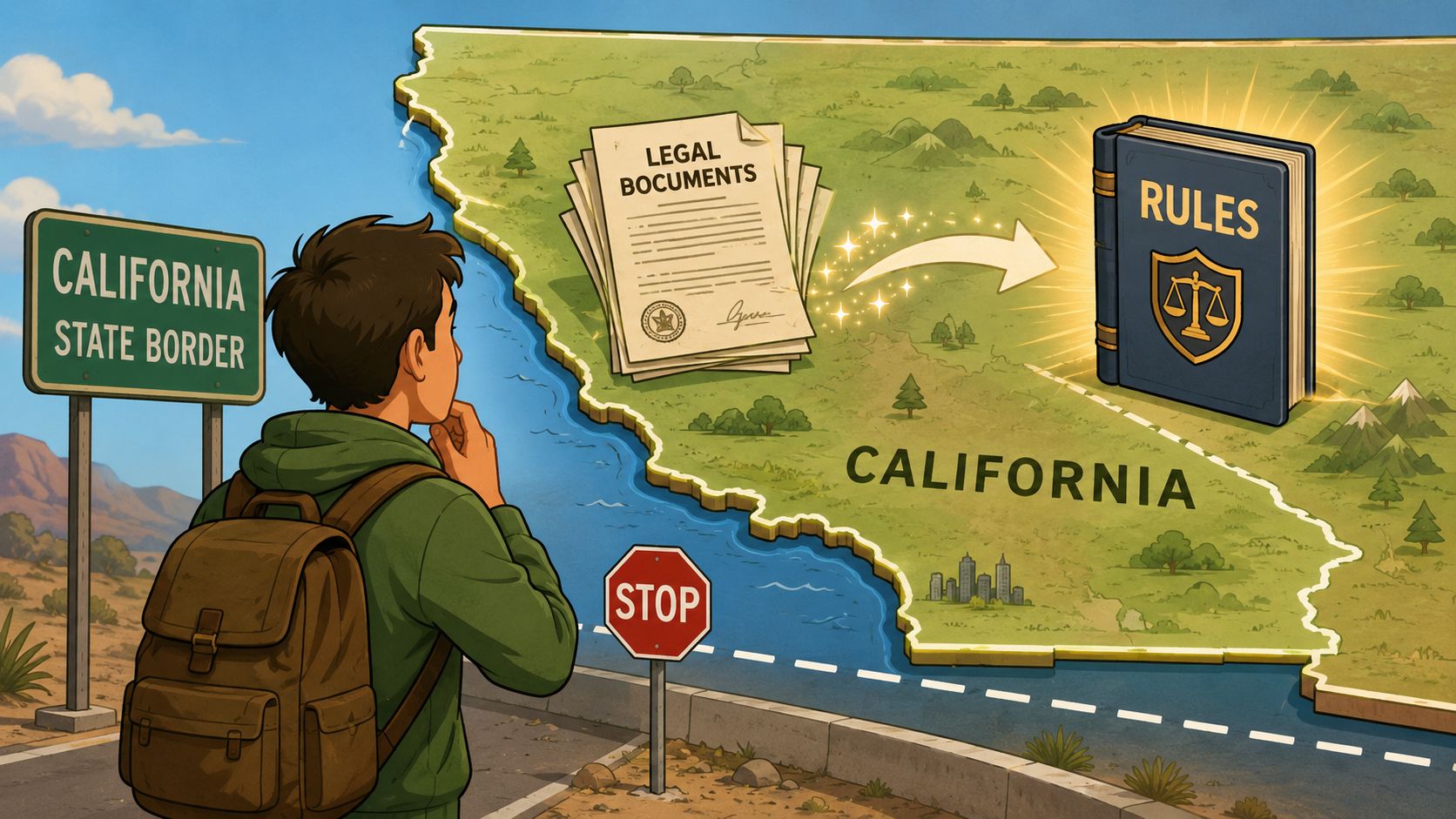
According to California travel rules while on bail, the standard requirement is written consent from both the court and the bail bond agent before leaving the state, and unauthorized out-of-state travel can lead to immediate bail revocation and incarceration pending trial.
Why state lines change everything
Travel inside California is often treated differently from travel outside California. Once a person wants to go to Nevada, Arizona, Texas, or anywhere else outside the state, the request gets more scrutiny because the court wants a reliable plan for return.
That’s especially true in cases involving:
| Situation | Why it matters |
|---|---|
| More serious charges | Judges are less likely to relax restrictions when the stakes are higher |
| Criminal history | Prior problems can make the court less confident about compliance |
| Unclear travel purpose | Vague reasons tend to weaken the request |
| Weak return plan | If the court can’t see how the person will remain reachable, the request suffers |
Federal matters are even stricter. The source above notes that federal courts can require explicit judicial approval for travel even within the state. That’s a different level of restriction than what many people expect from state court practice in Ventura or Santa Barbara.
What judges and agents are looking at
A judge doesn’t just ask, “Is this trip important?” The better question is, “Can this person go and still be counted on to come back?” That’s why a request usually needs dates, lodging, purpose, and a concrete return plan.
Leaving without approval is the kind of mistake that can turn a manageable bail situation into a custody problem overnight.
For practical purposes, Ventura County families should think in terms of documentation and credibility. A strong request is specific. A weak request sounds improvised. If you want a clearer picture of what happens after a violation, you can learn about bail jumping from Bada Bing.
How to Formally Request Permission to Leave the State
Most bad outcomes start with informality. Someone calls their lawyer but never gets the motion filed. Someone tells the bondsman but never gets court approval. Someone hears “it should be fine” and treats that as permission. None of that protects you.
The process is formal and sequential.
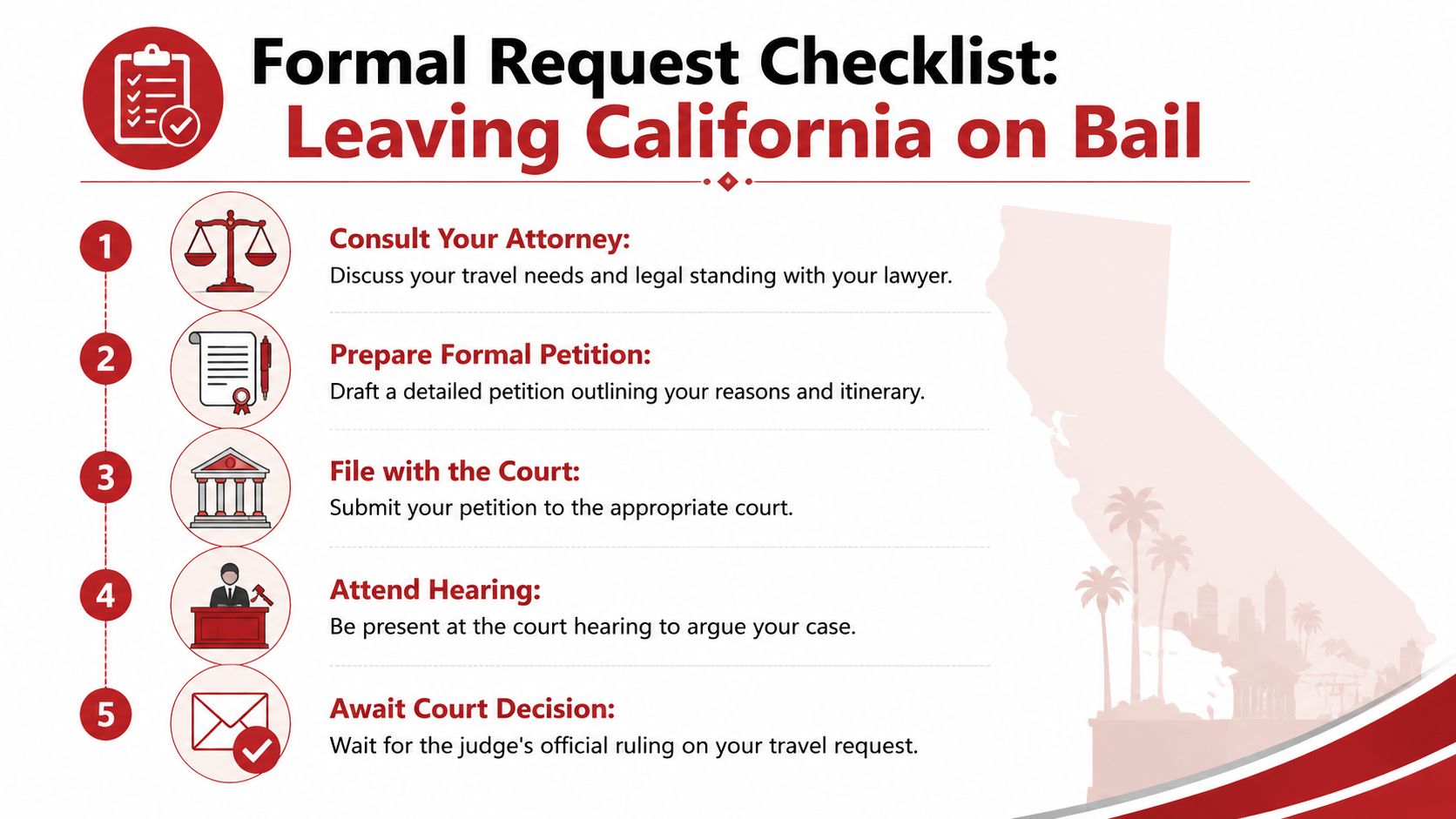
The six-step process that actually works
The most useful checklist comes from this six-step California bail travel protocol. It says a defendant should:
- Review the release order and bail agreement for geographic restrictions.
- Consult a defense attorney to draft a formal motion.
- Provide supporting documentation for the trip.
- Notify the bail bondsman about the request.
- Secure written court approval.
- Carry the signed order and bondsman contact details during travel.
That order matters. People get in trouble when they jump to step five in their own head and ignore steps one through four.
Here’s the checklist in motion:
- Start with the paperwork: Look at the release terms, not your memory of them.
- Get your lawyer involved early: If the trip is time-sensitive, delay hurts.
- Build the request with proof: Dates, hotel information, transportation details, and the reason for travel should be ready before the motion goes in.
- Tell the bondsman before the hearing if possible: Surprises are bad in bail matters.
- Wait for the signed order: A pending request is not permission.
A lot of clients find it helpful to understand related court motion practice before travel comes up. This is useful background from Bada Bing Bail Bonds’ Ventura guide.
A short overview can also help if you’re trying to understand how courts look at bail decisions generally.
What to put in the motion
A strong motion answers practical questions before the judge has to ask them. It should explain the purpose of the trip, where the person will stay, how long they’ll be gone, and how they’ll remain reachable. If the trip is tied to family or medical issues, attach proof.
What usually fails: a vague request, no travel dates, no address, and no documents showing why the trip can’t wait.
A good request package often includes:
- Purpose of travel: Funeral, medical treatment, work obligation, or another concrete reason.
- Specific timeline: Departure date, return date, and how long the person will be gone.
- Lodging details: Address, hotel confirmation, or family residence information.
- Transportation plan: Flight, car travel, or other clear route details.
- Return assurance: Why the person will come back and appear as required.
One more point matters more than people think. A verbal comment from a judge, hallway conversation, or “we filed it already” is not enough. The source above is clear that written approval is what counts. Until the signed order exists, the travel should not happen.
Your Bail Bondsman’s Critical Role in Travel Plans
Regarding this matter, many online guides fail people. They focus on the judge and barely mention the bondsman. In practice, that gap causes avoidable violations.
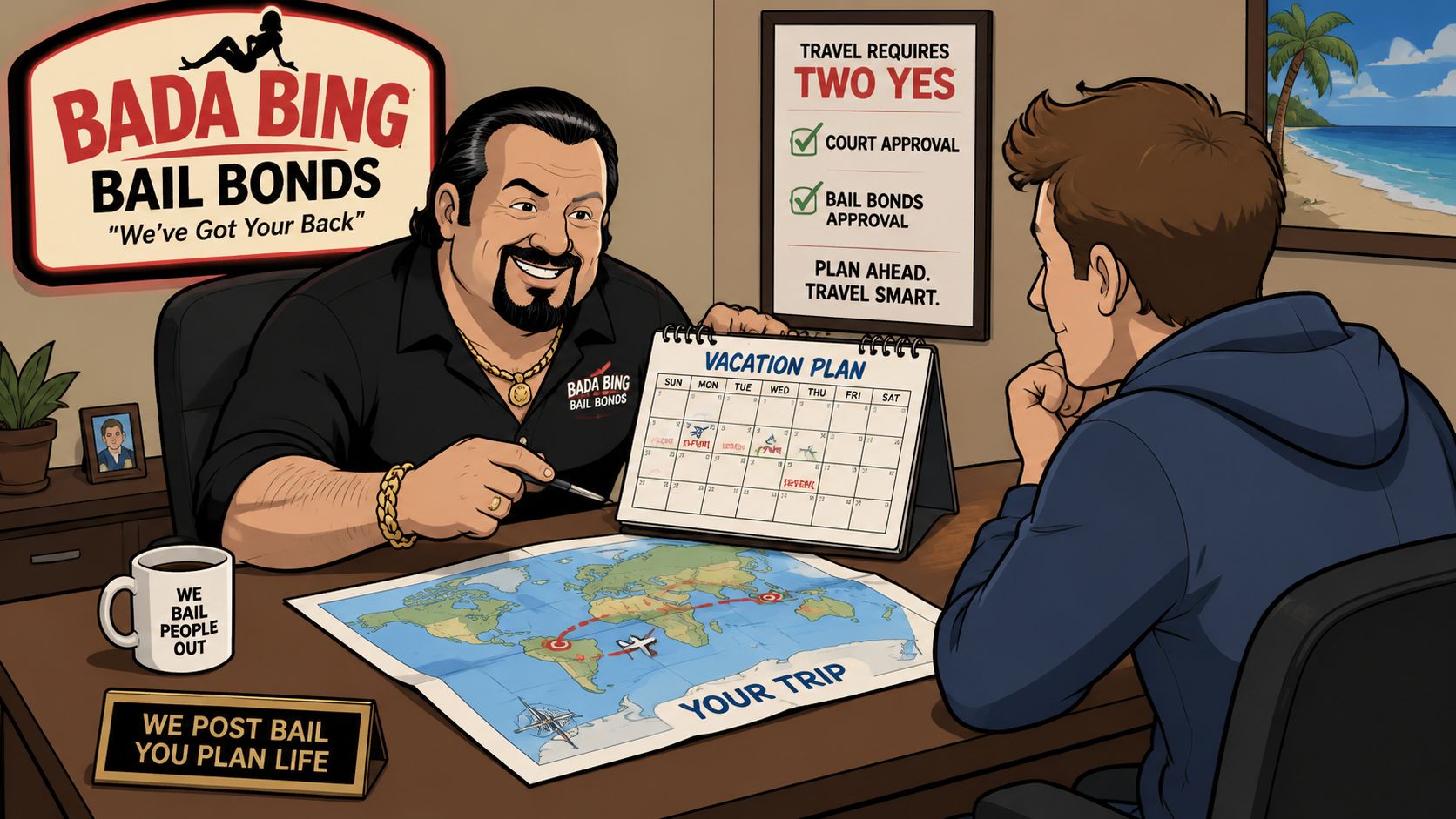
Court approval is only half of it
If someone posted cash bail, the analysis can be different. But when a bail bond company is involved, the defendant is also bound by the bond contract. That contract can restrict travel even if the court is willing to allow it.
That distinction is laid out in this explanation of court restrictions versus bondsman restrictions. The source explains that a defendant who posted cash bail may travel unless the judge forbids it, while a defendant using a bondsman is bound by the contract’s travel clause regardless of court orders.
That means two approvals may be needed in the same case:
| Decision maker | What they control |
|---|---|
| The court | Whether travel violates release conditions |
| The bondsman | Whether travel violates the private bond contract |
If either answer is no, the trip is unsafe.
Why the bond contract matters so much
A bondsman has money and risk tied directly to your compliance. California law fixes the bail premium at 10% of the total bail amount, and that premium is non-refundable. For example, California bail schedules and premium rules explain that a $20,000 bail requires a $2,000 payment to post bond under the standard rule. That doesn’t mean the bondsman’s risk ends there. If the bond is forfeited, the financial exposure is much larger.
This is why agents ask hard questions about travel. Where are you going. Why now. Who are you staying with. When are you back. How will you check in. Those aren’t personal intrusions. They’re part of managing the bond responsibly.
For people searching 24-hour bail bonds Ventura help after an arrest, this is worth understanding early. A bond agreement is not just a ride home from jail. It’s an ongoing obligation.
If the bond company learns about out-of-state travel after the fact, you’ve already made the situation harder than it needed to be.
If you’re comparing local release options, this background on 24 hr bail bonds helps explain how bond relationships work after someone gets out, not just during booking.
Navigating Emergency Travel and Common Pitfalls
Emergency travel is where people are most tempted to cut corners. They believe the reason is obvious, so formalities can wait. That instinct causes denials and re-arrests.
When courts may make room for emergencies
California courts have shown expanded discretion for out-of-state travel tied to necessities like urgent medical treatment or family emergencies, provided the defendant accepts responsibility and returns promptly, according to this discussion of emergency travel requests in California bail cases. The same source says 40% of pretrial travel requests are denied due to insufficient documentation.
That number tells you what actually matters in an emergency. The problem often isn’t the emergency itself. The problem is weak proof.
If the request is based on a medical issue, gather records that show urgency. If it’s based on a death in the family, include what confirms the event and your relationship. If the person needs treatment in another state, the request should make clear why the treatment can’t be handled locally and how the person will return.
Mistakes that sink travel requests
The biggest mistakes are usually preventable:
- Assuming silence means yes: If the release paperwork doesn’t spell out every restriction, people sometimes think they’re free to go. That’s not a safe assumption.
- Waiting until the last minute: Emergency doesn’t excuse disorganization. Courts and lawyers still need something concrete to work with.
- Giving partial information: A strong request includes dates, destination, lodging, and reason. Gaps raise concern.
- Skipping the bondsman call: Even a valid court request can become a contract problem if the bail agent isn’t informed.
- Treating a filed motion as approval: Filing is only the request. It is not permission.
In emergency situations, the fastest path is usually the most documented one.
For local families using Ventura County bail bonds, that means slowing down just enough to do the paperwork correctly. The trip may be emotional and urgent, but the approval still turns on details.
The High Stakes of Unauthorized Travel What You Risk
Some people still take the gamble. They leave California, plan to come back quickly, and hope nobody notices. That’s one of the worst decisions a defendant on bond can make.
What happens when someone leaves without approval
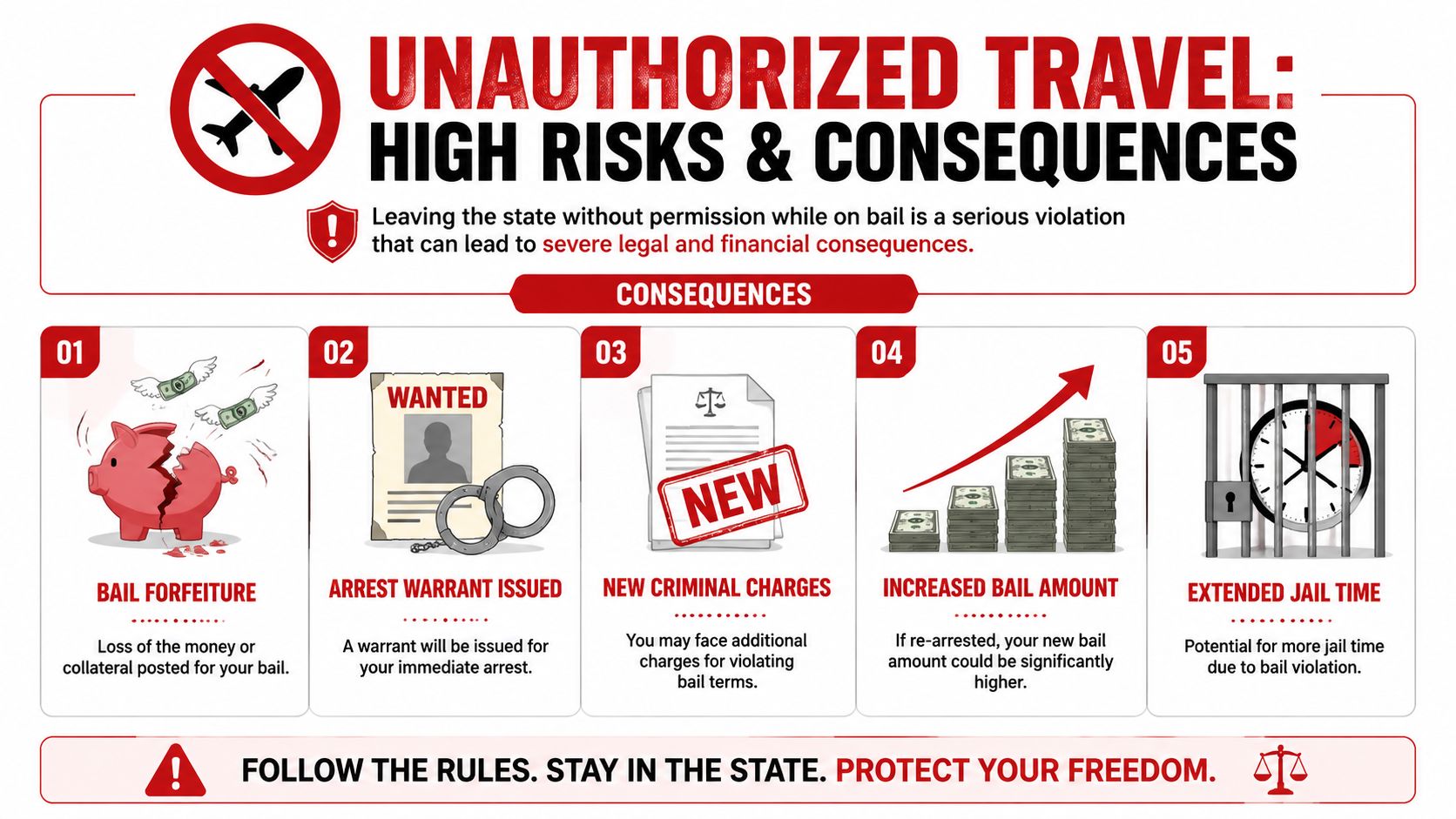
According to California bail forfeiture and travel violation consequences, if a defendant leaves the state without permission and fails to appear, the bail bond is forfeited, the bondsman must pay the full bail amount to the court, the co-signer becomes liable for that full sum plus any collateral pledged, and the defendant may face additional charges for bail jumping.
That’s the legal side. The practical side is just as serious. Once trust is broken, future release terms usually get harder, not easier. Judges and bond agents don’t look at a violation as a technical slip. They look at it as proof that supervision needs to be tighter.
Authorized travel versus unauthorized travel
The contrast is simple:
| If travel is approved | If travel is unauthorized |
|---|---|
| You leave with a signed court order | You risk revocation of release |
| Your bondsman knows where you are | Your bond can be pulled or forfeited |
| You keep the case manageable | You add new legal exposure |
| Your co-signer stays protected | Your co-signer’s money and collateral are in danger |
If a person misses court after unauthorized travel, the problem escalates fast. If you’re dealing with that kind of situation in Ventura County, this page on Ventura County bench warrant info is a useful next step.
The safest answer to can you leave the state on bail is also the simplest one. Don’t leave first and explain later. Get the court’s written approval. Get the bondsman’s written approval. Carry your documents. Then travel.
If you need clear, local help with Ventura County bail bonds, bail bonds Oxnard, Ventura County Jail bail bonds, or fast bail bonds Ventura families can reach any time of day, contact Bada Bing Bail Bonds. Their licensed agents are available around the clock to explain California bail laws in plain English, verify booking details, and help families in Ventura, Oxnard, Camarillo, Port Hueneme, Thousand Oaks, Santa Paula, Moorpark, Fillmore, Ojai, and Santa Barbara understand what it takes to stay compliant after release.