You’re standing at the sink, phone in hand, trying to make sense of a call from the Ventura County Jail or a local station in Oxnard, Ventura, Camarillo, or Thousand Oaks. Your first questions are always the same. Where are they? How long will they be there? How do we get them out?
For families in that moment, the county jail vs state prison question is usually not the one that matters first. The key issue is whether the person is sitting in a local jail right now, whether bail can be posted, and how fast release can happen once the bond is in motion. If you’re searching for Ventura County bail bonds, 24-hour bail bonds Ventura, bail bonds Oxnard, Ventura County Jail bail bonds, or fast bail bonds Ventura, you’re almost certainly dealing with the local jail side of the system, not a long-term prison sentence.
| Factor | County Jail | State Prison |
|---|---|---|
| Main purpose | Short-term local custody | Long-term incarceration after conviction |
| Who runs it | County or local authority | State or federal government |
| Typical custody stage | Pretrial, short sentences | Sentenced after conviction |
| What families deal with first | Booking, bail, release timing | Transfers, sentencing, parole |
| Practical question | How fast can we get them out? | Where will they serve a sentence? |
Table of Contents
- The Call That Starts This Whole Question
- What Each Facility Actually Is in California
- The Real Differences Side by Side
- How Ventura County Jail Intake and Release Actually Work
- How Bail and Bonds Work in California
- Three Real-World Scenarios in Ventura County
- Why a Local 24-Hour Agency Shortens the Whole Process
- Your Next Steps After an Arrest in Ventura County
The Call That Starts This Whole Question
At 2 a.m., the phone rings and the caller says they just got someone from the Ventura County Jail Intake line, or they were told to call after an arrest in Oxnard. Nobody on that call is asking for a correctional-policy lecture. They want a name, a location, a number, and a path.
The first thing I tell families is simple. Stop guessing about prison. Focus on the jail file in front of you. In the first 24 hours, the question is usually not where someone will serve a sentence months from now, it’s whether they’re in a local jail, whether the booking is real, and whether bail can be posted fast enough to get them home.
If you’re still trying to find the person, start with the basic steps to locate the booking and confirm the facility through this Ventura County arrest lookup guide. That saves time, and time matters because jail intake moves on its own schedule, not yours.
Practical rule: If the arrest is local, treat it like a local release problem first. Everything else comes after you confirm the booking.
Once the jail is confirmed, the rest gets more concrete. You need to know what facility is holding them, what the charges look like, whether bail exists, and what paperwork is needed to move the release forward. That’s the part families can control, and it’s where a local, 24-hour agency can turn a long night into one working phone call.
What Each Facility Actually Is in California
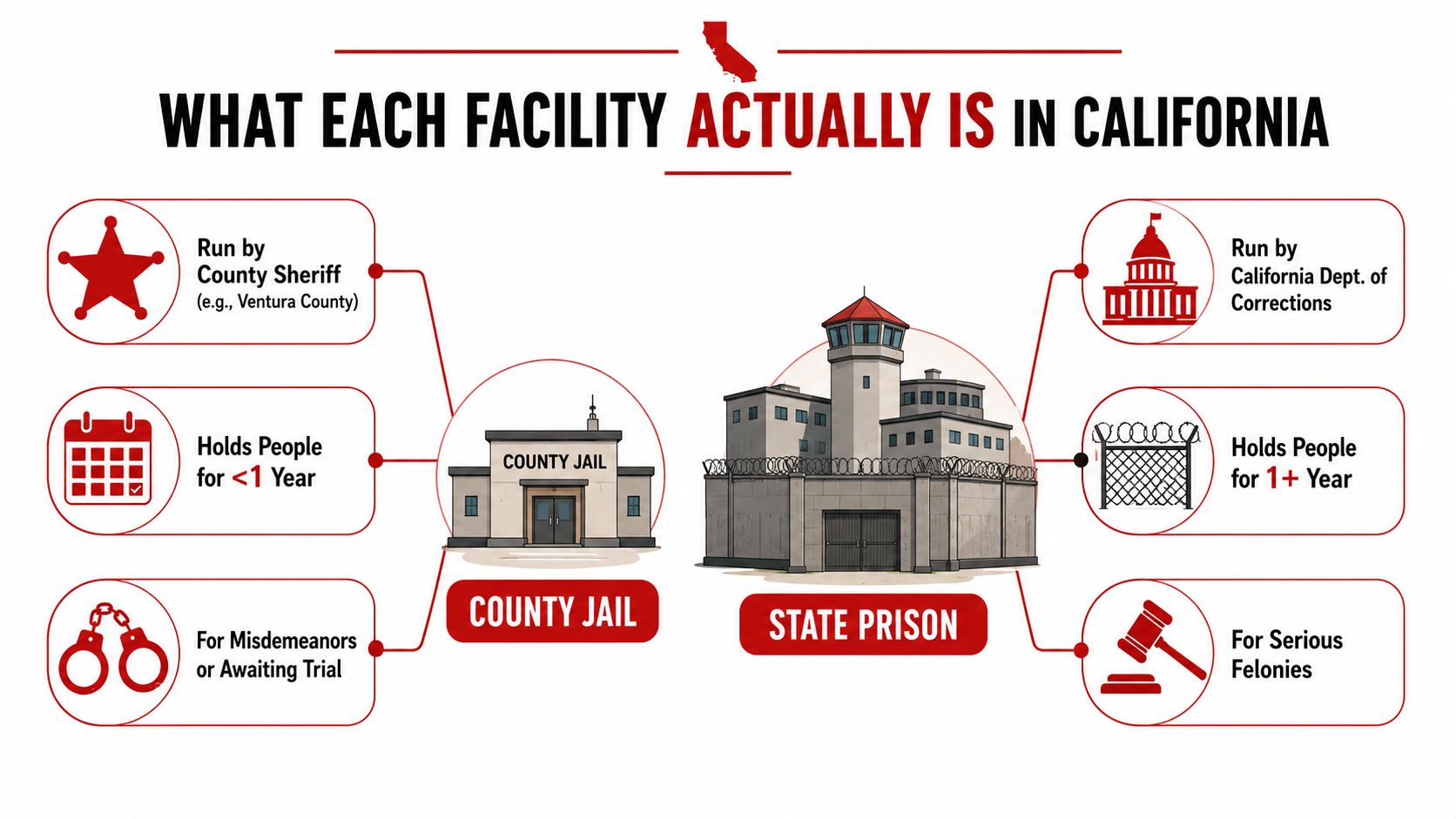
A county jail is a local holding facility. In California, it’s typically run by the county sheriff, and in Ventura County that means the sheriff’s jail system, including the main jail and Todd Road. Jails are where people usually go right after an arrest, while they’re waiting for arraignment, trial, sentencing, or a quick release path.
A state prison is different. It’s run at the state level by the California Department of Corrections and Rehabilitation, and it’s built for people who have already been convicted and are serving longer sentences. That’s the reason families often hear two very different sets of rules, phone systems, and timelines depending on which facility is involved.
California’s own numbers show the scale difference clearly. The Legislative Analyst’s Office reported that in 2024 about 58,300 people were held in county jails, while roughly 92,600 were held in state prison. That’s one reason most families calling after an arrest are dealing with a county jail case, not a prison placement.
County jail in plain English
County jails are local, short-term, and tied to the front end of the criminal process. They hold people who were just arrested, people waiting for court, and people serving shorter sentences. That’s why bail questions almost always start here.
If you need a local booking search after an arrest, use the California inmate search guide to narrow down the facility before you start making calls. It’s a better first move than arguing about the charge over speakerphone.
State prison in plain English
State prison is the long-game facility. It’s where the system sends people after conviction for longer sentences, and the release path is usually tied to sentence completion, parole, or state-level review. Families don’t usually post bail to get someone out of prison, because the person is already on the sentenced side of the system.
That’s the core distinction. County jail is about immediate custody and release. State prison is about long-term confinement after conviction. Once you understand that, the rest of the comparison stops being abstract.
The Real Differences Side by Side
Most people compare jail and prison like they’re two versions of the same building. They’re not. The useful comparison is about stage, status, and urgency, and that matters a lot when a Ventura or Oxnard family is trying to decide what to do next.
| Factor | County Jail | State Prison |
|---|---|---|
| Custody duration | Short-term | Longer-term |
| Legal status | Often pretrial or short sentence | Convicted and sentenced |
| Main purpose | Local detention and court processing | Long-term incarceration |
| Security level | Usually lower and more varied | Typically higher |
| Programs | More limited and inconsistent | More likely to include education and vocational programs |
| Oversight | Often thinner and more uneven | More established state oversight |
| Family priority | Get release moving | Manage sentence, parole, and transfer issues |
The detail families miss most is that jail populations are heavily pretrial. Vera’s 2024 report says the U.S. jail and prison population was about 1.8 million, with state and federal prisons holding roughly 1,252,600 people and local jails holding just over 660,000. Vera also found jail incarceration was down about 10% from 2019, while prison incarceration was down about 13%. That split matters because jail is the front end of the system, while prison is the long-term stage after conviction. Vera Institute report on people in jail and prison in 2024
Jail can be the more fragile place, not the easier one. Short stays, fast turnover, and inconsistent care can make the first day the hardest day.
That’s especially true for families dealing with medication, mental health needs, or release planning. Oversight is different too, and jail oversight can be thinner than prison oversight in some places, which is one reason the “prison is harder” line misses the actual risk. Families need to think about speed, access, and continuity, not just fences and uniforms. A clear look at oversight efforts is available from the Brennan Center’s correctional oversight research.
How Ventura County Jail Intake and Release Actually Work
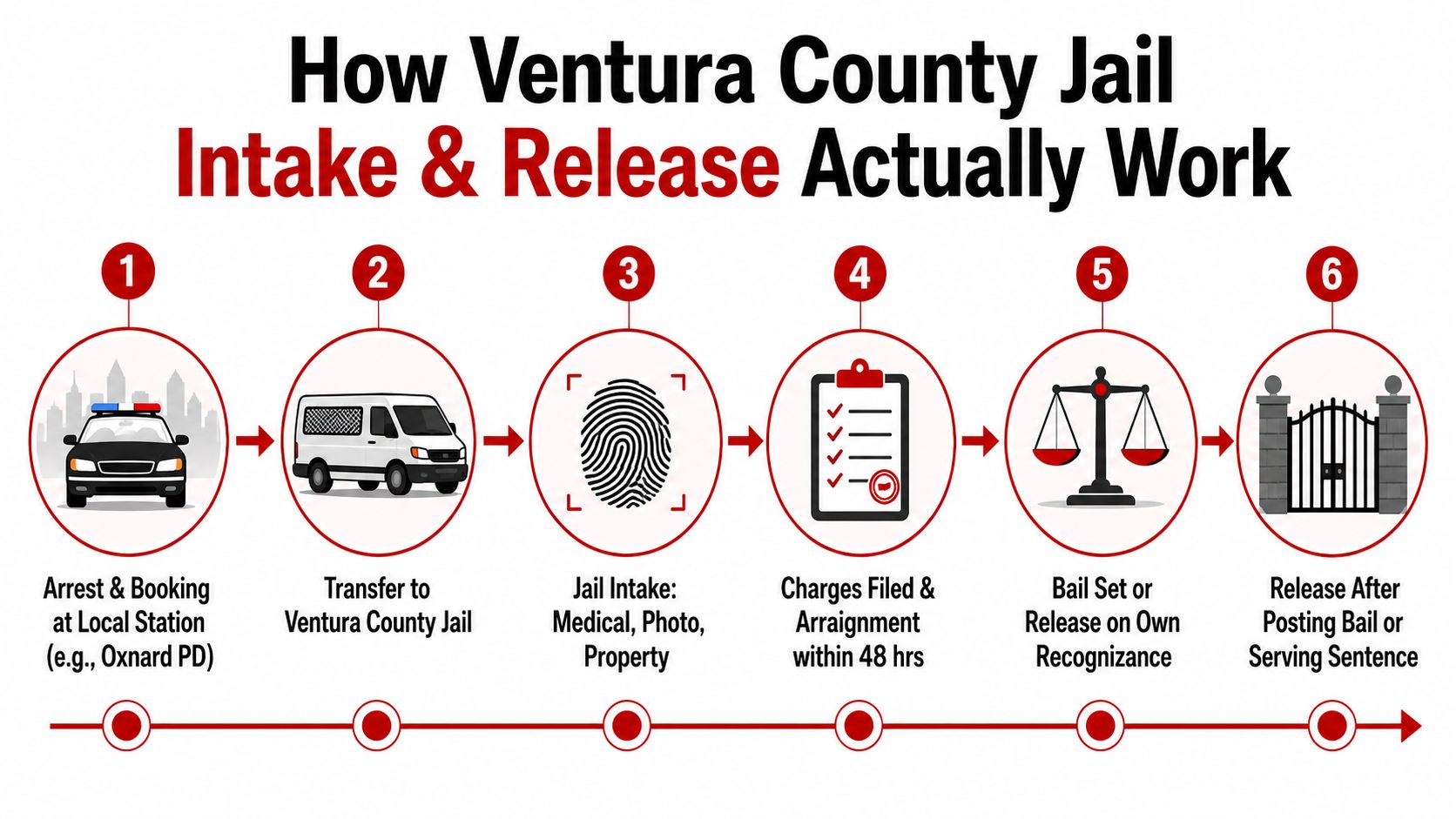
A Ventura County arrest usually starts at a local station, maybe Oxnard, Ventura, or Camarillo. From there, the person goes into booking, and that’s where the file gets built. Families hear a lot of noise during this stage, but the essentials are straightforward.
Booking is the gate
Booking usually means fingerprinting, photos, property inventory, and medical screening. That’s the paperwork and intake side that determines what the jail knows, what the court sees, and whether the person can move toward bail or a later hearing. If the booking is fresh, release won’t happen until the jail finishes that intake work.
The release window is rarely instant. Once a bond is posted, release can take several hours, and it can run longer if there’s a hold, medical clearance issue, or a late-night booking that lands outside normal processing flow.
Families should call with the right questions
Don’t ask general questions and hope the answer fills in the blanks. Ask for the booking number, charges, bail amount, and whether there’s any hold preventing release. If you’re not sure what to ask next, the Ventura County jail release timing guide helps you focus on the right details.
Visitation and phone access are usually where families get tripped up. The inmate’s phone account often works separately from the family’s regular number, and visiting privileges don’t reset just because someone was arrested. A bond usually has to be posted before anyone starts thinking about normal post-release access.
Best move: Have a licensed bondsman working the file while you gather the paperwork. Waiting until the family has “everything ready” usually adds delay, not speed.
How Bail and Bonds Work in California
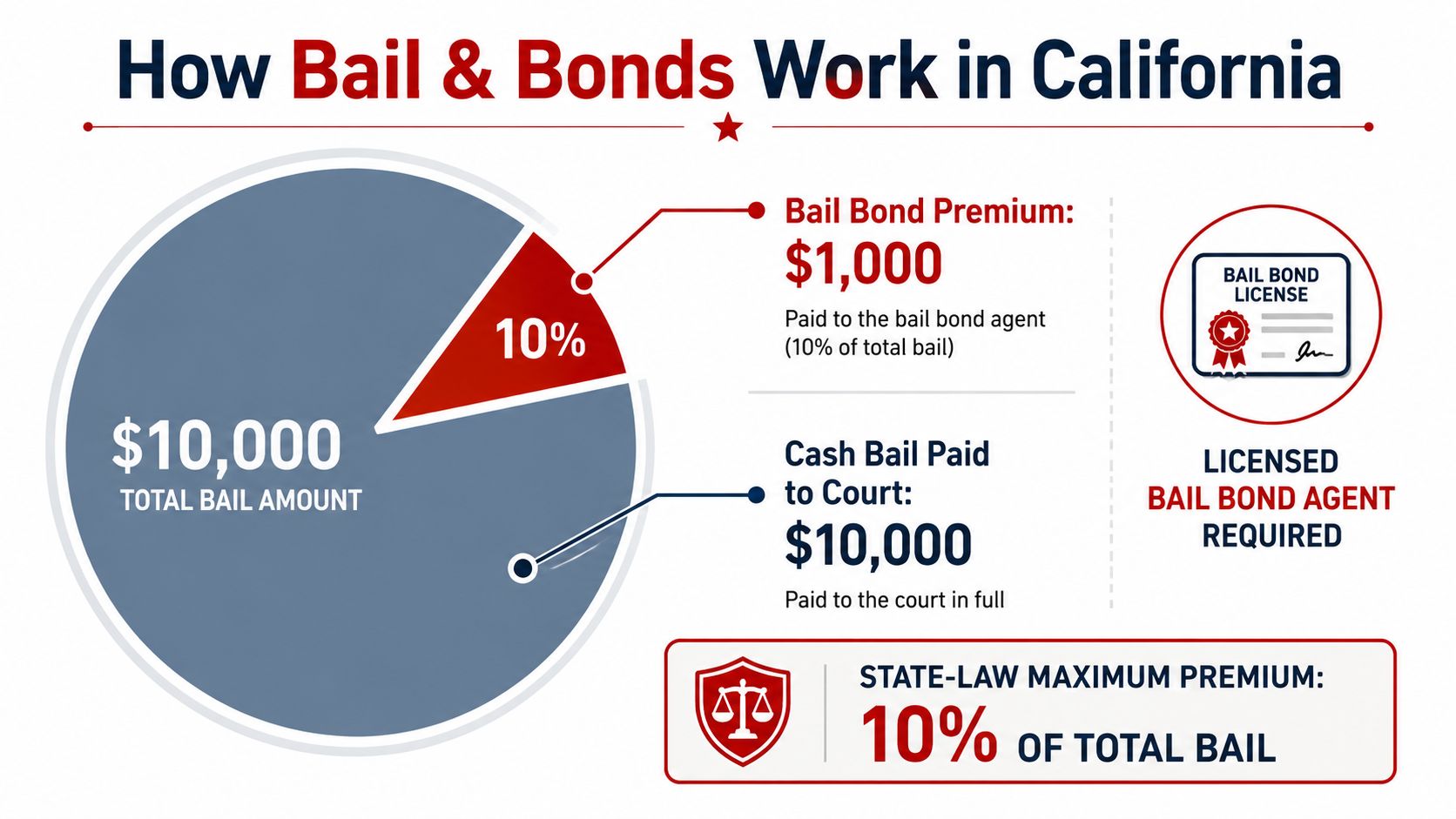
California bail is simpler than you might think, and the part families need most is the price. A licensed bail bond typically costs 10% of the total bail amount, and that premium is set by law. If a court sets bail at $50,000, the bond premium is usually $5,000. That premium is the agent’s fee, and it’s not the same thing as cash bail paid straight to the court.
Cash bail and a bond are not the same move. Cash bail goes directly to the court and is refundable under the court’s rules, while a bond uses a licensed agent and the premium is non-refundable. Families often choose the bond because they can’t tie up the full cash amount, or because they need the speed and coordination that comes with a bondsman handling the file.
What the court controls
The bondsman does not set the bail amount. The court does. In Ventura County, many misdemeanor charges have a preset bail schedule, which can make the process faster. More serious felonies can require a bail review hearing, which slows things down and usually needs more coordination.
That’s why the important call isn’t just, “How much is bail?” It’s also, “Is this a schedulable release or a review case?” If you want the process broken down in a practical way, the California bail bond basics page lays out the mechanics families ask about most.
What the premium means in real life
The premium stays at the lawful 10% rate, but the way a family pays it can vary. Larger bonds may involve payment plans, collateral, or a co-signer. That doesn’t change the premium itself, it changes how a household gets the bond posted without falling apart financially.
Three Real-World Scenarios in Ventura County
The right answer depends on the charge, the hold status, and how fast the jail file can be confirmed. I always tell families to verify the booking details first, because the bond strategy changes once you know whether you’re dealing with a straight release, a review hearing, or a hold that blocks release entirely.
DUI in Ventura
A first-time DUI arrest in Ventura usually stays on the jail side of the system. That means the family’s main job is to confirm the booking, confirm the bail amount, and get the bond moving as soon as the jail file is ready. If there are no priors and no special hold, speed is usually the issue, not facility type.
The takeaway is simple. This is a county jail bail problem, not a prison problem. The faster the paperwork moves, the faster the person gets out.
Domestic violence in Oxnard
A domestic violence arrest in Oxnard brings different conditions into play. Protective orders and no-contact terms can complicate release, and sometimes a bail review hearing becomes part of the process. The family should not assume that posting bond alone solves everything.
The release plan has to match the court’s conditions, or you create a bigger problem on the way out than the one you started with.
The jail vs prison framing breaks down. The issue isn’t what facility sounds harsher, it’s whether release is allowed at all and what rules follow the person home.
Probation violation or warrant
A probation violation changes the entire conversation. Now the family is not just asking about new bail, they’re asking whether there’s a no-bail hold, a transport issue, or a path that leads back into a longer state-level sentence. Sometimes the answer is immediate release with conditions. Sometimes it isn’t.
That scenario shows the limit of the simple comparison. The core question is not “jail or prison?” It’s “What is this hold, and can it be cleared today?”
Why a Local 24-Hour Agency Shortens the Whole Process
A generic call center can tell you what the law says. A local agent can tell you what’s happening at the jail right now. That difference matters at midnight, because the Ventura County Jail doesn’t wait for business hours, and neither does the family on the other end of the phone.
A local, 24-hour agency knows the intake rhythm, the common paperwork snags, and the release flow that follows a posted bond. Agents can verify booking details fast, coordinate directly with the jail, and keep the family updated from first call to pickup. That’s why a local file moves smoother than a slow, out-of-area handoff.
For larger or riskier bonds, the payment structure matters too. A family might use a co-signer, collateral, or a payment plan, depending on the case. The premium still sits at the lawful 10% level, but the route to posting it can be the difference between a release tonight and an overnight stay that should’ve been avoidable.
Bada Bing Bail Bonds handles that coordination for local families and also keeps the conversation plain. DUI, domestic violence, drug cases, theft, warrants, probation violations, and white-collar charges all need the same thing at the start, a real person who answers, verifies the file, and keeps things moving without judgment.
Your Next Steps After an Arrest in Ventura County
The moment you hang up with the jail, write down the full legal name, date of birth, booking facility, charges, and bail amount. Then contact a local Ventura County bail bond agent and confirm what paperwork they need to start the release. If you need a step-by-step follow-up after the arrest, the Ventura County arrest aftercare guide is the place to start.
Keep the court date in the phone, answer agent check-ins, and stay on top of conditions after release. That’s how you protect the bond, avoid new problems, and keep collateral moving toward return when the case is over.
If your arrest is local, make one call now to Bada Bing Bail Bonds. A licensed Ventura County bail bondsman can verify the booking, explain the bond amount, and start the release process 24/7 before the night gets longer.