The phone rings late, and the details come in fast. Someone in Oxnard has been booked, the booking number is half-copied from a voicemail, and the family wants one thing right now, a path that gets the person out without wasting money or getting turned away at the window. In that moment, how to pay for bail is less about theory and more about knowing which payment method fits the jail, the amount, and the clock.
What works in Ventura County is rarely the same as what sounds easiest on paper. A cash payment can move quickly if the facility accepts it in the exact form it wants, while a bail bond can preserve cash by replacing the full amount with a nonrefundable premium, usually 10% to 15% of bail in the United States, with collateral sometimes required for larger bonds. The Bureau of Justice Statistics explains that cash bail requires posting the full amount and that surety bonds can require collateral, and that difference is what families feel most in the first hour after an arrest.
Table of Contents
- Understanding How Bail Works in Ventura County
- Paying Bail Immediately at the Jail
- Using a Bail Bondsman in Ventura County
- Exploring Payment Plans and Funding Sources
- Navigating Local Jail and Bondsman Procedures
- FAQs Fast Release Checklist
Understanding How Bail Works in Ventura County
A Ventura County family usually hits the same wall at the same time. The arrest has already happened, the charge may still be unclear, and everyone wants to know whether the person can come home tonight or has to stay in custody until the next business day. Bail exists to secure a future court appearance, and California courts commonly look at the charge, prior record, seriousness of the offense, and flight risk when setting the amount, which is why a DUI, domestic violence case, warrant pickup, or probation violation can land in very different ranges. A California bail overview also notes that a defendant can generally post bail by cash, bail bond, or property bond, and that the typical bail-bond premium is 10% of the total bail amount.
The core question is usually simple. What can be paid right now? A full cash bond means posting 100% of the bail with the court, while a commercial bail bond usually costs 10% to 15% of the total bail as a nonrefundable fee. Bureau of Justice Statistics guidance also notes that surety companies may require collateral, which is why a bond can solve a timing problem even when a family cannot tie up the full amount in cash. That same BJS resource notes that surety companies may also require collateral
For Ventura County families, that difference matters the moment the jail starts processing paperwork. If the court has set a number tied to the charge and the person is held at or near Ventura County Jail, a direct payment may be the fastest route. Many households still choose a bond because rent, gas, childcare, and work are all pulling on the same paycheck, and a large cash payment can drain the money needed to keep daily life moving. A California bail schedule overview helps explain why the number shown at booking is usually tied to the charge and not picked at random.
Practical rule: use the payment method the jail will accept immediately, not the one that looks cheapest after the fact.
Paying Bail Immediately at the Jail
A family member walks up to the jail window with cash in hand, but the booking clerk still sends them back because one name is missing or the amount is off by a few dollars. That kind of delay is common when people assume any payment will work. In Ventura County, speed starts with the facility rules, because cash bail usually has to match the exact bail amount, and the jail decides what form of payment it will take. King County requires the detainee’s name, booking number, sender name, and address on the payment, while New York City requires the total to match the bail figure exactly and accepts cash, cashier’s or teller’s checks, money orders, and sometimes debit or credit card.
The safest sequence at the window
Start with the booking details before you leave home. If the jail wants a booking number, the detainee’s name, or a specific payee line, write it exactly the way the facility requires it. A missing identifier can stop the transaction even when the money is ready, and that is the sort of mistake that wastes the first opening to get someone out.
Then match the payment method to the jail’s rules. Some facilities take cash, cashier’s checks, or money orders, while others limit card use or do not allow it at all. The important part is not what feels easiest to the family, it is what the holding facility will process right then. That same source also notes that people are usually released fastest when bail is paid at the facility where they’re being held.
| Comparison of Jail Payment Methods | Accepted Forms | Processing Time |
|---|---|---|
| Cash | Exact bail amount in facility-approved form | Fastest when the jail accepts it immediately |
| Cashier’s check | Usually accepted with required identifiers | Fast when paperwork matches the jail’s rules |
| Money order | Often accepted, depending on the facility | Moderate, if the jail can verify it quickly |
| Card payment | Only at facilities that allow it | Fast when available, but not universal |
For Ventura County readers searching Ventura County Jail bail bonds, the practical step is to confirm the jail, confirm the exact amount, and bring every identifier the booking desk wants before you drive over. Local release timing can depend on the processing window at the holding facility, so a correct payment can still sit until the jail clears the paperwork.
Using a Bail Bondsman in Ventura County
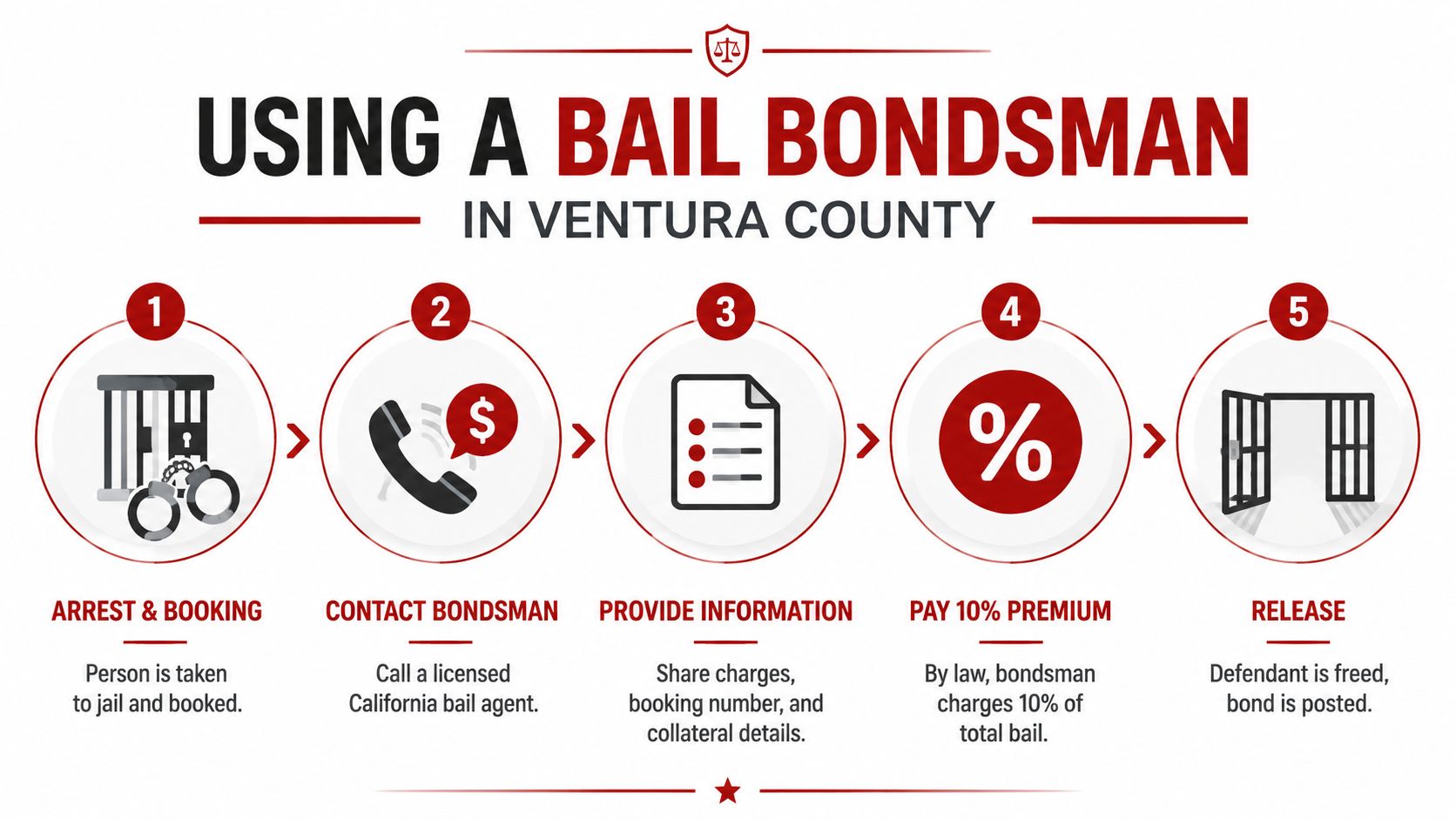
A bail bond is a financing tool, not a discount on bail. The standard market benchmark in the U.S. is a non-refundable premium of about 10% of the total bail, and collateral can be required for larger or higher-risk bonds. The usual workflow is to contact a licensed bail agent, provide the defendant’s identity and charge details, pay the premium, complete contract and collateral paperwork if needed, and let the agent post the full bond with the court.
The tradeoff is straightforward. Cash bail ties up 100% of the amount with the court, while a bond usually keeps more cash in the family’s hands up front, but the premium is generally not returned. That liquidity matters when a household is already covering rent, car payments, and missed work at the same time.
What the agent needs and what can slow things down
The paperwork has to be clean. Missing booking data, incomplete charge details, or a missing co-signer document can delay the file before the bond is even posted. Collateral can also become part of the conversation for higher-risk cases, and that can include vehicles or other property when the bond amount or risk profile makes it necessary.
A bond doesn’t end the jail process. It only removes the financial obstacle so the facility can finish processing release.
For families comparing Ventura bail bonds, bail bonds Oxnard, or fast bail bonds Ventura, local knowledge matters because Ventura County, Santa Barbara, and nearby courts don’t all move the same way. A bondsman cannot force release, but a clean file, correct charge info, and the right collateral paperwork can keep avoidable delays off the clock. If you want a plain-English explanation of the role itself, see the bail bond agent overview.
One practical option in this lane is Bada Bing Bail Bonds, which handles bond posting, payment-plan conversations, and jail coordination in Ventura County and surrounding areas. Used correctly, that kind of help keeps the family focused on release logistics instead of wrestling with forms while the jail clock keeps running.
Exploring Payment Plans and Funding Sources
Not every family has cash, a card with enough room, or a relative ready to cover the full amount. That’s where payment plans and outside funding become part of the answer, especially for people who are learning the system in a crisis and don’t have time to sort through vague advice. Nolo notes that some jurisdictions allow online or card-based payment, Alaska requires full payment online rather than partial payment, and nonprofit bail funds or revolving community bail pools can post bail without charging a fee.
Matching the money source to the timeline
Payment plans through a bail agent can help when the household can manage installments but can’t cover the full premium at once. That can be useful in a domestic violence case, a DUI arrest, or a warrant matter where the family wants release now and can handle the cost over time, but the tradeoff is still real, because the bond process, fee terms, and any co-signer obligations need to be understood before anyone signs.
Short-term loans and family contributions work differently. A loan can solve the immediate timing problem if credit is available, while family pooling spreads the burden across several people who each cover part of the amount. Crowdfunding can help in some cases, but it’s never guaranteed, and it depends on speed, trust, and whether the community reacts quickly enough.
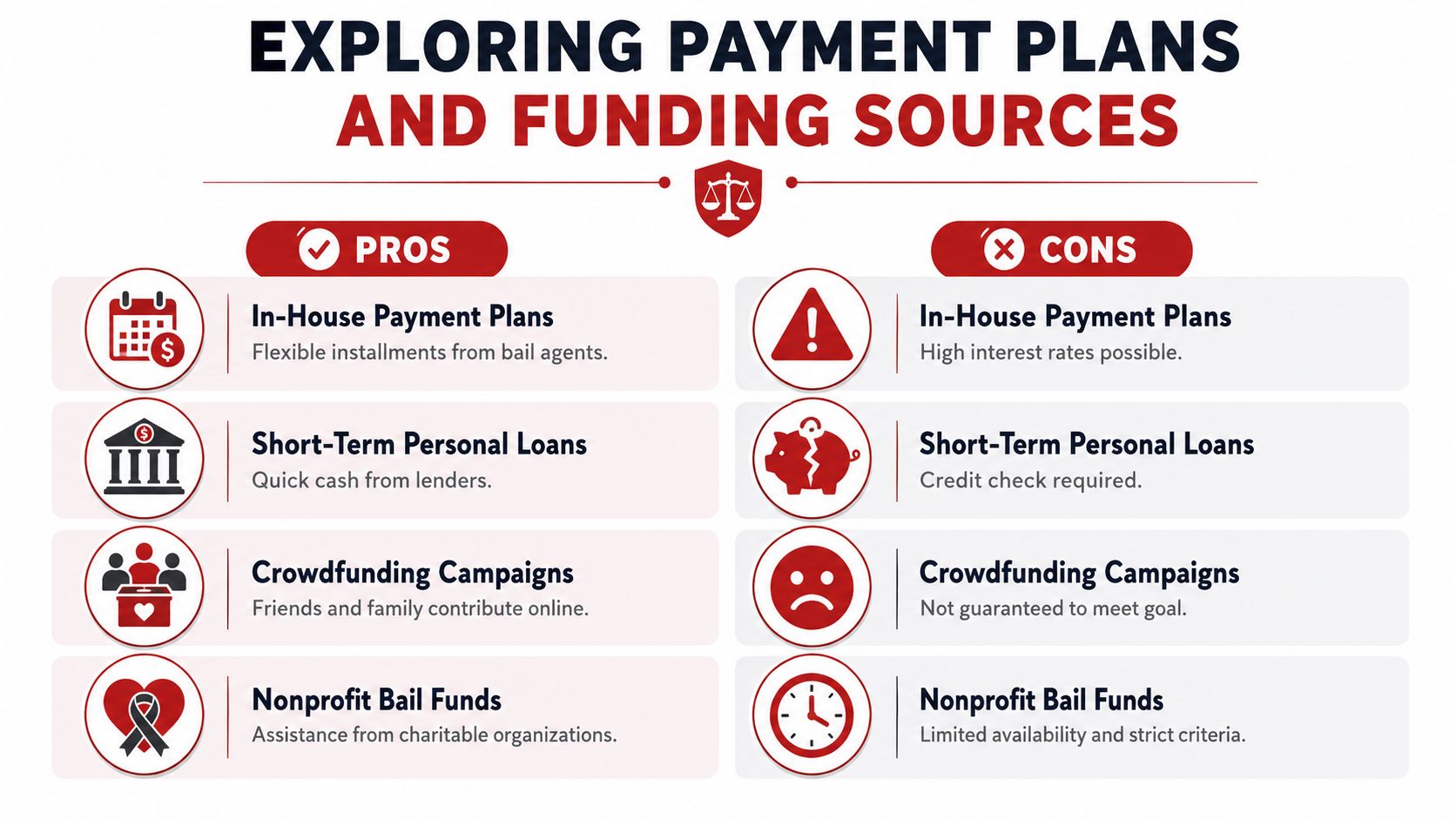
A useful way to think about these options is by risk, not just by price.
- In-house payment plans: can preserve cash today, but the repayment terms still need to be clear before signing.
- Short-term personal loans: may bring fast funds, but the credit check can be a barrier.
- Crowdfunding: can raise money from friends and relatives, but the outcome isn’t predictable.
- Nonprofit bail funds: can be valuable for low-income cases, but availability and criteria are limited.
For Ventura County families comparing how to pay for bail with no cash up front, these alternatives can bridge the gap between arrest and release. They’re not all equal, and they don’t all fit the same urgency, but they do widen the set of options beyond “pay the full amount today or stay in custody.” The bail bond payment options page is useful when you want to compare structured payment ideas against a direct bond.
Navigating Local Jail and Bondsman Procedures
At Ventura County Jail and nearby facilities, process matters as much as money. A family can have the right amount ready and still lose time if they call the wrong place, miss a booking detail, or show up before the facility accepts that form of payment. In practice, the smoothest releases usually come from families who verify the holding location first, then coordinate with a bondsman or jail clerk using the exact booking information.
What local coordination looks like on a busy night
If the arrest happened in Ventura, Oxnard, Camarillo, or Port Hueneme, the first call should confirm the holding facility and the booking number. Once that’s confirmed, a local agent can prepare the bond file while the family gathers whatever the jail requires for direct payment or release pickup. That kind of coordination is why 24-hour bail bonds Ventura searches matter after hours, the facility may be open, but the family still needs someone on the phone who knows what the jail wants.
The release clock also depends on where the payment is made. Ventura County rules can differ from other counties, but the practical lesson is the same. Pay at the correct facility, bring the right documents, and use the method the jail will accept. That usually saves more time than a rushed guess.
Useful habit: keep the detainee’s full name, booking number, charge information, and a callback number in one note before you make any payment call.
A common mistake is waiting for perfect information before acting. Get the booking details, confirm the jail’s payment method, and let the bondsman or payment contact tell you what can move now versus what needs more processing time. For local readers comparing Ventura with Santa Barbara or searching fast bail bonds Santa Barbara, that habit can cut down on avoidable back-and-forth and make pickup easier once the jail clears release. For families who want a quick refresher on the same release questions that come up under pressure, the Ventura bail bonds FAQ page is a useful reference point.
FAQs Fast Release Checklist
Families usually ask the same four questions under pressure. What ID do I bring, how do I confirm the bail amount, when does collateral come back, and what if the court won’t allow the release I expected. The answer to the first two is simple, bring the exact booking details and make sure the payment matches the facility’s rules, because the jail can reject a payment that doesn’t line up with the paperwork. For a broader list of common release questions, the Ventura bail bonds FAQ page is a useful reference point.
Collateral comes back only if the case moves forward without forfeiture, while the premium on a bail bond is generally not returned. That’s the hidden risk most families don’t think through in the first hour, because they’re focused on release, not the end-of-case accounting. If bail is denied or the court requires a different release condition, the next step is to ask what the facility and court will accept instead of assuming the same payment path still applies.
Use this checklist before you leave the house:
- Verify the booking number: the jail can’t process a vague name alone.
- Confirm the exact amount: payment has to match the facility’s number.
- Match the payment form: cash, cashier’s check, money order, or bond paperwork only if the facility accepts it.
- Keep contact info ready: the jail, the bondsman, and the pickup person should all have one current phone number.
- Plan for post-release compliance: court dates matter, because missing them can create a new problem even after release.
The fastest result usually comes from calm order, not from calling every option at once. Confirm the jail, choose the payment method that fits the rules, and keep the paperwork tight from the first call to pickup. If you need direct help right now, contact Bada Bing Bail Bonds for plain-English guidance, local Ventura County coordination, and a fast response when every minute counts.