
When a defendant misses a required court date without a valid excuse, the judge declares bail forfeited in open court on the spot. That declaration, governed by California Penal Code §1305, starts a strict statutory clock that can end in a money judgment against the surety, the cosigner, or both. The window to act is narrow, and the first 72 hours matter more than most people realize.
The single most urgent step after a bail forfeiture in California: call the bail agent or surety immediately. Every hour of delay shrinks the recovery window and limits the legal options available under Penal Code §1305.
Immediate actions to take within the first 24–72 hours:
- Contact the bail agent or surety and report the missed court date.
- Verify whether the court clerk has mailed the statutory forfeiture notice (required within 30 days for bonds over $400).
- Consider voluntary surrender of the defendant or coordinate with the bail agent to locate them.
- Consult a criminal defense attorney about filing a motion to vacate the forfeiture before the 180-day period expires.
For a fuller breakdown of what bail forfeiture means under California law, the sections below walk through every statutory deadline, who pays, and how to fight back.
Key Takeaways
California bail forfeiture is governed by Penal Code §1305, which gives sureties and depositors a 180-day window to reverse the forfeiture before a money judgment is entered, but only if the clerk mailed the required notice within 30 days of the declaration.
| Point | Details |
|---|---|
| Controlling statute | Penal Code §1305 requires an open-court declaration and starts the 180-day recovery clock immediately. |
| 30-day mailing rule | For bonds over $400, the clerk must mail forfeiture notice within 30 days; failure to do so is grounds to vacate. |
| 180-day recovery window | Sureties and depositors have 180 days (plus 5 for mailing) to return the defendant or file a motion to vacate. |
| Who bears financial liability | The surety faces the full bond judgment; the cosigner/indemnitor is contractually liable for reimbursement under the indemnity agreement. |
| Badabingbail | Serves Ventura, Santa Barbara, and Orange Counties 24/7 with forfeiture response, surrender coordination, and flexible bond financing. |
Table of Contents
- What does California bail forfeiture law actually require?
- How the forfeiture timeline unfolds step by step
- Who is financially liable after a forfeiture, and what are the consequences?
- How to file a motion to vacate a forfeiture
- Practical steps to avoid forfeiture or limit the damage
- What happens to forfeited cash or property?
- How a licensed bail bond agency responds to forfeiture
- Common misconceptions about bail forfeiture
- A licensed bail agent’s perspective on what actually matters
- Facing a forfeiture? Here is how Badabingbail can help right now
- Sources
What does California bail forfeiture law actually require?
The controlling statute is Penal Code §1305, and its requirements are specific enough that missing a single procedural step can void an entire forfeiture. Here is what the code actually says and what it means in practice.
The open-court declaration
§1305 requires the court to declare bail forfeited in open court the moment a defendant fails to appear without sufficient excuse. The declaration is not discretionary. Once the judge makes it, a bench warrant issues automatically and the forfeiture clock starts running.
The 30-day mailing rule and the 180-day window
For any bond or cash deposit exceeding $400, the court clerk must mail written notice of the forfeiture to the surety or depositor within 30 days of the declaration. That mailing extends the 180-day recovery period by five additional days to account for delivery time. The 180-day window is the period during which the surety may return the defendant to custody, file a motion to vacate, or otherwise seek relief before the court enters summary judgment.
Failure to mail the required notice is not a technicality. In County of Los Angeles v. Financial Casualty & Surety, Inc. (2016), the California Court of Appeal reversed a summary judgment because the trial court never mailed the statutorily required notice, holding that the omission stripped the court of jurisdiction over the bond entirely.
Related code provisions
Several other statutes work alongside §1305 in practice:
- Penal Code §§1299–1317 govern the broader bail procedure framework, including how bail is set, posted, and exonerated.
- California Insurance Code §§1800–1823 regulate the licensing and conduct of bail agents and sureties, including their obligations when a bond is forfeited.
- AB 1082 (2015–2016 legislative session) created a specific motion-to-extend-time procedure that allows courts to extend the statutory recovery period on a showing of good cause, capped at an additional 180 days from the court’s order. AB 1082 did not change the core §1305 framework; it added a procedural tool for situations where recovery is underway but cannot be completed within the original window.
Understanding the surety bond obligations that attach at the moment of forfeiture helps cosigners and indemnitors grasp exactly what they have agreed to.
How the forfeiture timeline unfolds step by step
The procedural sequence after a forfeiture is declared is linear and unforgiving. Miss one deadline and the next step becomes unavailable.
-
Open-court forfeiture declaration. The judge announces the forfeiture in open court. A bench warrant for the defendant issues simultaneously. This is Day 0 of the statutory clock.
-
Clerk mails notice within 30 days. For bonds over $400, the clerk must mail written notice of the forfeiture to the surety and, if applicable, the depositor. The certificate of mailing becomes critical evidence later. If the clerk fails to mail within 30 days, the forfeiture may be voidable.
-
180-day recovery period begins. The surety has 180 days from the date of forfeiture (plus five days when mailing is required) to return the defendant to custody, file a motion to vacate, or otherwise seek exoneration. This is the working window that bail agents treat as their operational deadline.
-
Motion to vacate or extend. At any point within the 180-day window, the surety or depositor may file a motion to vacate the forfeiture based on statutory grounds (see Section 5 below). Under AB 1082, the court may also grant a motion to extend the period, not to exceed an additional 180 days from the court’s order, on a showing of good cause.
-
Summary judgment if no relief is granted. If the 180-day period expires without the forfeiture being vacated or the defendant returned, the court may enter summary judgment against the surety for the full bond amount plus costs. There is a 90-day rule embedded in the statute: if the court does not enter summary judgment within 90 days after the 180-day period ends, the bond is exonerated by operation of law. Sureties and their attorneys watch this deadline carefully.
-
Collection and enforcement. Once summary judgment is entered, it is enforceable as a civil money judgment. The county may pursue collection through standard civil enforcement mechanisms.
Who is financially liable after a forfeiture, and what are the consequences?
Liability after bail forfeiture in California depends on how bail was posted. The paths diverge sharply.
Cash bail posted by the defendant or a third party: The cash sits with the court. If forfeiture stands, the clerk transfers the funds to the county treasurer after the 180-day period. The depositor loses the full amount with no recourse unless the forfeiture is vacated.
Surety bond posted through a bail agent: The surety (the insurance company behind the bail agent) is on the hook for the full bond amount if summary judgment is entered. The bail agent, as the surety’s representative, has contractual and statutory obligations to pursue recovery. The cosigner’s responsibilities under the indemnity agreement become the surety’s primary recovery mechanism once a judgment is entered.
Property bond: The property owner who posted the bond faces a lien and potential forced sale if the forfeiture is not reversed.
What the indemnitor actually faces
The indemnitor (the cosigner who signed the bail bond agreement) is contractually obligated to reimburse the surety for any loss. That means:
- The surety can pursue the indemnitor for the full bond amount after a judgment.
- Collateral pledged at signing (a car title, a deed of trust) can be seized and liquidated.
- The surety can file a civil lawsuit against the indemnitor for the judgment amount plus costs.
- Unpaid judgments can appear on credit reports and affect the indemnitor’s borrowing ability.
That fee is earned the moment the bond is posted and is non-refundable regardless of outcome. If a $50,000 bond is forfeited and summary judgment is entered, the indemnitor owes $50,000 to the surety, not $45,000.
Pro Tip: If you are a cosigner and forfeiture has just been declared, pull out your indemnity agreement and read the collateral and default provisions tonight. The surety’s rights to your pledged assets are spelled out there, and knowing them early gives you more options.
Beyond the financial exposure, the defendant faces an active bench warrant. Any contact with law enforcement, including a routine traffic stop, will result in arrest. The consequences of a failure to appear extend well beyond the bail bond itself: the underlying criminal case continues, and a new charge of failure to appear under Penal Code §1320 may be added.
How to file a motion to vacate a forfeiture
A motion to vacate is the primary legal remedy for reversing a California bail forfeiture. It is not a long shot, but it requires specific grounds, proper service, and timely filing.
Who can file and when
The surety insurer, the bail agent acting on the surety’s behalf, or the depositor (for cash bail) may file the motion. It must be filed within the 180-day recovery period. Under AB 1082, a separate motion to extend the time period may be filed before the 180 days expire, but the court will grant it only on a showing of good cause. Extensions are not automatic.
Step-by-step filing process
- Obtain the forfeiture record. Get a certified copy of the minute order declaring forfeiture and the clerk’s certificate of mailing (or confirm it was never sent).
- Identify the legal ground. Match the facts to one of the statutory grounds for vacatur listed in §1305 (see below).
- Gather supporting evidence. Assemble every document that proves the ground.
- Draft and file the motion. File in the court that declared the forfeiture, with proper notice to the prosecuting agency (district attorney or city attorney). Service on the prosecuting agency is mandatory.
- Attend the hearing. Present evidence and argument. The court may vacate, reinstate the bond on terms, or order a partial monetary assessment to cover return costs.
- If denied, consider appeal. Appellate courts have reversed trial court rulings where the clerk failed to mail required notice, as the County of Los Angeles v. Financial Casualty & Surety decision illustrates.
Documents and evidence that strengthen a motion
- Medical records showing the defendant was hospitalized or physically unable to appear.
- Jail or booking logs confirming the defendant was in custody in another jurisdiction on the court date.
- Written communications from the prosecuting agency refusing extradition.
- The clerk’s certificate of mailing (or its absence, which is itself grounds for vacatur).
- Travel records, immigration detention documentation, or other proof of an involuntary absence.
Statutory grounds for vacatur
§1305 lists specific circumstances under which a court shall vacate a forfeiture:
- The defendant voluntarily appears in court within the 180-day period.
- The defendant is surrendered to custody by the surety within the 180-day period.
- The defendant is returned to custody by law enforcement and the prosecuting agency is notified.
- The defendant’s failure to appear was caused by a circumstance beyond their control (documented illness, involuntary detention, etc.).
- The clerk failed to mail the required notice within 30 days, depriving the surety of the statutory recovery period.
The last ground is the one most often overlooked. Clerical compliance is not guaranteed, and checking the certificate of mailing early can open a procedural door that costs nothing to try.
Practical steps to avoid forfeiture or limit the damage
The timeline below is organized by urgency. Each phase has a different set of priorities.
Within 24–72 hours of the missed court date
- Call the bail agent immediately. The agent needs to know before the court does, if possible, or within hours of the declaration.
- Check the court calendar. Confirm the exact date and department of the missed hearing and whether a bench warrant has been issued.
- Assess whether voluntary surrender is feasible. If the defendant is reachable, voluntary surrender before the forfeiture is formally declared can prevent the clock from starting at all.
- Do not ignore the bench warrant. An active warrant compounds every problem. The defendant should not drive, travel, or have any contact with law enforcement until it is addressed.
Pro Tip: Voluntary surrender to the bail agent, rather than waiting for law enforcement to make an arrest, often gives the surety the best chance of getting the forfeiture vacated quickly and with lower costs. Coordinate with the agent before the defendant walks into any police station.
Within 30 days
- Request a copy of the clerk’s certificate of mailing. If the bond exceeds $400 and no notice was mailed within 30 days, document that fact immediately.
- Assemble any documentary proof of a legitimate excuse: medical records, travel documents, or detention records.
- Consult a criminal defense attorney about whether the facts support a motion to vacate.
- If recovery will take longer than 180 days, begin preparing a motion to extend under AB 1082 now, not later.
Within 180 days
- Coordinate the defendant’s surrender if they have not yet appeared voluntarily.
- Monitor the court docket for any summary judgment filings. The surety’s attorney should be tracking this.
- If a motion to vacate is filed and denied, evaluate whether the 90-day post-period window for summary judgment creates an exoneration opportunity.
- Preserve all records: every phone call log, every email, every document exchanged with the court or prosecutor.
What happens to forfeited cash or property?
The outcome depends entirely on whether the forfeiture is ultimately vacated or allowed to stand.
Exoneration vs. forfeiture: the practical difference
Exoneration means the court removes the bond obligation. The surety is released from liability, and any cash deposited with the court is returned to the depositor. Exoneration can happen because the defendant appeared, was surrendered, or because a motion to vacate succeeded. The bail exoneration process and what it means for refunds is worth understanding before assuming money is gone permanently.
Forfeiture means the obligation stands. For cash bail, the clerk transfers the funds to the county treasurer after the 180-day period expires without relief. For surety bonds, the court enters summary judgment for the bond amount.
| Outcome | Trigger event | Who bears the loss | Timeline | Typical remedy |
|---|---|---|---|---|
| Exoneration | Defendant appears, is surrendered, or motion succeeds | No financial loss to surety or depositor | Within 180-day window | Bond obligation removed; cash returned |
| Forfeiture stands | 180-day period expires without relief | Surety (bond) or depositor (cash) | After 180 days | Summary judgment; county receives funds |
Post-forfeiture collection mechanics
Once summary judgment is entered, the county can pursue collection through standard civil enforcement: wage garnishment, bank levies, and liens on real property. The statute also allows the court to impose costs for returning the defendant to custody, which are added to the judgment amount. Administrative costs are not capped at a flat figure; they reflect actual expenses documented by the prosecuting agency.
- The surety typically pursues the indemnitor for reimbursement through the indemnity agreement.
- Collateral pledged at the time of signing is the surety’s first recovery target.
- If collateral is insufficient, the surety may file a civil lawsuit for the deficiency.
How a licensed bail bond agency responds to forfeiture
From an operational standpoint, the 180-day window is the entire game. Agents who have worked California courts for years treat the forfeiture declaration as the starting gun, not a reason to panic.
What agents typically do immediately after forfeiture
- Contact the defendant by every available means: phone, text, email, and through family members listed on the bond application.
- Review the bond paperwork for the defendant’s last known address, employer, and emergency contacts.
- Coordinate with the indemnitor to gather any information about the defendant’s whereabouts.
- Engage licensed fugitive recovery agents (bail enforcement agents) where the facts warrant it and state law permits.
- File or prepare a motion to vacate if there is a documentable legal ground.
How agents decide whether to pursue recovery or pay the judgment
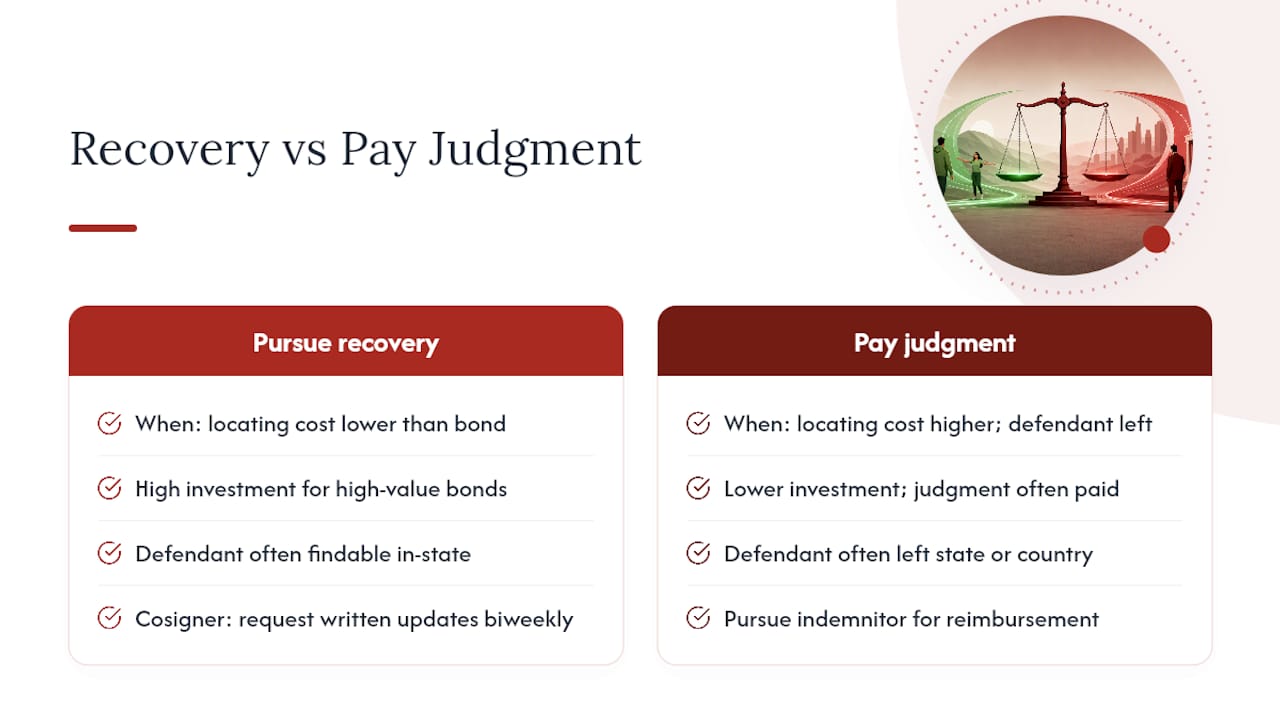
The calculus is straightforward: if the cost of locating and surrendering the defendant is lower than the bond amount, recovery is worth pursuing. For high-value bonds, agents will invest significantly in recovery efforts. For lower-value bonds where the defendant has left the state or country, paying the judgment and pursuing the indemnitor for reimbursement may be the more practical path.
Pro Tip: If you are a cosigner and the bail agent tells you they are “working on recovery,” ask for a written update every two weeks. Agents managing large caseloads sometimes let lower-value bonds drift toward summary judgment without telling the indemnitor. Staying in contact protects your interests.
County-specific procedures matter here. The Los Angeles County felony bail schedule and the Orange County Superior Court bail schedule both affect how agents calculate bond exposure and prioritize recovery efforts. Local knowledge of clerk practices, court calendars, and prosecuting agency preferences is a genuine operational advantage.
Badabingbail serves Ventura, Santa Barbara, and Orange Counties, and the team’s familiarity with local court procedures, clerk offices, and county-specific timelines directly affects how quickly a forfeiture response can be organized. Disclosure: this article is published by Bada Bing Bail Bonds, a licensed California bail bond agency.
Common misconceptions about bail forfeiture
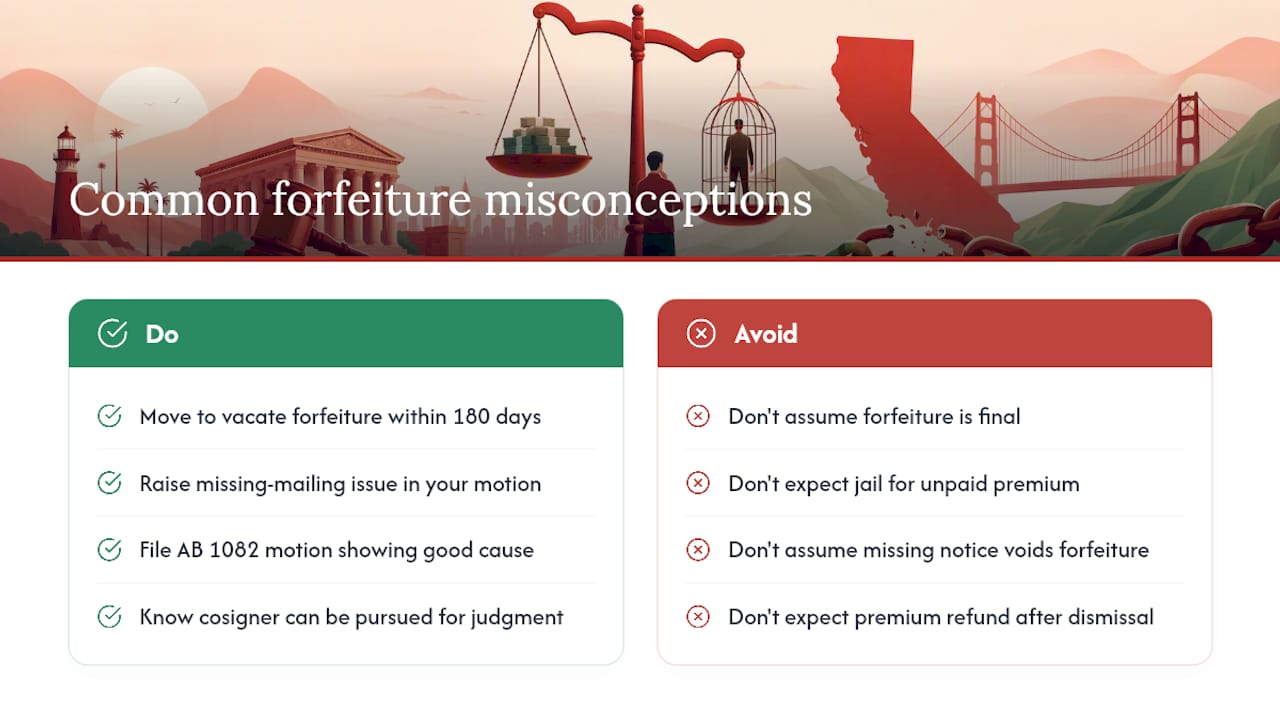
“Forfeiture is final — there’s nothing I can do.”
False. Penal Code §1305 provides multiple statutory grounds for vacating a forfeiture within the 180-day window. Courts vacate forfeitures regularly when the defendant is returned to custody or when the clerk failed to mail required notice.
“I’ll go to jail if I can’t pay the bail bond premium.”
The premium (the fee paid to the bail agent) is a separate transaction from the bond obligation. Non-payment of the premium is a civil debt matter, not a criminal one. What can result in a judgment is the full bond amount after summary judgment, which is a civil money judgment, not a criminal penalty.
“If the clerk didn’t mail notice, the forfeiture is automatically void.”
Not automatically, but it is a strong ground for vacatur. The surety must file a motion and raise the issue. The court will not void the forfeiture on its own. The County of Los Angeles v. Financial Casualty & Surety decision shows that courts take the mailing requirement seriously, but the surety has to raise it.
“The bail bond premium is refundable if the case is dismissed or the defendant is acquitted.”
No. The premium is earned at the moment the bond is posted and is non-refundable under California law, regardless of the case outcome. This is a common source of confusion for families navigating the system for the first time.
“Forfeiture only affects the bail agent, not me as a cosigner.”
The indemnity agreement you signed gives the surety the right to pursue you for the full bond amount after a judgment. Your pledged collateral is at risk. Forfeiture affects the cosigner directly and materially.
“AB 1082 automatically extends the 180-day period.”
AB 1082 created a motion procedure, not an automatic extension. The court must grant the motion, and it will do so only on a showing of good cause. Filing the motion does not pause the clock while the court decides.
A licensed bail agent’s perspective on what actually matters
The families and cosigners who come out of a forfeiture situation with the least damage share one trait: they called their bail agent within hours, not days. The statute gives you tools, but those tools have hard expiration dates. A motion to vacate filed on day 181 is worthless. A certificate of mailing that was never sent is a powerful defense, but only if someone checks for it before the 180-day window closes.
What gets overlooked most often is the clerk’s mailing obligation. Agents and attorneys who know California bail law check the certificate of mailing as a first step, not an afterthought. Courts are not perfect, and clerks miss the 30-day deadline more often than the public realizes. That single procedural failure can void an entire forfeiture, as the appellate record shows.
Badabingbail operates in Ventura, Santa Barbara, and Orange Counties, where the team has navigated these exact procedures across dozens of county courthouses. The local knowledge of which clerks, which courts, and which prosecutors handle forfeiture matters is not something you can replicate from a statute book.
The one recommendation worth acting on right now: if a forfeiture was declared within the last 30 days, request the clerk’s certificate of mailing today. It costs nothing and could change everything.
Facing a forfeiture? Here is how Badabingbail can help right now
A bail forfeiture does not have to end in a judgment. Badabingbail is available 24/7 to help families and cosigners in Ventura, Santa Barbara, and Orange Counties take the right steps before the statutory clock runs out.

The team at Badabingbail handles the operational side of forfeiture response: contacting the defendant, coordinating voluntary surrender, reviewing the clerk’s mailing compliance, and connecting clients with experienced criminal defense attorneys for motions to vacate. For clients who need to post a new bond after a warrant is resolved, flexible payment plans with low down payments are available for qualifying clients. Spanish-language support is also offered for families who need it.
If a loved one missed a court date in Ventura, Santa Barbara, or Orange County, reach out to Badabingbail now or call the 24/7 line to get a licensed agent working on the situation immediately. Every hour counts when the 180-day window is running.
Sources
The statutes and court resources below are the primary references for everything covered in this article.
- California Legislative Information. Penal Code § 1305
- California Bail Forfeiture: Rules, Deadlines, and Relief – LegalClarity
This article provides general legal information about California bail forfeiture procedures and is not a substitute for advice from a licensed California attorney. Deadlines and procedures vary by county; confirm current rules with the relevant court clerk or a qualified criminal defense attorney.