

At 2 a.m. in Oxnard or Ventura, the phone rings, and somebody in your family says the same thing every time, “They booked him on PC 236.” That’s when the panic starts, because nobody on the couch cares about statute numbers right then. They want to know whether this is a simple hold, whether jail will set bail, and how fast a Ventura County bail bonds agent can get moving.
PC 236 California means false imprisonment, and in plain English it means one person unlawfully stopped another person from moving freely. California’s statute defines it as “the unlawful violation of the personal liberty of another” and it’s been on the books since 1872 in the state’s Penal Code California’s official Penal Code section 236. You don’t need a separate kidnapping charge for it to matter, and you don’t need a visible injury for the case to exist.
That’s the part families miss. The jail sheet can say PC 236 and the arrest can still snowball into a real custody problem, even if nobody was physically hurt. A short argument, a blocked doorway, a locked room, or a threat can all put someone in the middle of a false-imprisonment allegation if the facts line up the wrong way.
Practical rule: if a person’s freedom of movement was allegedly restrained without consent, treat the case seriously right away. Don’t wait around hoping the charge “goes away” on its own.
For Ventura County families, the important question isn’t just what the statute says. It’s what happens next at the jail, how the charge gets classified, and whether the bond amount is something you can handle tonight.
Table of Contents
- What PC 236 California Means in Plain English
- The Core Elements a Prosecutor Has to Prove
- Misdemeanor vs Felony PC 236 and Where the Line Sits
- How PC 236 Arrests and Charging Work in Ventura County
- Bail Amounts, 10% Premiums, and How a Ventura Bondsman Moves
- PC 236 vs PC 207 and Why the Distinction Matters
- Common Defenses and How They Affect Release Strategy
- Practical Next Steps for Families and Key Questions Answered
What PC 236 California Means in Plain English
PC 236 is a restraint case, not a paperwork case. If a person says they were stopped from leaving, kept in a room, or pressured into staying when they didn’t want to, that can become a false-imprisonment allegation under California law California Penal Code section 236.
The short version families can use
Think of it this way. One person’s personal liberty got restricted without lawful permission. The focus is on the loss of freedom, not on whether someone ended up with bruises or whether the case was dramatic enough for a movie scene.
California’s statute is old because the problem is old. People have always argued about control, confinement, and who had the right to leave. The law still treats that seriously, which is why PC 236 keeps showing up in current criminal-defense materials and jury instructions.
A locked door is not the only way a false-imprisonment case starts. Words, pressure, fraud, or deceit can matter too if they actually kept someone from leaving.
What this means at the jail
A booking sheet that says PC 236 usually tells me one thing fast, the case may look “simple” on paper, but it can still lead to a real bail problem. Families in Ventura, Oxnard, Camarillo, Port Hueneme, Thousand Oaks, Santa Paula, Moorpark, Fillmore, Ojai, and Santa Barbara need to treat it like a live case, not a misunderstanding they can explain away later.
The jail doesn’t sort out emotions. It processes arrests, classifies custody, and waits for the rest of the system to catch up. That’s why Ventura County bail bonds calls need to happen early, not after the family has already spent hours guessing what the code means.
If you’re staring at a booking notice and trying to decode it, start with the basic question, was someone’s movement allegedly blocked or controlled without consent? If the answer is yes, you’re in PC 236 territory.
The Core Elements a Prosecutor Has to Prove
A Ventura County prosecutor does not just say “false imprisonment” and call it done. They have to prove three parts, and if one part is weak, the case gets harder to hold together.
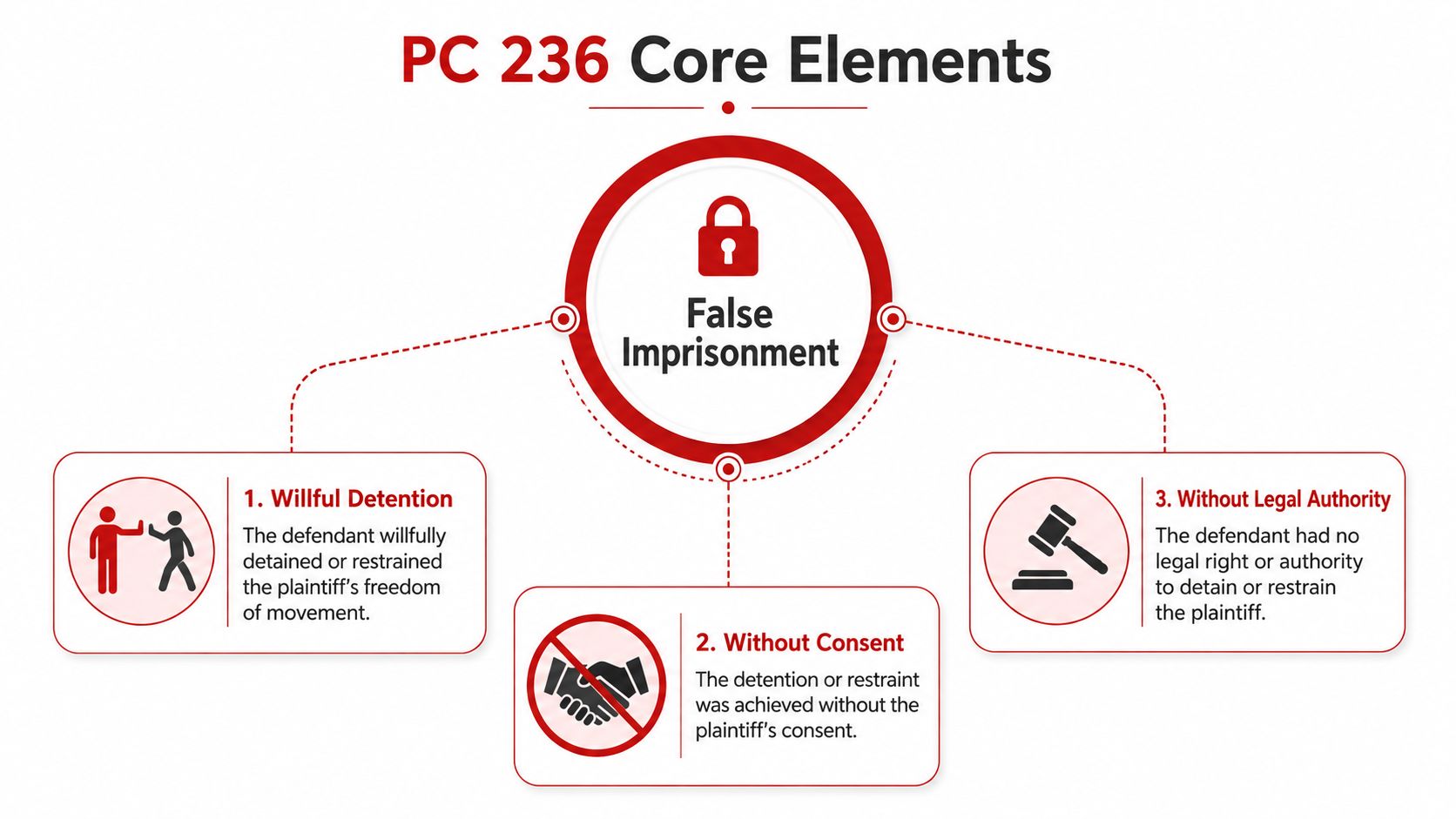
The three-box test
First, the person must have willfully detained or restrained someone else. That does not always mean grabbing an arm. A locked room, a car door held shut, or a direct threat that makes someone stay put can all matter depending on the facts.
Second, the other person must have not consented. That part matters more than people think. If someone stayed because they wanted to, the state has a much weaker case. If they stayed because they felt trapped, cornered, or deceived, the prosecutor will argue there was no real consent.
Third, the defendant must have known the person was being confined. In plain English, this is the awareness piece. The state has to show the restraint was not some accidental side effect. It had to be intentional enough to count.
One person’s personal liberty got restricted without lawful permission.
Real-world examples that matter
A verbal threat can count if it kept the person from leaving. A locked door can be enough even if nobody got hurt. The alleged victim’s perception matters too, because the law is looking at whether liberty was unlawfully restrained, not whether the scene looked violent to a stranger passing by.
That is why PC 236 cases often turn on details families do not realize matter, such as where people were standing, whether the exit was blocked, and whether the other person really felt free to leave.
Bottom line: the prosecutor’s job is to show restraint, lack of consent, and knowledge. If one of those is shaky, the defense has room to work.
Misdemeanor vs Felony PC 236 and Where the Line Sits
Families get tripped up here all the time. Simple false imprisonment under PC 236 sits at the misdemeanor level, with punishment of up to $1,000 in fines, up to 1 year in county jail, or both, under the California Penal Code. That said, plenty of PC 236 arrests do not stay in that lane once the facts get pushed through booking and charging review.
Charge tiers side by side
| Charge Tier | Code Section | Maximum Penalty | Bail Impact |
|---|---|---|---|
| Simple false imprisonment | PC 236 | Up to $1,000 and up to 1 year in county jail, or both | Usually lower than a felony, but still enough to create immediate custody issues |
| Aggravated false imprisonment | PC 236, aggravated form | Can escalate when violence, menace, fraud, or deceit are involved | Bail can rise quickly depending on the facts |
| Elder or dependent adult related conduct | Separate elder-abuse statute referenced in the code | Higher exposure than the simple misdemeanor version | Often treated more seriously at booking and release |
| Human trafficking | PC 236.1 | 5, 8, or 12 years under subdivision (a), 8, 14, or 20 years under subdivision (b), plus fines up to $500,000 | Serious felony-level bail exposure PC 236.1 penalties |
The line is simple. A simple PC 236 file is not the same as a felony restraint case. Once violence, menace, fraud, or deceit show up, the case can move into a more serious charging lane, and elder or dependent adult conduct adds another layer of exposure. The county jail and the DA do not treat those files the same way.
For families trying to understand why one arrest gets handled like a misdemeanor and another gets pushed harder, the felony-versus-misdemeanor split controls a lot of the pressure. A clear breakdown is in this guide to felony versus misdemeanor cases.
Bail follows that split. A simple PC 236 arrest can still mean a custody hold, but once the file starts looking felony-level, the release conditions tighten, the bail number climbs, and the bondsman has to move faster on verification and paperwork.
How PC 236 Arrests and Charging Work in Ventura County
A PC 236 arrest in Ventura County usually starts with a local agency, then moves straight into the jail system. If Ventura Police, Oxnard Police, Camarillo, or Port Hueneme officers make the arrest, the person is transported to the Ventura County Jail for booking, fingerprinting, and screening.
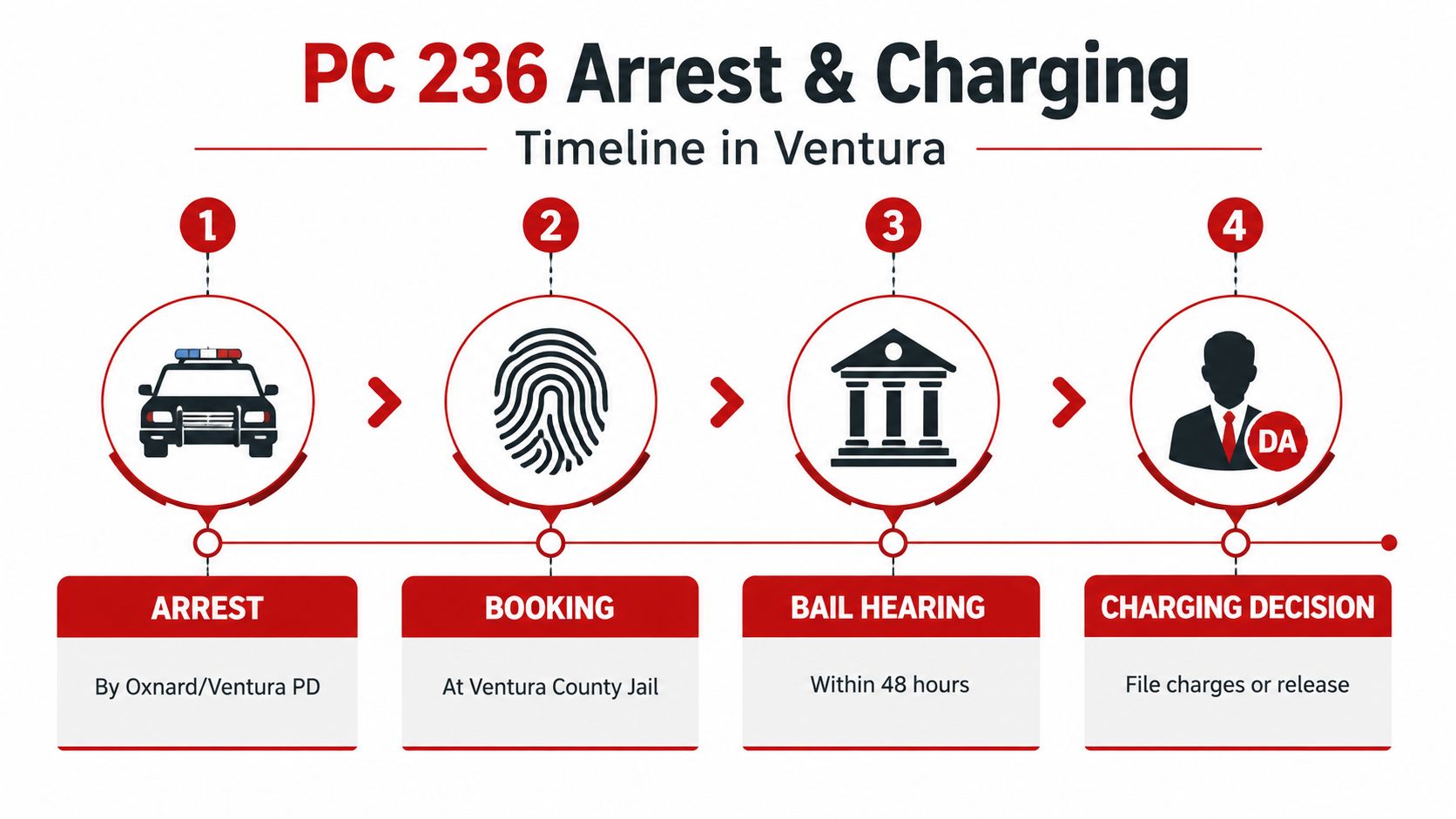
What happens first at the jail
Booking is where the system starts assigning real-world consequences. The jail records the arrest, checks identity, takes prints, and runs the custody process. Medical screening and classification come next, because the jail has to decide where that person fits while they’re in custody.
That’s also when bail first starts to matter in a practical way. The county bail schedule can put an initial number on the case before a judge or magistrate revisits it. Later, a magistrate can adjust bail based on the alleged facts and criminal history.
Why the DA’s timing matters
The arresting agency doesn’t file the case alone. The Ventura County District Attorney decides what charges move forward, and that decision can shift the pressure on release. A family may think they’re dealing with a minor custody issue, then the filing turns it into something more serious.
The key point is simple. Even a “simple” PC 236 allegation can create immediate custody consequences at the jail. Families who wait until the next business day often lose time they could’ve used to get the release process started.
The first day matters. Once the booking file is in motion, every hour you wait can slow down the next step.
For court logistics and the local process around filings and appearances, the county court system overview helps families understand where the case heads after booking Ventura County court system overview.
Bail Amounts, 10% Premiums, and How a Ventura Bondsman Moves
The bail number is where families need concrete answers about cost and timeline. California sets the bond premium at 10% of the total bail, so a family usually does not have to post the full cash amount to get release moving.
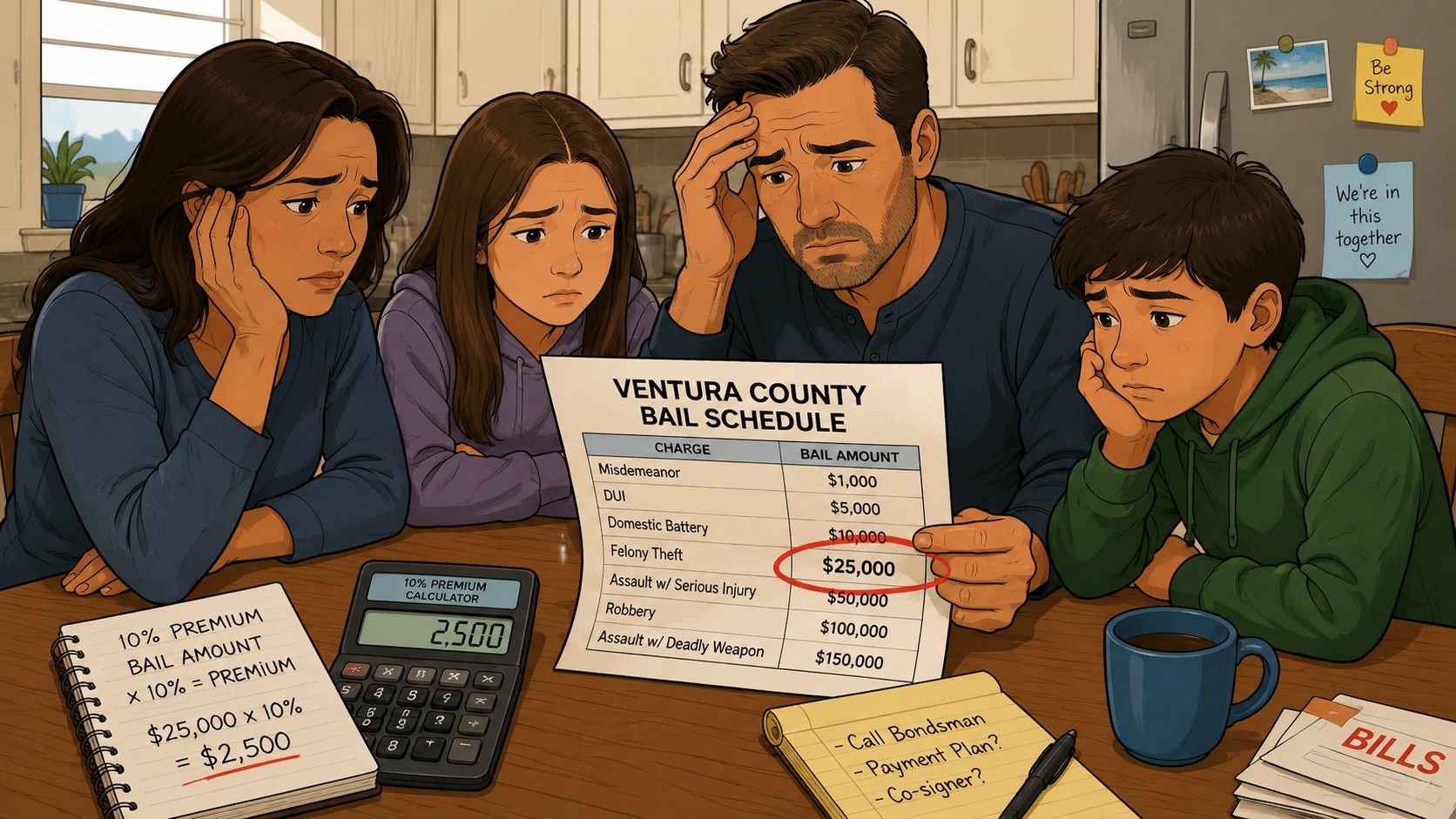
What the math looks like
If bail is set higher than a family can post in full, the bond premium is the amount many families pay to a licensed bondsman. That premium is fixed by law at 10%, and the California Penal Code sets the rule families keep hearing about at the jail and in court California bond premium rule as explained in the California Penal Code.
For larger or higher-risk bonds, payment plans, co-signers, and collateral can come into play. Families should ask those questions right away, before they agree to terms they do not understand.
What a local bondsman actually does
A good bail bonds Ventura call is practical, not theatrical. The agent verifies the booking details, reads the charge correctly, explains what the case means in plain English, and coordinates with the jail so the release process does not stall because of bad information.
That matters even more after a late-night arrest. 24-hour bail bonds Ventura service exists for exactly that reason, because a PC 236 arrest does not wait for office hours. If someone is sitting at the Ventura County Jail, speed and accuracy beat guesswork every time.
For families trying to estimate costs before they call, this breakdown of how bail bond costs work gives a straightforward starting point.
I would rather have a family call early with partial information than wait until morning and lose the chance to move the file fast.
The video below also walks through the bail-bond process in plain language.
What to have ready
A fast call usually goes smoother when someone has the defendant’s full legal name, date of birth, booking location, and any jail information they already have. If the family is in Ventura, Oxnard, Camarillo, Santa Paula, Moorpark, Fillmore, Ojai, Thousand Oaks, or Santa Barbara, the same rule applies. Clear information gets the release process moving faster.
PC 236 vs PC 207 and Why the Distinction Matters
Families call after an arrest and hear both labels tossed around, but false imprisonment and kidnapping are different charges with different consequences. PC 236 covers unlawful restraint or confinement. PC 207 covers moving a person from one place to another, and that is treated as a much more serious allegation.
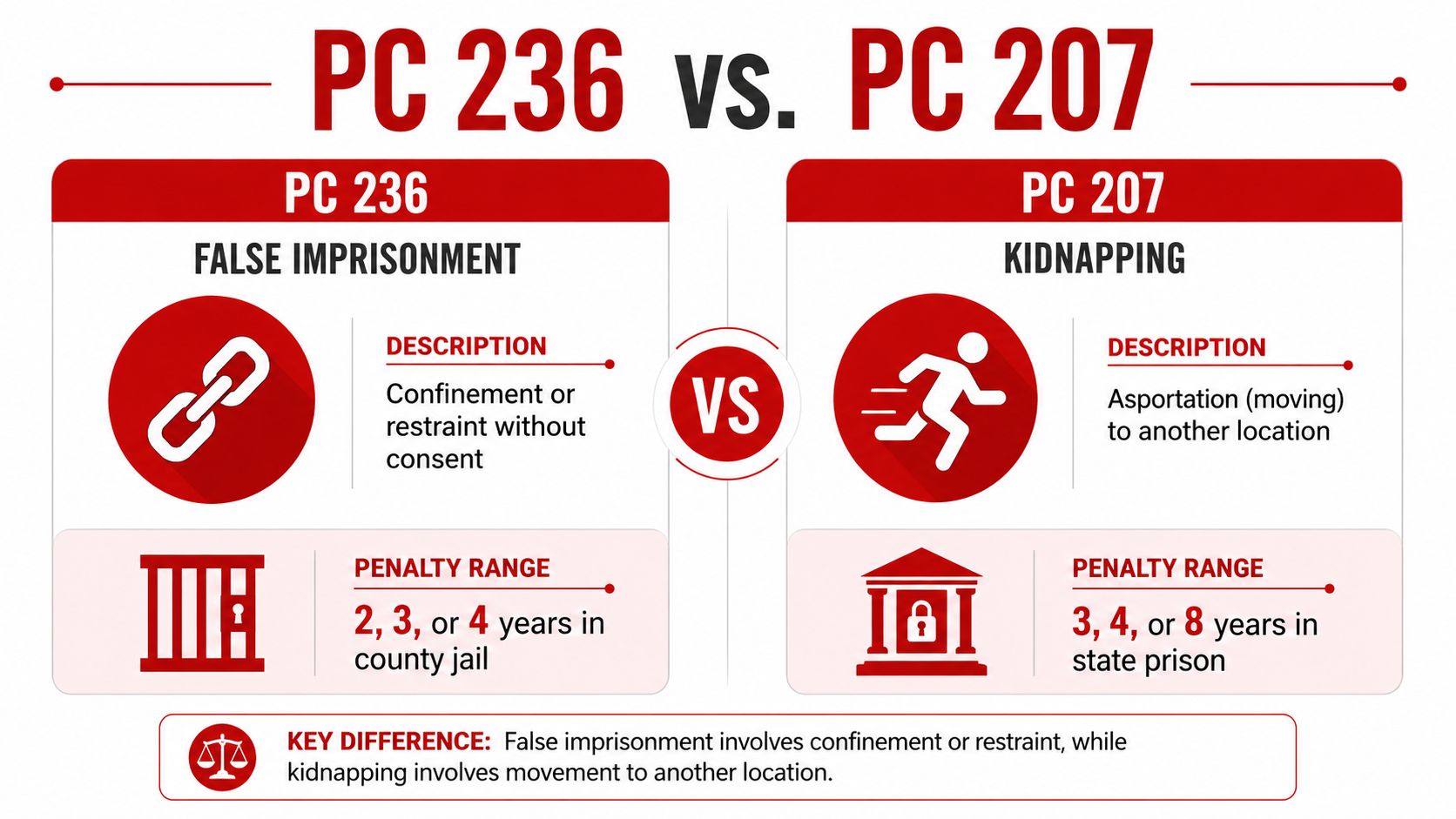
What separates false imprisonment from kidnapping
If someone was kept in a room, held in a car, or blocked from leaving, prosecutors usually start with PC 236. If the facts involve taking someone somewhere else by force or fear, PC 207 is the charge that raises the stakes.
That difference matters at the bail counter. A felony kidnapping allegation usually brings more custody pressure, tighter release conditions, and a heavier paperwork load for the bondsman.
Why families need to know this fast
A locked room with no movement and a forced drive across town are not the same thing. The first can fit false imprisonment. The second can push into kidnapping territory.
When I’m helping families with Ventura County Jail bail bonds, I care about the code section because it changes what the jail expects, what the court may later do, and how quickly the file needs to be reviewed. A PC 236 case and a PC 207 case can look similar to a nervous family, and they carry different handling at the jail and in court.
If the facts involve movement to another location, do not assume it is just a restraint case. That mistake can cost time and money.
Common Defenses and How They Affect Release Strategy
The strongest PC 236 defenses usually start with common sense, not legal jargon. If the other person consented, if there was no real restraint, if the detention was lawful, or if the accusation was made up in a relationship dispute, the defense has something real to work with.
The defense theories families hear most
- Consent: If the person agreed to stay, the state has a harder time proving unlawful restraint.
- No intent: If the detention was accidental or not knowing, the prosecution’s story gets weaker.
- Lawful detention: Store security holds and similar lawful stops are handled differently from an unlawful confinement claim.
- Insufficient restraint: The facts may show an argument, but not actual confinement.
- Fabricated accusation: Relationship disputes can produce claims that are exaggerated or false.
Some defenses help most at arraignment, especially if the lawyer wants to argue for release on own recognizance or push back against no-contact conditions. Others matter more in a later bail reduction hearing, where counsel can present a tighter facts packet and challenge an overly high bail amount.
How release conditions change
PC 236 cases often come with protective-order questions, especially when the allegation sits next to domestic-violence claims. That can mean no-contact terms, stay-away conditions, and practical limits on who can pick the person up after release.
A family should not assume a defense means instant freedom. It usually means a stronger position for negotiation. The bail agent still has to work with the jail, and the lawyer still has to line up the facts in a way the court can use.
One useful option in these situations is a licensed agency like Bada Bing Bail Bonds, which handles booking verification, release coordination, and payment-plan conversations for families dealing with local Ventura County custody problems.
Practical Next Steps for Families and Key Questions Answered
If someone you care about was booked on PC 236, don’t waste the first hour arguing about the code section. Gather the name, date of birth, jail location, and any booking number you can find. Then contact a local bondsman and stop discussing the case on speakerphone.
Fast answers families ask
Can PC 236 be reduced? Sometimes, yes, if the facts are weak or the defense has a strong position, but that depends on the case and the prosecutor.
How long does a PC 236 case take in Ventura County? It varies, and the only honest answer is that the court schedule and filing decisions control the pace.
What happens to bail money if the case is dismissed? The bond process doesn’t work like a refund on a store receipt, so families should ask the bondsman exactly how the paperwork works before paying.
If you’re trying to post bail tonight, read how to bail someone out of jail and then make the call. For families in Ventura, Oxnard, Camarillo, and the surrounding Southern California area, the right move is to get a local person on the phone who knows the jail process and doesn’t need a crash course.
If you’re dealing with a PC 236 arrest right now, call a local team that answers 24/7, verifies the booking details, and moves the paperwork without dragging its feet. Bada Bing Bail Bonds helps Ventura County families handle bail fast, including PC 236 cases, with plain talk and real jail experience.