
A bail hearing in California is the court proceeding where a judge decides whether a detained person can be released before trial and on what terms. The judge can order release on your own recognizance (O.R.), set bail at a scheduled or adjusted amount, impose conditions like electronic monitoring, or deny bail entirely for certain violent offenses.
Three things to do right now:
- Get counsel immediately. An attorney can request a bail reduction hearing at arraignment or file a written motion before one is scheduled. Without counsel, you are navigating procedural rules that prosecutors know cold.
- Gather proof of ties and finances. Employment records, a lease or mortgage, family support letters, and treatment enrollment documents are the evidence that moves judges. Collect them before the hearing, not after.
- If you need release fast, contact a licensed bail bonds agent or prepare cash or property options. A surety bond through a licensed agent typically requires a non-refundable premium of around 10% of the total bail amount and can often secure release faster than assembling cash.
Two statutory flags worth knowing now: under Penal Code §1275.1, a court can place a hold on release if there is probable cause the bail funds were feloniously obtained, requiring the defendant to prove the money is legitimate. And under PC §1270.1, any deviation from the scheduled bail amount in a serious or violent felony case requires an open-court hearing with two court days’ written notice to the prosecution.
Pro Tip: Don’t wait for the arraignment to start preparing. The window between arrest and the first court appearance is when the most useful evidence gets gathered or lost.
Key Takeaways
A California bail hearing decides release terms based on public safety and likelihood of appearance, and the fastest path to release combines immediate legal counsel, strong documentation, and a licensed bail agent ready to post bond.
| Point | Details |
|---|---|
| Get counsel before the hearing | An attorney can request a bail reduction or O.R. at arraignment and file motions with proper notice in felony cases. |
| Judges weigh two factors | Public/victim safety and likelihood of appearance drive every bail decision; evidence of local ties and employment directly addresses both. |
| Ability to pay matters legally | Under Humphrey, courts must inquire into ability to pay and consider nonfinancial alternatives before setting unaffordable bail or ordering detention. |
| Bond premium is non-refundable | The 10% surety bond premium stays with the agent regardless of case outcome; cash bail is refundable after case resolution minus fees. |
| Missing court has serious consequences | A failure to appear triggers a bench warrant, bail forfeiture, a new criminal charge, and likely higher bail on reinstatement. |
Table of Contents
- What is bail in California, and how does “Total Bail” work?
- How do judges decide bail at a California bail hearing?
- What actually happens at a California bail hearing?
- How do you request a bail reduction or O.R. release?
- How do you post bail in California?
- What are the consequences of skipping bail or missing court?
- What happens after release: next court dates and what happens to your money
- How a licensed bail bonds agent speeds up release
- What families facing a bail hearing actually need to prioritize
- Sources
What is bail in California, and how does “Total Bail” work?
Bail is a financial or conditional guarantee that a defendant will appear at all required court dates. It is not a fine or a punishment. The California Constitution, Article I, §28(f)(3), frames the purpose around both ensuring appearance and protecting public safety, and courts are required to weigh both when setting terms.
The starting point for most bail amounts is the county Uniform Bail and Penalty Schedule, which each county adopts under Penal Code §1269b. The Judicial Council promulgates statewide uniform schedules for certain offense categories to promote consistency across counties, and counties must consider those schedules when setting their own. In practice, a booking officer can release a defendant at the scheduled amount without waiting for a judge, but a judge can always adjust it at a hearing.
What surprises many families is that the number on the schedule is not what you actually pay. The schedule lists a base bail figure, but the Total Bail is the sum of several added components. A 2026 county Uniform Bail and Penalty Schedule illustrates how those components stack:
| Component | What It Is |
|---|---|
| Base bail | The offense-specific amount listed in the schedule |
| State penalty assessment | A surcharge added per dollar of base bail |
| County penalty assessment | A separate county-level surcharge |
| Court operations assessment | A flat fee supporting court operations |
| Criminal conviction assessment | An additional flat fee assessed on conviction |
The result is that a base bail amount can produce a Total Bail figure significantly higher once all assessments are added. That Total Bail figure is what a bail bond premium is calculated against. For a deeper breakdown of how county schedules translate into real numbers, the Judicial Council’s bail policy paper walks through the policy rationale and component structure.
How do judges decide bail at a California bail hearing?
Two factors drive every bail decision: the likelihood the defendant will appear at future court dates, and the risk to public or victim safety if the defendant is released. Everything else is evidence that speaks to one of those two questions.
Factors that push bail higher
- Prior failures to appear or an active warrant history
- Serious or violent felony charges (PC §1270.1 applies here)
- Victim vulnerability or a documented threat to a specific person
- Lack of stable housing or employment in the area
- Ties to other jurisdictions or a history of travel that suggests flight risk
Factors that push bail lower or toward O.R.
- Long-term local residence, family ties, and community roots
- Steady employment with a verifiable employer
- No significant prior criminal record or prior appearances honored
- Enrollment in or willingness to enter a treatment program
- Willingness to accept conditions (travel restrictions, check-ins, electronic monitoring)
The California Supreme Court’s Humphrey decision added a critical layer: before a court orders pretrial detention or sets bail at an amount the defendant cannot pay, it must inquire into the defendant’s ability to pay and consider less restrictive nonfinancial alternatives. Skipping that inquiry is reversible error, meaning the defendant can get a new hearing. This matters practically because it gives defense counsel a specific argument to make when a scheduled bail amount would effectively mean indefinite detention.
Pro Tip: Focus your evidence on flight risk and public safety, not on disputing the underlying charges. Judges at bail hearings are not deciding guilt. A letter from an employer confirming continued employment, a lease showing local ties, and a treatment enrollment form often do more work than a legal argument about the facts of the case. For a practitioner-focused breakdown of what judges weigh, this guide to factors judges consider when setting bail is worth reading before the hearing.
What actually happens at a California bail hearing?
The short answer: a bail hearing can happen at arraignment, at a separate PC §1270.1 hearing for serious or violent felonies, or on a motion for reduction filed by defense counsel. Each has its own rules.
At arraignment
The arraignment is typically the defendant’s first court appearance after booking. The judge reads the charges, takes a plea, and addresses bail and release conditions. Options at that point include O.R. release, supervised release, bail set at the scheduled amount, bail adjusted up or down, or continued custody. For most misdemeanors, this is the primary bail hearing. For felonies, it is often the first opportunity to argue for a lower amount or O.R., though a separate hearing may follow.
For serious or violent felonies
Penal Code §1270.1 requires an open-court hearing before a judge before bail can be reduced below the scheduled amount in cases involving serious or violent felonies. The defense must give the prosecution two court days’ written notice before that hearing. The prosecution gets to respond, present evidence, and argue against the reduction. Counsel is appointed if the defendant cannot afford one.
Automatic review when bail is not posted
When a defendant remains in custody because bail has not been posted, there is a right to a review hearing. Defense counsel can also file a motion for bail reduction at any point before trial, though the two-court-day notice requirement applies in serious felony cases.
Who speaks and what they present
At the hearing itself, defense counsel argues for release and presents evidence of ties, ability to pay, and proposed conditions. The prosecutor argues for the scheduled amount or higher, often citing the nature of the charges, prior record, and any victim impact. Pretrial services may submit a report with a release recommendation based on a risk assessment interview conducted after booking. The defendant can be present but typically does not testify at a bail hearing.
Possible outcomes: O.R. release with no financial condition, bail set at the scheduled amount, bail reduced or raised from the schedule, release with conditions (electronic monitoring, travel restriction, check-in requirements, treatment enrollment), or denial of bail for certain violent offenses when the prosecution proves by clear and convincing evidence that no condition will protect the public.
How do you request a bail reduction or O.R. release?
The process is more structured than most families expect, especially in felony cases. Here is the sequence:
- Request a hearing or file a motion. At arraignment, defense counsel can orally request O.R. or a bail reduction. For a separate hearing after arraignment, counsel files a written motion. In serious or violent felony cases, that motion must be served on the prosecution with two court days’ notice before the hearing date.
- Serve the prosecutor. Timing matters. Failure to give proper notice in a serious felony case can result in the court refusing to hear the motion that day. Confirm the local court’s filing and service requirements with counsel.
- Assemble an evidence packet. This is where families can directly help. Gather everything that speaks to ties and ability to pay before the hearing date.
- Bring witnesses or declarations. A family member, employer, or treatment counselor can submit a written declaration or, in some cases, appear in person. Written declarations are more common and easier to arrange on short notice.
- Be prepared for conditions. Even a successful reduction often comes with strings attached. Know in advance which conditions the defendant can realistically comply with, and propose them proactively rather than waiting for the court to impose something less workable.
For a step-by-step guide to filing a bail reduction motion in California, including what to include in the evidence packet, that resource covers the procedural specifics in detail.
Document checklist for a bail hearing
- Proof of employment (recent paystubs, employer letter, or business license)
- Lease agreement or mortgage statement showing local address
- Family support letters from relatives or community members
- Enrollment confirmation from a treatment or counseling program
- Government-issued ID
- Financial affidavit showing income, assets, and inability to pay the scheduled bail
- Any prior court records showing appearances honored
The Humphrey ability-to-pay requirement means the financial affidavit is not just a formality. If the defendant genuinely cannot pay the scheduled amount, that fact, documented clearly, is a legal basis for the court to consider nonfinancial alternatives. A documented plan for supervised release, such as electronic monitoring combined with treatment enrollment, frequently results in nonfinancial conditions rather than pretrial detention when the ability-to-pay showing is solid.
For a plain-language explanation of how O.R. release works locally in Ventura and Santa Barbara Counties, that guide covers what courts typically require and how to argue for it effectively.
How do you post bail in California?
Once bail is set, there are three ways to post it.

Cash bail means depositing the full Total Bail amount with the court or jail. If the defendant appears at all required dates and the case resolves, the cash is returned minus administrative fees. The upside is full refundability. The downside is that most families do not have $50,000 or $100,000 in liquid cash available on short notice.
Property bond means pledging real property as collateral. The property’s equity must typically equal or exceed the bail amount. The process involves court approval and can take days or weeks, making it impractical for urgent release.
Surety bond (bail bond) is the most common route. That premium does not come back regardless of the case outcome. The agent handles the paperwork and coordinates with jail staff, which usually means faster release than assembling cash.
What cosigners need to know
- The cosigner guarantees the full bail amount if the defendant fails to appear.
- If the defendant skips court, the cosigner may be liable for the entire bond amount and any recovery costs.
- The cosigner is typically responsible for keeping the defendant at a known address and reachable.
- Read the indemnity agreement carefully before signing. Know what triggers forfeiture.
One important flag: Penal Code §1275.1 allows a court to place a hold on release even after bail is posted if there is probable cause that the funds were feloniously obtained. When that hold is placed, the defendant must prove by a preponderance of the evidence that the money is legitimate before release proceeds. This can delay release by days even when everything else is in order.
For a full breakdown of how bail bonds work in California, including premium norms and cosigner obligations, that guide covers the mechanics in detail.
Callout: The bail bond premium is non-refundable. It is the cost of the agent’s service, not a deposit. Even if charges are dropped the next day, the premium stays with the agent.
What are the consequences of skipping bail or missing court?
Common questions, direct answers
Can a victim attend a bail hearing? Yes. Victims have the right to be heard at bail hearings under California’s Marsy’s Law provisions. The prosecution may present victim impact information, and the court considers victim safety as part of the public safety analysis.
Can charges be dropped at a bail hearing? No. A bail hearing is about release conditions, not guilt or innocence. Charges can only be dismissed by the prosecutor or the court at a later stage, such as a preliminary hearing or after a motion. Confusing the two leads families to expect outcomes the hearing cannot produce.
Can you still go to jail after bailing out? Yes. Release on bail is conditional. Violating any release condition, picking up a new charge, or missing a court date can result in immediate re-arrest and likely higher bail or no bail on the return.
Consequences of missing court
- The court issues a bench warrant for the defendant’s arrest, typically immediately.
- Bail is forfeited. For a cash bail, the court keeps the money. For a surety bond, the bail agent is liable for the full amount and will pursue the defendant and cosigner to recover it.
- The defendant faces an additional charge of failure to appear, which is a separate crime under California law.
- When bail is reinstated after a failure to appear, the amount is almost always higher, and the court is far less sympathetic to reduction arguments.
Navigating a serious bail situation without counsel is a significant risk. Procedural deadlines, notice requirements, and the evidentiary standards at PC §1270.1 hearings are technical. Missing a filing deadline or failing to give proper notice can cost the defendant the hearing entirely. Get an attorney involved as early as possible, ideally before the arraignment.
What happens after release: next court dates and what happens to your money
Release is not the end of the process. It is the beginning of a set of obligations with hard deadlines.
Upcoming court dates
- Arraignment (if not yet held): typically within 48 hours of arrest for in-custody defendants, or at a scheduled date for those released on bail or O.R.
- Preliminary hearing (felonies): generally within 10 court days of arraignment if the defendant is in custody, or 60 calendar days if released, unless time is waived.
- Pretrial conference: timing varies by county and case complexity, but typically follows the preliminary hearing or plea.
Waiving time means agreeing to a later date than the statutory deadline. Defense counsel often recommends waiving time to allow more preparation, but the defendant must understand that waiving time extends the period before a preliminary hearing or trial, which also extends the period of any release conditions.
Cash bail vs. bond premium after the case
Cash bail is refundable after the case resolves and all court appearances are complete, minus any administrative fees the court deducts. The refund process requires paperwork, and timing varies by county. For details on getting bail money back in California, including how to request exoneration paperwork, that guide walks through the steps.
The bond premium paid to a bail agent is non-refundable in all circumstances. When the case resolves, the bond is exonerated, meaning the agent’s liability ends, but the premium the family paid is not returned.
Keep every receipt, the bond agreement, and all court minute orders. You will need them for any refund request, exoneration filing, or dispute about fees.
How a licensed bail bonds agent speeds up release
A licensed California bail agent does more than write a check to the court. The practical value is in speed, local knowledge, and paperwork.
After a bail amount is set, the agent can post the surety bond directly with the jail, often within hours of the hearing. They know the booking procedures at local facilities, which forms are required, and which staff to contact to move the process along. For families in Ventura, Santa Barbara, or Orange County, that local familiarity with specific jail procedures can cut hours off the release timeline.
What a licensed agent provides
- 24/7 availability, including nights, weekends, and holidays
- Financing options and low down payment arrangements for qualifying clients
- Spanish-language support for families who need it
- Guidance on cosigner obligations before you sign anything
- Coordination with jail staff to process the bond and secure release
- Clear written terms for the premium and any payment plan
Questions to ask before you sign
- Are you licensed by the California Department of Insurance? (Ask for the license number and verify it.)
- What is the exact premium percentage and total cost?
- What financing or payment plan options are available?
- What are the cosigner’s obligations if the defendant misses court?
- How long do you expect release to take after the bond is posted?
- What happens to the bond if the case is dismissed?
Badabingbail has served Ventura, Santa Barbara, and Orange Counties for over 15 years. The agency is available around the clock, offers flexible financing with low down payment options for qualifying clients, and provides Spanish-language support. The team handles paperwork and jail coordination directly, so families are not left navigating an unfamiliar process alone during one of the most stressful situations they will face.

When you need to bail someone out fast, Bada Bing Bail is reachable 24/7 and covers Ventura, Santa Barbara, and surrounding counties. Call now to get the process started.
What families facing a bail hearing actually need to prioritize
The procedural complexity of California bail law can obscure a simple truth: the court process has built-in checks against excessive bail, and those checks work when someone uses them. The Humphrey ability-to-pay requirement exists precisely because cash bail, left unchallenged, can mean indefinite pretrial detention for people who simply cannot afford the scheduled amount. That is not an accident of the law. It is a recognized problem with a legal remedy, and defense counsel who knows how to invoke it can make a real difference.
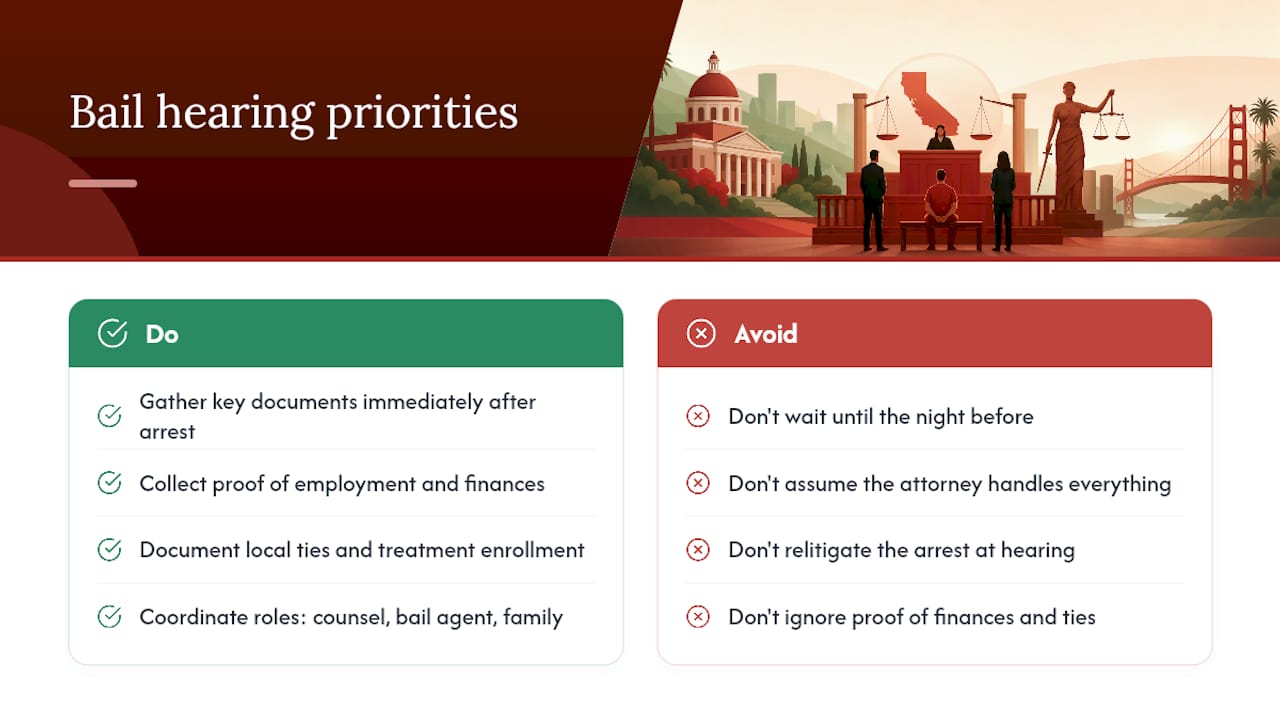
What families most often get wrong is timing. The evidence that matters most at a bail hearing, proof of employment, local ties, treatment enrollment, and financial circumstances, is easiest to gather in the hours between arrest and arraignment. Waiting until the night before the hearing to start collecting documents, or assuming the attorney will handle everything without input from the family, leaves the strongest arguments underdeveloped.
The other common mistake is treating the bail hearing as a preview of the trial. It is not. Arguing about the facts of the case at a bail hearing rarely moves a judge and can sometimes hurt the defense by previewing strategy. The hearing is about one question: can this person be trusted to return to court, and does release pose a genuine risk to public safety? Answer those two questions with concrete evidence, and the hearing goes better. Ignore them in favor of relitigating the arrest, and it usually does not.
For families coordinating with both an attorney and a bail agent, the most useful thing is to divide the work clearly. Counsel handles the legal arguments and court filings. The bail agent handles the financial mechanics and jail logistics. Families handle document collection and keeping the defendant informed of obligations after release. That coordination, done early and done clearly, is what actually speeds release and protects everyone involved.
This article is general information, not a substitute for advice from a qualified lawyer. Consult a qualified legal professional about your own circumstances before acting on anything here.
Sources
The statutes and official pages cited throughout this article are the primary sources to consult when verifying legal text or local court procedures.
- California Code, PEN 1275.1.
- IN THE SUPREME COURT OF CALIFORNIA S247278.pdf
- The arraignment | California Courts | Self Help Guide
- Rule 4.102. Uniform bail and penalty schedules-traffic, boating, fish and game, forestry, public utilities, parks and recreation, business licensing
- UBPS 2026 final
County Uniform Bail and Penalty Schedules vary. To find your county’s current schedule, contact the county superior court clerk’s office directly or check the court’s website. The Judicial Council’s framework under Rule 4.102 governs how those schedules are structured, but each county publishes its own version. For a plain-language explanation of how bail schedules work at the county level, that resource is a useful starting point.