
It’s 2 a.m. and your phone rings. A family member has been arrested in Oxnard or Ventura, and the booking information says Penal Code 236, but nobody has explained what that means. You’re trying to determine where they’re being held, whether bail is available, and how quickly they can come home.
Penal Code 236 concerns false imprisonment, a charge involving the unlawful violation of another person’s personal liberty. The accusation can arise from conduct that doesn’t look like a traditional jail-style confinement, which is why families often need clear information immediately. The legal definition, the circumstances of the alleged restraint, the county bail schedule, and the booking status all affect what happens next.
If you’re dealing with an arrest right now, start by confirming the booking location and gathering the person’s full legal name, birth date, and booking information. A practical overview of the first stages after an arrest is available in this guide to what happens after you get arrested.
Table of Contents
- What Happens When Someone Is Arrested for False Imprisonment
- Understanding the Legal Definition of Penal Code 236
- Misdemeanor vs Felony False Imprisonment Charges
- How Bail Is Set for Penal Code 236 in Ventura County
- Common Defenses Against False Imprisonment Charges
- Immediate Steps to Take After a Penal Code 236 Arrest
- Frequently Asked Questions About Penal Code 236 Bail and Release
What Happens When Someone Is Arrested for False Imprisonment
An arrest in Ventura County can move quickly from the arresting city to Ventura County Main Jail, located at 800 South Victoria Avenue in Ventura. The arrest may begin in Ventura, Oxnard, Camarillo, Port Hueneme, Thousand Oaks, Santa Paula, Moorpark, Fillmore, Ojai, or another county location. For the family, the practical question is where the person is being booked, what charge appears in the jail system, and whether bail information is available.
Families often make two costly assumptions. They may believe false imprisonment requires locking someone in a cell, or they may wait for the alleged victim to “drop” the case. California Penal Code Section 236 defines the offense as “the unlawful violation of the personal liberty of another” (California Penal Code Section 236). Allegations can involve blocking an exit, stopping someone from leaving, or using conduct that keeps the person somewhere against their wishes.
Practical rule: Use the first hours to confirm facts, locate the person, and arrange release. The phone is not the place to argue the entire criminal case.
Booking comes first. Jail staff record identifying information, fingerprints, the alleged charge, and other intake details before a bail agent can reliably coordinate a bond. The bail amount may not appear right away, and facility procedures can delay release even after the family is prepared to proceed.
The person in custody should avoid discussing the incident during jail calls. Those conversations may be recorded, and casual explanations can create problems later. Families should keep their questions focused on identity, location, medical needs, assigned bail information, and release coordination. Use this guide to understand what happens after an arrest while the booking information is being confirmed.
A licensed bail bondsman can explain the release process. A criminal defense attorney should address statements, evidence, possible defenses, and contact with the alleged victim. Gather the booking details first, then make the call that fits the immediate problem.
Understanding the Legal Definition of Penal Code 236
California Penal Code Section 236 gives the offense its central definition. It describes false imprisonment as the unlawful violation of another person’s personal liberty, a phrase that focuses on freedom of movement rather than the walls of a jail. California’s jury instructions treat the offense as involving intentional restraint, confinement, or detention against the alleged victim’s will.
The prosecution generally has to prove that the accused intentionally restricted the other person’s movement and that the restriction was unlawful. Physical chains aren’t required. A person might be accused of standing in a doorway to prevent someone from leaving, taking car keys with the purpose of keeping the person at the location, or using threats to make the person stay.
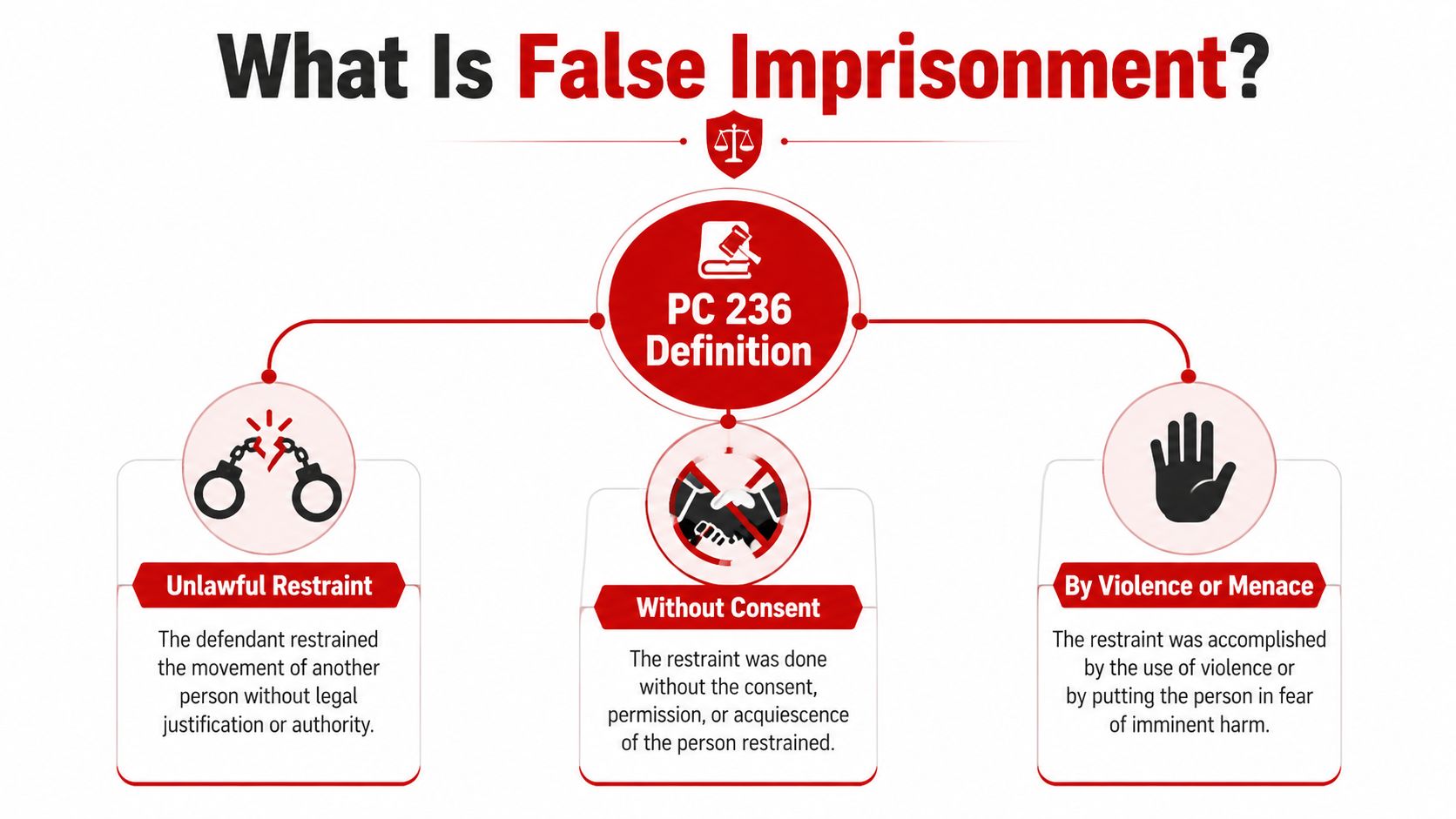
What the prosecution must establish
The words intentional, unlawful, and against the person’s will carry substantial weight. Accidental contact, an ordinary disagreement, or a person choosing to remain somewhere usually isn’t enough by itself. The surrounding facts matter, including what was said, whether an exit was available, whether force or threats were used, and whether the person understood they were free to leave.
Consent can also change the analysis. If two people voluntarily agreed to remain in a room, participate in an argument, or travel together, the defense may argue that the alleged restraint wasn’t against the person’s will. That issue requires a careful review of messages, witness accounts, video, 911 recordings, and the statements made during the incident.
False imprisonment is different from kidnapping. Kidnapping generally involves moving a person a substantial distance through force, fear, or another unlawful method. A PC 236 accusation can focus on restraint without the alleged victim being moved. Assault or criminal threats may also be filed when the same event includes alleged physical harm or threatening conduct, but those are separate legal theories with separate elements.
Misdemeanor vs Felony False Imprisonment Charges
False imprisonment has a serious dividing line under California law. Section 237 provides that the basic offense can carry a fine of up to $1,000, county jail for up to one year, or both, while false imprisonment effected by violence, menace, fraud, or deceit is punishable as a state-prison offense (California Penal Code Section 237 summary).
Historical California code versions show that this punishment framework has remained recognizable across older compilations, including versions from 2005, 2007, and 2009 (historical California Penal Code Sections 236 and 237). Modern secondary summaries commonly describe the offense as a wobbler, meaning the charge may be treated as a misdemeanor or felony depending on the facts and charging decision.
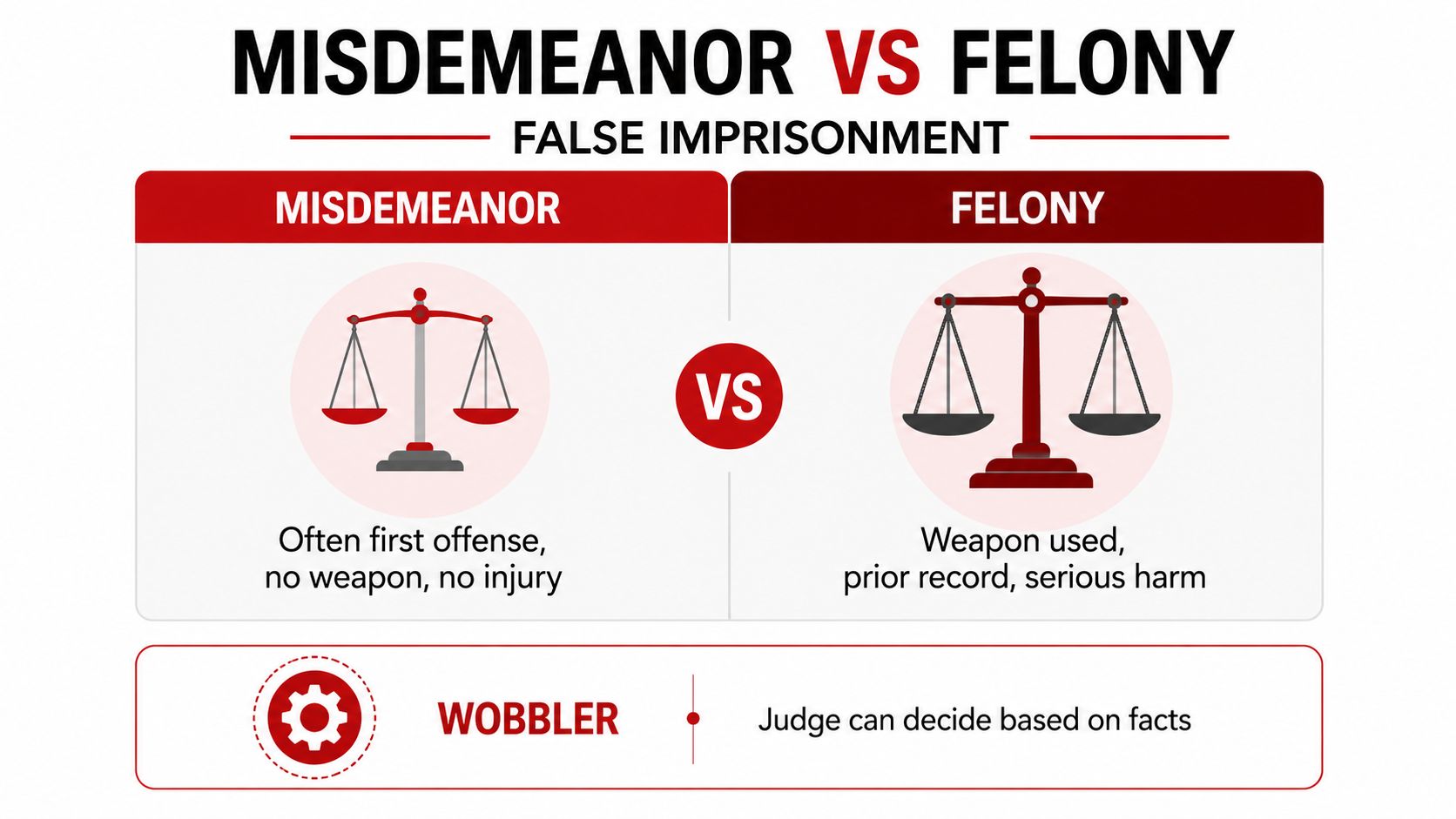
What pushes a case toward felony treatment
A basic accusation might involve alleged restraint without violence, menace, fraud, or deceit. A felony theory may arise when prosecutors claim the accused used physical force, threatened harm, manipulated the alleged victim through deception, or used intimidation to prevent departure. The label depends on the evidence, not on the fact that an argument occurred.
That distinction affects more than the possible sentence. It can influence the scheduled bail amount, the prosecutor’s position at court, release conditions, protective orders, and the defense attorney’s immediate strategy. Families should never assume that a person will be released because nobody suffered a visible injury.
The charge on the booking record is only the starting point. The police report, alleged facts, prior record, and prosecutorial decision determine how the case develops.
A person facing felony treatment needs counsel who can examine whether the evidence supports violence, menace, fraud, or deceit. The defense may challenge the alleged restraint itself, the intent behind the conduct, the credibility of witnesses, or the accuracy of statements made during a stressful incident. Families seeking information about the bond process for more serious accusations can review bail for felony charges, while the criminal defense attorney handles the legal response.
How Bail Is Set for Penal Code 236 in Ventura County
A family may be trying to arrange release while the person arrested for Penal Code 236 is still waiting through booking. Bail does not come from one statewide amount for every arrest. County schedules can differ sharply, and the charge level and alleged facts can affect the scheduled amount. One California superior court schedule lists false imprisonment at $5,000, while another lists PC 236 at $50,000 (California superior court bail schedule example).
Use the current booking information and applicable Ventura County procedures, not a search result from another county. Confirm the listed charge, the scheduled bail, and whether a judge has changed the release terms.
| County | Charge Level | Scheduled Bail Amount |
|---|---|---|
| Example California county | False imprisonment | $5,000 |
| Another California county | PC 236 | $50,000 |
What the family needs to arrange
California’s Department of Insurance explains that bail bond companies must file their rates with the department, and bail agents representing a surety must charge those filed rates. The department also states that bail premiums are most commonly 10% of the total bail amount, while the court sets the bond amount (California Department of Insurance bail bond guidance).
A $5,000 bond commonly carries a $500 premium under the 10% rate described by the department. A family using a licensed bond agent generally does not need to provide the entire scheduled bail amount in cash. The agent can explain available payment arrangements, co-signer responsibilities, and collateral requirements based on the application and risk.
The release process usually follows this order:
- Confirm booking: Verify custody and confirm that PC 236 appears in the booking information.
- Review the amount: Ask which bail amount applies and whether the booking lists misdemeanor or felony treatment.
- Complete paperwork: Responsible parties complete the indemnity agreement and payment arrangements.
- Post the bond: The bail agent submits the bond according to the jail’s procedures.
- Track release: Jail staff still must process the release, so timing depends on the facility and its workload.
Families searching for Ventura County bail bonds, bail bonds Ventura, or bail bonds Oxnard should contact an agent early, confirm the booking details, and ask what documents the co-signer must provide. The county process is explained in this guide to how bail works in Ventura County. For facility information, consult the available Ventura County Main Jail information and verify current procedures directly with the jail before sending paperwork.
Common Defenses Against False Imprisonment Charges
The strongest defense depends on what happened, not on the charge’s title. A defense attorney should test every part of the accusation, especially whether the alleged victim was restrained, whether the restraint was intentional, and whether the conduct was legally justified.
Consent and freedom to leave
Consent is often central. Suppose two people enter a room voluntarily, argue, and one person remains there after the argument begins. If the door is open, no threat is made, and the person could leave, the defense may argue that there was no unlawful detention.
That argument becomes weaker if the accused blocked the exit, took the person’s keys, or threatened consequences for leaving. The attorney should compare the alleged victim’s account with texts, recordings, witness statements, and the physical layout of the location.
Lack of intent
PC 236 isn’t established merely because someone’s movement was restricted during a chaotic moment. If a person accidentally stood in front of a doorway, moved a vehicle without realizing someone intended to leave, or briefly held an object without intending to detain anyone, the defense may challenge the required intent.
The facts must be preserved quickly. Messages can disappear, surveillance footage can be overwritten, and witnesses may remember an emotionally charged incident differently after speaking with others.
Lawful authority
Some restraints can be legally authorized. A store may have limited authority to detain a suspected shoplifter under California’s shopkeeper’s privilege, provided the detention follows the law. A parent may also reasonably restrain a child to prevent immediate danger.
Those examples don’t excuse excessive force or an unjustified detention. They show why context matters. The attorney must determine whether the person had lawful authority, whether the restraint was reasonable, and whether the conduct exceeded that authority.

Getting the defendant out on bail can help them participate in gathering records, identifying witnesses, and following counsel’s instructions. It doesn’t resolve the case, but it gives the defense a better practical position than trying to coordinate everything while the person remains in custody.
Immediate Steps to Take After a Penal Code 236 Arrest
A family in Ventura County may have only a few hours to arrange release, protect the defendant from harmful statements, and get counsel involved. Work from verified custody information, not rumors or assumptions.
-
Confirm custody. Contact the Ventura County Jail or check the available inmate-information system to learn where the person was taken. Arrests in Oxnard, Ventura, Camarillo, Port Hueneme, Thousand Oaks, Santa Paula, Moorpark, Fillmore, and Ojai may eventually involve the county facility.
-
Record the identifiers. Write down the defendant’s full legal name, date of birth, booking number, arresting agency, and exact charge. A bail agent can use those details to locate the correct record and avoid delays caused by incomplete or inaccurate information.
-
Call a licensed bail agent. Ask for the listed bail amount, premium, payment options, co-signer requirements, and collateral conditions. For 24-hour bail bonds Ventura, fast bail bonds Ventura, or Ventura County Jail bail bonds, state that the arrest involves Penal Code 236 and provide the booking information available.
-
Keep jail calls focused. Jail calls may be recorded. Do not discuss who started the argument, what happened inside the home, whether the alleged victim wants prosecution, or what anyone should tell law enforcement. Those details belong with defense counsel.
-
Contact a criminal defense attorney. Counsel can review the available reports, advise the defendant about statements and protective orders, and prepare for court. The bail agent handles release logistics. The attorney handles the criminal case. Both should be contacted promptly.
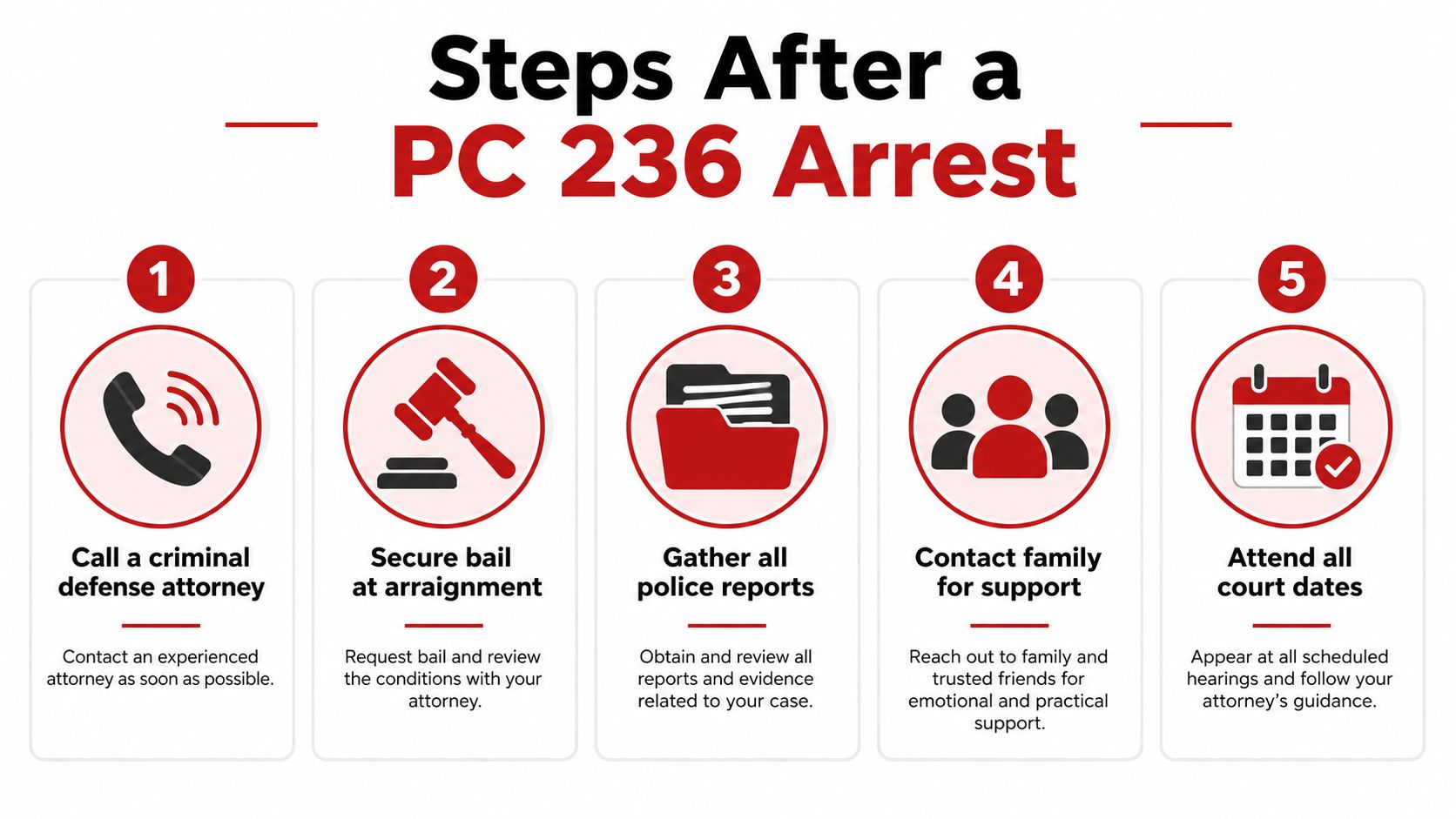
Bada Bing Bail Bonds verifies available custody information, explains the listed bail amount, prepares the paperwork, and coordinates with the jail. Release still depends on facility procedures and current jail workload, so families should not rely on an exact release promise before the record is checked.
Urgent calls also require accurate information. Law practices that need coverage outside ordinary office hours may use a service to capture missed legal cases, including the caller’s name, location, charge, and requested callback.
After release, keep every court date, respond to agent check-ins, follow each release condition, and avoid contact that violates a protective or no-contact order. Families can review the practical release steps in this guide to what to do after an arrest.
Frequently Asked Questions About Penal Code 236 Bail and Release
Can someone receive release on their own recognizance
Possibly, but it isn’t automatic. A court may consider the alleged facts, criminal history, community ties, appearance history, public-safety concerns, and whether the person appears likely to follow future court orders. The charge level and any allegation of violence or threats can weigh heavily against release without a financial bond.
The defense attorney should make the request directly and explain why the person can safely remain in the community. Families should provide counsel with stable address information, employment details, family responsibilities, and records showing reliable court attendance when those materials are available.
How long does Ventura County booking take
There isn’t one guaranteed timeline. Booking may involve identification, fingerprinting, medical screening, property handling, classification, and entry of the charge and bail information. Delays can occur when the arresting agency hasn’t completed its paperwork, when the jail is handling a high volume of bookings, or when the charge requires additional review.
A bail agent can begin by verifying the record, but the jail generally must have the person properly entered before it can accept the bond. Calling repeatedly without the booking number usually doesn’t speed the process.
Does a PC 236 arrest affect immigration status
A noncitizen should speak with an immigration attorney and a criminal defense attorney before entering a plea or making statements about the case. The immigration consequences of a criminal accusation depend on the person’s status, the exact charge, the plea language, the sentence, and the facts admitted in court.
A bail agent can help with the state-court release process, but bail does not determine whether immigration authorities take action. Don’t rely on a general answer for an individual immigration situation.
What happens if the alleged victim recants
A recantation doesn’t automatically end the prosecution. Prosecutors may consider other evidence, including recorded emergency calls, photographs, witness accounts, messages, surveillance, and statements made during the investigation.
The accused and family members shouldn’t pressure the alleged victim to change a statement or refuse cooperation. That conduct can create additional legal problems. The defense attorney should manage communication and determine whether the new account can be used in court.
What factors affect the bail amount
The scheduled amount, charge classification, alleged use of violence or menace, prior record, court appearance history, and judicial orders can all matter. Families can review the broader bail amount factors while waiting for counsel to evaluate the individual case.
Bada Bing Bail Bonds helps families coordinate Ventura County bail bonds for PC 236 arrests, including bookings connected to Ventura, Oxnard, and nearby communities, with 24-hour contact, clear premium explanations, payment-plan discussions, and jail paperwork coordination. If someone you love has just been booked, visit Bada Bing Bail Bonds now to verify the booking and begin the release process.