
In California, bail is a court-ordered financial guarantee that a defendant returns to court, and you can usually secure release by posting cash, a property bond, a surety bond, or by getting the defendant released on their own recognizance (OR). The single best first move: call the jail for the booking number and charge, then check the county bail schedule while you decide which posting method fits your situation.
Pro Tip: Write down the booking number the moment jail staff gives it to you. Bail agents and court clerks need it to look up the case, and asking twice slows everything down.
Before you call anyone, have this ready:
- Full legal name and date of birth of the person arrested
- Booking number and the facility where they’re held
- The charge or charges, if known
- Your own photo ID
- A plan for funds, whether that’s cash, a card, or a cosigner who can qualify for a bail bond
Key Takeaways
California bail works through four legal paths, cash, surety bond, property bond, or OR release, with county schedules setting the starting amount and judges holding the power to adjust it.
| Point | Details |
|---|---|
| Bail is a guarantee, not a fine | It secures court appearance and gets refunded (cash) or exonerated (bond) once the case concludes. |
| Four posting methods exist | Cash, surety bond, property bond, and OR release each fit different financial situations and risk levels. |
| County schedules set the starting point | Judges can raise or lower that amount at arraignment based on ability to pay and case-specific risk factors. |
| Bail bond premiums are typically 10% | That premium is generally nonrefundable, and agents must charge only their CDI-filed rate. |
| Local expertise speeds release | Bada Bing Bail Bonds offers 24/7 licensed help across Ventura, Santa Barbara, and Orange Counties, with flexible payment plans. |
Table of Contents
- How the California Bail Process Actually Works
- What Are the Four Ways to Post Bail in California?
- How Are California Bail Amounts Set?
- What Is the Step-by-Step Process to Post Bail?
- How Much Does It Cost to Post Bail in California?
- Who Handles What: Agents, Cosigners, and Attorneys
- What Happens to Bail Once the Case Ends?
- Can You Get Bail Reduced or Changed Later?
- How Do County Bail Schedules Vary Across California?
- Need Bail Posted Right Now in Ventura, Santa Barbara, or Orange County?
- Where Can You Verify California Bail Rules and Amounts?
- Sources
How the California Bail Process Actually Works
Bail is a financial guarantee, not a punishment. The court holds the money (or the promise of it, through a bond) to make sure the defendant shows up for every court date. If they do, the money comes back. If they don’t, it’s forfeited.
California’s Constitution guarantees this right directly. Article I, Section 12 states that a person is entitled to release on bail in most cases, with narrow exceptions for capital offenses and certain violent or sexual felonies where the court finds a substantial likelihood the person’s release would endanger others. The California Penal Code fills in the mechanics: who can accept bail, how county schedules are built, and what a judge must weigh before setting or changing an amount.
When a magistrate sets or reviews bail, the law requires consideration of:
- The seriousness of the alleged offense
- The defendant’s criminal history
- The likelihood they’ll return to court
- Public and victim safety
- The defendant’s ability to pay, a factor that carries far more weight since the In re Humphrey decision reshaped pretrial practice in California
What Are the Four Ways to Post Bail in California?
Every county recognizes the same four release paths, though the fine print varies by jurisdiction and by the seriousness of the charge.
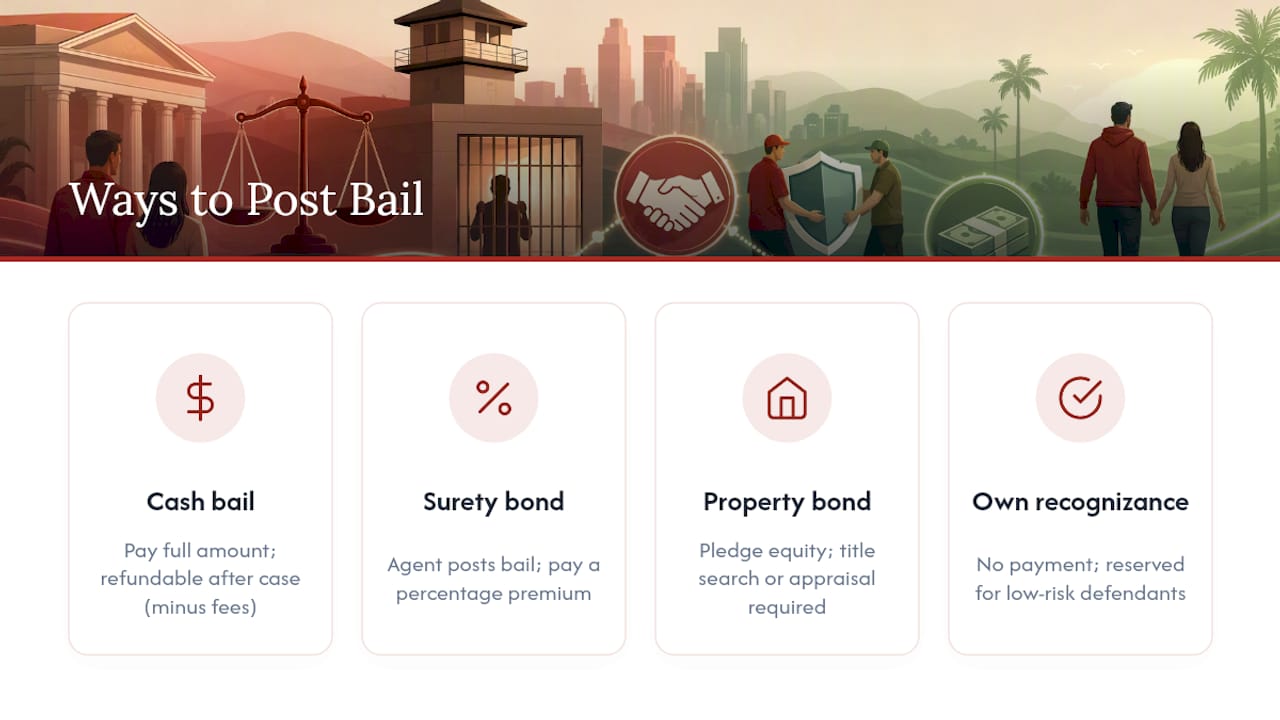
Cash bail means paying the full amount directly to the court or jail. It’s refundable at the end of the case, minus administrative fees, if the defendant makes every appearance. Families who can front the full sum sometimes prefer this route specifically because they get most of it back.
Surety bonds, better known as bail bonds, are what most families actually use. A licensed bail agent posts the full bail amount on the defendant’s behalf in exchange for a premium, typically a percentage of the total. This is the practical option when the bail amount is set at $20,000, $50,000, or higher and nobody has that kind of cash sitting around.

Property bonds let a defendant or family member pledge real estate equity instead of cash. Penal Code §1276.5 requires specific disclosures before a court accepts one, and most courts demand a title search or appraisal first, which can take days. It’s rarely the fastest option, but it matters when a family has equity and no liquid cash.
Release on own recognizance (OR) requires no payment at all. The defendant simply promises, in writing, to appear. Judges reserve this for lower-risk defendants: minor charges, strong community ties, no history of missed court dates.
A defendant charged with a nonviolent misdemeanor and no prior record has a real shot at OR release at arraignment. A defendant facing a serious felony with a criminal history almost never gets that option, no matter how sympathetic the family’s situation.
How Are California Bail Amounts Set?
Every county publishes its own bail schedule, a presumptive list of dollar amounts tied to specific charges. Jail staff use this schedule at booking, before any judge gets involved, which is why bail can be posted within hours of an arrest rather than waiting for a court date. A Santa Clara County bail schedule shows how this works in practice: multiple charges stack, and the schedule spells out exactly how combined amounts get calculated.
That schedule is a starting point, not the final word. Once a case reaches arraignment, a judge or magistrate can raise or lower the amount based on:
- The specific facts of the arrest and the strength of the case
- Prior convictions or pending cases
- Ties to the community, including employment and family
- Documented risk to a victim or witness
- The defendant’s actual financial ability to pay the scheduled amount
That last factor has carried more legal weight since In re Humphrey, which pushed California courts to treat an unaffordable bail amount as functionally equivalent to no bail at all when cheaper alternatives could protect the same public safety interest.
What Is the Step-by-Step Process to Post Bail?
Every California bail process overview follows roughly the same sequence, whether the arrest happens in a small city or a major county jail.
- Confirm the booking details. Call the facility’s booking line and get the name, booking number, and charge exactly as the jail has them recorded.
- Check the bail amount. The booking sheet usually lists it, or you can cross-reference the county’s published bail schedule.
- Choose your posting method. Decide between cash, a surety bond, a property bond, or find out whether OR is realistic given the charge.
- Contact a licensed bail agent if you’re going the surety route, and have your ID and payment method ready.
- Sign the paperwork. The agent or the court clerk files the bond, and the defendant is queued for release.
- Confirm the court date before you leave the counter. Missing it undoes everything.
Timelines vary enormously by facility size. Booking itself typically takes two to twelve hours, and release after bail is posted can happen within an hour at a small city jail or stretch several hours at a busy county facility processing dozens of releases at once. Arraignment generally must happen within 48 hours of arrest, excluding weekends and holidays, so if bail isn’t posted before then, the case moves to a judge regardless.
Pro Tip: If the charge is minor and the person has no significant record, ask an attorney about filing a request under Penal Code 1269c before arraignment. It lets a magistrate lower bail or grant OR without waiting for the formal court date, sometimes shaving a day or more off the wait.
How Much Does It Cost to Post Bail in California?
Say the court sets bail at $50,000. A cash deposit means the family needs the full $50,000 up front, refundable later minus fees. A bail bond means paying a bail agent a premium, commonly 10% of the total, so $5,000, to secure that same release.
That premium is generally nonrefundable once the bond is written, because it’s the fee for the risk the agent and surety company are taking on, not a deposit. The main exception: if the defendant is surrendered back into custody by the indemnitor rather than skipping court, part of the premium may be refunded under limited circumstances.
Agents can also charge for actual, necessary expenses beyond the base premium: things like travel costs, notary fees, or guard fees tied to the specific transaction. What they cannot do is charge above their filed rate or invent extra fees. The California Department of Insurance regulates every licensed agent’s rate schedule, and Penal Code 1276.1 bans renewal premiums entirely, closing off a fee structure some agencies used to lean on.
Who Handles What: Agents, Cosigners, and Attorneys
A licensed bail agent is the surety company’s representative, the person who actually writes and posts the bond. The California Department of Insurance licenses roughly 2,300 of these agents statewide and prohibits them from soliciting business unsolicited, whether that’s showing up uninvited at a jail or cold-calling families.
Cosigners, usually called indemnitors, take on real financial exposure. Signing means promising to pay the full bail amount if the defendant skips court, and often means pledging collateral like a car title or home equity to back that promise.
Before you cosign anything, ask three questions: what collateral is required, when does the lien get released after the case closes, and what happens to your money specifically if the defendant doesn’t show up. A reputable agent answers all three without hesitation.
An attorney’s role is separate from the agent’s. They can request a bail reduction or OR release at arraignment, file formal motions challenging the scheduled amount, and represent the defendant at every hearing that follows.
What Happens to Bail Once the Case Ends?
If the defendant appears at every hearing, the court exonerates the bail. Cash deposits get refunded, minus authorized administrative deductions, and any property or collateral used to secure a bond gets released once the exoneration paperwork clears.
- Case concludes or defendant completes all required appearances
- Court issues an exoneration order
- Cash deposits are refunded through the county treasury process
- Liens on pledged property or collateral are released
If the defendant misses a court date, the court can forfeit the bond under Penal Code 1305. That triggers a chain reaction: the bail agent has to locate the defendant within a statutory window, and the family or cosigner may be on the hook for the full amount if they can’t. If forfeiture happens, contact county counsel immediately. A motion to set aside forfeiture has to be filed within specific statutory timelines, and waiting even a few days can close that door permanently.
Can You Get Bail Reduced or Changed Later?
Yes, and it happens more often than most families expect. Before arraignment, an attorney can file a request under Penal Code 1269c asking a magistrate to lower the amount or grant OR outright. After arraignment, formal motions under sections tied to Penal Code 1275 and 1289 let either side ask a judge to revisit the number, and California courts generally schedule these reviews within days rather than weeks.
What actually moves a judge:
- Stable employment and documented community ties
- Minimal or no prior criminal record
- A clear, honest account of financial inability to pay the scheduled amount
- A defense attorney’s declaration laying out the case for release
How Do County Bail Schedules Vary Across California?
No two counties publish identical numbers. A misdemeanor DUI might carry a different scheduled bail in Ventura County than in a Central Valley county, even though the underlying statute is the same statewide.
- Search “[county name] bail schedule” or go straight to that county’s Superior Court website for the current PDF.
- Call the jail for the booking sheet amount; call the court clerk for questions about a scheduled hearing or a pending motion.
- Cross-check anything you find against Courts and the California Department of Insurance for agent licensing questions.
A publisher’s view from the ground in Ventura, Santa Barbara, and Orange Counties
Bada Bing Bail Bonds has worked bail cases across Ventura, Santa Barbara, and Orange Counties for more than 15 years, and the pattern repeats itself constantly: families lose hours not because bail is complicated, but because nobody has the booking number handy or knows which jail actually has their relative. Local knowledge of which facility processes releases fastest, and which court clerk to call first, routinely shaves real time off that wait. If anything about an agent’s fees or licensing feels off, verify it directly through the California Department of Insurance before you sign anything.
Need Bail Posted Right Now in Ventura, Santa Barbara, or Orange County?
Bada Bing Bail Bonds exists for exactly the moment you’re in: a family member is booked, the clock is running, and you need someone who knows the local jails and courts well enough to move fast without cutting corners. Every agent is licensed under California Department of Insurance rules, and rates are filed, not negotiated on the spot, so there are no surprise numbers when you’re already stressed.
What sets this apart from figuring it out alone is speed paired with flexibility: 24/7 availability, Spanish-language support, and financing options with low down payments for families who don’t have a full premium sitting in a checking account. If the scheduled bail feels out of reach, ask about payment plans before assuming cash is your only path.
Call now or start online to bail someone out fast, with the booking number and facility name ready so the process starts the moment you connect.
Where Can You Verify California Bail Rules and Amounts?
- The California Department of Insurance confirms whether a bail agent is licensed and lists the rules governing solicitation and filed rates.
- Your county’s Superior Court website hosts the current bail schedule PDF, the definitive source for the presumptive amount tied to any charge.
- Courts explains statewide pretrial procedure in plain language.
- The California Penal Code is the statutory text behind every rule above, useful when an attorney references a specific section.
Search “[your county] bail schedule” first; call the jail for booking-specific numbers second.
This article is general information, not a substitute for advice from a qualified lawyer. Consult a qualified legal professional about your own circumstances before acting on anything here.
Sources
- Bail Bonds
- Courts
- 2026 Criminal Bail Schedule (Santa Clara Superior Court)
- California Penal Code – Bail (Legislative Information)
- California Code of Regulations, Title 10 §2081 (Law.Cornell)