At 2 a.m., a family member may call from the Ventura County Pre-Trial Detention Facility with only a few details: the arrest happened in Oxnard, the charge is a felony, and nobody knows what happens next. The questions come quickly. Has bail been set? Can someone post it tonight? How much will a bond cost? Will the defendant be released before court?
Felony bail bonds in Ventura County involve more than paying a percentage and waiting by the phone. Booking status, the local bail schedule, the charge, possible court review, release conditions, and the co-signer’s financial responsibility all matter. This guide explains the practical decisions families face in Ventura, Oxnard, Camarillo, Port Hueneme, Thousand Oaks, Santa Paula, Moorpark, Fillmore, Ojai, and nearby Santa Barbara.
Table of Contents
- What Changes When the Charge Is a Felony
- Felony Bail vs Misdemeanor Bail in California
- How Felony Bail Is Posted in Ventura County
- Premiums, Collateral, and Payment Plans for Felony Bonds
- Common Felony Charges and Typical Bail Amounts
- Legal Risks and Conditions After Release
- Choosing a Trustworthy Local Bondsman
What Changes When the Charge Is a Felony
The first surprise is often the classification. A family may hear “assault,” “burglary,” “drug offense,” or “DUI,” then learn that prosecutors or booking officers are treating the allegation as a felony rather than a misdemeanor. That distinction can affect the amount listed on the county schedule, the time required for booking, the possibility of judicial review, and the conditions attached to release.
California’s modern bail system also reflects a long debate about whether money should determine pretrial freedom. The federal Bail Reform Act of 1966 created a presumption of release and directed judicial officers to use the least restrictive conditions reasonably necessary to ensure court appearance. The Pretrial Services Act of 1982 later authorized pretrial services in each federal judicial district outside the District of Columbia. The historical background on federal bail reform describes those milestones and notes that the Manhattan Bail Project recorded a failure-to-appear rate of less than seven-tenths of 1 percent.
The first hours are mostly about verification
A felony booking usually requires patience because the jail must establish the defendant’s identity, enter the charge, complete processing, and determine whether bail can be posted under the applicable schedule or must be addressed through a magistrate or court process. A possible hold, warrant, probation issue, or protective condition can change the release path even when a family has money ready.
That’s why calling a bondsman before transferring funds is useful. The agent should verify the booking, charge classification, bail amount, and whether the jail will accept a bond at that moment. Families gathering information for a defense lawyer can also use CasePulse’s criminal law intake guide to organize names, dates, arrest details, and documents without relying on memory during a stressful night.
Practical rule: Don’t assume that a listed bail amount means immediate release. Confirm that the defendant is fully booked, that no hold blocks release, and that the facility will accept the proposed form of payment or bond.
Felony cases also bring greater scrutiny. The court may impose no-contact, travel, testing, or reporting requirements, depending on the facts and the judge’s order. A local agent familiar with Ventura County Jail procedures can explain what paperwork is needed, but a bondsman can’t change the charge, guarantee dismissal, or replace a criminal defense attorney.
Felony Bail vs Misdemeanor Bail in California
At two in the morning, a Ventura County family may have a booking number, a charge, and no clear release time. The difference between a misdemeanor and felony case affects what happens next. A misdemeanor may move through a citation or a simpler payment process. A felony is more likely to involve a scheduled bail amount, court review, a co-signer’s financial responsibility, and conditions ordered at release.
California consumers commonly pay a 10% premium of the total bond amount, plus actual, necessary, and reasonable transaction expenses, under the California Department of Insurance explanation of bail bonds. The premium is calculated on the total bond amount set by the court.
| Factor | Misdemeanor Bail | Felony Bail |
|---|---|---|
| Charge level | Lower-level criminal allegation, sometimes handled by citation | Felony allegation that may produce a scheduled bail amount and a court appearance |
| Bail decision | May follow a citation or applicable schedule | May require the Ventura County schedule, magistrate review, or added release terms |
| Financial commitment | Often involves a smaller payment or bond | May require a co-signer, underwriting, and collateral for a larger bond |
| Release logistics | Can proceed after citation or completed booking | Booking, holds, record checks, and court review can extend the wait |
| Conditions | Court appearance and case-specific terms may apply | The judge may order no-contact, travel, testing, or regular reporting requirements |
Families often ask for a single number before the charge and booking are confirmed. Start with the California bail schedule resource to understand how scheduled amounts are organized, then verify the current Ventura County entry and whether it is active for that defendant. A listed amount may not reflect a warrant, probation hold, protective order, or pending court decision.
Why felony cases take more coordination
A bondsman typically needs the defendant’s booking details, identification, and charge information. The co-signer must provide identification and information showing where they live or work and can accept responsibility under the indemnity agreement. Larger or higher-risk bonds may also require property, vehicle, or other collateral details.
The first-hours decision is often whether to wait for booking or begin the bond application while the jail finishes processing. An application can be prepared early, but the jail still controls acceptance and release. Timing depends on the facility’s workload, complete paperwork, and whether a magistrate or court must review the case. No responsible agent should promise a release time before those steps are complete.
How Felony Bail Is Posted in Ventura County
The Ventura County Pre-Trial Detention Facility is at 800 South Victoria Avenue in Ventura, according to the Ventura County Sheriff’s bail-posting information. Families may encounter different references to county detention operations, so confirm the defendant’s current location and booking status before traveling or sending documents.
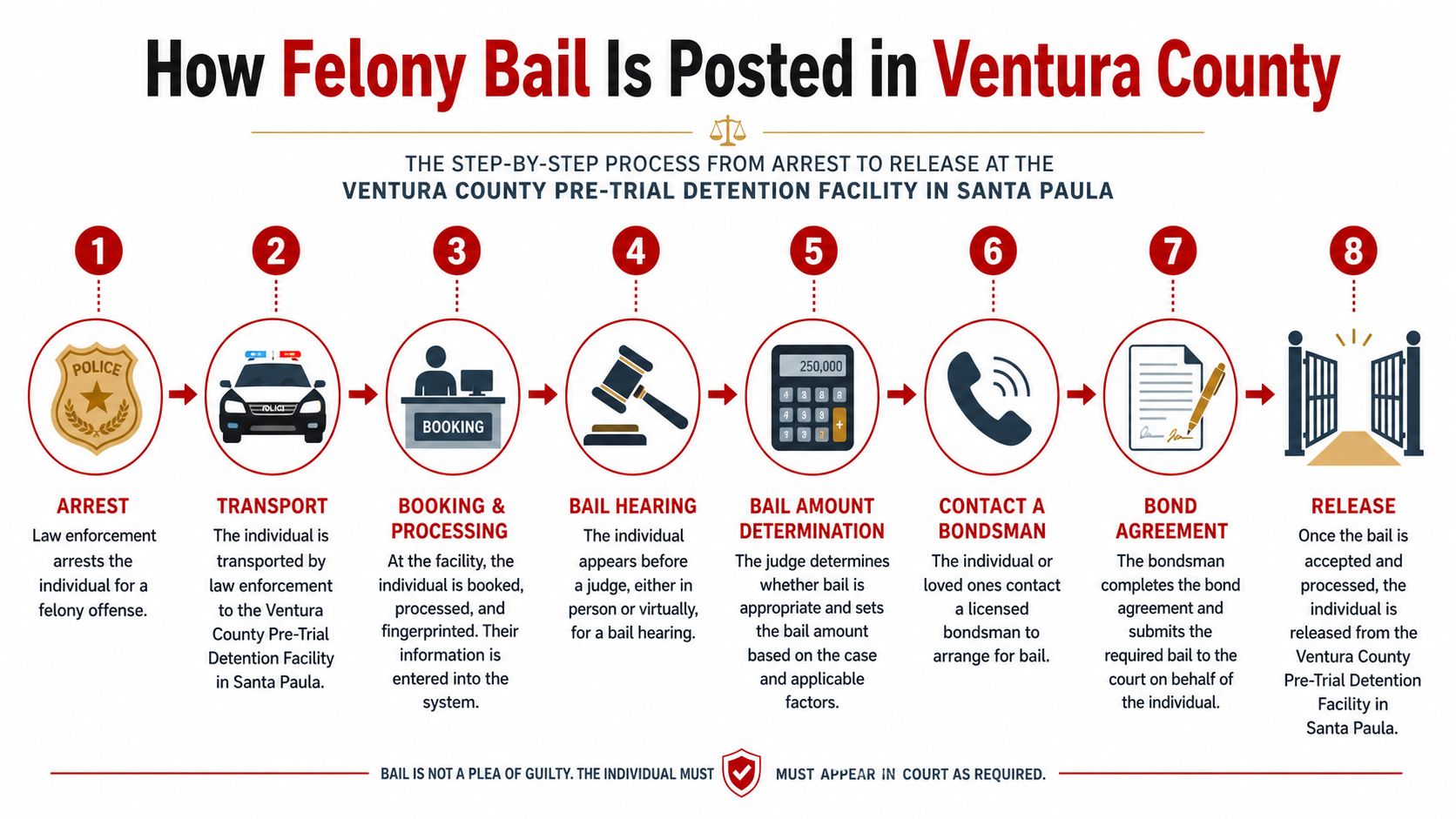
The release sequence
-
Arrest and transport: Law enforcement arrests the defendant and transports them to the appropriate detention facility. The family may not receive complete information until the booking record is entered.
-
Booking: Jail staff verify identity, take fingerprints and photographs, record the alleged charge, and enter the defendant into the county system. A bondsman needs accurate booking information before preparing a bond.
-
Bail determination: The amount may come from the county schedule, or the case may require review by a magistrate or court. Felony cases can involve holds or conditions that prevent immediate posting.
-
Application and underwriting: The co-signer provides identification, signs the indemnity agreement, and supplies requested financial or collateral documents. The agent verifies the charge, bail amount, and release requirements.
-
Premium and paperwork: The co-signer pays the premium under the agreed terms. Families should read every obligation before signing, especially provisions concerning missed court dates, collateral, and payment plans.
-
Submission to the jail: The bondsman submits the approved bond to the facility. Processing continues on the jail’s side after acceptance, and staff control the final release sequence.
-
Release and pickup: Once processing is complete, the defendant leaves through the facility’s release process. The bondsman should explain the next court date and any conditions known from the paperwork, but the defendant must follow the court’s actual orders.
The Sheriff’s Office says bail may also be posted through cash in the exact amount, cashier’s checks payable to the Ventura County Superior Court, bail bonds, and credit or debit card payments through GovPayNet or by phone. Families comparing methods can review how to pay a bond before choosing the option that fits their situation.
The jail may take additional time after accepting a bond. The facility’s workload, document review, classification, and release queue all affect the wait. A bondsman can coordinate paperwork, but neither the agent nor the family controls the jail’s final processing time.
Premiums, Collateral, and Payment Plans for Felony Bonds
California’s common pricing rule is straightforward. If the court sets bail at $100,000, a bond based on that amount commonly carries a $10,000 nonrefundable premium, before any actual, necessary, and reasonable transaction expenses permitted under state guidance. The California Department of Insurance consumer guidance explains the relationship between the court-set bond and the consumer’s premium.
A premium isn’t a deposit that comes back when the case ends. It pays for the surety service and the agent’s assumption of appearance risk. If the defendant appears as required and the case is later dismissed, reduced, or resolved, the premium generally remains earned under the bond agreement. Collateral is different. If the agreement requires collateral and the defendant satisfies the bond obligations, the agent follows the contract and applicable rules for returning it.
What the co-signer is actually signing
The co-signer, or indemnitor, accepts financial responsibility for the defendant’s obligations under the bond. That can include unpaid premium installments, permitted expenses, and losses connected to a failure to appear. A family member signing at night in Ventura or Oxnard should ask for a written explanation of every fee, collateral condition, payment deadline, and surrender procedure.
Collateral may be requested when the bond is large, the defendant has limited local ties, the charge presents a higher appearance risk, or the agent’s underwriting review identifies other concerns. Possible forms include real estate equity, vehicle titles, or cash deposits. There isn’t one universal threshold that applies to every felony bond, so families should ask what the agent needs before promising property or transferring money.
| Bail Amount | 10% Premium | Typical Collateral Required | Payment Plan Down Payment |
|---|---|---|---|
| $50,000 | $5,000 | May be requested based on underwriting and appearance risk | Depends on written agreement and approval |
| $100,000 | $10,000 | More likely to involve documented assets or guarantees | Depends on written agreement and approval |
| $250,000 | $25,000 | May involve substantial property, vehicle, or cash security | Depends on written agreement and approval |
The source for the 10% premium examples is the Hamilton Project analysis of bail and pretrial reform, which also uses a $50,000 bail and roughly $5,000 upfront as an illustration of the liquidity problem families face. Payment plans aren’t automatic. An agent may evaluate credit, income, residence, co-signer strength, and collateral before agreeing to installments or a reduced initial payment.
Common Felony Charges and Typical Bail Amounts
To estimate a felony bail amount in Ventura County, start by identifying the alleged charge and checking the current Ventura County bail schedule. The Ventura County bail schedule page publishes county schedules, including the Ventura Superior Court Bail Schedule for 2024 and the 2026 Judicial Council Uniform Bail and Penalty Schedules. Those figures provide a starting point, not a promise that the defendant can leave immediately.
The first hours after an arrest can change the practical answer. Booking may still be incomplete, a hold may remain active, or a judge may review the case before release authority is confirmed. The statute entered in the booking record, prior convictions, alleged injury, weapon allegations, probation status, and court orders can all affect the amount or the release process.
| Felony Charge | Typical Bail Range | Average Release Timeline | Common Aggravating Factors |
|---|---|---|---|
| Assault with a deadly weapon | Confirm current Ventura County schedule | Depends on booking, holds, and court review | Alleged injury, weapon facts, prior convictions |
| Residential burglary | Confirm current Ventura County schedule | Depends on booking completion and release authority | Occupied residence, prior record, additional allegations |
| Felony DUI with injury | Confirm current Ventura County schedule | May require additional review and conditions | Injury severity, prior DUI history, alcohol or drug allegations |
| Drug possession for sale | Confirm current Ventura County schedule | Depends on charge coding and any hold | Quantity allegations, prior convictions, probation status |
| Domestic violence causing corporal injury | Confirm current Ventura County schedule | May be affected by protective or no-contact orders | Alleged injury, prior incidents, victim concerns |
A family should avoid relying on a figure found in another county. Ventura County schedules and procedures may differ, and the same broad charge category can produce a different result when the booking details are different.
How local details change the answer
Violent allegations generally receive closer review when the record includes injuries, weapons, threats, or prior cases. A person arrested in Santa Paula may face a different practical timeline from someone arrested in Thousand Oaks because transport, booking status, and court availability can affect when the bond becomes available.
The financial decision also depends on the premium and any approved payment arrangement. Families can review felony bail bond payment options while confirming what the agent requires before accepting a plan. A local bondsman can verify whether a bond is available, identify the co-signer documents needed, and provide questions for defense counsel.
The schedule gives the family a working estimate. The booking record and court review determine what can happen next.
Legal Risks and Conditions After Release
In Ventura County, release starts a period of strict compliance while the felony case continues. The defendant must follow each court order, which may restrict travel, prohibit contact with an alleged victim, require drug testing or check-ins, and require attendance at every scheduled hearing.
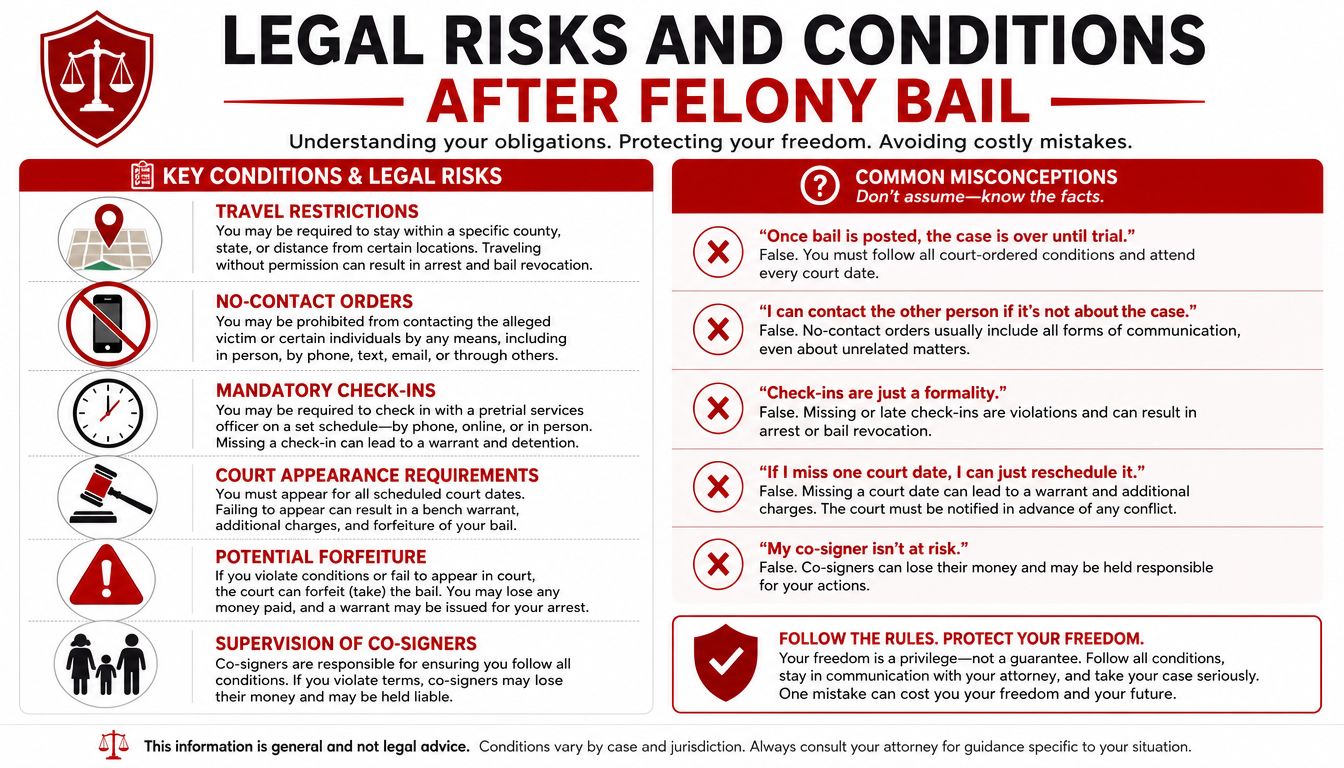
Release still carries legal and financial risk
A missed court date can produce a bench warrant and bail forfeiture proceedings. The bondsman may have contractual and legal authority to locate and surrender the defendant. The co-signer may then face the financial consequences set out in the indemnity agreement.
Problems often begin with decisions that seem harmless:
- Contacting a protected person: A phone call, message, or visit can violate a no-contact order, even if the defendant believes the conversation is harmless.
- Leaving the permitted area: Travel restrictions may cover Ventura County, California, or another location named by the court.
- Missing testing or check-ins: A missed appointment can trigger enforcement action or a request to change release conditions.
- Ignoring court notices: The defendant, defense lawyer, and co-signer should keep the court date and courthouse information in writing.
Higher money bail does not automatically produce safer or more reliable pretrial outcomes. Research on a Palm Beach County court-imposed policy change found that reducing bond amounts for eligible felony offenses increased release and reduced custody length without evidence of worse pretrial compliance, including new criminal activity or failure to appear, as summarized in this court-imposed policy shock research record.
If a defendant may miss court, the co-signer should contact the defense lawyer and bondsman immediately. A notice, transportation problem, medical emergency, or scheduling issue may need documentation before a warrant is issued. The bondsman can explain bond-related steps, while only the court or defense attorney can address legal relief or modify court conditions.
Choosing a Trustworthy Local Bondsman
At 2 a.m., the first agent who answers is not automatically the right choice. Verify that the bondsman holds a California Department of Insurance license, regularly works with Ventura County bookings, and can explain what happens after the application is submitted. Felony bookings may involve delays, so ask who will provide updates while the defendant remains in custody.
Questions to ask before signing
- Licensing: Request the license information and verify it through the state.
- Pricing: Get the premium, permitted expenses, installment terms, and collateral requirements in writing.
- Facility experience: Ask how the agent handles posting at the Ventura County Pre-Trial Detention Facility.
- Contract terms: Read the indemnity agreement, including financial duties if the defendant misses court.
- Collateral return: Ask which documents control the return process and when review begins after the bond ends.
- Availability: Prefer a direct local line when possible, rather than an anonymous intake center.
A reliable agent explains the premium plainly, refuses to promise guaranteed approval, and does not pressure anyone to sign blank documents. The agent should also separate bond-related work from decisions reserved for the court or defense attorney. Families can review the benefits of hiring a trustworthy bail company while comparing providers.
Bada Bing Bail Bonds is a licensed Ventura County agency that can verify booking details and explain premium terms. Request a written contract before sending funds, and confirm that every signer understands the financial responsibility.
Before choosing an agent, match the paperwork to the actual booking. Confirm the defendant’s name, bail amount, facility, premium, collateral terms, and payment schedule. Those details can change after a felony booking is reviewed, so keep copies of every document and receipt.