

In Ventura County, release processing typically takes 1 to 4 hours after bail is posted, but ordinary releases don’t occur between midnight and 6:00 a.m. unless the person is bailing out or has a forthwith court release. Those windows describe processing after the jail can begin the release, not necessarily the time from arrest or from the moment a family pays a bond.
At 2:00 a.m., a call from a son arrested in Oxnard after a traffic stop can make every minute feel urgent. The family starts searching for bail bonds Ventura, calling relatives, and asking the same questions in different ways: Where is he being held? Has booking finished? How much is bail? When can someone pick him up?
The uncomfortable answer is that the first hours often produce very little reliable information. The person may still be in transport, waiting in a temporary holding area, or beginning intake at the Ventura County Pre-Trial Detention Facility. Until booking is complete, jail staff may not have a confirmed housing location, bail amount, or usable release estimate.
That uncertainty isn’t a sign that nobody is working on the case. Booking and release depend on separate queues, staff availability, records checks, court information, and discharge procedures. A family can act quickly without expecting the jail to move at the same speed.

Table of Contents
- What Happens in the First Hours After an Arrest
- How the Booking and Release Pipeline Works
- Factors That Change Jail Release Times
- How to Check Inmate Status and Release Windows
- How Bada Bing Bail Bonds Expedites the Process
- Cash Bail Versus Bail Bonds in Ventura County
- Your Action Plan When a Loved One Is Arrested
What Happens in the First Hours After an Arrest
The early uncertainty is part of the process
The first 2 to 6 hours after arrest can feel like a black hole. That phrase describes the family’s ability to obtain dependable information, not a guaranteed jail timetable. Police transport, intake volume, medical screening, fingerprinting, and records checks can all happen before the booking record becomes visible or complete.
For a family in Oxnard, Ventura, Camarillo, Port Hueneme, or Thousand Oaks, the first useful step is identifying the arresting agency and likely facility. A traffic stop can lead to processing through a city or county system, and a person may not appear in an online search immediately. Calling repeatedly before booking is complete usually produces little beyond confirmation that staff can’t yet provide a release estimate.
A practical overview of the immediate steps is available in this guide on what to do when someone gets arrested. Gather the person’s full legal name, date of birth, arresting agency, and any information about the alleged charge before calling for help.
What families should handle first
While the arrestee is being processed, one person should record every update and time of contact. Another family member can arrange childcare, notify an employer if necessary, or prepare transportation for release. Don’t send several relatives to call the same jail at once. A single point of contact keeps the information consistent and reduces confusion.
Families also face concerns beyond the immediate pickup. Booking photographs and arrest information can circulate online, so relatives may later need practical guidance to protect your reputation after arrest. That issue shouldn’t distract from confirming custody and release conditions, but it belongs on the family’s broader checklist.
The most important expectation is simple: a bail agent can prepare early, but a bond can’t bypass unfinished booking, a hold, medical clearance, or a court requirement. Early preparation matters because paperwork can be ready when the jail accepts the release transaction, not because the person will necessarily walk out immediately.
How the Booking and Release Pipeline Works
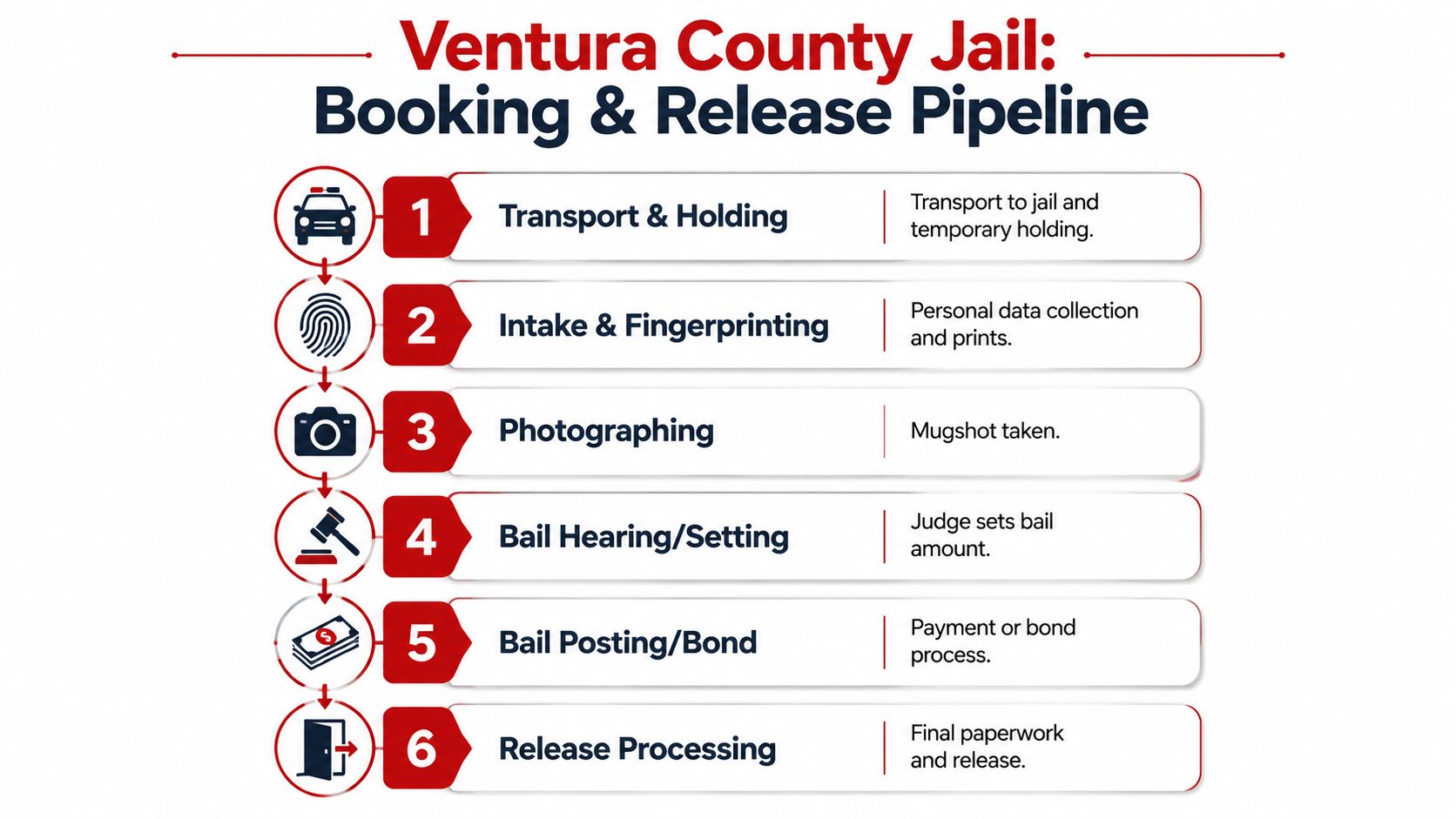
Release starts long before someone reaches the discharge window. Each step creates a record that the next staff member must review, and a delay at one stage can hold up every later step.
Six stages inside the facility
-
Transport and holding
The arresting agency transports the person to the appropriate facility. During busy periods, the person may wait in a temporary holding area before intake begins. -
Intake and identification
Staff collect personal information, fingerprints, and arrest details. Incomplete or conflicting information can require additional verification. -
Photographing and property inventory
Staff take the booking photograph and document personal property. Property must later be matched to the correct person at discharge. -
Court review and bail setting
The applicable schedule or a judicial decision determines the bail amount and conditions. Ventura Superior Court publishes the official fee and bail schedules, which helps families distinguish a court-set amount from the cost of obtaining a bond. -
Bail posting or another release decision
The family may post cash, arrange a bail bond, or wait for a court decision involving another release pathway. The jail still has to verify that the transaction matches the person’s booking record. -
Release processing
Staff confirm authorization, send the release instruction through the facility, call the person out, return property, complete discharge records, and direct the person to the release area.
Why a completed bond doesn’t end the wait
After a bond is posted, the clerk or receiving staff must process the paperwork, verify it against the inmate file, and route the release order to the appropriate housing or records personnel. The person may then wait to be called out, have property returned, and complete discharge at the release window.
Shift changes, meal service, court transport runs, and competing intake work can interrupt that sequence. The same operational pattern appears in public jail guidance, which explains that release can take several hours after bond is satisfied because booking, court processing, and payment verification still have to be completed. Ventura County release-process guidance provides local context for what families should expect.
Ventura County materials commonly describe release as taking about 1 to 4 hours after processing starts, and ordinary releases generally don’t occur between midnight and 6:00 a.m., except for a person bailing out or receiving a forthwith court release. Those are facility rules and operating windows, not promises that every case will finish at the same speed.
Factors That Change Jail Release Times
Two people arrested at nearly the same time can have completely different jail release times. One may have a clear booking record and a bond ready for verification. The other may need medical observation, a warrant review, or additional court paperwork.
The main sources of delay
A person arrested for driving under the influence may remain in custody until required observation and medical concerns are addressed. Some county guidance states that an intoxicated arrestee can be held until sober, adding 12 hours or more when medical or observational clearance must come before release. A person injured during arrest may face a separate medical clearance requirement.
Domestic violence cases can involve protective-order review and no-contact conditions. Those requirements can affect whether release is authorized and what instructions the person receives. Posting money doesn’t erase a court order or release condition.
Outstanding warrants create another branch in the process. A hold from Los Angeles County, Santa Barbara County, another agency, ICE, probation, or parole may prevent a local release while the agencies coordinate. The person may therefore remain in custody even after the original Ventura County bond is addressed.
| Delay Factor | Typical Added Time | Why It Happens |
|---|---|---|
| Intoxication or medical observation | 12 hours or more in some cases | Staff must obtain sobriety or medical clearance before discharge, as described in county inmate-release guidance. |
| Delayed hearing or missing paperwork | Variable | Hearings may be postponed, or documents from another party may not reach the jail promptly. |
| Outstanding agency hold | Variable | Another county, probation authority, parole authority, or federal agency must review the matter. |
| Night, weekend, or holiday staffing | Variable | Fewer staff and different operating schedules can lengthen paperwork queues. |
| High-volume intake | Variable | Friday and Saturday nights can create a backlog that affects every later stage. |
A person with a straightforward charge may move once booking, bail, and records checks are complete. Someone arrested for a similar charge can remain in custody when a hold or medical issue changes the release path. Families should use the California bail schedule as a starting point, not as proof that release is authorized.
The practical lesson is to ask about holds, paperwork, and clearance, not only whether bail has been paid. Release delay research also identifies postponed hearings and late documents as major causes of delayed release, which means information flow can matter as much as payment.
How to Check Inmate Status and Release Windows
Online status information is useful, but it isn’t always a live release clock. A record can show that bail is set while the person is still waiting for booking completion, verification, or a separate agency response.
Start with the basic record
Use the Ventura County Sheriff’s inmate search process when the arrest is believed to be within Ventura County. If the name doesn’t appear, confirm the spelling, date of birth, arresting agency, and whether transport or intake is still underway. Nearby cases involving Santa Barbara County or Los Angeles County may require checking the responsible jurisdiction instead.
Look for the booking number, listed charges, bail amount, and status language. A status such as In Custody confirms detention, while Bail Set indicates that an amount may be listed. Pending Court can mean the next release decision depends on a hearing or judicial action. These labels should be treated as indicators, not guarantees of a specific walking-out time.
The Ventura County inmate search resource can help families locate the relevant record and organize the information before speaking with the jail or a licensed bail agent.
Use a focused call checklist
Have these details ready before calling:
- Full legal identity: Name, date of birth, and booking number if available.
- Arrest information: Arresting agency, approximate arrest time, and suspected facility.
- Financial record: Listed bail amount and whether a bond or cash payment has already been submitted.
- Hold questions: Ask whether another county, probation, parole, or federal agency has placed a hold.
- Release status: Ask whether release processing has started, whether paperwork is complete, and whether pickup is permitted during the current operating window.
Call volume and staffing change throughout the day. A jail employee may confirm custody but not provide a precise estimate while the file is moving between departments. After bail is posted, check for status changes and keep a written timeline rather than refreshing a page without speaking to anyone.
A licensed agency may monitor the booking record and coordinate updates with the family. Bada Bing Bail Bonds monitors these systems continuously, so families don’t have to keep refreshing pages or sitting on hold. The useful question remains the same: What step is still outstanding?
How Bada Bing Bail Bonds Expedites the Process
A bail bond agent can’t order jail staff to release someone, remove a legal hold, or override a medical requirement. The practical value comes from reducing avoidable friction before and during the part of the process the jail controls.
Preparation before posting
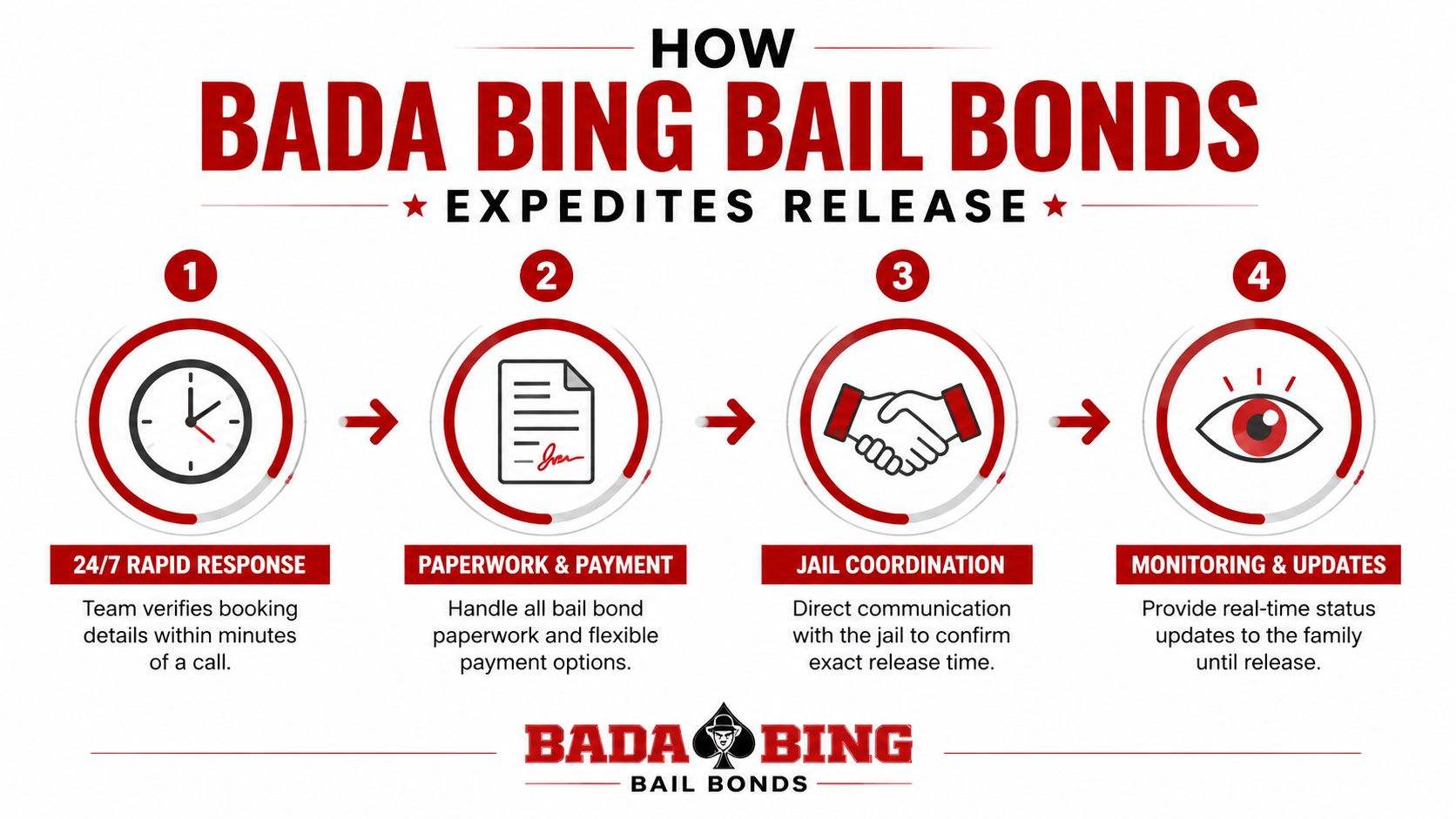
When a family calls, Bada Bing Bail Bonds can verify the booking details, confirm the listed bail amount, and ask whether an apparent hold or court requirement changes the release path. That initial verification matters because families shouldn’t commit financially based only on a name found in an incomplete record.
The agent can prepare the bond paperwork in advance, so the transaction is ready when booking has cleared and the jail can accept it. Payment arrangements, co-signer information, and any required collateral can be discussed before the file reaches the point where delay is caused by missing documents.
Coordination after the bond
The team can track movement from booking to housing and then to release processing, while keeping the family informed when paperwork has been accepted or the release process has begun. Families also need practical pickup information, including where to go and whether the person should expect additional waiting outside the facility.
That coordination is especially useful for a late-night arrest in Oxnard, a Ventura County Jail matter involving a Santa Paula resident, or a case that touches Thousand Oaks, Moorpark, Fillmore, Ojai, or Santa Barbara. A multi-county hold or transfer may require a different response than a routine local bond, and the family needs to know that before assuming a quick release.
The agency is available around the clock and can explain what it knows without promising a time the jail hasn’t confirmed. That distinction protects families from the most common misunderstanding, which is treating the moment a bond is submitted as the moment the discharge begins.
Cash Bail Versus Bail Bonds in Ventura County
Families generally compare two paths: paying the full cash bail amount directly or using a licensed bail bond agent to guarantee the court’s amount. The right choice depends on available funds, timing, refund expectations, and the complexity of the case.
California’s Department of Insurance explains that the court determines the bond amount and that the consumer cost is most commonly 10% of the total bond amount, plus permitted actual, necessary, and reasonable expenses tied to the transaction. For example, a $25,000 bail amount generally means a $2,500 premium before permitted expenses. See the California bail bond cost explanation for the governing consumer information.
| Factor | Cash Bail | Bail Bond |
|---|---|---|
| Amount paid upfront | The full court-set amount | A premium commonly based on 10% of the bond amount |
| Refundability | Subject to the court’s rules and case resolution | The premium is generally non-refundable |
| Processing path | Requires direct payment and court or jail verification | The agent submits a guarantee and related paperwork |
| Family finances | Ties up the full bail amount | Preserves more cash for counsel, housing, and household needs |
| Risk | The payer must follow court procedures to protect the deposit | The co-signer remains responsible under the bond agreement |
Cash can make sense when a family has the full amount available and understands the court’s handling of the deposit. A bond can make more sense when the amount is substantial, the arrest happens outside ordinary business hours, or the family needs to preserve funds for legal defense and essential expenses.
Families comparing terminology can review what a cash bond means before deciding. Neither option eliminates the jail’s booking, hold, medical, or release-processing requirements.
Your Action Plan When a Loved One Is Arrested
A calm sequence prevents the late-night call from becoming a series of disconnected guesses. Assign one person to communicate with the jail and bail agent, while others manage transportation, childcare, work notifications, and any needed attorney contact.
The first 15 minutes
- Collect identity details. Write down the full legal name, date of birth, arresting agency, approximate arrest time, and possible charge.
- Confirm the facility. Use the Ventura County Sheriff’s inmate lookup process or call the jail directly if the record isn’t available.
- Record the booking number. Keep the number, bail amount, listed charges, and every update in one place.
- Ask about the release path. Find out whether bail is set, a hearing is pending, or another agency may have a hold.
- Contact a licensed bail agent. A professional can explain the listed amount, begin paperwork, and identify missing information before booking is fully complete.
Prepare for the actual pickup
Have a government-issued ID, relevant income information, collateral details if required, and a reliable ride ready. Don’t send a driver to the jail based only on the fact that bail was posted. Wait for confirmation that release processing has started or that the jail has provided a usable pickup window.
Ventura County release materials describe processing as taking about 1 to 4 hours after it begins, while ordinary releases generally don’t occur between midnight and 6:00 a.m., with exceptions for bailouts and forthwith court releases. The federal jail data also shows why no single estimate works everywhere: from July 2022 through June 2023, people admitted to local jails spent an average of 32 days in custody before release, compared with 25 days eight years earlier, even though many people still leave quickly. Federal jail statistical tables show that release timing varies substantially by case and facility.
Practical rule: Ask what is holding up release, not simply whether the bond was posted.
Release patterns differ by pathway as well. One large jail-system study found that 59% of released people left within 48 hours of booking, while 3% left within 4 hours; among people released pretrial, 83% were out by 48 hours. The same source notes that 75% of people entering U.S. jails are released within 72 hours. The release-pattern research illustrates why a hearing, own-recognizance release, or pretrial supervision decision may follow a different schedule than money bail.
If a loved one has been arrested in Ventura, Oxnard, Camarillo, Port Hueneme, or a neighboring county, Bada Bing Bail Bonds can verify the booking, explain the bond and any known holds, and coordinate paperwork and release updates around the clock. Call now with the person’s full name, birth date, and arresting agency so the next step can begin while the jail completes its internal process.