You’re at the kitchen table with an envelope you didn’t expect. The words “Court Document” or “Urgent” may be printed across the front, and inside is a dense page filled with unfamiliar names, formal commands, dates, and signature lines. Your first reaction may be fear, especially if you’ve never dealt with a legal proceeding before.
A subpoena is easier to understand when you treat it as a map, not a verdict. It identifies the court and case, tells you whether you must testify or provide records, gives the place and time for compliance, and usually identifies the authority behind the demand. The exact appearance varies by jurisdiction and proceeding, but official forms share recognizable features. Federal court subpoena forms illustrate how standardized the basic layout can be.
Table of Contents
- The Moment You Open the Envelope
- Anatomy of a Subpoena From Top to Bottom
- How Civil Criminal and Federal Versions Differ
- Reading the Command Language and Service Details
- What to Do After You Are Served
- When an Arrest or Bail Bonds Come Into Play
- Quick Reference Checklist Before You Respond
The Moment You Open the Envelope
The paper may feel heavier than an ordinary letter because the language is direct. You might see your full name, a case title, a court name, and a command to appear or produce something. That combination can make the document seem like an accusation, but receiving a subpoena doesn’t by itself mean you’re charged with a crime or that a judge has ruled against you.
A subpoena is typically a court-issued document naming the person being served, the case or agency involved, and the required place, date, and time for appearing or producing records. It may arrive by personal delivery or another legally permitted method, and it often feels unexpected because the issuing party usually contacts you when your participation has become relevant to an active proceeding.
Start with the top of the first page. Look for the court’s name, the title of the proceeding, and any seal or formal court design. Those details anchor the document in a particular legal system. California Courts’ guidance, for example, directs a person seeking a trial or hearing subpoena to use the designated Civil Subpoena for Personal Appearance at Trial or Hearing, form SUBP-001, rather than treating an informal letter as the subpoena itself. Ventura County’s court system can help you understand which local court may appear on a document connected to Ventura, Oxnard, Camarillo, or another nearby community.
First response: Put the paper down, take a breath, and read it once without trying to solve every legal issue. Your first job is to identify what it is and when it requires action.
Don’t throw it away, write on the original, or assume a threatening tone means the document is fraudulent. Courts use formal wording because the subpoena must communicate a legal command. Once you identify the court, case, recipient, and deadline, the page becomes a set of questions you can answer one at a time.
Anatomy of a Subpoena From Top to Bottom
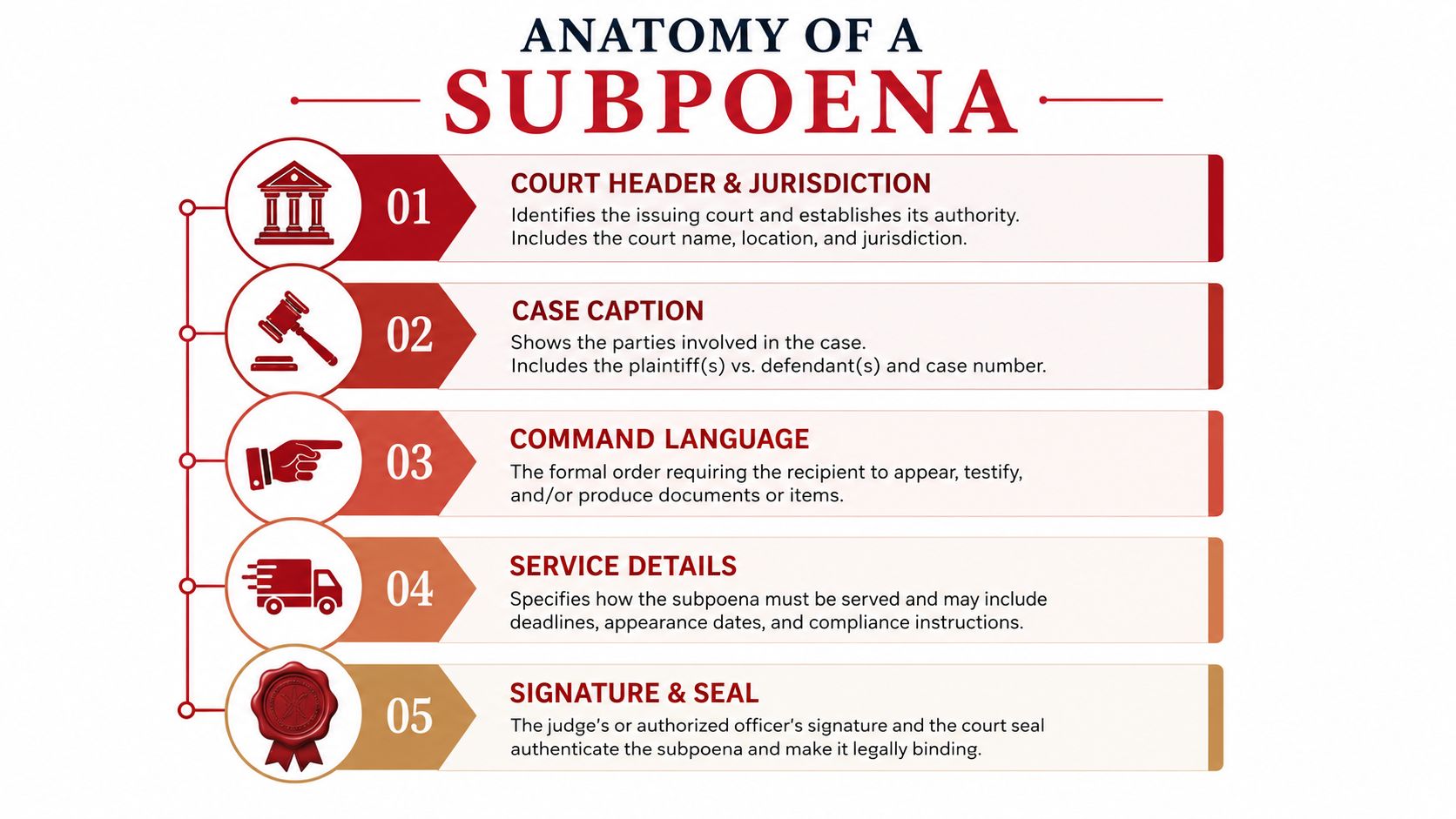
Read the document from top to bottom, as though you’re following a route on a map. Each block answers a different question, and missing or inconsistent information deserves attention before you respond.
Start with the court and caption
At the top, find the court header. It may identify a state superior court, a federal district court, or another tribunal, along with a division or location. The case caption usually follows, naming the parties and identifying the proceeding. A case number connects the paper to the court’s file and helps the clerk or attorney locate the correct matter.
The title often appears in a prominent position, such as Subpoena, Subpoena to Testify, or wording identifying a demand for documents. The title matters because it gives you an early clue about whether the issuing party wants your presence, your records, or both.
Find the command block
The central command section states what you must do. It commonly identifies the appearance date, time, and location, and it may direct you to bring particular records, objects, or electronically stored information. A document subpoena may separate the obligation to attend from the obligation to produce, which is why federal forms show distinct sections for appearance and production.
Look for the issuing party’s information next. This block may include the attorney or agency responsible for issuing the paper, along with contact details. Those details let you ask procedural questions, request clarification, or have your lawyer communicate about scope and timing.
Finish with authority and service
Near the bottom, check for a clerk’s signature date, an issuing authority’s signature, a seal, and service information. The return-of-service area records how and when delivery occurred, and may identify the person who served it. A practical fax legal documents guide can be useful when a legal office needs to transmit copies, but a transmitted copy shouldn’t be assumed valid without checking the governing court rules.
The federal form and federal subpoena rule show why these elements matter. A subpoena typically displays the court, proceeding, recipient, command, and issuing authority. If the page has no identifiable court, case, demand, or service information, pause and obtain legal guidance before treating it as complete.
How Civil Criminal and Federal Versions Differ
Three subpoenas can look similar at first glance while serving different purposes. The caption, issuing authority, and rule references usually provide the fastest way to tell them apart.
A civil subpoena commonly appears within a lawsuit between private parties. The caption may identify a plaintiff and defendant, and an attorney may issue the form under applicable court rules. A criminal subpoena may identify the State or People against a defendant and may come from a prosecuting office or a county or superior court. A federal subpoena generally identifies a United States District Court and refers to federal civil or criminal procedure.
| Feature | Civil Subpoena | Criminal Subpoena | Federal Subpoena |
|---|---|---|---|
| Caption | Private parties in a civil action | State or People against a defendant | United States District Court proceeding |
| Main demand | Testimony, records, objects, or inspection | Testimony or evidence connected with a criminal case | Testimony, documents, objects, or inspection under federal procedure |
| Issuing authority | Often an attorney for a party | Prosecuting authority, court, or authorized attorney | Federal court or authorized attorney |
| Header clues | State court name, civil case title, case number | County or superior court wording, criminal case title | United States District Court banner and federal case number |
| Signature and seal | State form requirements | Court or authorized issuing signature | Federal form signature and court identification |
Paper color isn’t a reliable authenticity test. Courts and issuing offices may use different approved forms, and a clean photocopy can look different from an original. Focus on the court name, case caption, case number, command language, date, issuing authority, and service details instead.
Federal and state proceedings can also involve different protections, deadlines, and objections. If a document from Ventura County refers to a state superior court, that’s a different pathway from a federal paper bearing a United States District Court heading. Readers comparing those systems may find this overview of California, federal, and immigration bail differences useful for separating court systems, although a subpoena itself isn’t a bail document.
Reading the Command Language and Service Details
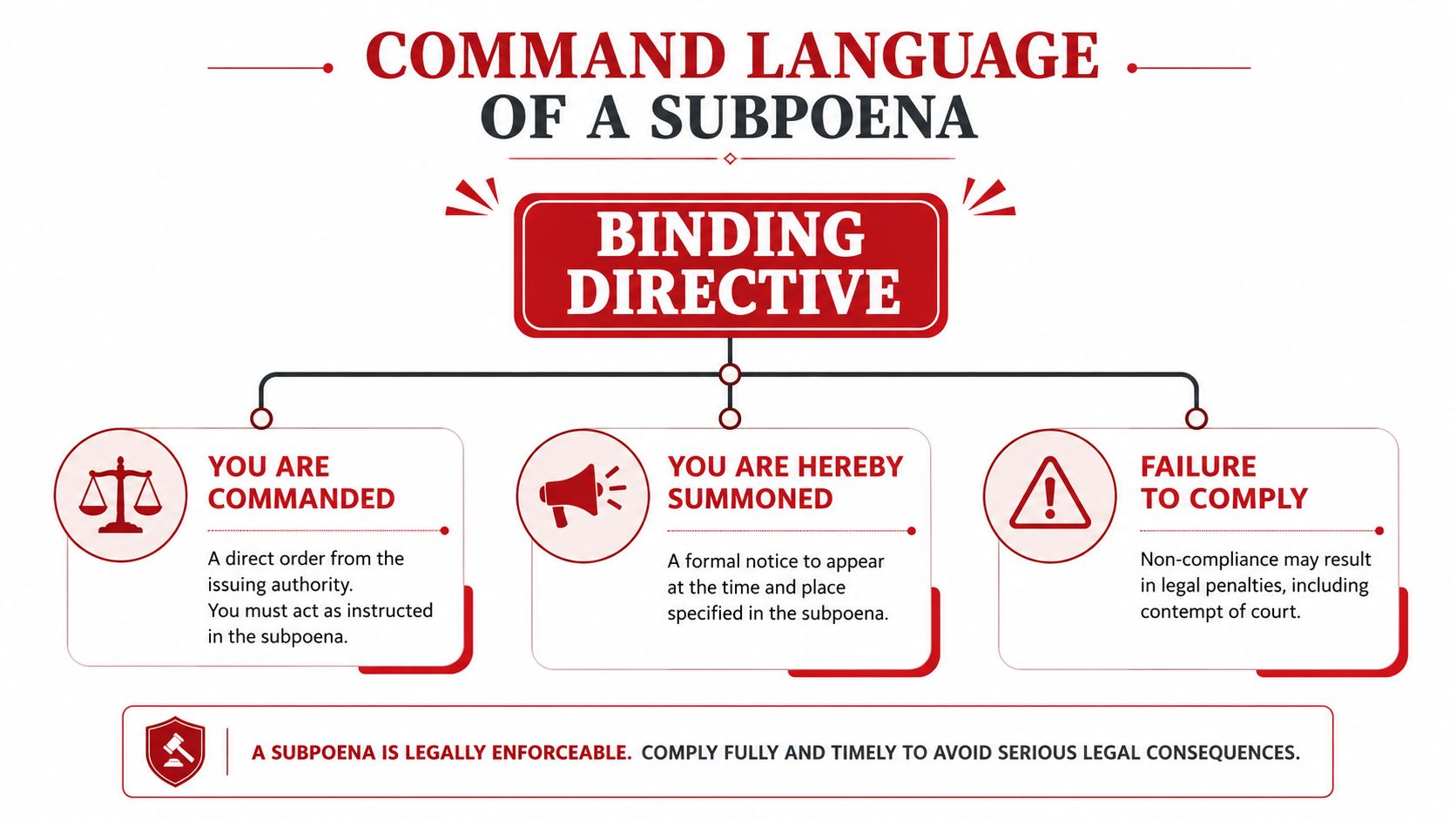
The command paragraph is the part that turns a page of information into a legal directive. Watch for phrases such as “YOU ARE COMMANDED” or “YOU ARE HEREBY SUMMONED.” The wording identifies an obligation, not a casual invitation, and the surrounding text should explain what you must do.
A subpoena typically states the place, date, and time for testimony or production. It may identify a hearing or trial, or it may provide a separate deadline for sending records. The document can also describe the consequences of failing to comply, including a potential contempt proceeding. Don’t assume that a mistake in the form automatically cancels the demand, and don’t assume that a defect is harmless. A lawyer can evaluate whether the issue supports an objection, motion to quash, or request to modify.
Separate testimony from records
The Latin labels may appear in the text or in related paperwork. Subpoena ad testificandum refers to a demand for testimony. Subpoena duces tecum refers to a demand to bring or produce documents, objects, or other specified materials. Some subpoenas combine both obligations, so read the command instead of relying only on the title.
Attachments and schedules deserve close attention. They may list categories of records, date ranges, locations, or specific items. Official civil-practice guidance explains that subpoenas commonly identify the action, court, issuing party, recipient, and the recipient’s duties and protections, with attachments used to describe requested items specifically. North Carolina’s subpoena practice guidance provides an example of that structured approach.
Inspect the service record
The service block may state who delivered the subpoena, the delivery method, and the date. A return-of-service certificate or proof-of-service stamp helps establish whether and when service occurred. Compare that information with your own recollection, but don’t argue with the process server or ignore the paper if the entry seems wrong.
Missing seals, incomplete signatures, an incorrect recipient, or unclear delivery information can raise authenticity or enforceability questions. Preserve the document exactly as received and show it to counsel. This video provides another visual explanation of command language and noncompliance concerns.
What to Do After You Are Served
The first hours matter because a subpoena can contain more than one deadline. Don’t begin by calling everyone named in the case. Begin by preserving the paper and extracting the information that controls your next move.
Make a clean record
Write down when and how you received the subpoena. Photograph or scan every page, including attachments and the envelope, then place the original in a secure folder. Keep a separate note of the server’s name, contact information, and anything said during delivery.
Read the demand twice. On the first pass, identify whether the subpoena requires personal attendance, document production, or both. On the second, list every date, location, category of requested material, and instruction about objections or delivery.
- Calendar every deadline: Record the appearance date and each production date, then set reminders early enough to obtain legal advice.
- Preserve potentially relevant material: Don’t delete messages, alter files, discard records, or ask another person to change anything connected with the demand.
- Separate originals from copies: Keep the original subpoena untouched and prepare working copies for counsel or document review.
- Check logistics: Confirm the courthouse address, parking or travel needs, accessibility concerns, and whether remote attendance is expressly permitted.
Choose a response path
You generally have three practical paths. You may comply fully, negotiate the scope or date through an attorney, or challenge the subpoena through a motion to quash or modify. The right choice depends on the issuing court, the requested information, privilege concerns, burden, timing, and whether your answers could create separate legal exposure.
If records are requested, organize them against the numbered categories in the attachment. Don’t volunteer unrelated files just because they’re nearby. If attendance is required, ask counsel whether witness fees, travel arrangements, or remote appearance rules apply in the specific proceeding.
Written record: Keep emails, letters, call notes, delivery confirmations, and agreements about extensions. A clear paper trail can prevent a later disagreement about what you promised.
You may need legal advice even when you intend to comply. A subpoena can involve confidential information, employment records, medical material, trade information, or testimony that overlaps with another investigation. If the document connects to an arrest or upcoming court appearance, learn how an arraignment works and tell counsel about the conflict immediately.
When an Arrest or Bail Bonds Come Into Play
Suppose your friend is arrested, and the next morning you receive a subpoena connected to the same incident. The paper may ask you to testify, while the arrest creates a separate question about release from custody. Those events can feel connected, but a subpoena and a warrant do different jobs.
A subpoena commands testimony or production. A warrant authorizes law enforcement to arrest or search, depending on its type. Ignoring a subpoena can lead to enforcement proceedings, and in some circumstances a court may issue a bench warrant after a person fails to appear. That possibility makes avoidance a poor strategy, but it doesn’t mean the subpoena itself is an arrest warrant.
Protect the witness role
A criminal case can create contact restrictions. For example, a person released on bond may be ordered not to contact a potential witness. That condition can affect ordinary conversations, transportation, document exchange, and family communication. Don’t assume that a bail agent can change a court order. Bail agents arrange bonds and communicate practical release information, while the court and attorneys address subpoena obligations and protective conditions.
Contact a defense lawyer or lawyer representing the witness as soon as the two matters overlap. Counsel may request a protective order, narrow the testimony, seek a different appearance date, or explain whether separate representation is necessary. If a subpoenaed person must appear in another jurisdiction or has a release-related obligation, coordinate the schedules with counsel and, where appropriate, the bail agent.
California release procedures can involve court orders, booking information, and county-specific practices. A plain-language explanation of how bail bonds work in California may help a family distinguish the bond process from the witness process, but it can’t replace advice about the subpoena itself.
When the papers converge: Tell each lawyer about every related hearing, release condition, and contact restriction. One overlooked date can create a conflict that counsel could have addressed in advance.
For families in Ventura, Oxnard, Camarillo, Port Hueneme, Thousand Oaks, Santa Paula, Moorpark, Fillmore, Ojai, or Santa Barbara, local jail and court logistics may affect travel and timing. People searching for Ventura County Jail bail bonds, bail bonds Ventura, 24-hour bail bonds Ventura, or bail bonds Oxnard may be dealing with an arrest at the same time as a subpoena. The safest response is coordinated preparation, not silence.
Quick Reference Checklist Before You Respond
Keep the subpoena beside you and move through it in document order. The goal isn’t to decide the entire case at the kitchen table. It’s to identify what the paper is, what it demands, and which deadline controls.
Verify the paper
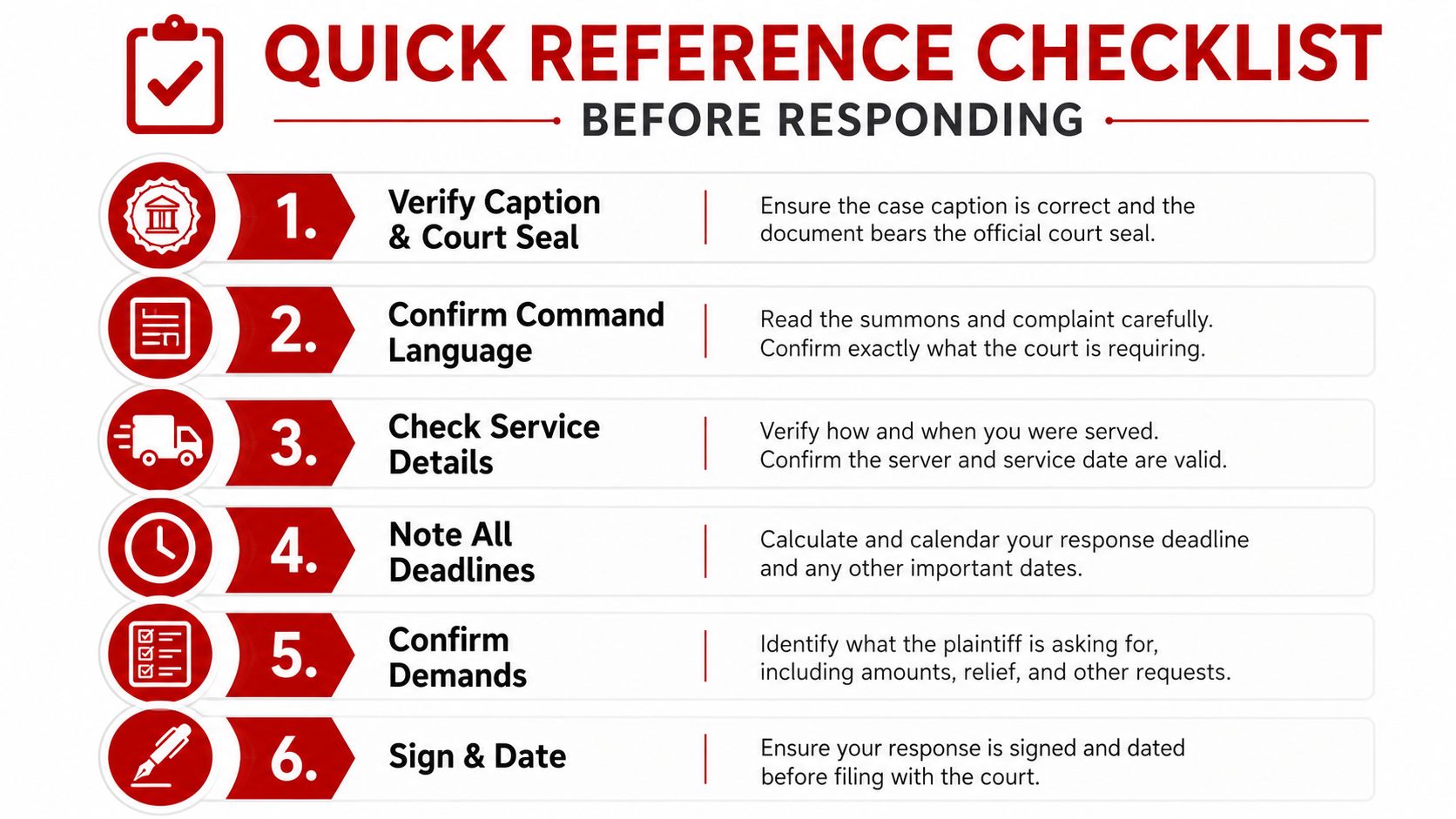
- Confirm the caption: Match the court name, proceeding title, parties, and case number.
- Look for formal authority: Check the court seal or other identifying court design, plus the clerk’s or issuing authority’s signature where required.
- Identify the subpoena type: Determine whether it demands testimony, documents, objects, inspection, or a combination.
- Read every command: Find the exact appearance location, time, production deadline, delivery method, and listed consequences.
- Review service details: Compare the service date and method with what happened, then preserve the return-of-service information.
- Check the requested materials: Use the attachment or schedule as an inventory. Mark items that may be privileged, confidential, unavailable, or outside your possession.
Decide what needs attention
Ask whether personal attendance is required or whether the form permits production without appearing. Ask whether a remote appearance is authorized, whether the requested records can be narrowed, and whether a motion to quash, modify, or seek protection may be appropriate.
Don’t rely on a search result alone to authenticate a paper. You can compare the case number and court information with the court’s official records, but a matching case number doesn’t answer every service or scope question. A lawyer can examine defects that aren’t visible from a basic docket search.
Put the next move on the calendar
Photograph the full document, preserve relevant records, contact counsel, and keep communications in writing. If the subpoena relates to a criminal matter, an arrest, or a release condition, tell counsel immediately. If someone misses a required appearance, the consequences can become more serious, so review what happens if you miss court rather than assuming the date can be fixed later.
The useful question isn’t “Does this look scary?” It’s “Which court issued it, what exactly does it command, and what must happen before the deadline?”
If you’re also dealing with an arrest in Ventura County, contact Bada Bing Bail Bonds for 24/7 help with booking verification, bail schedules, paperwork, payment plans, and release coordination. Visit Bada Bing Bail Bonds to speak with a local licensed agent and get clear next steps while you handle the subpoena through the appropriate court or attorney.