A phone call at two in the morning can turn a confusing breakup dispute into an urgent criminal matter. A family in Oxnard may be trying to learn whether their loved one is being held at Ventura County Jail, what Penal Code section applies, how much bail will cost, and whether a protective order will prevent contact after release.
California’s stalking laws reach beyond repeated messages. They can affect the criminal charge, a parallel restraining-order case, release conditions, and the practical steps required before someone leaves custody. This guide explains the process in plain English for families in Ventura, Oxnard, Camarillo, Port Hueneme, Thousand Oaks, Santa Paula, Moorpark, Fillmore, Ojai, and Santa Barbara.
Table of Contents
- A Late-Night Call and Why California Stalking Charges Move Fast
- How California Defines Stalking Under Penal Code 646.9
- Misdemeanor Stalking Versus Felony Stalking in California
- How Restraining Orders Change a Stalking Case
- How Stalking Affects Bail and Bond Costs in Southern California
- What Happens at the Ventura County Jail After an Arrest
- Next Steps for Families and Common Questions About Stalking Arrests
A Late-Night Call and Why California Stalking Charges Move Fast
At about 2 a.m., a mother in Ventura answers a collect call from the county jail. Her son says an officer arrested him after his former girlfriend reported unwanted texts and a drive-by near her workplace. He knows bail has been set, but he doesn’t understand why he can’t leave after the paperwork is signed.
That confusion is common. A stalking arrest can move quickly because police may treat repeated contact, threats, and an existing protective order as connected events rather than isolated arguments. The arrest record may also begin a second track involving a criminal protective order or a civil restraining order.

The family’s first questions usually sound practical:
- What was the exact charge? The booking record should identify the Penal Code section and whether the accusation is being treated as a misdemeanor or felony.
- What is the bail amount? The applicable county schedule and the facts alleged can affect the amount.
- Are there contact restrictions? A person may face no-contact or stay-away terms even if a bond is posted.
- When will release happen? Posting a bond starts a jail release process. It doesn’t guarantee an immediate walkout.
If the alleged victim is worried about personal safety, practical precautions matter alongside legal advice. A general practical night safety guide can help with immediate planning, but it can’t replace emergency assistance or a conversation with law enforcement.
Families often call a 24-hour bail bonds Ventura office before they have the full booking information. Try to obtain the person’s full name, date of birth, booking location, charge, and bail amount. A local agent can then explain the paperwork, co-signer requirements, and likely release sequence while a defense lawyer addresses the criminal case.
The rest of the process turns on what the prosecutor must prove, whether a court order was already active, and what conditions the judge attaches to release.
How California Defines Stalking Under Penal Code 646.9
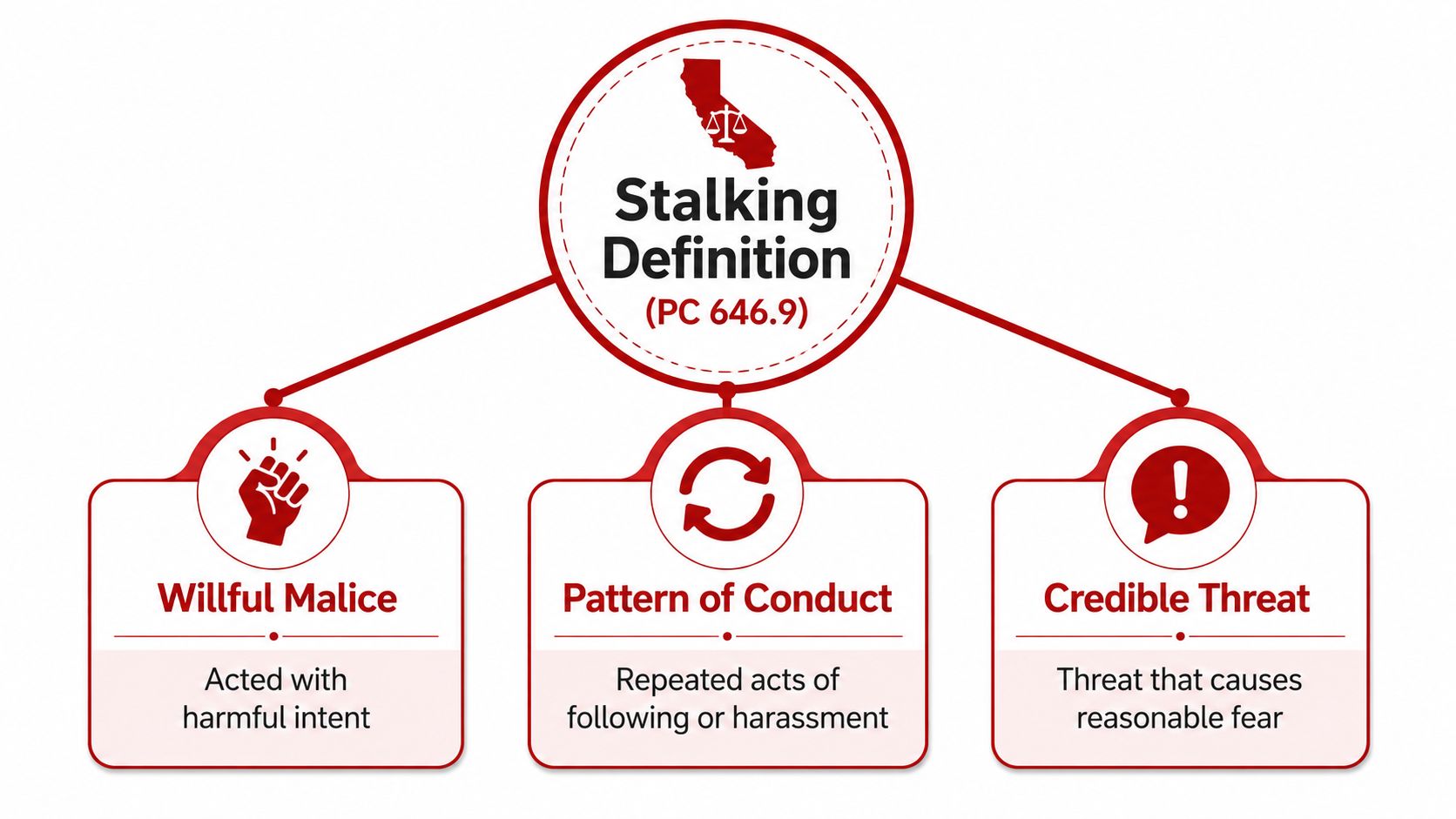
California Penal Code section 646.9 makes stalking a crime when a person willfully, maliciously, and repeatedly follows or harasses another person, makes a credible threat, and intends to place that person in reasonable fear for safety. The current statute provides for a base penalty that can include up to one year in county jail, a fine of up to $1,000, or both, or imprisonment in state prison. Read the current statutory language in California Penal Code section 646.9.
The conduct must be intentional
“Willfully” generally means the act wasn’t accidental. “Maliciously” points to conduct intended to disturb, injure, or interfere without a legitimate purpose. A prosecutor doesn’t need to show that every message contained an explicit threat, but the alleged conduct must fit the statute’s required pattern and threat elements.
Consider a former partner who repeatedly appears uninvited at a gym in Ventura after being told to stop, sends texts saying they’ll find the other person, and leaves voicemails from blocked numbers about where the person lives or works. Those facts could support a stalking allegation because the conduct combines repeated harassment or following with a threat that may cause reasonable fear.
The surrounding circumstances matter. A single polite attempt to return property, without harassment or a credible threat, isn’t automatically stalking. Likewise, reading scripture outside a workplace, with no threatening language or conduct, doesn’t by itself satisfy the statutory definition.
Repetition and credibility are separate questions
Repeated contact can include in-person following, messages, calls, online posts, or conduct directed through other people. A credible threat doesn’t have to be written as “I will hurt you.” The statute has been revised so implied threats and broader fear for safety can matter, rather than only direct threats of death or great bodily injury. Historical legal analysis reported 10 convictions under section 646.9 within the first year after enactment, as described in this McGeorge Law Review discussion of California’s stalking law.
Online behavior can create the same legal concern as in-person conduct when it forms part of the alleged following, harassment, or threat. Families sometimes use the term “cyberstalking,” but the important question is still what the messages, posts, account activity, and related conduct show. For a related explanation of online deception and criminal exposure, review whether catfishing is a crime.
A defense lawyer will examine the complete communication history, not just selected screenshots. Context, timing, prior instructions to stop, location records, witnesses, and any existing court order can change how the facts are evaluated.
Misdemeanor Stalking Versus Felony Stalking in California
The label on the booking paperwork matters, but it isn’t the final outcome. California stalking allegations can begin as a misdemeanor or become a felony based on prior history, an order violation, or other aggravating circumstances. Families should ask for the exact subsection, not rely on a shorthand description such as “stalking charge.”
The statute’s current base penalty includes up to one year in county jail and a fine of up to $1,000, or imprisonment in state prison, as stated in the official text of Penal Code section 646.9. The precise charging decision depends on the alleged conduct and the person’s record.
| Factor | Misdemeanor PC 646.9(a) | Felony PC 646.9(b) or (c) |
|---|---|---|
| Basic posture | Often associated with a first alleged offense without listed aggravating circumstances | May involve prior stalking history, an order violation, or other aggravating facts |
| Custody exposure | County jail exposure may apply | State prison exposure may apply |
| Court concern | Alleged repeated following or harassment and a credible threat | Increased concern based on history, order violations, weapons, prior felony history, or the alleged victim’s age |
| Release planning | Bail and conditions still depend on the booking and schedule | Bail may be higher or conditions more restrictive |
| Defense focus | Challenge the required elements and clarify the context | Address the current allegation plus the prior record or aggravating circumstance |
What can push the case toward felony treatment
Prosecutors may rely on a prior section 646.9 conviction, an alleged violation of a restraining order, a deadly weapon allegation, a prior felony conviction, or the alleged victim being a minor. A prior protective-order violation can also make the court view new contact as a direct challenge to an existing court command.
Felony treatment carries more serious consequences than a routine county-jail booking. It can create state-prison exposure and may raise separate questions about firearm restrictions, immigration consequences, employment, and future court orders. A defense attorney should review the charging documents before a family assumes the booking label tells the whole story.
Practical rule: Don’t post a bond based only on the word “stalking.” Confirm the subsection, the alleged enhancements, and every protective order attached to the case.
For families searching for 24hr Ventura County bail bonds, the immediate task is release planning. The legal defense remains a separate job for a criminal defense attorney, especially where the alleged conduct may be charged as a felony.
How Restraining Orders Change a Stalking Case
A stalking complaint may create a criminal case and a civil-protection issue at the same time. Those tracks serve different purposes, involve different court procedures, and can affect release conditions even before the criminal case is resolved.
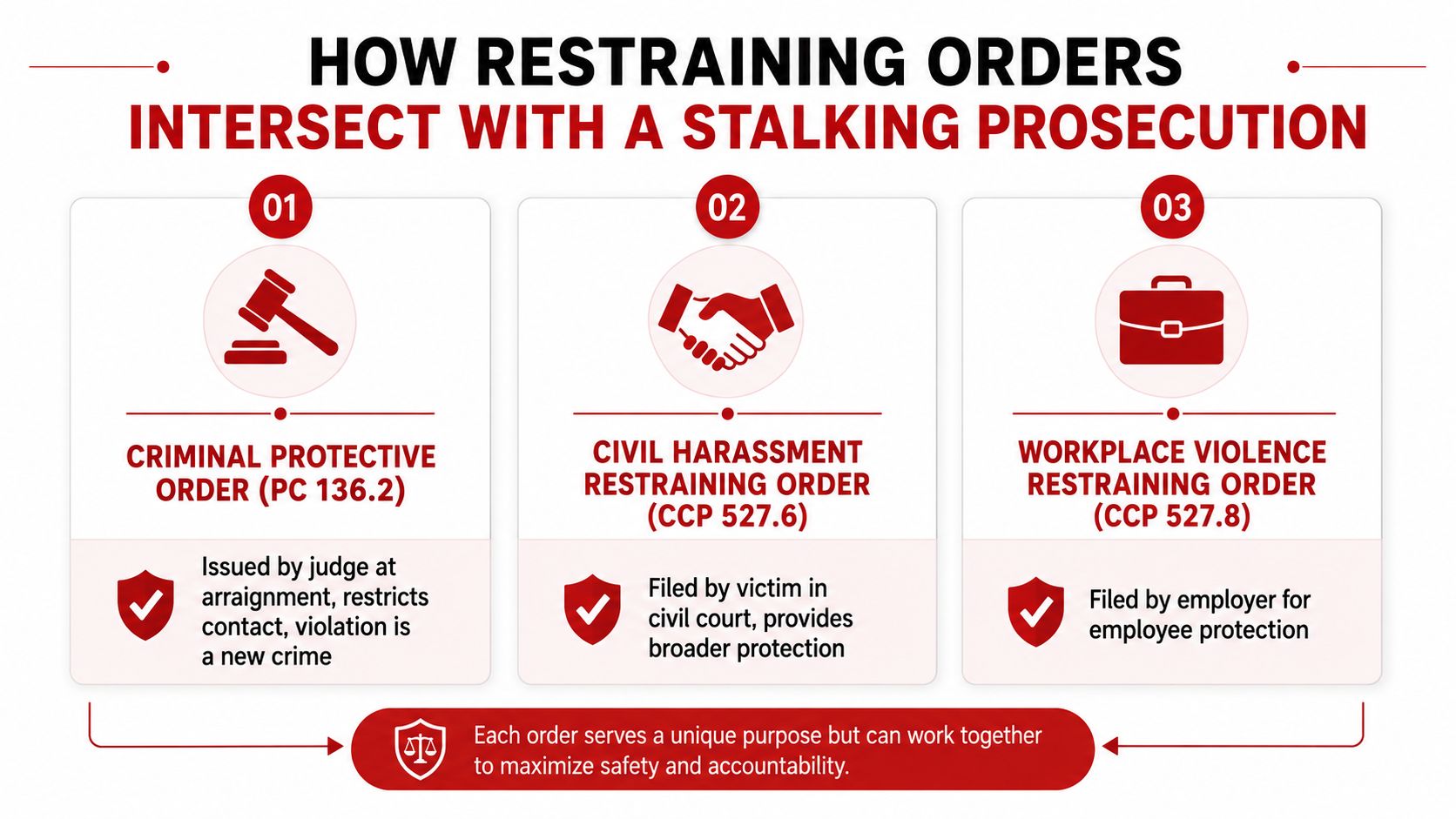
A criminal protective order is issued by a judge in the criminal case. It can prohibit contact, require a person to stay away from a residence or workplace, and restrict communication through other people. A civil harassment restraining order is requested by the person seeking protection in a civil proceeding. A domestic-violence order may apply when the parties have the qualifying relationship required by the Domestic Violence Prevention Act.
The California Department of Justice’s restraining-order report states that, on a given date in 2023, nearly two-thirds of active protection orders with firearm provisions were domestic violence restraining orders, and it identifies civil harassment restraining orders as one of the most common order types with firearm provisions. The report is available in the California DOJ restraining-order materials.
Three orders can create different problems
- Criminal protective orders: The judge can issue one during the criminal proceeding. Violating it may create a new criminal problem and may affect bail.
- Civil harassment orders: The alleged victim can seek protection from unwanted contact, following, threats, or harassment outside a qualifying domestic relationship.
- Domestic violence orders: A spouse, former partner, close family member, or another qualifying person may seek restrictions under the domestic-violence process.
California law also separately classifies stalking as a felony when a qualifying restraining order or other court order is already in place. That means an alleged new contact can matter twice, first as evidence in the stalking case and second as a possible order violation.
Release conditions can reshape daily life
A defendant may be ordered to avoid a shared home, school, workplace, gym, or neighborhood. The person may be prohibited from sending messages through friends, relatives, or social-media accounts. Even an attempt to “clear things up” can create a problem if the order says no contact.
Review the types of restraining orders in California with a lawyer and read the actual order issued in the case. Don’t assume that a victim’s willingness to talk cancels a judge’s order. Only the court can modify or terminate its restrictions.
How Stalking Affects Bail and Bond Costs in Southern California
A late-night arrest call often leads to one immediate question: “How much will release cost?” The answer starts with the charge and the county’s bail schedule, then changes with the booking classification, prior record, alleged protective-order violation, and any conditions the judge imposes.
A stalking booking is not priced from the charge name alone. If an existing restraining order is involved, the alleged conduct may create a separate order-violation issue and may lead the court to examine release conditions more closely. Prior violations can also matter under the applicable felony bail schedule, so families should not assume that one stalking case will be treated like another.
California’s Department of Insurance explains that the court sets the bond amount. For a surety bond, the consumer cost is most commonly 10% of the total bond amount, plus actual, necessary, and reasonable expenses connected to the transaction. Surety companies file their rates with the department, and agents must charge those filed rates. Families can review the state’s consumer guidance on bail bonds and premiums.
Because the available facts do not establish a Ventura stalking bail range, a responsible agent should not promise a “typical” amount or create a dollar example. Ask the jail or court for the actual bail amount before calculating the premium.
| Charge level | Typical bail range | 10% premium bond cost | Common added fees |
|---|---|---|---|
| Misdemeanor stalking | Varies by county schedule and case facts | Most commonly 10% of the court-set bond | Actual, necessary, and reasonable transaction expenses may apply |
| Felony stalking | Varies by county schedule, prior history, and alleged order violations | Most commonly 10% of the court-set bond | Actual, necessary, and reasonable transaction expenses may apply, with possible collateral requirements |
County schedules do not all work the same way
California counties publish their own bail schedules. Santa Barbara County’s 2025 felony bail schedule lists certain repeat DUI and domestic-violence-related cases at higher amounts. It also lists domestic-violence or battery conduct with a prior conviction for the same offense at $10,000, as shown in the Santa Barbara County felony bail schedule.
That example shows why families should not transfer an amount from a DUI or domestic-violence entry to a stalking booking. For Ventura, Oxnard, Camarillo, or another local jurisdiction, the agent needs the exact booking information and county schedule. A guide to California bail schedules can help explain how those schedules are used without guessing at the amount.
Release conditions can include no contact, stay-away terms, or electronic monitoring. They are separate from the premium and can change the paperwork a bondsman must complete before release. The family should also understand that a bond handles financial security for court appearance, while only the court can change a restraining-order condition.
What Happens at the Ventura County Jail After an Arrest
A late-night arrest can leave a family watching the clock and waiting for answers. In Ventura County, the person may be taken to the county detention facility for booking. Hearing that “the bond is posted” does not mean the person walks out immediately. Jail staff must still complete the release process.
Intake includes medical screening, a search, fingerprinting, identity checks, property records, and booking documentation. Staff also review the person’s bail status and any holds. A public defender may address the initial appearance or release issue. A private defense lawyer can give advice about the facts and the related criminal protective or restraining order.
The booking sequence has several moving parts
Families can use this general sequence to understand what is happening:
- Transport and intake: The jail receives the person and begins medical and property screening.
- Identification and records: Staff complete fingerprints, photographs, database checks, and booking documents.
- Bail confirmation: The court-set or schedule-based amount is checked against the booked charge.
- Bond paperwork: A licensed bail agent submits the bond after payment and indemnity documents are complete.
- Release review: Jail staff process the bond, check for holds, and confirm required release conditions.
- Pickup: The family arranges transportation, clothing, medication, and a destination that will not violate an order.
The Ventura County Main Jail is at 800 S. Victoria Ave., Ventura. Families can review the Ventura County Jail information guide for facility contact and bail-posting information. Confirm current details with the jail before relying on a phone number or posting instruction.
Posting the bond does not finish the release
Release commonly requires additional processing after the bond is posted. Jail workload, staffing, holds, paperwork, and release conditions can all affect the wait. Families can consult this Ventura County inmate release and bail information while the agent and facility provide updates.
The best pickup plan starts before the jail calls. Confirm where the person will leave, who can drive, and what clothing or medication is needed.
A person may need to sign conditional-release documents before leaving. In a stalking case, a no-contact rule or stay-away zone can make an ordinary pickup plan unsafe. Do not arrange a route through the protected person’s home, workplace, or school. The bond addresses financial security for court appearances. Only the court can change a criminal protective order or restraining-order condition.
Next Steps for Families and Common Questions About Stalking Arrests
The first few hours are easier when one person gathers facts and another handles communication. Don’t contact the alleged victim to negotiate, apologize, or ask for a statement to be withdrawn. That contact can create new evidence or violate an order.
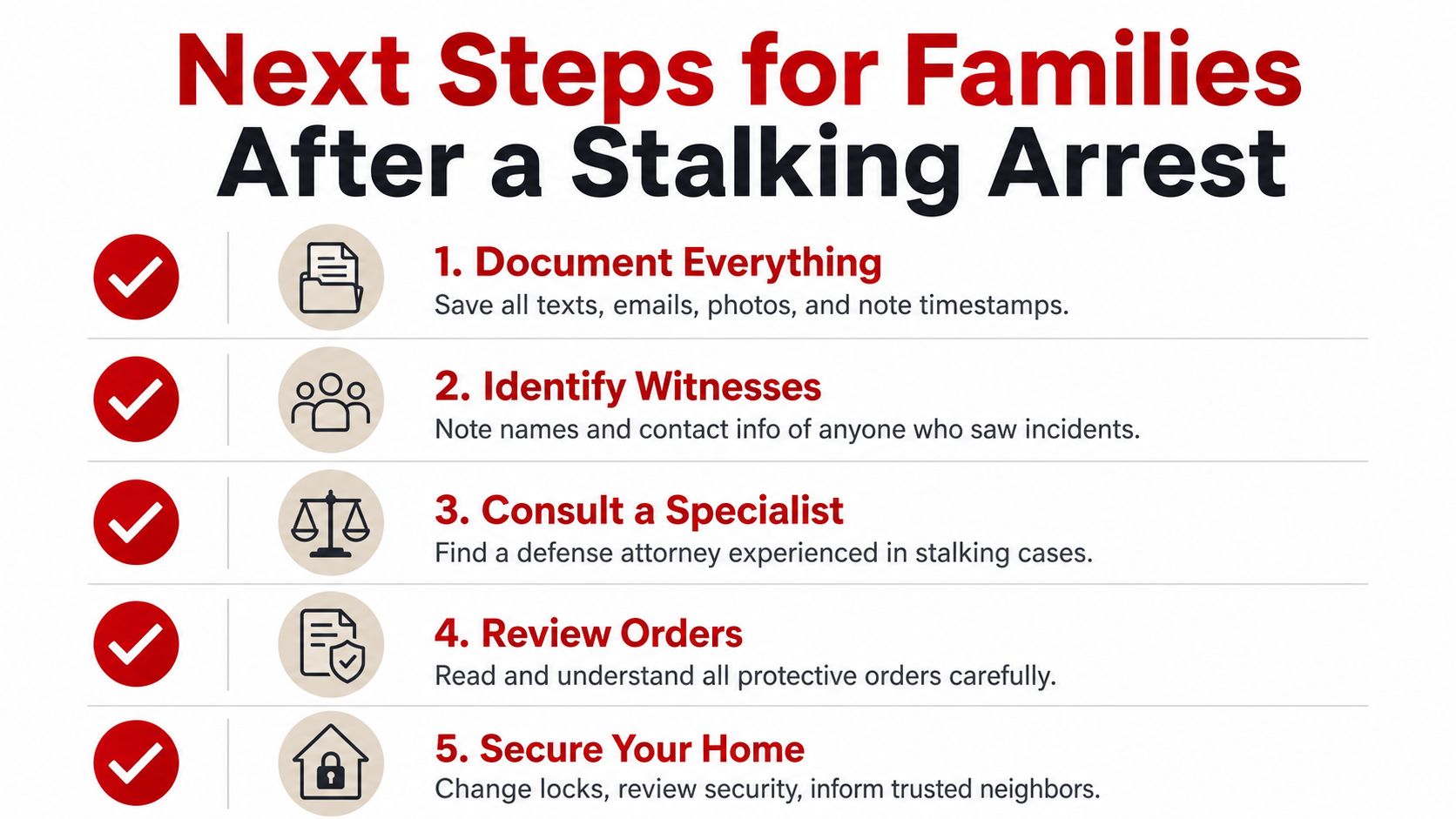
Use this immediate checklist
- Document everything: Save texts, emails, photos, call records, and timestamps. Keep the original files rather than editing screenshots.
- Identify witnesses: Write down the names and contact information of anyone who saw an encounter or received a message.
- Consult a specialist: Speak with a defense attorney who handles stalking allegations before discussing the facts with anyone connected to the case.
- Review orders: Read every criminal protective order and restraining order carefully. Follow the restrictions immediately, even if formal service is disputed.
- Secure the home: Change locks, review security, and tell trusted neighbors what to do if unwanted contact occurs.
Confirm the exact Penal Code subsection and bail amount on the Ventura County jail information system or by calling the facility. Then speak with a local agent about the 10% premium, payment plans, co-signer requirements, and any collateral discussion. A bail agent can address the bond paperwork, but only a lawyer can advise on defenses, plea decisions, or how to challenge an order.
Questions families ask during late-night calls
Can stalking be a misdemeanor or a felony?
Yes. The classification depends on the charged subsection, alleged facts, prior history, and any order-related circumstances.
Does a PC 646.9 conviction trigger a federal firearm prohibition?
The requested question involves a 10-year prohibition under 18 U.S.C. section 922(g). Because firearm consequences depend on the final conviction and the applicable federal and state rules, ask a criminal defense lawyer for advice before treating that consequence as automatic in a particular case.
Is violating a restraining order a separate offense?
Yes. California Penal Code section 273.6 addresses certain restraining-order violations, and an alleged violation can affect release or create a separate criminal case.
Can a Ventura County bail agent post quickly?
A licensed agent can often submit the bond after the family completes the paperwork, but the jail controls processing and release. Ventura County information states that release typically takes one to four additional hours after posting, so nobody should promise an exact walkout time.
For a free, confidential consultation about a stalking arrest, Bada Bing Bail Bonds can verify booking details, explain the court-set bond and 10% premium, and coordinate paperwork with Ventura County Jail. Visit Bada Bing Bail Bonds to speak with a licensed agent serving Ventura, Oxnard, Santa Barbara, and surrounding Southern California communities.