At 1:40 a.m., a mother in Oxnard gets a call she never expected. Her son missed an arraignment at Ventura County Superior Court, and someone has told the family that a warrant may be issued. She wants to know one thing first: what is bond revocation, and can anyone still fix this before he goes back to jail?
In plain English, bond revocation means the court cancels the defendant’s release. The defendant may be taken into custody, the bond can become financially exposed, and the co-signer may face demands involving the premium, collateral, or the full bond obligation. Revocation and forfeiture are related, but they aren’t identical. Revocation concerns the defendant’s freedom, while forfeiture concerns the money promised under the bond.
The details matter in Ventura, Oxnard, Camarillo, Thousand Oaks, Santa Paula, Moorpark, Fillmore, Ojai, Port Hueneme, and nearby Santa Barbara. A missed date, a new arrest, or a technical condition violation can set off a chain of court notices, warrants, custody decisions, and financial deadlines. Acting quickly can give the defense, the family, and the original surety more options.
Table of Contents
- What Bond Revocation Actually Means
- Common Triggers That Lead to Revocation
- How California Courts Forfeit and Revoke a Bond
- Financial Consequences for the Defendant and Co-Signer
- How Revocation Plays Out in Ventura County
- What a Bail Bondsman Can Do to Respond or Prevent It
- Prevention Tips for Families and Co-Signers
- Next Steps When Revocation Has Already Started
What Bond Revocation Actually Means
Bond revocation is the court’s formal decision to cancel a defendant’s release before the criminal case ends. Once release is revoked, the defendant no longer has the protection of the existing bond and may be returned to custody under a bench warrant, a hold, or a direct surrender arrangement.
That’s what the mother in Oxnard is facing. Her son might not have intended to avoid court. He may have written down the wrong date, gone to the wrong department, or believed someone else had confirmed the appearance. None of those explanations automatically prevents the court from treating the absence seriously. The judge still has to decide what happened and what should happen next.
California law separately addresses the financial side. Under California Penal Code section 1305, a court must declare a bond forfeited in open court when a defendant fails to appear for certain required proceedings, including arraignment, trial, judgment, or another appearance required before judgment. That doesn’t mean every alleged violation produces the same result, but it explains why a missed appearance can affect both custody and money.
Revocation and forfeiture are different
Think of the bond as a promise backed by financial responsibility. Revocation cancels the defendant’s permission to remain free. Forfeiture puts the bond’s financial value at risk. Courts may address both during the same sequence, but they serve different purposes.
A revocation can lead to a warrant and a return to jail. A forfeiture can expose the surety and co-signer to the bond amount under the applicable court process. The premium paid for arranging the bond also isn’t automatically restored because the defendant later returns to court.
The practical words families often hear are bench warrant, surrender, hold, and reinstate. A bondsman may discuss surrendering the defendant, checking whether a warrant has issued, asking whether the bond can be reinstated, or arranging a new bond if the original one can’t be restored.
Practical rule: Don’t wait for the defendant to call from a holding cell before you ask what happened. The original bondsman should be told about a missed appearance or alleged violation as soon as the family learns about it.
For a co-signer, the danger isn’t limited to the defendant’s custody status. The co-signer may have pledged property or signed an indemnity agreement that creates a separate financial obligation. That’s why a revoked bond can become a family emergency even before anyone understands the court’s final decision.
Common Triggers That Lead to Revocation
Ventura County courts can consider a range of alleged release violations. A revocation hearing is generally an evidentiary proceeding, not an automatic penalty. Texas law, for example, requires proof by a preponderance of the evidence before a magistrate may revoke a bond, while Indiana requires clear and convincing proof for revocation of bail or personal recognizance, as summarized in this comparison of revocation standards. California procedure depends on the charge, order, and circumstances, so a defendant should have counsel address the specific allegation.
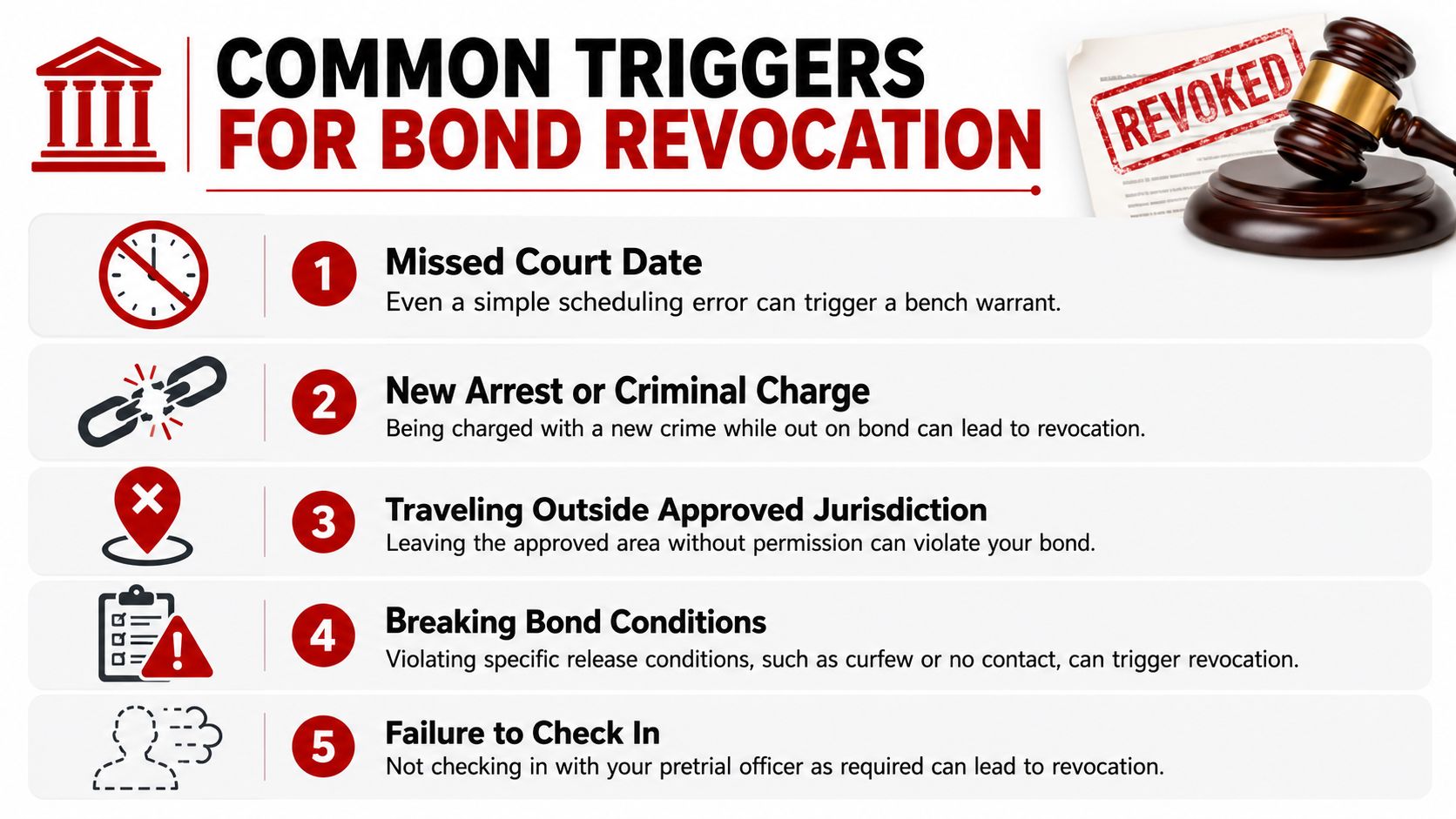
Five problems that commonly put release at risk
-
Missed court date: A scheduling mistake can still result in a failure-to-appear issue and a bench warrant. The court may allow an explanation, but families shouldn’t assume the defendant can appear later without addressing the warrant. The practical steps after a missed appearance are outlined in this guide to what happens if you miss court.
-
New arrest or charge: A new arrest while the defendant is already released can prompt the court to review the original bond. Allegations involving violence, a protected person, or interference with a witness can receive especially serious attention. An arrest is an allegation, not proof of guilt, but the release court can still consider the circumstances when reviewing conditions.
-
Failed or skipped testing: If a judge ordered drug, alcohol, or other testing, a missed appointment or failed result may be reported as a condition violation. The response might involve stricter testing, a modification of release, a hearing, or revocation, depending on the record and the court’s assessment.
-
Curfew, monitoring, or travel problem: A late return, an unapproved address change, travel outside an allowed area, or a monitoring alert can bring the defendant back before the court. A single alert doesn’t answer every factual question, but ignoring the alert or failing to communicate can make the situation harder to explain.
-
No-contact violation: Direct messages, calls through another person, or social media contact can create problems when a protective or no-contact order applies. California Penal Code section 166 addresses contempt-related conduct, and the court may treat an alleged violation as a serious release concern.
The defendant may get an opportunity to explain before release is finally revoked, but that opportunity can arrive after a warrant or motion has already been filed. A defense lawyer should address the allegation directly, preserve evidence of compliance, and avoid making informal statements that could be used against the defendant.
How California Courts Forfeit and Revoke a Bond
The California process usually begins with an event the court treats as a release problem, most commonly a missed appearance or an alleged violation of a release order. The court may issue a bench warrant, mark the bond as in arrears, and begin the financial forfeiture process while the defendant remains out of custody or is being located.
The surety’s notice is important. Under California Penal Code section 1305, when the bond amount exceeds $400, the clerk must mail notice of forfeiture to the surety or depositor within 30 days. That rule determines when the surety receives formal notice, but families shouldn’t treat the mailing window as permission to delay. The defendant’s custody status and the bond’s financial exposure can develop before everyone has the same paperwork.
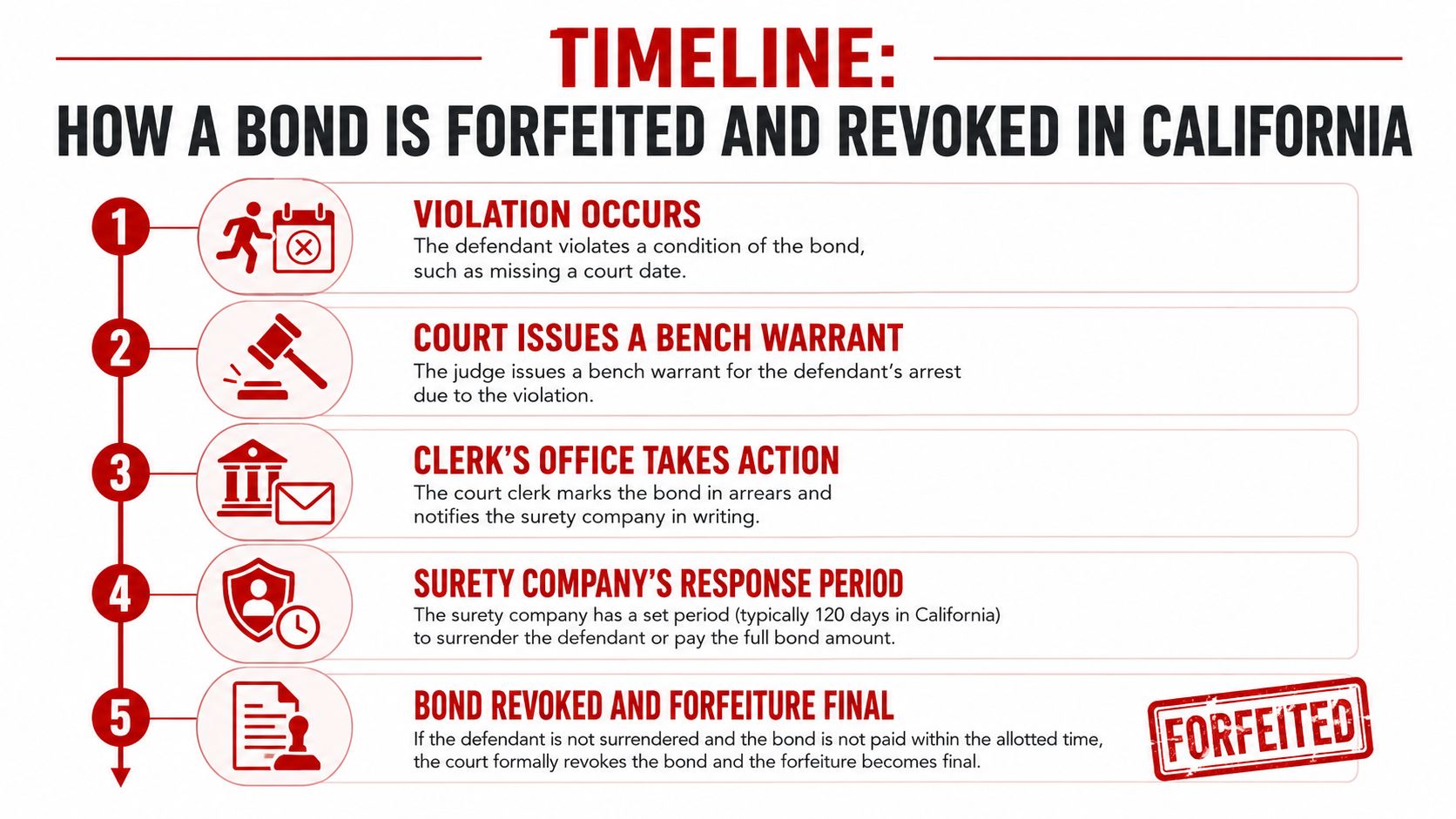
The two tracks running at once
The criminal court handles revocation. It decides whether the defendant should remain released, follow different conditions, or return to custody. The financial process concerns forfeiture, notice, surrender, and potential payment by the surety or responsible co-signer.
The district attorney’s office may pursue the court’s forfeiture position, while the surety can work through the statutory procedures to surrender the defendant or seek relief. California Penal Code section 1306 addresses the judgment side of forfeiture, and the surety may need a lawyer to move to set aside or challenge the forfeiture based on the facts and applicable deadlines. This explanation of bail forfeiture helps separate the financial judgment from the release decision.
A useful way to understand the sequence is:
- Missed date or alleged violation: The court receives information that a release condition may not have been followed.
- Bench warrant or court action: The judge may issue a warrant, set a hearing, or order another response.
- Clerk notice: The clerk records the forfeiture and mails required notice to the surety when the statutory requirements apply.
- Surrender or legal response: The surety and defense team evaluate whether to surrender, seek modification, request reinstatement, or challenge the forfeiture.
- Financial judgment risk: If the matter isn’t resolved under the applicable procedure, forfeiture can become a judgment requiring payment.
Revocation is therefore not just a label on the docket. It changes the defendant’s release status, while forfeiture can create a separate financial dispute that the co-signer must take seriously.
Financial Consequences for the Defendant and Co-Signer
A revoked Ventura County bail bond can affect three different parties, and those effects shouldn’t be blended together. The defendant may lose freedom and face new release conditions. The co-signer may face contractual responsibility for the bond and pledged collateral. The surety may owe the court if the bond is forfeited and may then seek reimbursement under the agreement.
The premium is the fee paid for the bond service. It generally isn’t treated like a refundable deposit that comes back whenever release ends. Collateral is separate. If property, funds, or another asset secured the bond, the agreement and the outcome of the forfeiture process determine whether that collateral remains protected or becomes exposed.
Who pays when a bond is revoked
| Party | What They Lose or Owe | When It Happens |
|---|---|---|
| Defendant | Freedom, release privileges, and potentially added costs connected with custody or new release terms | After the court revokes release, issues a warrant, or imposes stricter conditions |
| Co-signer | Possible responsibility under the indemnity agreement, including collateral exposure and reimbursement obligations | When the bond is threatened, forfeited, or the surety incurs covered losses |
| Surety | The bond amount owed under a final forfeiture, subject to applicable procedures and available legal relief | After the forfeiture process reaches the stage requiring payment |
| Defendant and co-signer | The paid premium may not be returned simply because the defendant is later arrested or surrendered | Under the bond agreement and the result of the case |
Exoneration is the outcome families want to understand. It means the bond obligation has been discharged under the applicable circumstances. It isn’t the same as forfeiture, which means the court is seeking the financial promise. The distinction is explained in this guide to what bail exonerated means.
The co-signer’s signature is a financial commitment, not merely a favor to a relative.
The smartest response is to protect the collateral before the situation becomes irreversible. That may mean contacting the bondsman, gathering proof that the defendant can be located and surrendered, and having a defense attorney address the alleged violation. Waiting can leave fewer choices, especially if the surety has already received formal notice or the court has entered a judgment.
How Revocation Plays Out in Ventura County
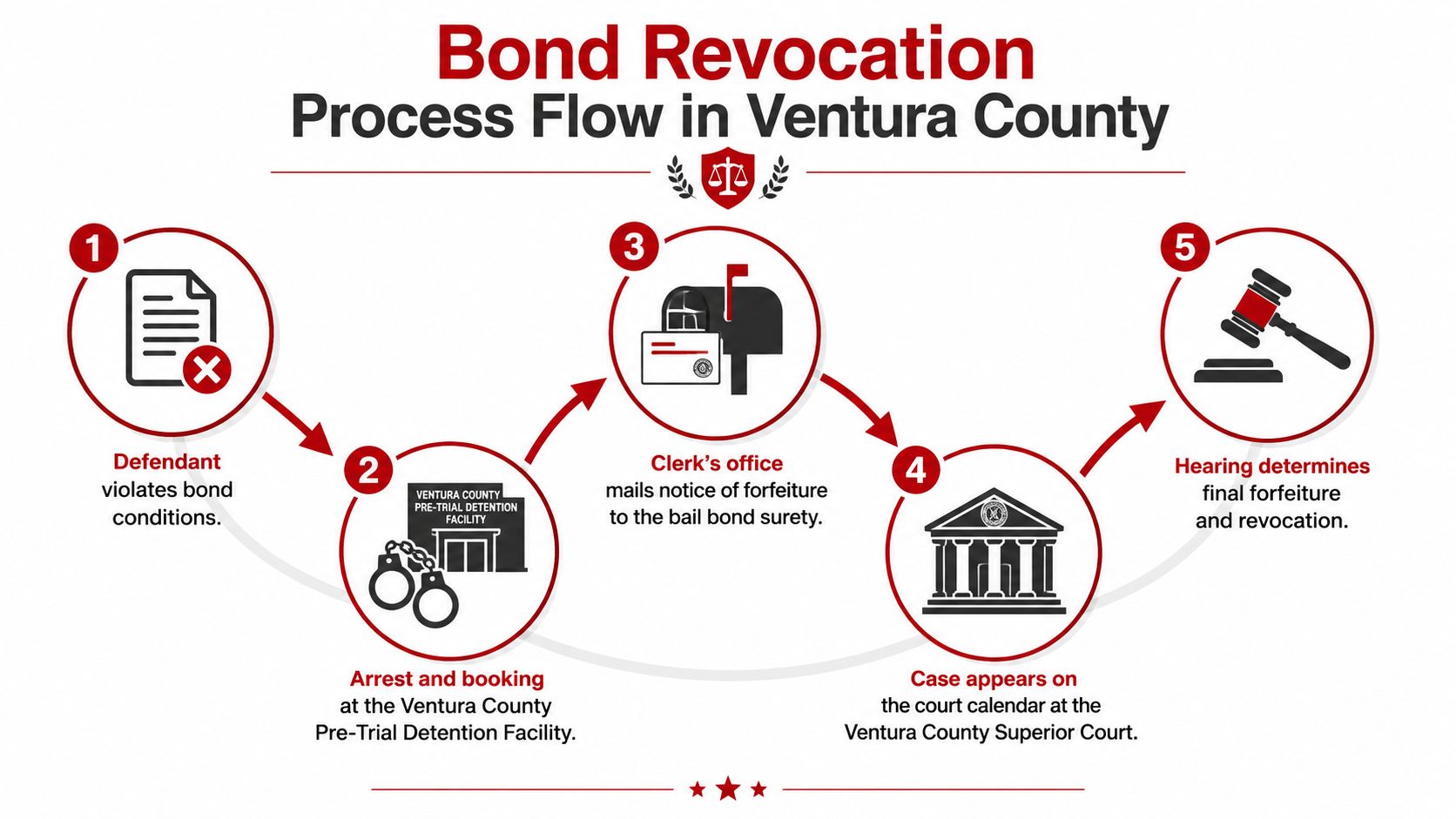
A Ventura County case can involve several local agencies in a short period. The defendant may first be booked at the Ventura County Pre-Trial Detention Facility, while the Ventura County Superior Court handles the criminal calendar and the Sheriff’s Department enforces an active warrant or custody order.
For families searching for Ventura County Jail bail bonds, the Sheriff’s Office states that bail may be posted at the Pre-Trial Detention facility at 800 South Victoria Avenue in Ventura. The listed payment options include cash in the exact amount, cashier’s checks payable to the Ventura County Superior Court, bail bonds, and credit or debit card payments through GovPayNet or by phone using PLC #6404. Details can change by facility, so confirm current instructions through the Ventura County Sheriff’s bail posting information.
The local sequence
A typical chain looks like this:
- The defendant allegedly violates a condition or misses a court appearance.
- The court may issue a warrant or set a hearing.
- The clerk sends required forfeiture notice to the surety.
- The matter appears on the Ventura County Superior Court calendar, often connected with the Hall of Justice.
- The court decides whether release will be revoked, modified, reinstated, or replaced.
The defendant may be transported, booked, and held while the legal response develops. A family member may be dealing with the jail, the court clerk, the defense lawyer, and the bondsman at the same time. The Ventura County court system guide can help identify the court functions involved, but it doesn’t replace case-specific legal advice.
Local bail amounts are tied to the applicable court schedule before a surety bond premium is calculated. California courts adopted the 2026 Uniform Bail and Penalty Schedules effective January 1, 2026, as shown in the published statewide schedule used by California courts. That schedule doesn’t decide whether a specific revocation motion succeeds, but it helps explain why the amount attached to a later bond can change when the court modifies release.
What a Bail Bondsman Can Do to Respond or Prevent It
A bondsman’s role changes once the court questions the bond. The immediate job is to determine what has happened, not to rely on a rumor from a relative, a text message, or an assumption that a warrant is active.
If the defendant can be located, the surety may evaluate a voluntary surrender. A controlled surrender can be preferable to allowing the Sheriff’s Department to find the defendant through an active warrant, but it doesn’t guarantee that the court will reinstate release or forgive the alleged violation. The defense attorney still needs to address the criminal matter and ask for the result the defendant wants.
Options worth discussing early
- Confirm the docket status: Find out whether the court issued a warrant, scheduled a hearing, declared forfeiture, or only noted a compliance concern.
- Protect the collateral: Review the indemnity agreement, identify the assets pledged, and document the status of the property before a dispute grows.
- Request a modification: The defense may ask for tighter conditions, a new testing plan, monitoring, a curfew, or another structure instead of full detention.
- Explore reinstatement: Reinstatement isn’t automatic. It may require court approval, surety consent, a motion, or proof that the defendant can comply going forward.
- Arrange a new bond: If the original bond is lost or can’t be restored, the family may need to discuss a replacement bond and its separate financial terms.
Families often call a 24-hour bail bonds Ventura office because the problem appears outside normal court hours. That call can help identify the practical next move, but a bondsman can’t give the defendant legal advice or guarantee a judge’s decision. For lawyers and legal teams evaluating workflow support, AI for lawyers may be a useful general resource, but it doesn’t replace counsel in a revocation hearing.
The original bondsman should be contacted before the family pays another company or sends the defendant somewhere without a plan. Understanding how bail bonds work in California helps explain why the surety that issued the first bond is usually the starting point for status, surrender, and collateral questions.
Prevention Tips for Families and Co-Signers
Most bond problems don’t begin with a dramatic decision. They begin with a missed message, an outdated address, a misunderstood condition, or a defendant who assumes a reminder will arrive automatically. Prevention is mostly coordination, and families can build that system before the first court date.
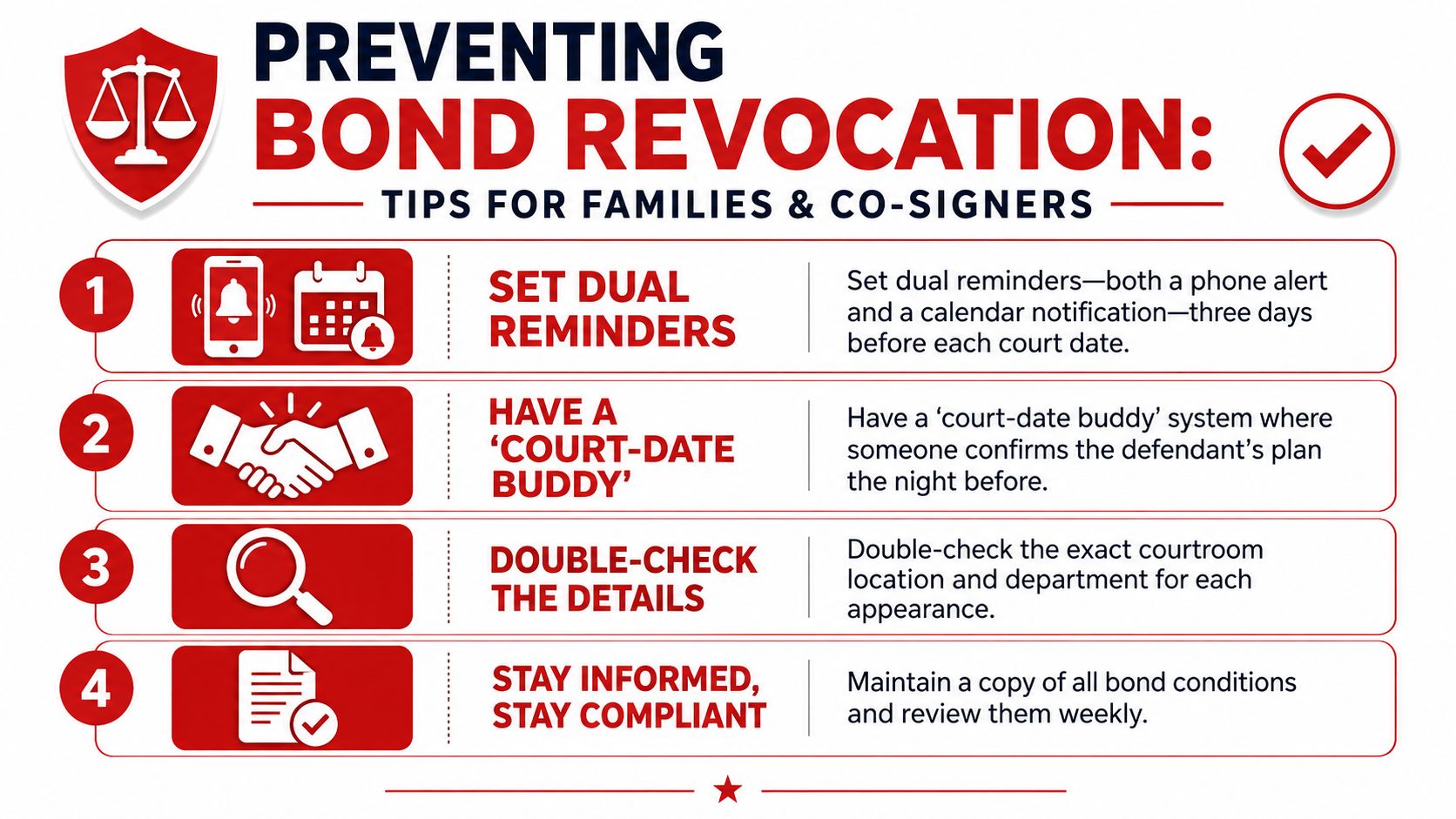
Start with the paperwork. Keep the bond agreement, release conditions, court notices, attorney information, and bondsman’s contact details in one place. The defendant should know the exact date, time, courthouse, department, and transportation plan for every appearance.
A practical family checklist
- Use two reminders: Put every appearance in a phone calendar and a second shared calendar. A phone buddy should confirm the plan with the defendant the night before.
- Verify the location: Confirm the Hall of Justice address, courtroom, department, and arrival plan before the appearance. Don’t rely on an old text or a remembered location.
- Prepare transportation and identification: Arrange a backup ride and keep required identification and paperwork ready. A dead phone or missed bus shouldn’t become a court crisis.
- Respect no-contact rules: Write down who the defendant can’t contact, including indirect contact through friends or social media. If the order is unclear, the defense lawyer should request clarification.
- Treat testing as a scheduled obligation: Put testing, treatment, check-ins, curfews, and monitoring requirements on the same calendar as court dates. The defendant should report a problem before missing an appointment.
- Report changes promptly: Tell the bondsman and attorney about a new phone number, address, job schedule, or travel need. Unapproved changes can create avoidable questions.
- Keep payment arrangements organized: If the court or surety requires a payment connected with reinstatement or a new bond, know which lawful payment method is available before an emergency.
- Save the contact correctly: Store the bondsman’s number under “Bail” so a family member can find it quickly during a late-night call.
A reminder system won’t cure a new arrest or override a no-contact order. It does prevent the ordinary confusion that turns a manageable problem into a warrant and a financial dispute.
Next Steps When Revocation Has Already Started
Start with facts, not panic. If a family member says the defendant missed court or violated a condition, call the original bondsman first and ask whether the bond is active, whether a forfeiture notice has been received, and whether a warrant or hearing appears in the available records.
Don’t use the defendant’s phone to contact a protected person, argue with a witness, or explain the alleged violation. Preserve messages and documents, but let the defense attorney decide what should be presented to the court. A well-intended family conversation can create a second problem when a no-contact order applies.
Follow this order
- Confirm the status: Ask about the case number, court date, alleged violation, warrant status, forfeiture status, and any notice sent to the surety.
- Gather the bond file: Collect the original bond paperwork, premium receipts, collateral documents, co-signer information, court notices, and the defense lawyer’s contact details.
- Choose the response with counsel: Depending on the facts, the options may include a voluntary surrender, a motion addressing the warrant or forfeiture, a request to modify conditions, reinstatement, or a new bond.
- Protect the defendant’s legal position: Don’t make admissions to police or court personnel without legal advice. The bondsman can explain the bond process, while the defense lawyer handles the criminal allegations.
- Keep communication open: Give the bondsman accurate phone numbers, addresses, work information, medical details when relevant, and any reliable location information for the defendant.
Voluntary surrender may reduce the risk of a chaotic arrest, but it isn’t a guaranteed way to avoid custody or preserve the bond. Contesting the revocation may be appropriate when the facts are disputed, but a court motion requires a lawyer who understands the case and the applicable California procedure.
Have the defendant’s full name, date of birth, booking information if available, case number, court location, bond paperwork, co-signer details, and collateral records ready before calling. If you’re looking for fast bail bonds Ventura, bail bonds Thousand Oaks, bail bonds Oxnard, or service near Camarillo, Santa Paula, Moorpark, Fillmore, Ojai, Port Hueneme, or Santa Barbara, clear information lets the local agent work without wasting the first call.
Bada Bing Bail Bonds offers 24/7 local assistance with Ventura County bond status, surrender questions, reinstatement discussions, co-signer concerns, and new-bond options when release has been revoked or threatened. Visit Bada Bing Bail Bonds now, and have the case number, defendant’s details, and original bond paperwork ready so an agent can explain the next practical step.