
If the phone rings after midnight, the first thoughts usually hit all at once. Where is he being held, what’s the bond, was anyone hurt, and what do I tell the kids in the morning? That kind of panic is normal, but the first few hours matter because the charge can set both the criminal case and any separate protective-order issue in motion before the family has even had time to breathe.
For families looking at assault on a female NC, the confusion usually starts there. The label sounds simple, but the law is built around who the accused is, who the alleged victim is, and what happened in the moment, not just whether anybody ended up with visible injuries. If you’re trying to sort out a late-night arrest, what to do when someone gets arrested is the right first conversation to have while the details are still fresh.
Table of Contents
- The Phone Call That Starts Everything
- What the Statute Actually Says
- Sentencing Ranges and Misdemeanor Levels
- How This Charge Compares to Related Offenses
- When No Visible Injury Still Means a Charge
- Defenses That Actually Get Used
- Bail, Pretrial Release, and Protective Order Overlap
- Practical First Steps for Families
The Phone Call That Starts Everything
The call usually comes from a county detention center, and it arrives when the house is quiet enough for every detail to feel louder than it should. One parent is still trying to figure out the charge, another is staring at a phone that keeps lighting up, and somebody else is wondering whether this is a misunderstanding or the start of something bigger. That confusion is exactly why the first decision should be careful, not fast.
Start with the basics, not the fear
When a person is booked, jail intake and the initial magistrate appearance happen before most families have a chance to talk through what occurred. The magistrate looks at the charge, the booking information, and the initial facts the officers put forward, then decides whether release can happen and on what terms. That is the moment when a family often has to decide whether to post bond, wait for more information, or call counsel first.
Practical rule: don’t assume the quickest release is the safest one. A rushed bond decision can make it harder to respond to a separate no-contact order or to correct a mistaken narrative later.
The impulse is usually to fix everything with one phone call. In reality, the criminal case and any protective-order track can split apart quickly, and what seems like a simple misdemeanor can carry consequences that reach into housing, contact, and custody discussions. That’s why families should slow down long enough to understand the charge before they hand over money or start making promises to other people involved.
Avoid the early mistakes that create bigger problems
The most common early mistake is trying to clear things up directly with the complaining witness while emotions are still high. A text that sounds apologetic can be read later as an admission, and a phone call from jail can become evidence if a no-contact order is in place or gets issued soon after. Another mistake is posting on social media before anyone has even seen the charging paperwork.
The better move is simple. Write down who called, what was said, where the arrest happened, and whether any children were present. Then decide, calmly, who should make the attorney call and who should handle the practical work at home, like rides, work, and school pickup. That structure helps the family stay focused while the case starts moving through a system that doesn’t wait for anyone to catch up.
What the Statute Actually Says
North Carolina’s assault-on-a-female law is not built around injury first. It is a status-based statute, which means the law cares about who the accused is and who the alleged victim is, then asks whether an assault occurred. Under G.S. 14-33(c)(2), the offense applies when a male person at least 18 years old assaults a female, and the statute is codified as a Class A1 misdemeanor, the state’s highest misdemeanor class. North Carolina General Statute 14-33
Why the statute works like a train schedule
A thermometer measures how hot something is. This charge works more like a train schedule, because the law is tracking who the passengers are and whether they got on the right train, not how dramatic the ride felt. If the sex and age elements fit, prosecutors still have to prove an assault, but they do not need a broken bone, a hospital trip, or even a visible mark.
In North Carolina, an assault can include an attempted battery or conduct that puts another person in fear of imminent harm, and it can also include offensive physical contact. That is why grabbing, shoving, or an attempt that misses can still matter. Families often expect a line like “no injury, no case,” but that’s not how this statute is described in legal explanations.
A lot of people hear “assault” and picture a serious beating. Under this charge, the law can focus on a much smaller moment, a hand on an arm, a shove in a doorway, or a movement that made the other person fear contact.
What prosecutors still have to show
The statute doesn’t automatically fit every argument between adults. Prosecutors still need the assault component, plus the age and sex conditions that trigger this specific offense. Just as important, the charge does not require a romantic relationship, a domestic-violence label, or a showing that the other person ended up with a medical diagnosis.
That distinction is where families get tripped up. They often assume a breakup changes the charge, or that a domestic context creates a separate offense by itself. In practice, the same set of facts can travel through more than one legal lane, and the label on the warrant is only one part of the picture.
Sentencing Ranges and Misdemeanor Levels
The headline fact is simple, assault on a female is a Class A1 misdemeanor. In North Carolina, a published defense-law summary explains that Class A1 misdemeanors are the only misdemeanor class where active jail time can be imposed even without a prior record, and it notes sentencing ranges can run from 1 to 150 days depending on prior conviction level. The same source also cites 29,483 statewide district-court charges in 2015 for assault-on-a-female and assault-by-strangulation combined, which shows how often these matters move through the system. Defense-law summary on assault on a female in North Carolina
Reading the punishment tiers without the jargon
The judge’s maximum authority is not the same thing as what a first-time defendant will serve. Structured sentencing looks at prior convictions, then places the case into a range that can include active time, intermediate sanctions, or community-based punishment. A fine can also be added, and the statute allows a maximum jail exposure of up to 150 days. North Carolina General Statute 14-33
Assault on a Female NC: Class A1 Misdemeanor Sentencing Tiers
| Prior Record Level | Punishment Range | Maximum Fine |
|---|---|---|
| No prior record | Active, intermediate, or community punishment depending on the court’s sentencing view | As authorized by court |
| Prior Class A1 conviction | Higher exposure within the Class A1 misdemeanor framework | As authorized by court |
| Prior Level 1, 2, or 3 convictions | Increased sentencing exposure under the misdemeanor framework | As authorized by court |
The table above is a quick map, not a promise. The actual outcome depends on the record, the facts, and what the prosecutor can prove. A person with no record may still be facing serious consequences, but the court still has room to consider alternatives in the right case.
Why this matters before anyone posts bond
A family sometimes hears “misdemeanor” and assumes the problem is minor. That word can be misleading, because active custody is still possible, and the long-term impact can be larger than the label suggests. If you’re trying to understand whether the case is being treated as a misdemeanor or something more serious, felony vs. misdemeanor differences is a useful plain-English reference point while the attorney reviews the paperwork.
How This Charge Compares to Related Offenses
Assault on a female is often confused with other North Carolina charges because the facts can overlap even when the statutes don’t. The quickest way to separate them is to ask four questions, who was involved, was there physical contact, was there a threat instead of contact, and was there already a court order in place. Those details usually decide which charge fits.
Side by side, the statutes do different jobs
Assault on a Female vs. Related North Carolina Offenses
| Offense | Statute | Key Element | Typical Class |
|---|---|---|---|
| Assault on a female | G.S. 14-33(c)(2) | Male defendant 18 or older assaults a female | Class A1 misdemeanor |
| Simple assault | G.S. 14-33(a) | Assault without the sex-and-age trigger | Misdemeanor assault |
| Communicating threats | G.S. 14-277.1 | Threats communicated in a way that places another in fear | Misdemeanor offense |
| Protective-order violation | G.S. 50B-4.1 | Violating an active domestic-violence order | Separate offense tied to the order |
The practical difference is bigger than the names suggest. A verbal threat is not the same thing as physical contact, and an active court order changes the whole case because the defendant is no longer just dealing with a dispute, they’re dealing with a direct court command. Assault on a female is also not a separate violent felony, and it is not automatically a domestic-violence designation, even though it often appears in domestic situations.
The protective-order track can run alongside the criminal case
That separate civil track is where families are often least prepared. A Chapter 50B complaint can lead to restrictions that affect contact, housing, and child exchanges before the criminal case is resolved. A worried spouse or parent may hear one charge and think only about court dates, when the bigger daily disruption is the order that can limit who can come home, who can call, and who can stay in the same space.
For another common charge that gets mixed into these cases, what counts as felony stalking helps show how North Carolina separates threatening conduct from physical assault when the facts start to spread across more than one event.
When No Visible Injury Still Means a Charge
The bruise never shows up, the ambulance never comes, and still the arrest happens. That is the part most families struggle with, because they expect the law to wait for a visible injury before it reacts. In these cases, it usually doesn’t.
A no-mark argument can still trigger both tracks
A couple argues in the kitchen. Someone calls 911, officers arrive, and the people are separated into different rooms. One person gives a written statement saying there was unwanted touching or an attempted grab, and that account is enough for the magistrate to consider a warrant or release conditions even if no one went to the hospital.
That is because the charge focuses on force, attempted force, or offensive touching, not just medical evidence. A visible injury can help prove a case, but it isn’t required as a legal element. The same alleged facts can also support an ex parte protective order, which means the court can act quickly on one side’s sworn statement and put rules in place before the other side has had a full chance to respond.
Practical takeaway: if the police were called to a home, the absence of blood or broken bones does not end the analysis. The statement, the timing, and the officers’ observations can still move the case forward.
Why the civil order changes daily life so fast
The civil order can reshape housing, contact, and child-related routines within hours. That’s often the hardest part for families, because they’re trying to understand a criminal charge while also adjusting to an immediate no-contact structure. If the order says no contact, then a text, a phone call from jail, or an attempt to work through a third party can become a new problem on top of the original arrest.
People feel blindsided. They thought they were dealing with one courtroom issue, but the order can affect where someone sleeps that night, who picks up the children, and how the household communicates until the next hearing. The result is a legal situation that looks small from the outside and feels enormous at the kitchen table.
Defenses That Actually Get Used
The defenses that matter most in these cases are usually the ones tied to ordinary human behavior, fear, confusion, and bad timing. That means self-defense, lack of intent, and identity disputes come up often, because families usually argue about what happened in a messy few seconds, not in a scripted confrontation.
Self-defense, accidental contact, and mistaken identity
Self-defense and defense of others are the first places many lawyers look. The point is proportionality, if someone was reaching, hitting, or otherwise using unlawful force, the response still has to stay within what was necessary. A shove to create space is a very different story from a hard strike after the other person had already backed away.
Lack of intent matters too. Sometimes touching happens during a crowded doorway, a struggle over a phone, or a consensual encounter that turns chaotic. If the contact was accidental or part of a situation that got out of hand, the proof needs to show more than frustration or an argument.
Evidence wins these cases more than labels do. A 911 recording, body-worn camera footage, photographs, third-party witnesses, and text messages can show whether the contact was defensive, accidental, or misread.
When the only witness is the complaining witness
Identity disputes show up when the state has one account and little else. If there’s no corroborating physical evidence, the defense may focus on inconsistencies, bad lighting, confusion during the call, or whether the witness had a reason to exaggerate. Relationship-driven cases can also involve false accusation dynamics, especially when the conflict is tied to housing, custody, or a breakup.
That doesn’t mean every accusation is false. It means the court should see the whole context, not just the first version that landed in the police report. In cases where trauma is part of the backdrop, a family member may also need support outside court, and Interactive Counselling trauma services can be a meaningful resource when someone is trying to process the fallout while the legal case is still unfolding.
Bail, Pretrial Release, and Protective Order Overlap
A family often gets two calls at once after an arrest, one about release from jail and one about a no-contact problem that starts right away. In North Carolina, a magistrate may set a secured bond, an unsecured bond, or a written promise to appear, and a separate custody hold can still slow release until the paperwork clears. That is why this charge can reach daily life before the criminal case has even settled into a routine.
A pretrial release hearing can add more rules after bond is set. Supervision, check-ins, GPS monitoring, or a third-party custodian may be ordered if the court wants to protect the alleged victim or make sure the defendant comes back to court. The process also runs alongside the civil side of the case, where domestic violence protective order eligibility NC helps explain how a separate order can shape contact, housing, and family routines very quickly.
How release conditions stack up
The bond and the protective order do different jobs, but they can collide in practice. Bond is about release from jail, while a protective order can control who may call, text, visit, or pass messages through another person. For families used to comparing systems across state lines, a California-style restraining-order framework shows that other states also separate release rules from contact rules, and types of restraining orders in California gives a plain example of that split.
A simple way to read the situation is this: one order answers, “Can the person get out?” The other answers, “Who can they reach once they are out?” Those questions are related, but they are not the same.
| Factor | North Carolina Approach | California-Style Restraining Order System |
|---|---|---|
| Bond setting | Magistrate or judge can set secured, unsecured, or written promise release | Separate court process can restrict contact |
| Release conditions | Supervision, GPS, or custodian conditions may be added | Contact limits may stand on their own |
| Protective order overlap | 50B order can add no-contact limits quickly | Domestic-violence and restraining-order rules can also control contact |
Why the bond and the order can collide
A no-contact order can bar direct or indirect communication, even if a friend says they are only helping with logistics. If a jail call goes out, that call may be recorded and later reviewed for violations. A court may also treat contact about bond money, pickup plans, or family updates as a problem if the order is broad enough.
That overlap is where families get tripped up. The criminal case may allow release, but the civil order can still block contact, and the wrong text message can create a new issue on top of the old one. A bond company can help with the release paperwork, but it cannot change a judge’s no-contact limits. Bada Bing Bail Bonds can coordinate the jail-side steps, while the court order still controls communication.
The safest approach is to treat release and contact as two separate files, because that is how the court sees them. One file opens the door out of jail. The other decides what happens after the door opens.
Practical First Steps for Families
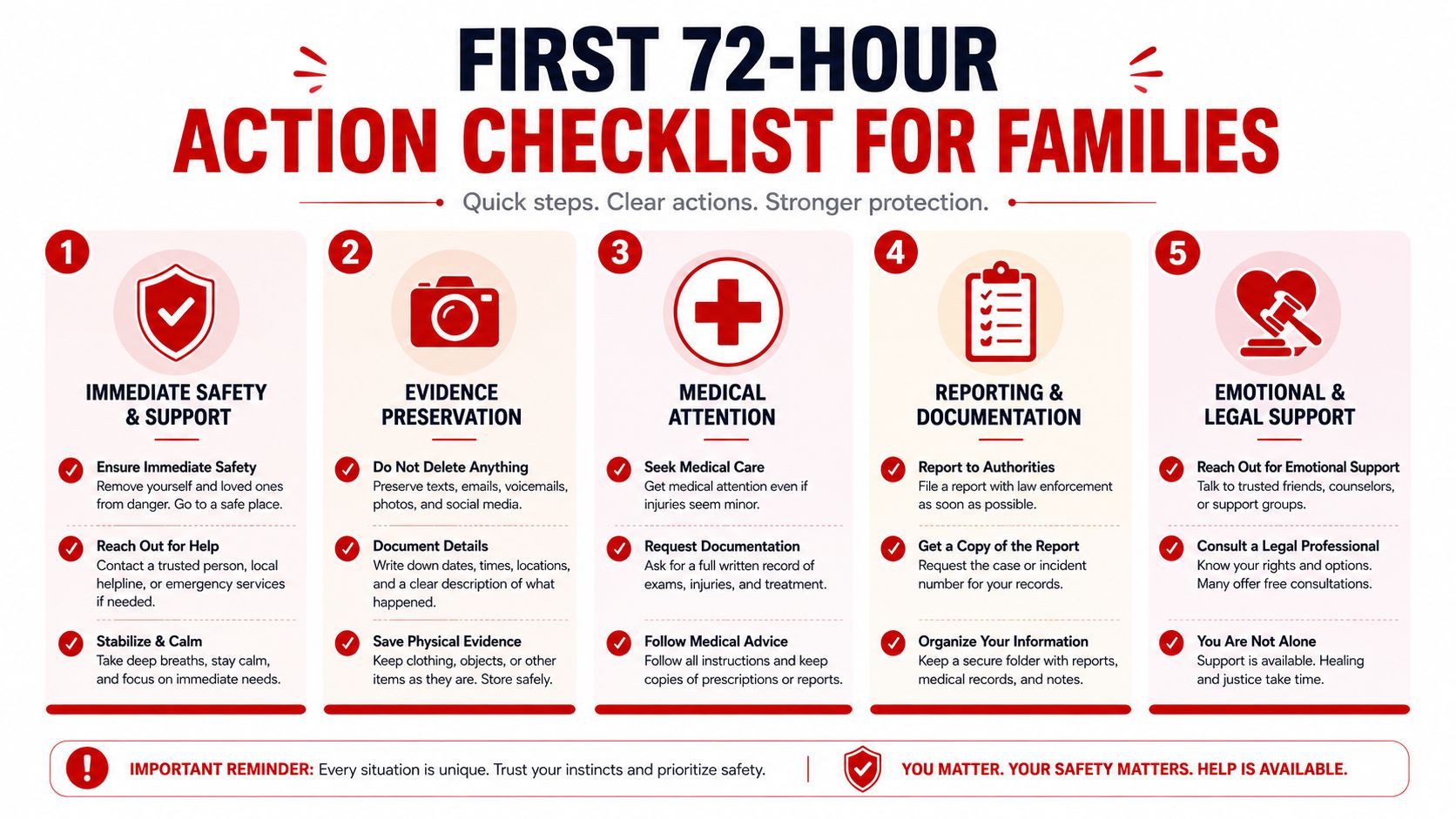
The first 72 hours are about preserving facts before stress, sleep loss, and missing messages erase them. Start by saving everything that might explain what happened, photographs of injuries or the absence of injuries, texts, doorbell video, call logs, and any timeline written while the memory is still fresh. Don’t post about the incident online, because a casual comment can become evidence in both the criminal case and any civil order hearing.
Choose counsel with the right case experience
Ask direct questions before hiring anyone. You want to know whether the lawyer has handled misdemeanor assault and domestic-violence dockets, how they approach protective orders, and whether they’re comfortable dealing with both the criminal case and the related custody or no-contact issues. If the defendant has no record, ask whether a pretrial intervention or deferred prosecution option is realistic.
Fees matter too. A public defender may be available if the person qualifies, while retained counsel costs depend on the complexity of the case and the amount of early work needed. Families should also remember that Bada Bing Bail Bonds can coordinate jail paperwork, explain release steps, and help families move quickly when they’re trying to get someone home while keeping the case organized.
Keep the compliance rules front and center
If there’s a no-contact order, follow it exactly. That means no direct calls, no messages through friends, and no attempts to work around the order from jail or after release. Firearms surrender can also come into play under state and federal law, and child-custody paperwork may need to be filed quickly if the order affects where the children stay or who handles exchanges.
Victim-advocate contacts through the district attorney’s office can help explain court dates and safety planning, and family members can ask about local hotlines for immediate support. The alleged victim can speak with prosecutors and advocates, but they can’t control every charging decision on their own, because the State makes the final call on whether to proceed. Stay focused on the paper trail, the court orders, and the next required appearance.
If your family is dealing with an arrest, a bond question, or a no-contact order tied to a domestic case, call Bada Bing Bail Bonds and get a real person on the line right away. The team can help you understand release steps, coordinate with the jail, and move quickly when time matters most.