
The call came after midnight. Your loved one missed curfew, stopped answering, and then a friend mentioned an arrest. You need to know where they are, whether bail has been set, how fast they can get out, and who will be waiting at the jail. Searching for inmate release notification is only the beginning. In Ventura County, the useful plan combines custody verification, release alerts, bail decisions, transportation, and court reminders.
The first rule is simple: don’t wait for an alert to make every decision. Alerts can arrive after a release event posts, while the jail, court, bond paperwork, and transportation arrangements may all move on different timelines. The steps below are designed for families in Ventura, Oxnard, Camarillo, Port Hueneme, Thousand Oaks, Santa Paula, Moorpark, Fillmore, Ojai, and Santa Barbara who need a clear answer now.
Table of Contents
- What to Do in the First Hour After an Arrest in Ventura County
- How VINE Works for Inmate Release Notification
- Using the Ventura County Sheriff Inmate Lookup and Jail Phone Line
- What the Ventura County Release Window Actually Looks Like
- Jail Release, Bail Bonds, or Notification Alone
- What a Bail Bondsman Needs Before Posting Bond in Ventura
- Putting the Notification Plan Together After the Call
What to Do in the First Hour After an Arrest in Ventura County
Start by confirming where the arrest happened. Ventura County custody information may involve a city police agency, the main Ventura County Jail, a pretrial detention facility, or an East County location in Thousand Oaks. Calling the wrong facility wastes time and can leave you with several conflicting stories.
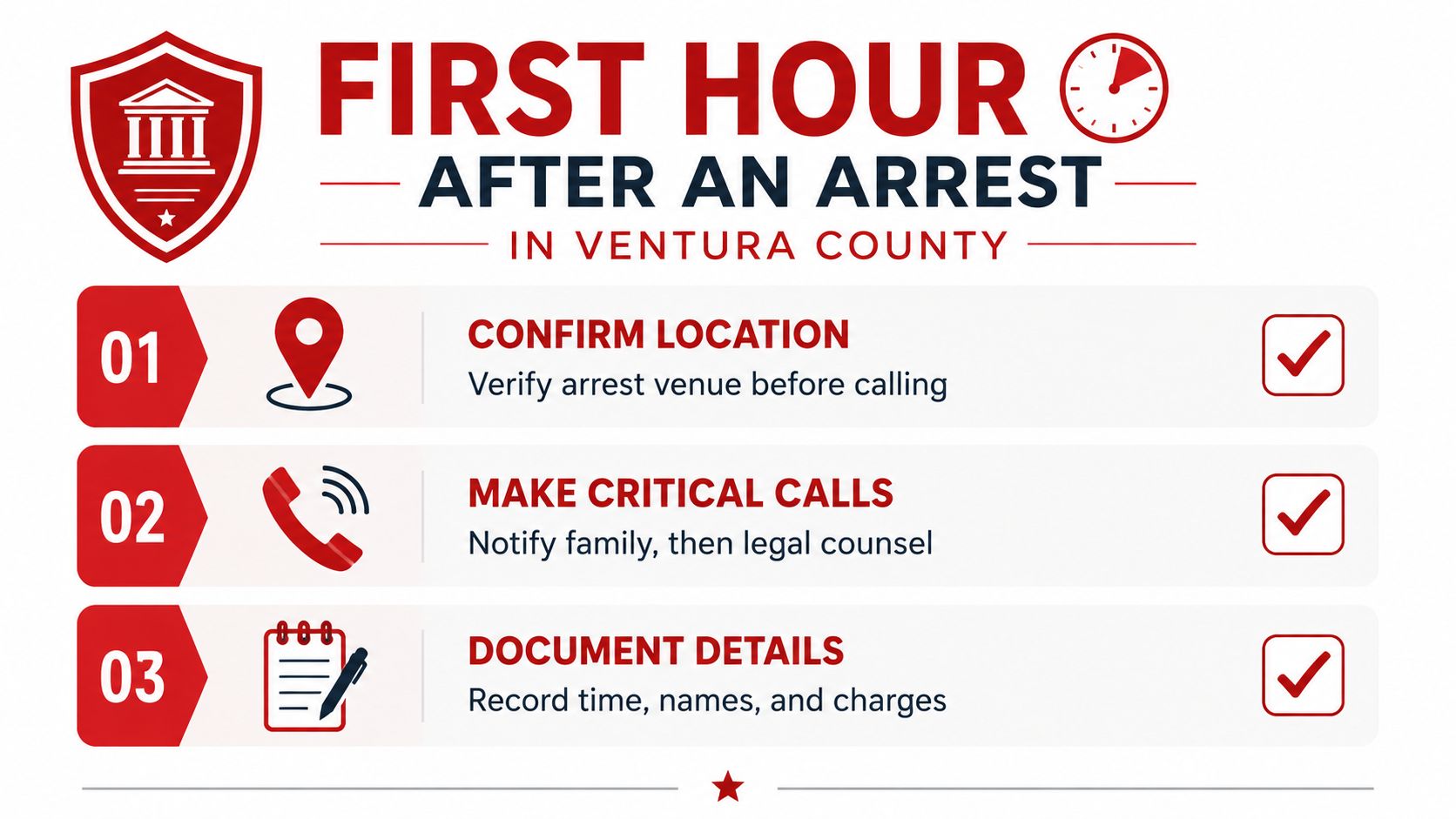
Follow these three actions in order
-
Confirm the arrest location. Call the Ventura County Sheriff’s non-emergency line or the arresting city’s station. Ask whether the person is in custody, which agency booked them, and which facility received them. The Ventura County District Attorney directs the public to call the jail at (805) 654-3335 or use the Sheriff’s inmate information page for inmate information. The Ventura County District Attorney’s victim information page is a useful official starting point.
-
Search the Sheriff’s online inmate lookup. Use the person’s legal name, not a nickname. Booking information can take time to appear, so check again after the agency confirms custody. If you’re unsure which details matter, this guide on what to do when someone gets arrested can help you organize the call.
-
Write down the record before making a bail decision. Record the booking number, listed charges, bail schedule amount, arresting agency, and facility. Also note the time of each call and the name or identification of the person who helped you.
Avoid the mistakes that slow families down
Don’t drive to a jail until custody and location are confirmed. Don’t call multiple facilities at random, and don’t rely on a friend of a friend who says the person “should be out soon.” For a plain-language explanation of the early arrest process, The Law Offices of Attorney Angel Lugo offers another useful legal resource.
Once the booking baseline is locked in, VINE registration, a bondsman call, and pickup planning become much more reliable. Before that, you’re guessing.
How VINE Works for Inmate Release Notification
VINE, or Victim Information and Notification Everyday, grew from the United States victim-rights movement in the early 1990s. It was founded in 1994 after the murder of Mary Byron in Louisville, Kentucky, became the first automated victim notification system in Jefferson County in 1995, and Kentucky implemented the first statewide system in February 1996. Kentucky’s VINE history documents that development.
The system expanded from local programs into a broad notification network. By 1999, agencies in more than 33 states had contracted with VINE, and by 2024 VINE reported operating in 46 states plus the District of Columbia and delivering more than 800 million notifications nationwide. The Office of Justice Programs summary also describes how New York’s statewide program became institutionalized, including its January 1, 1999 launch and later registration and confirmation activity.
Registration is not the same as guaranteed notice
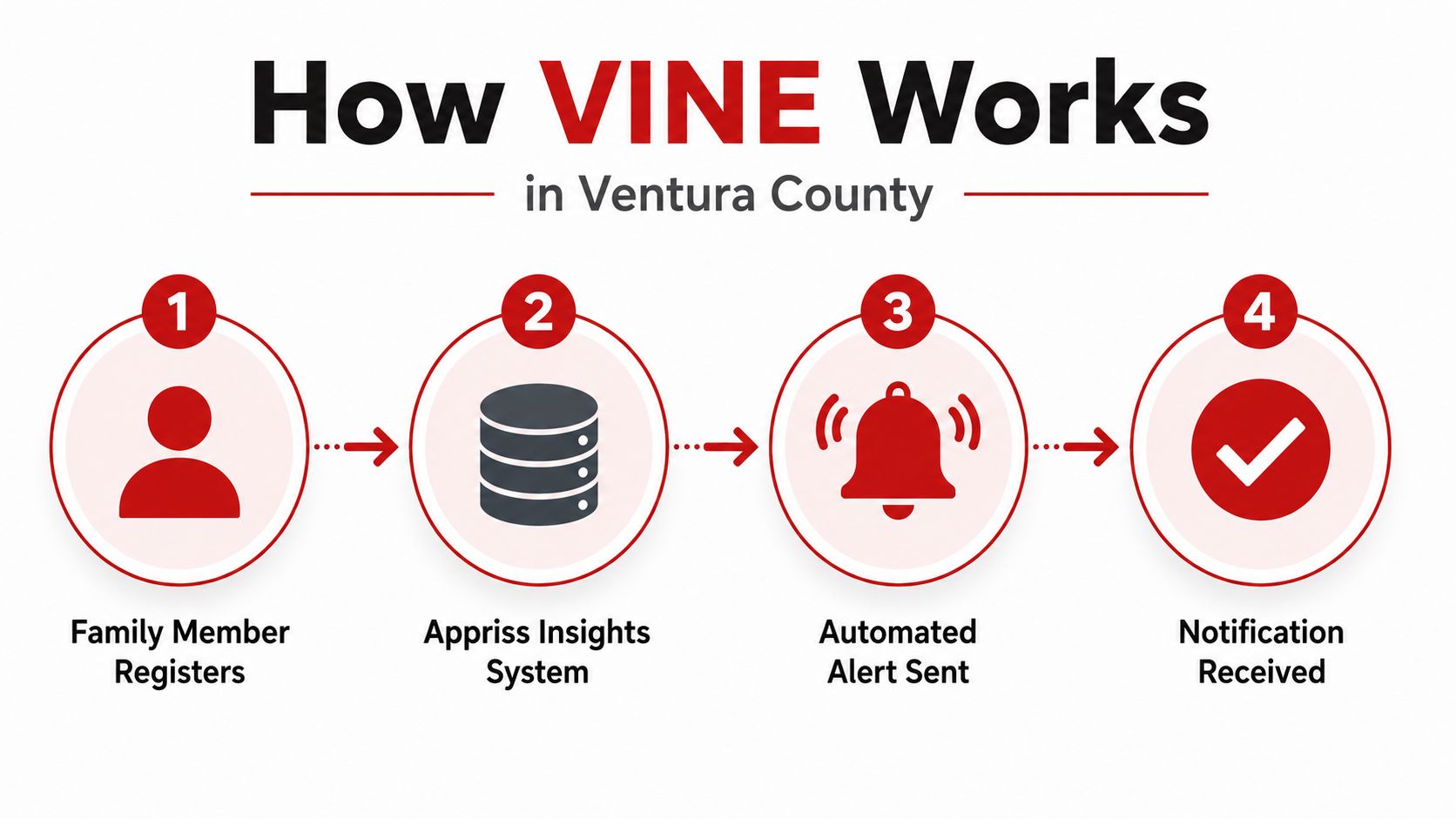
In practice, you register using the person’s name and a unique custody identifier or date of birth. The system checks participating custody data and may send a phone, text, or email alert when a qualifying release or custody event posts.
That doesn’t mean every family member automatically receives a message. Some systems are designed primarily for registered victims, while others expose broader custody status and transfer information. Registration may have to happen through a particular portal, telephone line, or agency, and the system may stop sending alerts after release. Texas Department of Criminal Justice victim notification guidance illustrates why families should confirm the specific rules for the jurisdiction involved.
Events VINE may not catch in real time
Families commonly expect an alert for every movement. That’s the wrong assumption. A housing-unit transfer, a bail posting before the custody system refreshes, an early-release program change, or a same-day release from court may not create the message you’re waiting for.
Register for VINE, any Sheriff custody alert option, and the arresting agency’s victim liaison during the same call session. Then keep checking the official custody record. The Ventura County inmate search guide can help you locate the record and interpret the basic booking fields.
Using the Ventura County Sheriff Inmate Lookup and Jail Phone Line
The online lookup gives you a searchable snapshot. The jail phone line can clarify whether the record is current, incomplete, or affected by a hold. Use both, because neither channel should carry the entire burden of release planning.
Start with the online record
Enter the last name first, then the first name, and use the booking-date field. If nothing appears, widen the date range and search again. Booking records can post after the arrest, and a delayed update doesn’t necessarily mean the person was released.
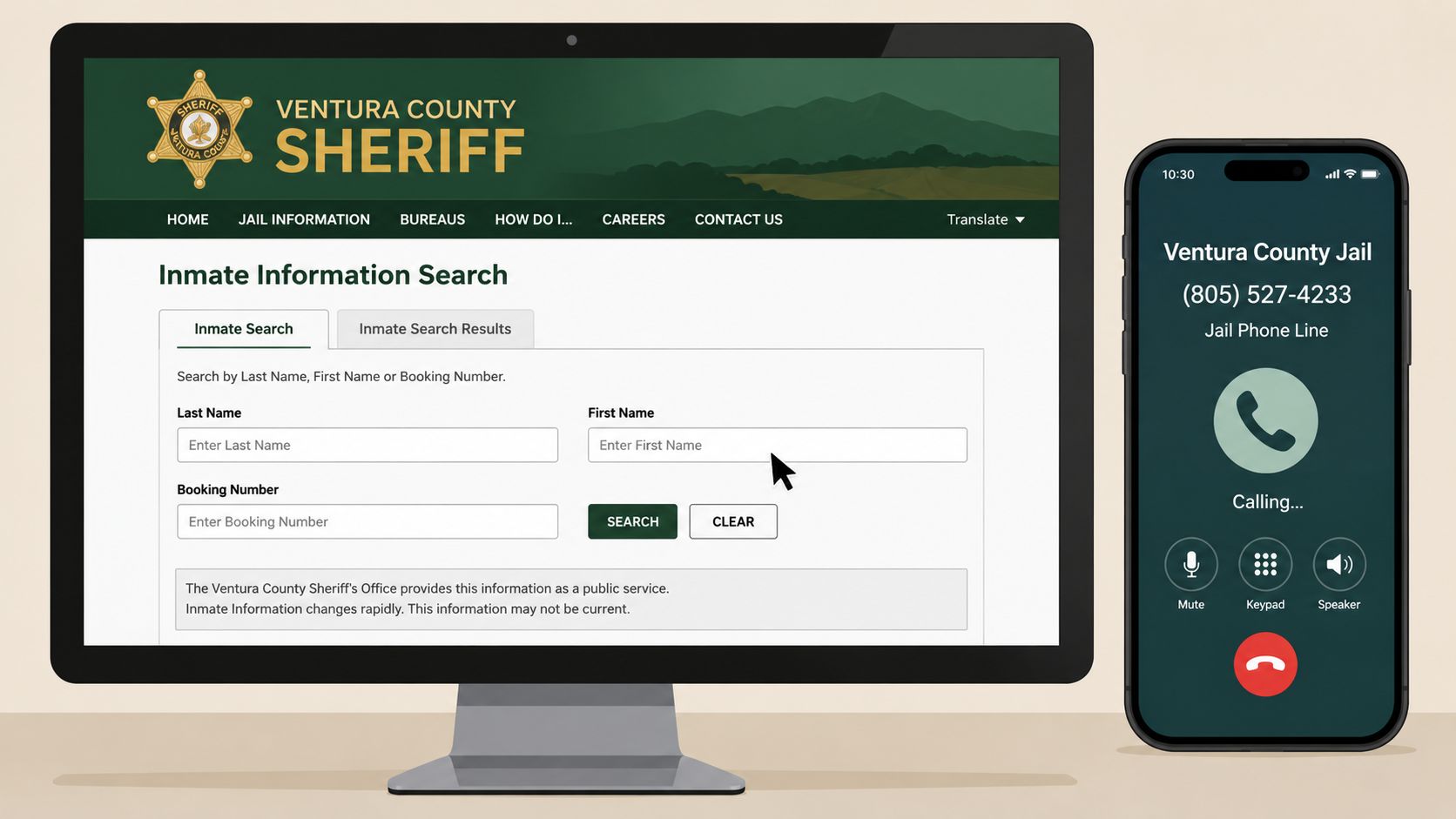
Screenshot the entry that shows the booking number, charge code, and listed bail. Save the image with the date and time so you can show it to a licensed bail agent or attorney without recreating the search.
Ask the jail focused questions
When calling the Ventura County jail information line, follow the prompts for custody records rather than visitation. The District Attorney’s office identifies (805) 654-3335 as the jail information number for the public. Avoid calling during the morning count hold, roughly 1 a.m. to 5 a.m., and during shift changes when staff may have limited access to updated records.
Ask these questions directly:
- Housing: Where is the person currently housed?
- Release: Is there a scheduled release date or release process underway?
- Holds: Is there a medical, classification, or outside-county hold?
- Bail: Has bail been set, or is it pending a magistrate?
Jail staff won’t provide legal advice. They also may not confirm a release beyond what’s already public. If you need a broader custody-search workflow, this guide to finding someone after an arrest gives you a practical record-checking sequence.
The answers determine whether you’re waiting for a court decision, arranging a Ventura County Jail bail bonds transaction, or preparing for a pickup after paperwork clears.
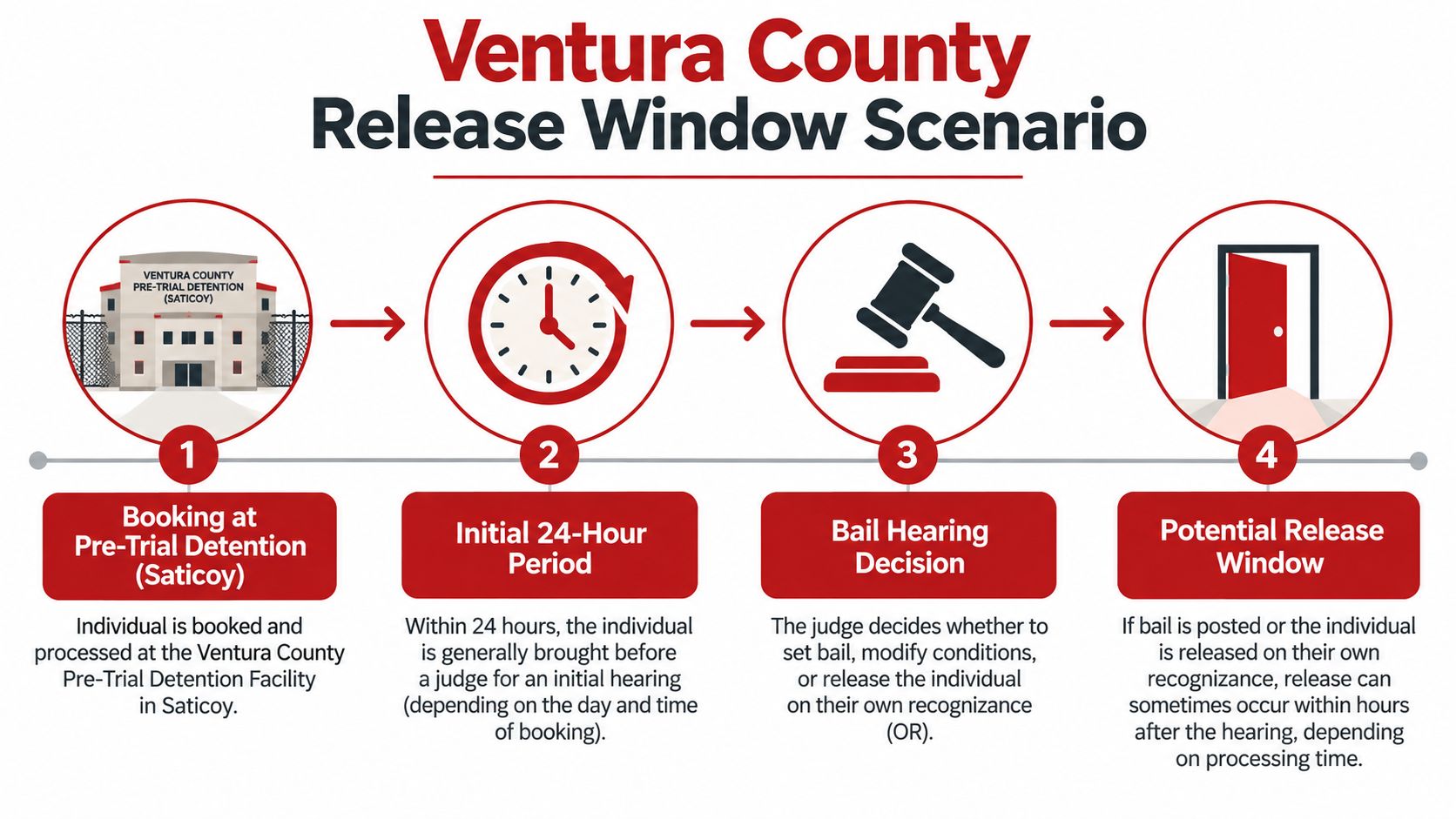
What the Ventura County Release Window Actually Looks Like
A representative Ventura County booking may begin at a pretrial detention facility in Saticoy after an arrest in Ventura, Oxnard, Camarillo, Port Hueneme, or another local city. The person usually moves through medical screening, classification, and housing assignment before the jail can process the next release step. A family member may hear “bail is available” while the defendant is still completing intake.
The first operational delays
A misdemeanor DUI, domestic violence booking, and felony drug case can follow different paths. A cite-out or own-recognizance release may avoid a full bail transaction, while a bail-required case can wait for a magistrate, paperwork review, and jail processing. Domestic violence cases may also involve release conditions and protective-order issues that families shouldn’t try to interpret on their own.
The timing becomes less predictable overnight and on weekends. Court calendars may operate only on weekdays for certain decisions, while the jail’s early-morning release sweep can create a narrow pickup window. Even after a bond is accepted, the defendant still has to clear classification, release documentation, property handling, and transportation coordination.
Practical rule: Treat “bond posted” as a process milestone, not a promise that the person is already walking out.
Plan for the pickup, not just the alert
Someone released from the Ventura County Jail may need a ride to Ventura, Oxnard, or Simi Valley. Don’t send a driver before the jail confirms the release is active, and don’t assume the alert will arrive before the person leaves the facility.
The Ventura County public-records guidance identifies the fields families use to verify the event, including the person’s name, date of birth, arrest and booking details, bail amount, charges, and time and manner of release. This explanation of how to post bail shows why those details matter when you’re trying to confirm whether the bond process can begin.
For a practical timeline discussion, this guide to jail release times can help you prepare for the gap between a bail decision and the actual pickup.
Jail Release, Bail Bonds, or Notification Alone
A release alert tells you that a custody event occurred. It doesn’t choose the right release path. In Ventura County, families generally compare a cite-out or own-recognizance release, direct cash bail, and a surety bond through a licensed bail agent.
| Path | Typical Cost | Speed | Best For |
|---|---|---|---|
| Cite-out or own-recognizance release | No bail premium, but conditions may apply | Depends on jail and court processing | Eligible lower-level cases where the court or jail authorizes release |
| Cash bail paid directly | Full listed bail amount, subject to court and jail rules | Can move quickly once accepted, but processing still applies | Families with immediately available funds who understand refund and forfeiture rules |
| Ventura County bail bond | California’s commonly filed premium basis is 10% of the total bond amount, plus actual, necessary, and reasonable transaction expenses, as explained by the California Department of Insurance | Often practical when paperwork and payment are ready | Families who need to preserve cash or handle a larger bond |
Choose based on the booking, not the alert
If the person is eligible for a cite-out, waiting can make sense, especially when the family has confirmed the conditions and court obligations. Don’t pay for a bond because an alert hasn’t arrived.
Cash bail makes sense when funds are liquid, the family understands the court’s rules, and speed matters. The full amount is exposed if the defendant fails to appear, and families should confirm how the court handles refunds.
For a bail amount in the five-figure range, a bond is usually the more practical route. The California premium basis is commonly 10%, rather than the full bail amount, although the agent will review payment, indemnity, collateral, and case-specific requirements. The Ventura County bail posting guide explains the paperwork families should expect.
Notification alone is not a release strategy. It’s a warning system. Use it to react, not to avoid confirming bail and release conditions.
What a Bail Bondsman Needs Before Posting Bond in Ventura
A bail agent can move faster when the family has the record ready. Before calling about bail bonds Ventura, collect the defendant’s full legal name, date of birth, booking number, exact facility, charges, and full bail amount. Ask the jail or review the Sheriff’s record for holds from another county, because a bond for one case may not produce release if another agency has custody authority.
The defendant information comes first
Have these details in front of you:
- Identity: Full legal name and date of birth.
- Booking: Booking number and arresting agency.
- Location: Exact facility, whether in Ventura, Thousand Oaks, or another custody location.
- Financial exposure: Full bail amount and any separate counts.
- Custody complications: Other-county holds, probation issues, warrants, or no-bail holds.
A licensed agent will verify the booking rather than relying on an informal message. That protects the family from paying against the wrong record.
The indemnitor carries the agreement
The person signing for the defendant, often a family member, should prepare a government-issued ID, proof of address, Social Security number, and a credit or debit card for the California-regulated premium. California’s Department of Insurance explains that bail premium rates are filed by each surety company and that the consumer cost is most commonly 10% of the total bond amount, plus actual, necessary, and reasonable expenses connected to the transaction.
Don’t assume every payment arrangement is permissible. Agents may reject partial arrangements that don’t comply with California Insurance Code requirements, collateral without clear title, or a request involving a defendant already subject to a no-bail hold. Ask for the written premium, any approved fees, collateral terms, and return conditions before signing.
Put the documents beside the phone
Keep the booking screenshot, government ID, proof of address, payment method, and any available court or warrant paperwork together. If the case involves DUI, domestic violence, drug charges, theft, a probation violation, or another charge category, tell the agent immediately. The charge can affect the release conditions and the questions that must be answered before a bond is posted.
Putting the Notification Plan Together After the Call
An inmate release notification is one part of the response, not the response itself. A strong Ventura County plan gives one person responsibility for the primary phone, another person responsibility for transportation, and a third person responsibility for attorney and court information. That division prevents the familiar failure where everyone waits for someone else to check the jail.
Build one alert chain
Use several channels, but assign each one a purpose:
- VINE: Register for custody events when the person and facility are eligible.
- Sheriff updates: Opt into available custody messages or alerts.
- Jail calls: Check the official record when release timing matters.
- Bail contact: Keep one 24/7 bail agent’s number available for booking verification, paperwork status, and release coordination.
- Attorney contact: Send the booking number, charges, and release information to defense counsel.
The National Center for State Courts found that notifying defendants who received a desk appearance ticket reduced failure-to-appear rates, while Philadelphia pretrial release experiments reported weak or no impact from notification strategies on defendant misconduct. The court-notification research summary supports the practical conclusion: alerts help, but alerts alone don’t solve the case.
Prepare before the message arrives
Court reminders should begin as soon as the date is known. The evidence review from the Office of Justice Programs found that notification interventions produced a small, statistically significant reduction in failure-to-appear rates, with an effect size of -0.07 across four studies, and that reminders sent close to the hearing date performed best. The pretrial intervention evidence review also emphasizes verified contact information and reminder timing.
Release risk and missed appearances often concentrate early after release. Bureau of Justice Statistics data found that 12% of failure-to-appear events occurred within one week, 35% within one month, and 74% within three months, with a median time to the first missed court date of 46 days. The same analysis reported prior missed-appearance histories of 35% for unsecured release and 44% for emergency release. The Bureau of Justice Statistics release and appearance analysis supports using more frequent reminders and verified contact information during that early period.
Before the alert, confirm the charges and bail, choose cash or bond, stage identification and a ride, save the attorney’s number, and write down every release condition. If the case involves domestic violence, don’t assume a pickup conversation overrides a protective order or no-contact condition. If the defendant is released late at night, keep the driver available but wait for verified release information before traveling.
Bada Bing Bail Bonds provides 24/7 booking verification, explains bail and charges in plain English, coordinates paperwork with the jail, tracks release progress after a bond is posted, and can discuss payment plans, co-signers, and collateral for qualifying cases. That makes it one option for families who need a single contact handling the bond and release-status workflow.
If someone has been arrested in Ventura County, visit Bada Bing Bail Bonds for 24/7 help verifying custody, reviewing the bail amount, and coordinating the release process. Have the defendant’s name, booking number, facility, and listed charges ready so an agent can give you a direct next step.