The call usually comes after midnight. Someone in your family was picked up at home after a missed appointment, a failed drug test, or an allegation of a new offense. Now you're trying to answer the only question that matters: will the court release them, or will they remain in Ventura County Jail until a probation hearing?
Probation violation consequences depend heavily on what rule was broken, what happened afterward, and how the case reaches the judge. A technical violation and a new criminal offense aren't treated the same way. Acting quickly during the first 24 hours can also affect whether the family is prepared for release, counsel, and the hearing ahead.
Table of Contents
- What a Probation Violation Actually Means in California
- Technical Violations Versus New Offense Violations
- The California Violation Process From Arrest to Hearing
- Reinstatement, Modification, and Revocation Compared
- Which Violations Are Most Likely to Lead to Jail
- Your First 24 Hours After a Violation Arrest
- Local Help in Ventura County and Common Questions
What a Probation Violation Actually Means in California
At midnight, the family often hears only fragments. The probationer tested positive, a warrant was issued, or an officer took them into custody. Nobody knows whether the arrest means a short hold, a new criminal case, or the return of an old suspended sentence.
Probation is the court's agreement to let a person remain in the community instead of serving the suspended jail or prison sentence immediately. In exchange, the probationer must follow specific conditions, such as reporting to a probation officer, submitting to drug testing, attending treatment, completing community service, obeying travel limits, and staying out of new trouble.
Practical rule: Treat every probation condition as enforceable, even when it feels administrative.
California uses both formal probation, commonly associated with felony cases under Penal Code section 1203, and informal probation, often associated with misdemeanor cases. The labels and supervision arrangements can differ, but either type can produce serious consequences when the court finds a violation. The court may continue probation, impose tighter conditions, or revoke probation and enforce the sentence that had been suspended.
That's why a failed test isn't automatically the same as a new arrest. The judge looks at the condition, the evidence, the probationer's history, and whether the person has been trying to comply. A person who missed one appointment because of a documented emergency stands in a different position from someone who ignored repeated orders or picked up a new felony case.
California probation also differs from parole, and confusing the two can lead families to call the wrong office or misunderstand the process. This California probation versus parole guide explains the distinction in practical terms.
The national picture shows why families shouldn't assume every violation ends in prison. In 2018, more than 1.8 million people exited probation nationwide. Fifty-eight percent completed probation successfully, 16% were revoked to incarceration, and 26% exited for other or unknown reasons, according to Vera Institute of Justice probation data. Among those revoked to incarceration, about 46% involved technical violations and roughly 24% involved new-offense violations, showing that rule-breaking can lead to custody even without a new conviction.
The rest of the outcome turns on the category of violation and the steps taken after arrest.
Technical Violations Versus New Offense Violations
The first question I ask a family is simple: Was there a new criminal allegation, or was a probation rule broken without a new offense? That distinction doesn't decide the case by itself, but it often shapes the judge's starting point.
A technical violation breaks a condition of supervision. Examples include missing a check-in, failing a drug test, traveling without permission, missing a required class, or not completing community service. A technical violation may not create a separate criminal charge, but it still gives the court a reason to review probation.
A new-offense violation involves an arrest, citation, or allegation that the probationer committed another crime. The new case and the probation case can move on separate tracks. Even before the new charge is resolved, the alleged conduct can persuade a judge that ordinary probation conditions haven't worked.
Why the categories matter
National data shows that technical violations account for a substantial share of incarceration outcomes. In the 2018 estimate cited above, about 46% of probation revocations to incarceration involved technical violations, while roughly 24% involved new offenses. The Vera Institute report also reported that about 12% of all probationers exiting supervision in 2015 were incarcerated for a new offense or another probation revocation, representing more than 233,000 people entering prison or jail after probation discharge.
That data doesn't predict a Ventura County case. It does reject the dangerous assumption that technical violations are harmless. A missed appointment may begin as a correctable problem, but repeated noncompliance, dishonesty, or failure to respond to a warrant can change the court's view quickly.
California Penal Code section 1203.2 gives the court authority to revoke or modify probation after the required court process. At the initial appearance, the judge may consider whether probable cause supports the alleged violation. The later revocation hearing uses a lower evidentiary standard than a criminal trial, which is one reason a probation matter can become serious even without a conviction on a new charge.
| Factor | Technical Violation | New Offense Violation |
|---|---|---|
| Basic conduct | Breaks a probation condition | Involves alleged new criminal conduct |
| Common examples | Missed reporting, failed test, unauthorized travel | Arrest or citation for another offense |
| Separate criminal case | Often no new charge | Usually may involve a separate case |
| Judicial concern | Whether supervision can be corrected | Whether the probationer poses a broader compliance risk |
| Likely first response | Modification, warning, or added conditions may be considered | Custody, stricter terms, or revocation becomes more plausible |
The practical takeaway is direct. A first technical violation may leave room for reinstatement or modification, but a new offense, especially one combined with prior noncompliance, creates a much harder argument for release and continued probation.
The California Violation Process From Arrest to Hearing
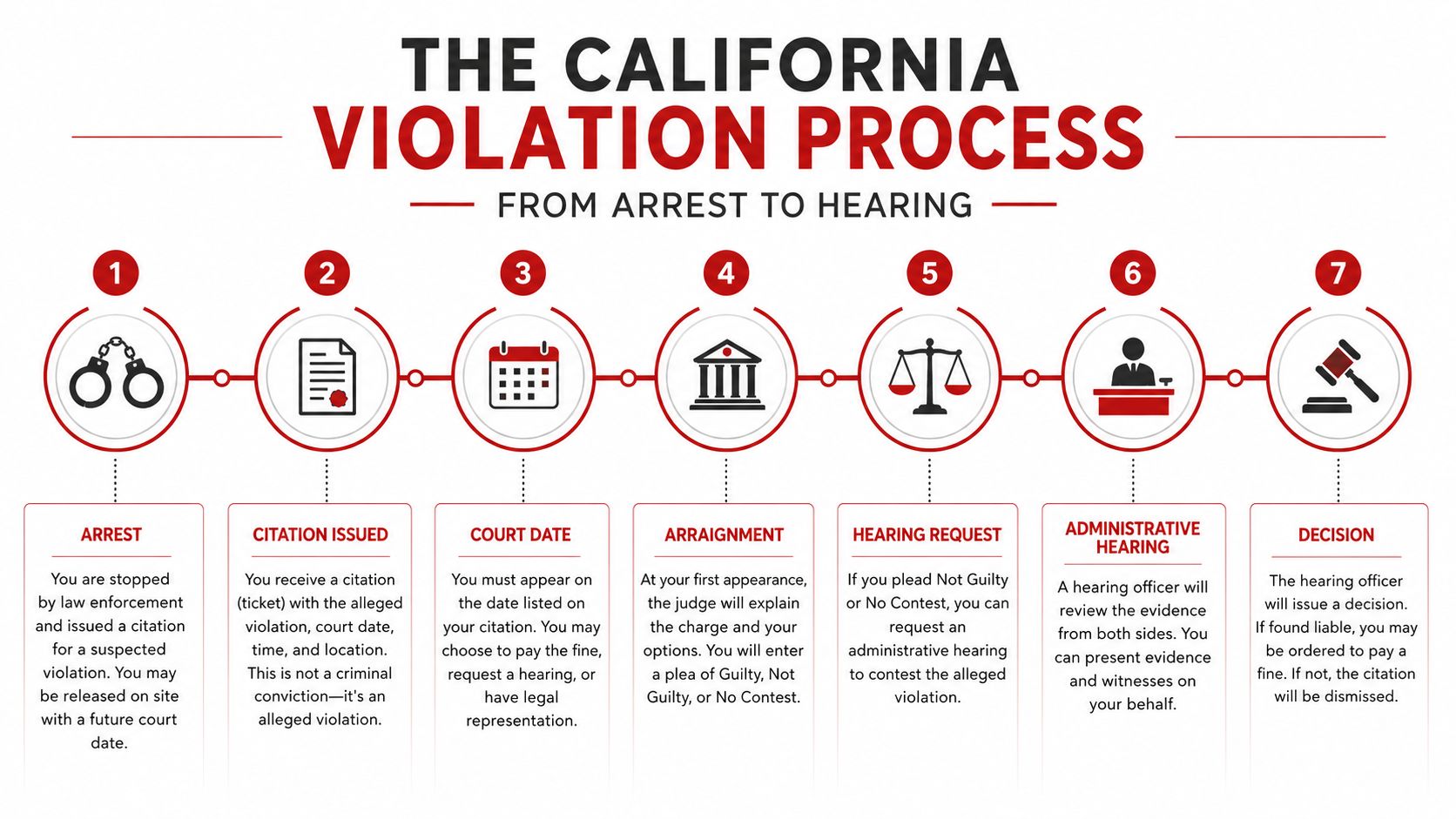
A probation case usually moves through a recognizable pipeline, although the exact timing depends on the court, jail, warrant status, and whether a new criminal case was filed.
The arrest and initial custody
Under California Penal Code section 1203.2, a probationer can be arrested without a warrant when an authorized officer relies on a written declaration of probable cause. That authority can turn a probation report into a custody event without waiting for a traditional warrant process.
The person may then be booked into a local facility, including Ventura County Jail. Families should confirm the booking location, alleged violation, hold status, and whether bail has been set. The Ventura County jail booking process can help families organize those first questions.
Arraignment on the violation
At arraignment, the judge addresses the alleged violation, advises the probationer of the proceeding, and handles counsel. If the person qualifies and needs representation, the court can address appointment of counsel. The judge may also consider custody, release conditions, and the date for a formal hearing.
For document-heavy matters, families and attorneys should also confirm how filings must reach the court. This e-filing versus mail versus fax guide provides a practical overview of submission methods, but the receiving court's rules control.
The revocation hearing
The revocation or modification hearing is not a full criminal trial. The court reviews evidence such as probation records, test results, reports, payment history, and police information. The defense attorney can challenge the allegations and present mitigation, including employment, treatment participation, transportation problems, medical records, family responsibilities, or proof that the probationer corrected the issue.
The judge generally decides whether the alleged violation is supported by a preponderance of the evidence, a lower standard than proof beyond a reasonable doubt in a criminal trial. A hearing may take place over a short period or be continued while counsel gathers records and negotiates a resolution. A realistic overall timeline can extend from arrest to final hearing over two to six weeks, depending on the circumstances.
The family should expect several separate events, not one single courtroom moment:
- Booking and hold review, where custody and bail information are clarified.
- Arraignment, where the allegations and representation are addressed.
- Preparation, where counsel gathers compliance records and mitigation.
- Revocation hearing, where the judge determines whether to continue, modify, or revoke probation.
Reinstatement, Modification, and Revocation Compared
California judges have three broad paths after a probation violation is established or admitted. The label matters less than the practical result: does the person remain on probation, or does the suspended sentence come back into play?
Reinstatement keeps probation in place under the existing terms. A judge may choose this after a limited technical violation, especially when the probationer can show an honest effort to comply and a credible plan to prevent another problem. Reinstatement can still come with a warning, and the next violation may be viewed more harshly.
Modification keeps probation alive but adds control. The court may require more frequent reporting, additional testing, counseling, a stricter curfew, electronic monitoring, or other conditions. This is often the most realistic middle ground when the judge sees a correctable risk but doesn't believe immediate revocation is necessary.
Revocation ends probation and activates the sentencing consequences available in the original case. For a misdemeanor, that can mean county jail exposure. For a felony, the court may impose the previously suspended sentence, which can include state prison depending on the original sentencing posture and applicable law.
The three outcomes in practical terms
| Outcome | Typical Trigger | Jail Exposure | Custody Status |
|---|---|---|---|
| Reinstatement | Limited violation with credible mitigation | No new custody term required by the outcome | Release may continue if the court permits it |
| Modification | Compliance problem that the judge believes tighter supervision can address | Conditions may increase without immediate incarceration | Release may continue under stricter terms |
| Revocation | Serious, repeated, or new-offense conduct | Jail or prison may follow, including enforcement of a suspended sentence | The probationer may be remanded or remain in custody |
California sentencing rules tie revocation punishment to the original sentencing posture. If imposition of sentence was suspended, the judge must impose judgment and sentence upon revocation after considering the earlier findings. If execution of sentence was suspended, the judge must order the previously pronounced judgment into full force and effect under California Rule of Court 4.435.
That distinction can decide whether the family is facing a new sentencing decision or the activation of a sentence already pronounced. A defense attorney needs the original minute order, plea paperwork, sentencing transcript, and probation terms before giving a reliable assessment.
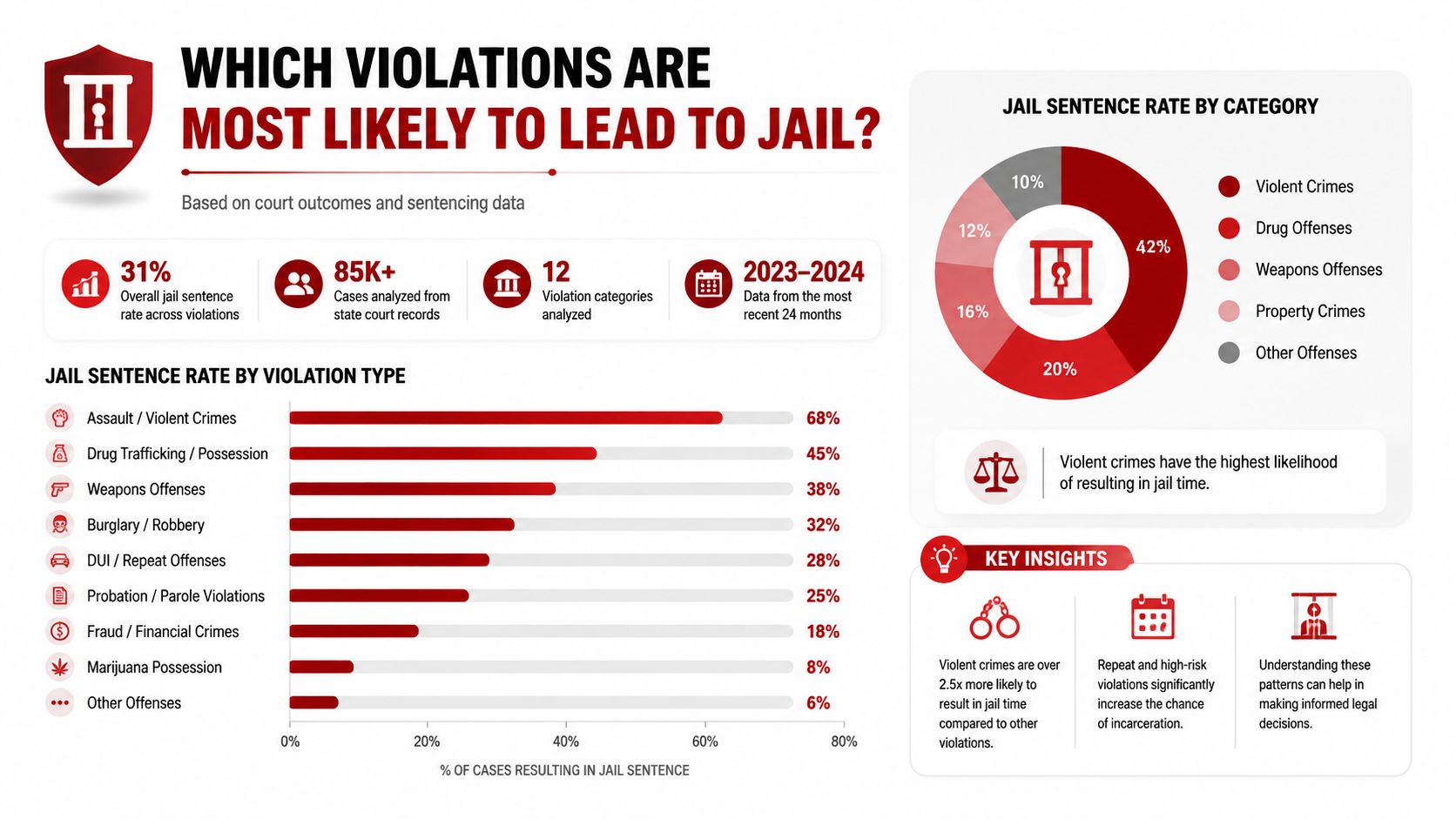
Which Violations Are Most Likely to Lead to Jail
The violations most likely to produce custody are the ones that convince the judge probation has stopped working. A new felony arrest, ignoring a prior bench warrant, or a positive drug test combined with missed reporting and failed treatment presents a much tougher release argument than one isolated administrative mistake.
A missed appointment, late payment, or unauthorized trip may still be serious, but courts often have room to respond with tighter conditions when the conduct is isolated and the probationer appears willing to fix it. Repetition changes the calculation. So does concealment, failure to appear after notice, or conduct that creates a new public-safety concern.
The available national data confirms substantial local variation. In a study of nine counties cited by the Prison Policy Initiative's probation conditions report, between 10% and 87% of probation violations resulted in revocation, depending on the county. The same source reported that judges revoked 73% of people who returned to court on a motion to revoke probation over a four-year period. Once a case reaches that stage, the family should stop treating it like a routine check-in.
Federal guidance also separates more serious Grade A and Grade B violations, where revocation is mandatory under the applicable framework, from Grade C violations, where the court may continue or modify probation. That structure supports the practical distinction between conduct that demands a custody response and conduct that may be corrected through supervision.
What this means in Ventura County
Ventura County judges apply California law, but the result still depends on the assigned courtroom, the original case, the probationer's record, and the local facts. Don't assume a statewide rule guarantees a warning. Don't assume a warrant guarantees prison either.
For a new felony arrest, families should review bail for felony charges while the defense attorney investigates the probation hold and the new allegations. The bond question and the revocation question may be related, but they aren't always identical.
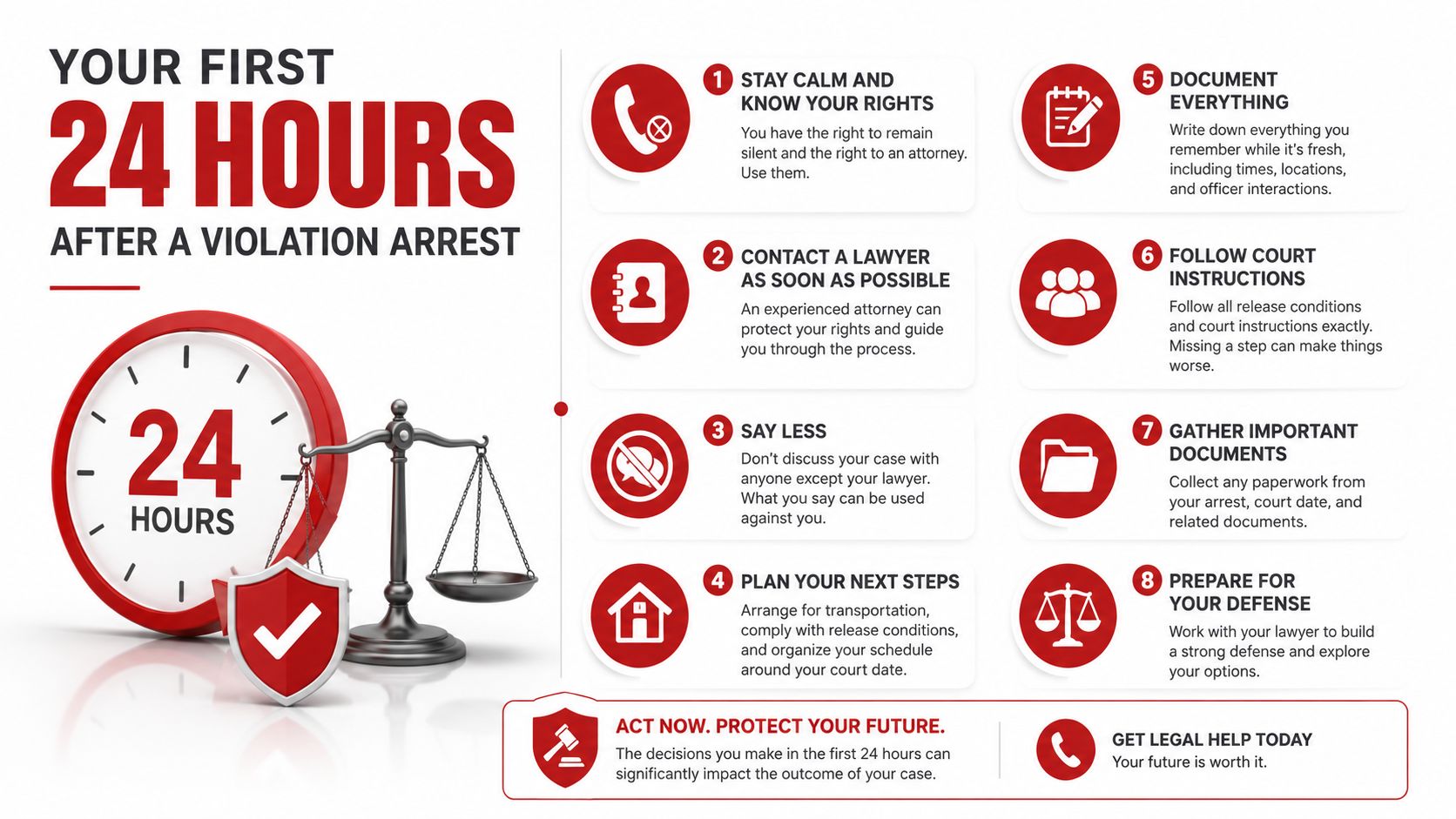
Your First 24 Hours After a Violation Arrest
The first day is for information, counsel, and damage control. Do not spend it arguing with the probation officer, posting explanations online, or waiting for the jail to call back.
Start with the right calls
First, contact a California criminal defense attorney who handles probation violations. A general practitioner may not know the local courtroom process, the original sentencing posture, or how to present a technical violation as a solvable compliance problem.
Next, determine whether the probationer is held on a probation warrant, a new criminal charge, a no-bail hold, or a bond that can be posted. A bail bond is relevant only if the court and jail permit release by bond. Some probation holds require a court appearance before release can occur, so a bondsman can't promise release before verifying the booking details.
If bail is available, a family member can contact a licensed agency that handles 24-hour bail bonds in Ventura. The agent should verify the booking, explain the bail schedule and hold, identify the required signer information, and state the financial terms before paperwork begins. Families searching for Ventura County bail bonds, Ventura County Jail bail bonds, or fast bail bonds Ventura should focus on verification and clear communication, not a rushed promise.
Build the defense file
Gather these records immediately:
- Probation paperwork: Collect the sentencing order, probation conditions, and any later modification.
- Compliance proof: Save appointment confirmations, treatment attendance, drug-test records, payment receipts, work schedules, and transportation documentation.
- Case materials: Give counsel police reports, notices, court papers, and the booking information.
- Mitigation records: Include medical documents, employment verification, housing information, and character references when they directly explain compliance or rehabilitation.
Don't coach witnesses or create a new story. Give the attorney the complete timeline, including facts that feel embarrassing or damaging. Counsel can't protect the case from information they don't know exists.
Avoid making the situation worse
Tell the probationer not to discuss the allegations over jail calls, text messages, or social media. Those communications can create evidence or undermine an explanation later. The safest approach is to provide identifying information, request counsel, and avoid substantive statements until the attorney gives direction.
Families can also review what to do after someone gets arrested while they confirm the facility, court department, and next appearance. Keep a written log of every call, name, confirmation number, and document submitted.
Local Help in Ventura County and Common Questions
A Ventura County probation matter can touch several offices. The Ventura County Superior Court handles the courtroom proceedings, including locations serving Ventura and the East County area. The Ventura County Probation Agency handles supervision and compliance records, while the Public Defender's Office on Victoria Avenue may assist eligible people who need appointed counsel.
For bail information, check the booking facility and court status first. Ventura Superior Court publishes its local bail and fee schedules, and California courts also use statewide Judicial Council schedules alongside local references. A probation hold may not function like an ordinary new-offense booking, so ask specifically whether bail is set, whether a judge must review the hold, and whether another case has its own bail amount.
Local searches may use terms such as bail bonds Ventura, bail bonds Oxnard, Ventura County Jail bail bonds, and fast bail bonds Ventura. Families in Oxnard, Camarillo, Port Hueneme, Thousand Oaks, Santa Paula, Moorpark, Fillmore, Ojai, and Santa Barbara should provide the exact jail and court information, because the correct procedure depends on where the person is booked and which court has jurisdiction.
Common questions from Ventura County families
Is a probation violation a separate crime?
A technical violation usually concerns the existing probation case and doesn't automatically create a new criminal charge. New criminal conduct may produce a separate case as well as a probation proceeding.
How long can a revocation hearing take?
The timeline varies. Some matters resolve at an early appearance, while contested cases can take weeks as attorneys gather records, review reports, and schedule the hearing.
Must an attorney be present at every stage?
The probationer should request counsel before discussing the allegations. Whether counsel must physically attend each event depends on the proceeding and the court, but legal advice at the beginning is critical.
Can a family member post bail for the probationer?
Yes, a family member may contact a licensed bail agency and act as the indemnitor or co-signer if bail is available and the agency approves the arrangement. The jail or judge may still require a court appearance before release.
What documents will a bondsman need?
Expect to provide the probationer's full identity and booking information, the facility, the alleged charge or hold, and the court details. The signer may also need identification, contact information, employment or income details, and collateral documentation when applicable.
The core message is straightforward: identify whether the allegation is technical or tied to a new offense, act within the first 24 hours, and get both defense counsel and a licensed bondsman on the phone before the case escalates. For families needing one option for probation violation bail bonds, Bada Bing Bail Bonds provides booking verification, release coordination, and information about co-signers and documents when the court permits a bond.
Bada Bing Bail Bonds offers 24/7 assistance with Ventura County probation violation bookings, warrant checks, bail verification, co-signer questions, and release coordination. Call when you need clear answers about the hold and next step, or visit Bada Bing Bail Bonds to start the process.