At 2 a.m., a call from a loved one in Ventura County can leave you trying to answer several questions at once. Where are they being held? Has booking finished? How much is bail? Can someone post it tonight, or will they stay in custody until court?
Bail is easier to understand when you separate the process into stages. A person is arrested and booked, a release decision or bail amount is made, payment or a bond is arranged, the jail processes the release, and the person must follow court orders afterward. This guide explains how bail works in California in plain English, with practical details for Ventura, Oxnard, Camarillo, Port Hueneme, Thousand Oaks, Santa Paula, Moorpark, Fillmore, Ojai, and nearby communities.
Table of Contents
- When the Call Comes Late What Bail Really Means
- Understanding Bail and Your Pretrial Release Options in California
- How Bail Amounts Are Set in California and Ventura County
- The Bail Posting Process From Booking to Release
- Paying for Bail Cash Bonds Payment Plans and Collateral
- Ventura County Bail Bonds Help Across Southern California Cities
- After Release Court Dates Conditions and Staying Compliant
When the Call Comes Late What Bail Really Means
Suppose your family member was arrested in Oxnard. The first thing to understand is that bail isn’t a fine, a conviction, or a punishment. It’s a financial promise connected to release before the criminal case is resolved. The promise is simple: the person will return to court and follow the court’s conditions.
The amount may appear on a county schedule soon after booking, but that number doesn’t always tell you whether money will be required. California uses several pretrial release paths, including citation release, release on recognizance, supervised release, and bail. The California Policy Lab and PPIC found that 41.5% of people booked into California jails on misdemeanors or felonies were released before trial from October 2011 through October 2015, representing about 648,000 releases. The most common paths were cite-and-release after booking, bail, and release on recognizance, while supervised pretrial release was least common. The PPIC summary explains California’s broader pretrial release system.
That distinction matters at night. Your first question shouldn’t be only, “How much is bail?” It should also be, “What release decision has been made, and what does the jail need before release can happen?”
Bail is security for appearance
When someone posts cash bail, the payment gives the court financial security while the case continues. When a licensed bail agent posts a bond, the agent guarantees the scheduled amount to the court, while the family typically pays a premium and signs an agreement tied to the defendant’s court appearance.
Release doesn’t end the case. The person still has court dates, possible protective orders, reporting requirements, and other conditions. Missing court or violating an order can create new problems, including a warrant, forfeiture proceedings, or re-arrest.
At 2 a.m., focus on three facts first: the person’s location, whether booking is complete, and the current release option or bail amount.
A Ventura County bail agent can help verify those details, explain whether a Ventura County Jail bail bond is workable, and tell you what information is needed to begin. The goal is to replace guesswork with a clear sequence, so your family knows what happens next.
Understanding Bail and Your Pretrial Release Options in California
Bail works much like a security deposit for a court appearance, although the legal rules are more complicated than a rental agreement. The court wants a reliable way to require future attendance, but California also has release options that don’t require a full cash payment.
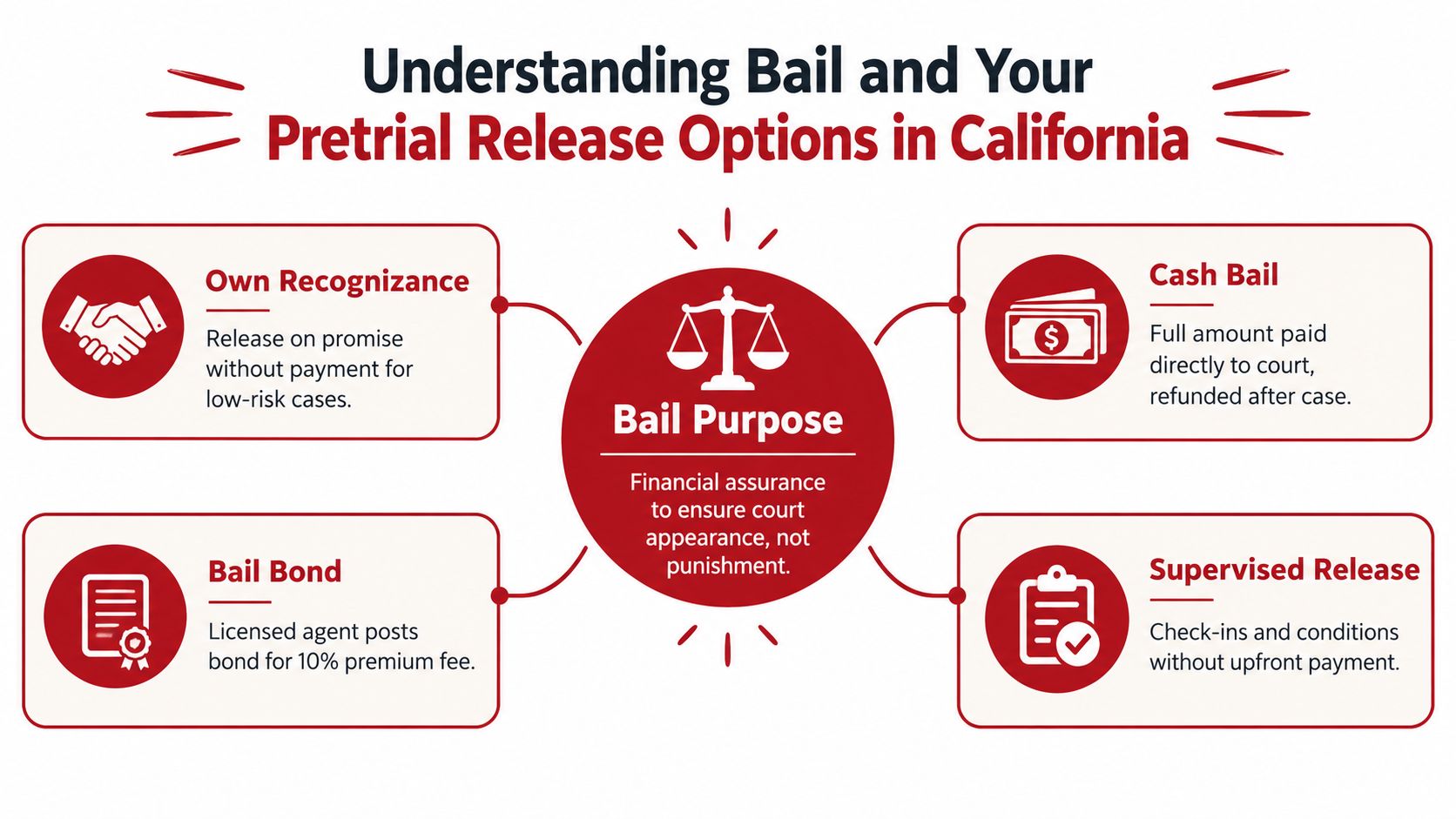
The four paths families most often need to understand are:
- Cite-and-release: In qualifying situations, an officer issues a written notice requiring the person to appear in court instead of taking them through a longer jail stay.
- Own recognizance: The court releases the person based on a signed promise to appear, without requiring bail payment. California Penal Code § 1318 describes promises to appear, obey reasonable conditions, remain in California unless permitted to leave, and waive extradition after a failure to appear. Read the California OR release agreement requirements.
- Supervised pretrial release: The person leaves custody but follows court-ordered supervision, such as check-ins or other conditions.
- Bail: The person secures release through cash, a licensed surety bond, or another approved financial arrangement.
Why a person may leave without paying
A judge may release someone on their own recognizance when the court believes the person can be trusted to return and comply. For misdemeanor cases, California Penal Code § 1270 says the defendant is entitled to OR release unless the court finds on the record that release would compromise public safety or not reasonably assure appearance. Review California’s own-recognizance release rule.
That doesn’t mean every misdemeanor results in immediate release. The charge, criminal history, alleged facts, warrants, safety concerns, and court orders can all affect the decision. A person might also receive conditions without paying money, such as check-ins, travel limits, or no-contact orders.
For a straightforward explanation of the release choices, families can review California pretrial release options. If bail is required, the next question is how the amount was selected and whether a judge can change it.
How Bail Amounts Are Set in California and Ventura County
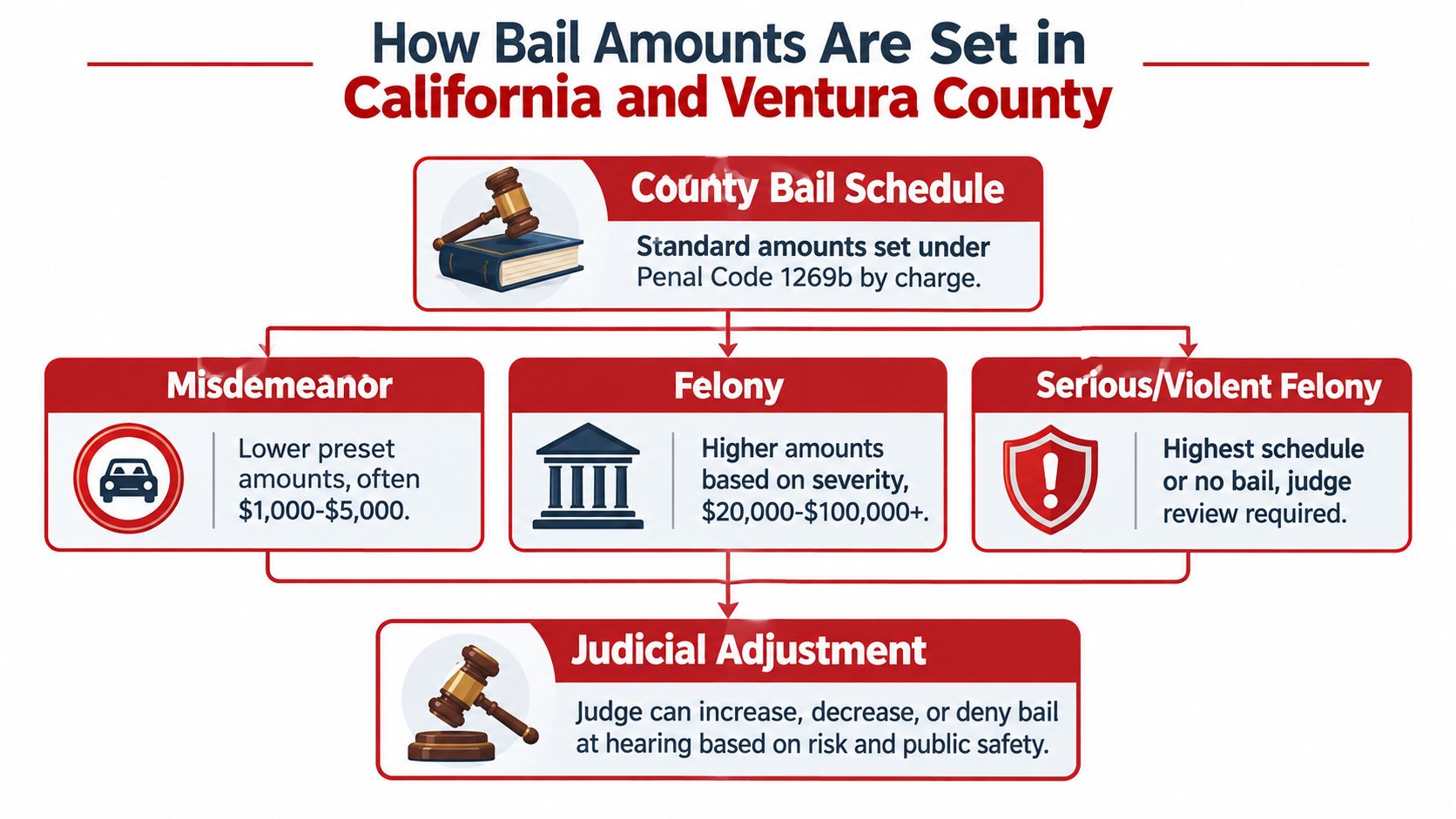
California usually begins with a county-approved bail schedule adopted under Penal Code section 1269b. The schedule gives law enforcement and courts a starting amount based on the offense classification. It lets a family see why a number may appear quickly after booking, even before a full hearing occurs.
The county matters. The Fresno court materials, for example, show a 2026 schedule listing unscheduled felonies at $15,000, unscheduled misdemeanors at $3,000, and unscheduled infractions at $100. Those figures are examples of how schedules can differ by offense and county, not a universal Ventura County price. See how California county bail schedules establish starting amounts.
Ventura County has its own published schedule. The Ventura Superior Court’s 2024 schedule lists presumptive bail of $10,000 for felonies, $2,500 for other misdemeanors, and 17(b) misdemeanors at one-half of the felony bail amount. View the Ventura County bail schedule.
A schedule is only the starting point
The charge classification is important, but it isn’t the entire decision. A judge may consider public safety, the likelihood of appearing in court, the facts alleged, prior court history, and the person’s financial circumstances. The court can sometimes increase, reduce, or replace financial bail with conditions after reviewing the case.
The 2026 California Supreme Court ruling in Kowalczyk adds an important protection. Judges must consider a defendant’s ability to pay and can’t set unaffordable bail as a way to detain someone indirectly. The ruling also limits no-bail detention to narrow constitutional categories and requires a hearing before that type of order is made. Read coverage of the California money-bail decision and its practical effect.
That means a family in Ventura, Oxnard, or Thousand Oaks should ask two separate questions:
- What amount appears on the schedule?
- Will the judge require financial bail, or can release occur with conditions?
You can use this California bail schedule guide to understand the schedule concept, but only the current jail and court records can confirm what applies to a particular arrest.
The Bail Posting Process From Booking to Release
The release timeline starts before anyone can post a bond. After arrest, law enforcement transports the person to the appropriate holding facility. Depending on the arresting agency and the charge, that may involve a local police hold followed by transfer or processing through the county jail system.
Booking creates the record needed for the release decision. Jail staff typically record identifying information, take fingerprints and photographs, enter the charges into the system, check warrants, and complete other intake tasks. A bondsman can’t safely begin with a name alone because the booking number, facility, charges, and bail amount must be verified.
Five steps families can follow
- Confirm the arrest and location. Ask whether the person is at Ventura County Jail, being held by a local department, or awaiting transfer.
- Wait for booking information. Get the booking number, legal name, date of birth, charges, and listed bail amount when available.
- Identify the release path. The person may qualify for citation release, OR release, supervised release, cash bail, or a bail bond.
- Complete the posting paperwork. Cash bail goes through the approved court or jail process. A bail agent files a surety bond and obtains the required signatures and information.
- Wait for jail release processing. Posting the bond doesn’t mean the person walks out immediately. Jail staff still verify the filing, complete internal checks, and arrange discharge.
California legal guidance commonly describes booking as taking 2 to 12 hours, with release after posting taking 1 to 4 hours at smaller jails or 4 to 12 hours or longer at larger facilities. These are published ranges, not promises for every Ventura County arrest. Review the California booking and release timing explanation.
Why the jail may be the slowest part
Families often assume the agent’s paperwork is the final step. In practice, the jail may still need to finish medical screening, property handling, identity checks, warrant review, and discharge procedures. Shift changes, crowded facilities, transfers, and court activity can extend the wait.
A 24-hour bail bonds Ventura service can accept information and prepare paperwork outside normal office hours, but no agent can control the jail’s release queue. For that reason, call early, provide accurate information, and keep the phone available in case the facility or agent needs clarification.
For a practical document checklist, see how to post bail in California.
Paying for Bail Cash Bonds Payment Plans and Collateral
Families usually compare the full cash amount with the cost of a surety bond. California bail bond premiums are typically 10% of the total bond amount, so a $50,000 bond generally carries a $5,000 nonrefundable premium, plus actual, necessary, and reasonable transaction expenses. The California Department of Insurance says surety companies must file their rates and bail agents must charge those filed rates. Read the California Department of Insurance explanation of bail bond costs.
Cash bail and a bond serve the same basic release purpose, but they create different financial obligations.
| Feature | Cash Bail Full Amount | Bail Bond 10 Percent Premium |
|---|---|---|
| Upfront payment | The full court-set amount is paid through the approved process. | The family generally pays the filed premium, usually 10% of the bond amount. |
| Refund treatment | Cash may be returned after the case and bond obligation are resolved, subject to court handling and compliance. | The premium is generally nonrefundable because it pays for the bond service. |
| Collateral | The cash itself secures the obligation. | An agent may request collateral or a financially responsible co-signer, depending on the bond. |
| Speed and paperwork | The payer must meet the court or jail’s payment requirements. | The agent prepares and files the bond after verifying the arrest and signer information. |
| Best fit | Families with immediate access to the full amount. | Families who need to preserve cash or can’t pay the entire scheduled amount. |
Questions to ask before signing
Ask for the total premium, payment schedule, co-signer responsibilities, collateral terms, and what happens if the defendant misses court. A payment plan may reduce the immediate burden, but it doesn’t remove the underlying obligation or the need for compliance.
Collateral is not automatically required in every case. A larger or higher-risk bond may lead an agent to request property or another form of security. Make sure the agreement explains when collateral is released after the court exonerates the bond.
Some 2026 legislative proposals address premium refunds when charges aren’t filed, are dismissed shortly after arraignment, or the bond is exonerated within a short period. Related bill text discusses refunds of up to 80% in certain situations, but proposals aren’t the same as current law. Review the SB 562 bill materials and proposed refund provisions.
For a written overview of available arrangements, families can review California bail bond payment options. Read every term before paying, especially where the agreement addresses refunds, collateral, and missed appearances.
Ventura County Bail Bonds Help Across Southern California Cities
A local arrest can involve more than one agency. Someone arrested in Ventura, Oxnard, Camarillo, Port Hueneme, Thousand Oaks, Santa Paula, Moorpark, Fillmore, or Ojai may be booked through a local department, held during processing, or moved into the Ventura County jail system. The exact facility and booking status determine what information an agent can verify and when paperwork can be filed.
That’s why families searching for bail bonds Ventura, Ventura County bail bonds, or Ventura County Jail bail bonds should provide the arresting agency, city, booking number, and charges if they have them. A search for bail bonds Oxnard may involve an Oxnard Police Department hold, while a case from Santa Paula or Fillmore may follow a different intake path before the county record is complete.
Ventura Superior Court handles local criminal court matters, but the first release decision can depend on the jail record, the arresting agency, the charge classification, and any judge’s order. A local agent can help separate those steps instead of treating every arrest as if it follows the same timeline.

Local help doesn’t mean the same result everywhere
Families near Ojai may need county coordination even though the arrest occurred in a smaller community. A person arrested in Thousand Oaks may have a different booking path from someone arrested in Oxnard. Santa Barbara arrests can involve a separate county process, even though the communities are close and families often search for the same type of assistance.
East County Jail Bail Bonds and bail bonds Thousand Oaks describe availability and response, not a guaranteed release time. Jail processing remains outside the agent’s control. For overnight assistance across these communities, find 24-hour bail bond help near you.
After Release Court Dates Conditions and Staying Compliant
Walking out of jail is the beginning of the next responsibility, not the end of the process. The released person should keep every court document, confirm the next appearance, and follow each condition exactly as written.
For an OR release, California Penal Code § 1318 requires a promise to appear when ordered, obey reasonable conditions, avoid leaving California without court permission, and waive extradition if the person is arrested outside California after failing to appear. A person released on a bond may also have court conditions involving travel, contact with an alleged victim, testing, treatment, or supervision.
A simple compliance checklist
- Save every date: Put court appearances and required check-ins on more than one calendar.
- Read every condition: Protective orders and no-contact conditions can apply even when the defendant disagrees with the allegations.
- Tell the agent about changes: Share updated phone numbers, addresses, employment information, or travel concerns.
- Contact a lawyer about legal questions: A bail agent can explain bond obligations, but defense counsel handles the criminal case and arguments about release conditions.
- Never ignore a missed date: Call counsel and the agent immediately if an emergency affects attendance.
Missing court can lead to a warrant and can place the bond at risk. If the court later exonerates the bond, collateral is handled according to the agreement and the agent’s release procedures. Keep receipts and written records until that process is complete.
Bada Bing Bail Bonds helps families verify booking details, explain Ventura County release procedures, arrange bond paperwork, and review payment or collateral options at any hour. Visit Bada Bing Bail Bonds to get clear guidance on the next step for a Ventura County, Oxnard, or Southern California arrest.