A payment bond is a three-party guarantee that a contractor will pay subcontractors, laborers, and material suppliers, with federal payment bonds generally required at 100% of the contract value on covered projects above $100,000. The word “bond” can also appear during a call to a bail agent, but a bail bond and a construction payment bond protect completely different interests.
You might be searching for “what is a payment bond” after seeing the term in a construction contract, an unpaid-invoice dispute, or a surety document. You might also have reached this topic while trying to understand bail bonds Ventura, Ventura County bail bonds, or a late-night call about release from jail. Those uses sound similar because both involve guarantees, premiums, and a surety relationship. The people protected, the event that triggers payment, and the legal rules are different.
Table of Contents
- What a Payment Bond Actually Is
- How a Payment Bond Works Step by Step
- Payment Bond vs Surety Bond and Other Bonds
- When a Payment Bond Is Required and How the Amount Is Set
- Who Can Claim on a Payment Bond and When
- Why the Term Bond Shows Up When You Call a Bail Agent
- Key Takeaways Before You Trust Any Bond
What a Payment Bond Actually Is
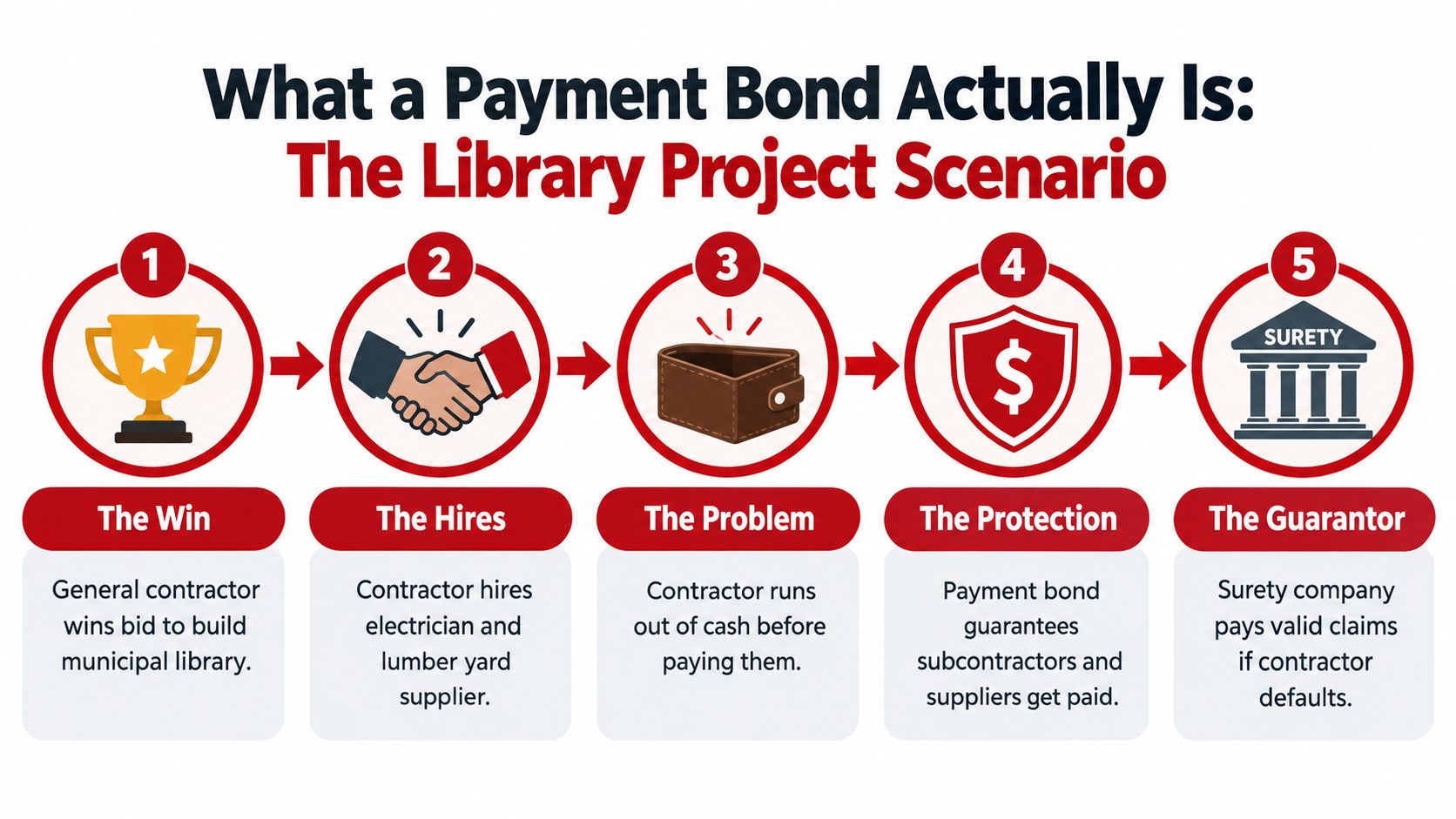
A municipal library project can look healthy from the outside while payment trouble builds behind it. The general contractor hires an electrician, orders lumber, and keeps the work moving. If the contractor runs out of cash before paying either business, the electrician has completed labor, the supplier has delivered materials, and both are left with unpaid invoices.
A payment bond addresses that specific risk. It is a three-party surety contract connected to the construction agreement. The contractor promises to pay eligible subcontractors, laborers, and material suppliers. The surety provides a financial backstop if the contractor defaults, subject to the bond's terms, claim requirements, and limit. A construction payment bond explanation describes how this arrangement supports payment protection and can reduce disputes over unpaid work.
The three parties on the bond
The formal labels become clearer when connected to the library example:
- Obligee: The project owner, such as the municipality commissioning the library. The obligee requires the bond.
- Principal: The general contractor. The principal obtains the bond and remains responsible for paying its construction team.
- Surety: The bonding company. The surety supports the contractor's payment promise and reviews whether a claim meets the bond's requirements.
The surety does not become the contractor's ordinary replacement for every unpaid bill. The contractor remains the party that owes the money. If the surety pays a valid claim, it may later seek reimbursement from the contractor under their agreement.
For a subcontractor or supplier, the bond is a possible recovery route when the contractor's default leaves an eligible invoice unpaid. It is not an automatic payment system. Coverage can depend on the claimant's relationship to the project, notice and filing rules, the type of work or materials involved, and disagreements about defective work, contract scope, or the amount owed.
That structure also explains why the word “surety” can confuse people who encounter bonds through a bail agent. The same broad idea of backing an obligation appears in both settings, but a construction payment bond protects eligible project participants, while a bail bond concerns a person's release obligations. The parties, trigger, and governing terms differ.
Practical rule: Identify the obligee, principal, and surety before interpreting any bond document. Those names often reveal its purpose more clearly than the word “bond” alone.
How a Payment Bond Works Step by Step
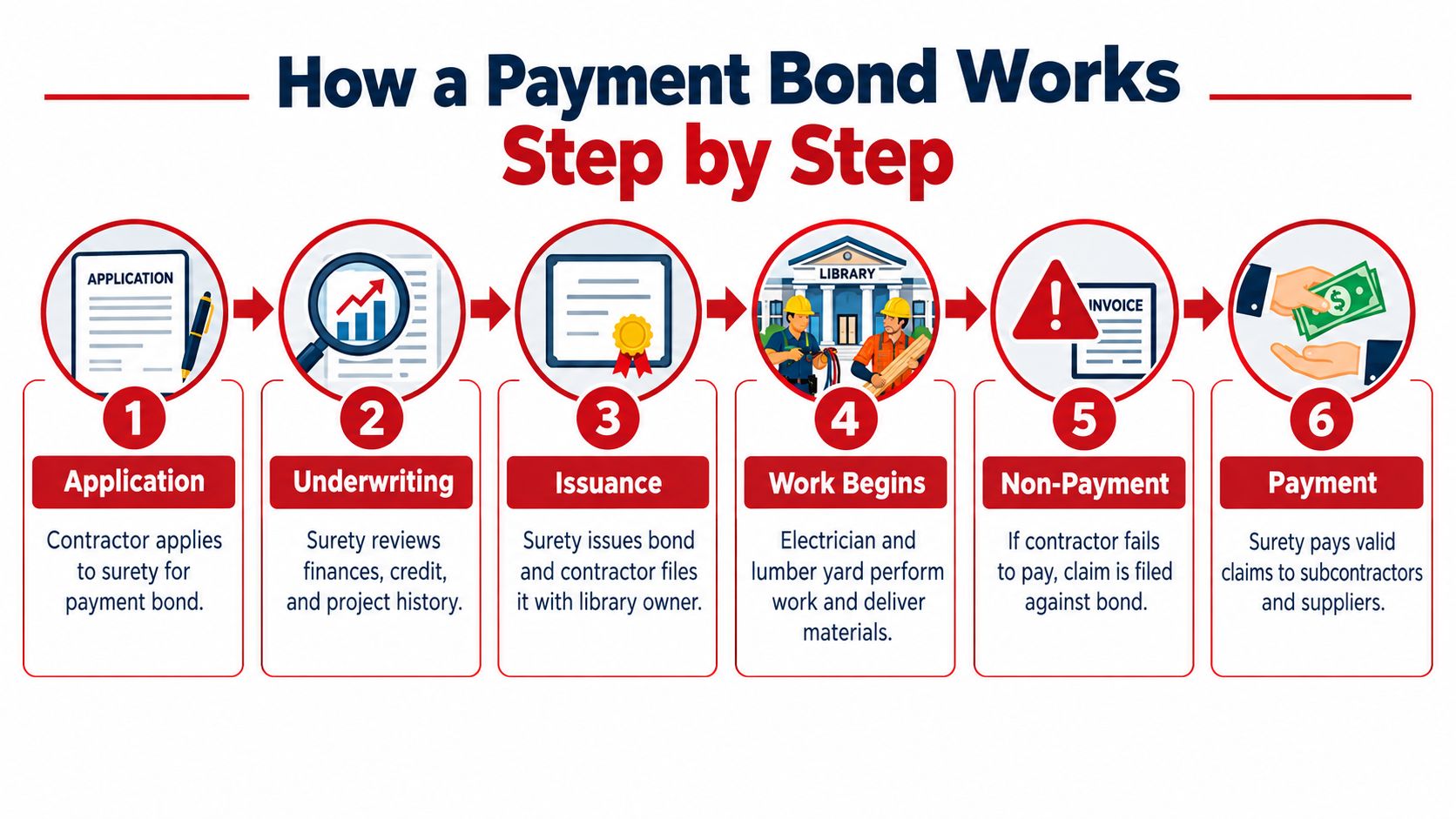
The process starts before anyone pours concrete or installs wiring. The contractor applies to a surety for a payment bond, and the surety reviews the contractor's financial condition, credit profile, project history, and ability to perform the proposed work. The surety is deciding whether the contractor can responsibly take on the obligation and whether the project presents an acceptable risk.
If the surety approves the application, it issues the bond and the contractor files it with the project owner. The bond then travels with the contract documents. Subcontractors and suppliers can review it as they decide whether to provide labor or materials on credit.
The claim sequence
Using the library example, the lifecycle looks like this:
- Application: The contractor requests the bond from a surety.
- Underwriting: The surety examines financial and project information.
- Issuance: The bond is delivered to the library owner.
- Performance: The electrician works and the lumber supplier delivers materials.
- Nonpayment: The contractor fails to pay an eligible party.
- Claim review: The unpaid party submits a claim to the surety.
The surety investigates the claim. It may request contracts, invoices, delivery records, payroll information, change orders, proof of completion, and correspondence showing that payment was due. If the claim is valid under the bond and applicable law, the surety pays it up to the bond's limit.
Think of the surety as a co-signer who steps in when the primary borrower fails to pay. The co-signer may protect the creditor from immediate loss, but the borrower doesn't get a free pass. In construction bonding, the contractor generally remains responsible for reimbursing the surety under the indemnity agreement.
The process isn't identical to the release process explained in how bail bonds work in California. A construction surety investigates a payment obligation, while a bail agent arranges a court-related guarantee for a defendant's appearance.
Payment Bond vs Surety Bond and Other Bonds
The word “surety” describes a broad family of guarantees. A payment bond is one member of that family, not a synonym for every bond used in construction or legal proceedings.
A useful way to separate the terms is to ask three questions: Who is protected? Who provides the guarantee? What event activates the claim? The answers prevent a payment bond from getting confused with a performance bond, a bid bond, or a bail bond.
| Bond Type | Who It Protects | Who Provides It | Trigger for Payout |
|---|---|---|---|
| Payment bond | Subcontractors, laborers, and material suppliers | A construction surety | Contractor fails to pay covered parties |
| Performance bond | Project owner | A construction surety | Contractor fails to perform the contract as required |
| Bid bond | Project owner | A surety | Successful bidder fails to honor the bid or execute the contract |
| License bond | Public or contractual beneficiaries | A surety | Licensed party violates an applicable obligation |
| Bail bond | Court and the defendant's release process | Bail agent backed by a surety | Defendant's release is conditioned on court compliance |
The construction distinctions
A performance bond protects the owner from incomplete or defective contract performance. A payment bond protects the people who supplied labor and materials. A project may use both, but their claimants and remedies aren't interchangeable.
A surety bond is the umbrella term. It can include payment, performance, bid, and license bonds. A plain-language surety bond guide can help if you're trying to understand the broader category rather than one construction instrument.
A contract bond usually refers to a project-specific guarantee written for a particular job. Payment and performance bonds are often issued as part of that contract-bond package. The payment bond answers, “Who gets paid if the contractor defaults?” The performance bond answers, “What protects the owner if the contractor doesn't deliver the promised work?”
Why bail bonds are separate
A bail bond concerns a defendant's release from custody and court obligations. It doesn't pay an electrician, protect a lumber supplier, or guarantee completion of a library. For another accessible explanation of the distinction between bail and bond, readers can consult the Brian Hansford Law bail bond guide.
That separation matters for people searching locally. Someone looking for bail bonds Oxnard or Ventura County Jail bail bonds needs a bail agent, not a construction surety. Someone pursuing an unpaid public-works invoice needs to examine the payment bond, claimant rules, notice requirements, and bond language.
When a Payment Bond Is Required and How the Amount Is Set
A contractor can win a public project, hire subcontractors, and still leave suppliers unpaid if the project runs into trouble. A payment bond works like a payment backstop, but the law does not require one for every construction job.
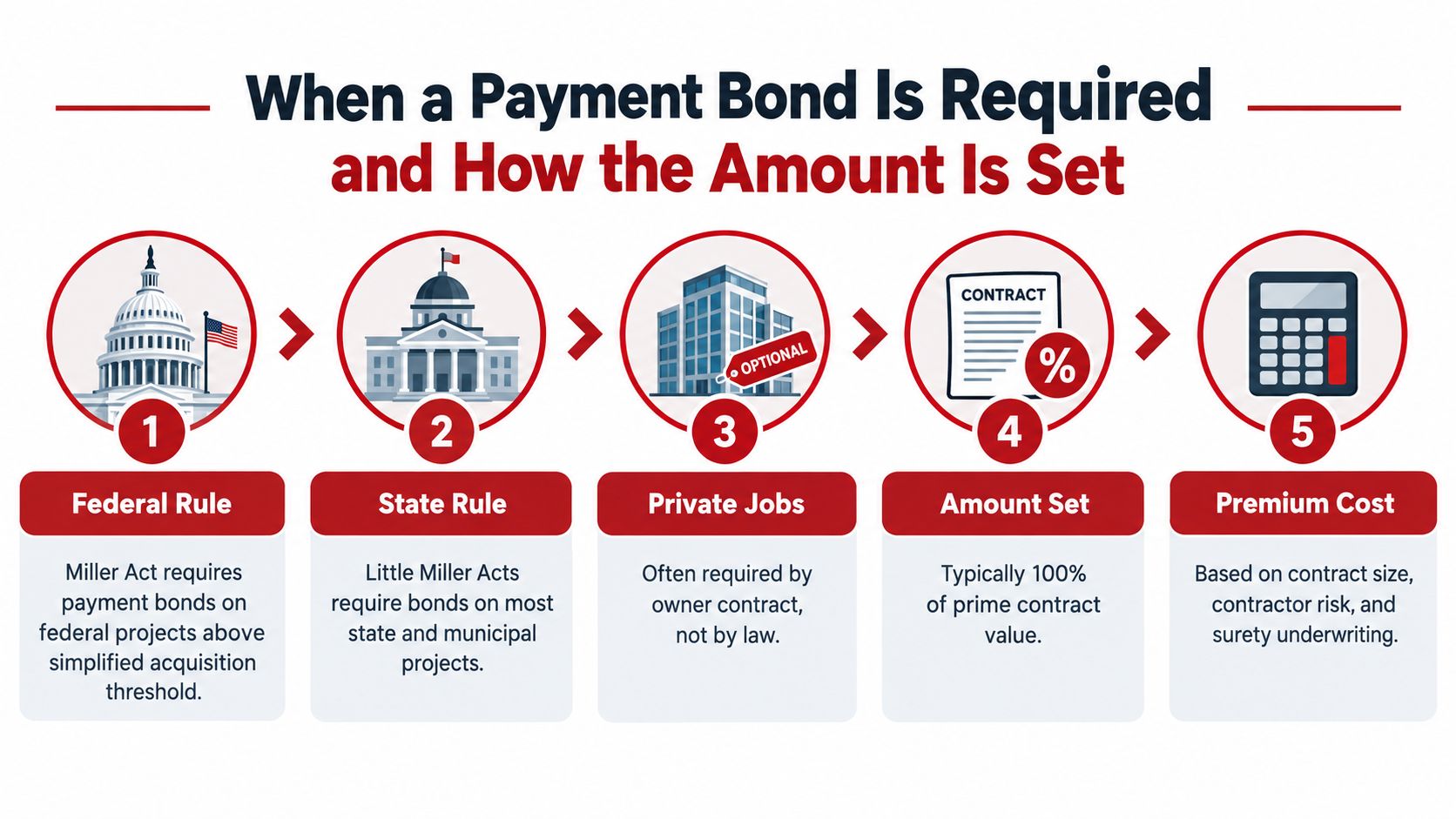
For federal public works, the Miller Act establishes the main rule. It was enacted in 1935, replacing the Heard Act of 1894, and requires separate performance and payment bonds for covered federal construction contracts. The original law applied to contracts exceeding $2,000. Later amendments raised that threshold to $25,000 in 1978 and $100,000 in 1994. This Duke Law source records that history.
Current federal rules generally require a payment bond for construction, alteration, or repair of federal buildings when the contract exceeds $100,000. Contracts between $30,000 and $100,000 may use other payment protections. The General Services Administration's Miller Act brochure describes these federal protections, including the right of eligible unpaid subcontractors and suppliers to sue in U.S. District Court in the name of the United States.
Legal requirement versus contract requirement
State and local public projects may follow different rules. A private owner may also require a payment bond in the contract, even when no statute requires it. Bid documents should show whether the bond is legally required, contractually required, or both.
The bond amount is commonly connected to the contract price. For covered federal projects, it is generally set at 100% of the contract value. Federal acquisition guidance also allows the government to seek additional protection when the contract price increases. Federal Acquisition Regulation guidance explains how changes to the contract can affect bond requirements.
A change order may therefore require a larger bond. The contractor may need to increase coverage through the same surety so the protection matches the expanded work. Review the original contract, amendments, bond form, and supplemental requirements before assuming the stated amount is fixed.
Bail schedules follow a different method. A California court schedule can assign offense-specific bail amounts, as shown in this California bail schedule resource. That amount relates to a court case, not to the value of construction work.
Who Can Claim on a Payment Bond and When
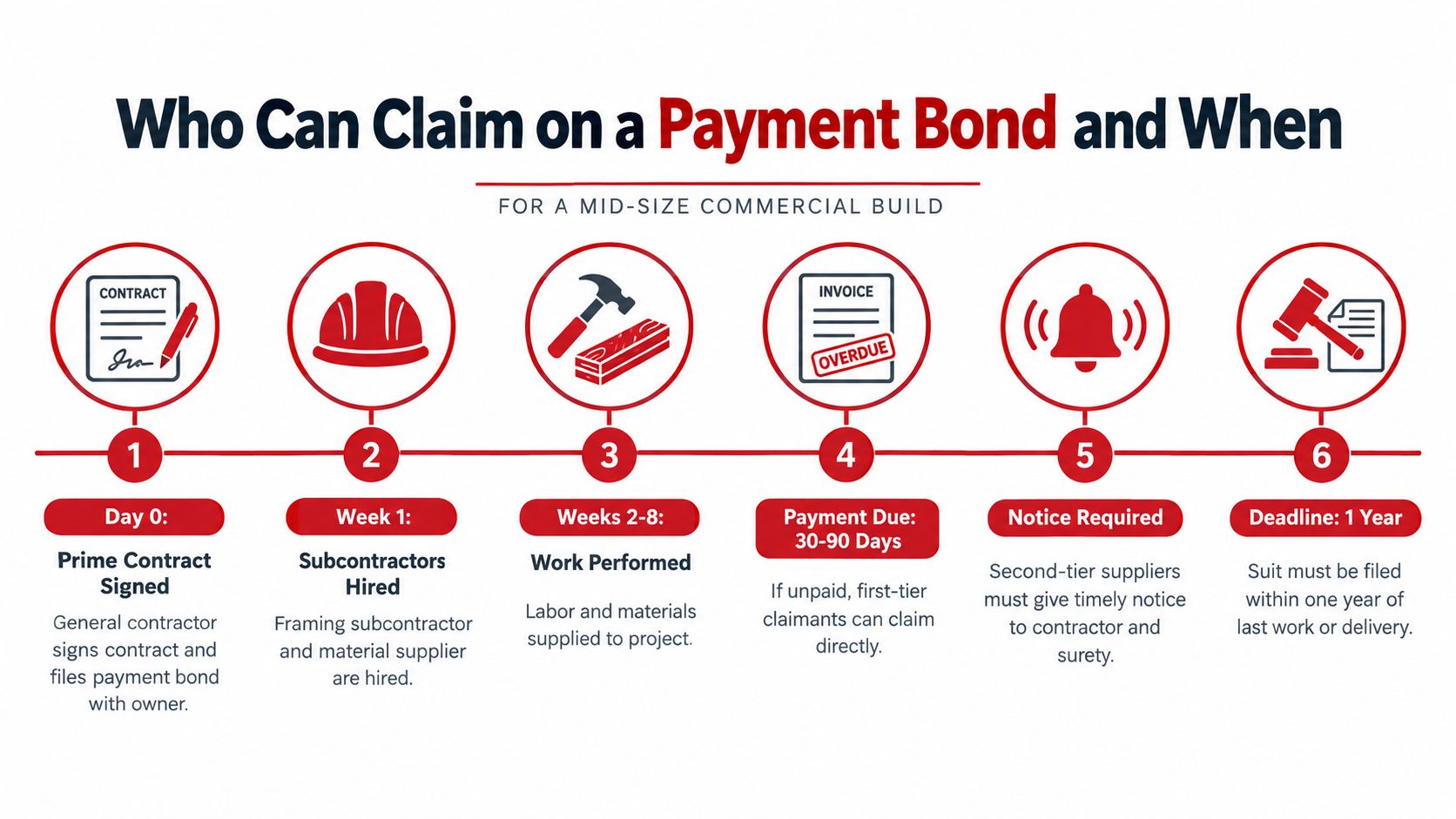
On a commercial building project, the general contractor signs the prime contract, gives the owner a payment bond, hires a framing subcontractor, and orders steel from a supplier. If the contractor stops paying, the framing company and steel supplier may claim against the bond, depending on the bond wording and governing law.
A supplier can sometimes claim even when it sold materials to a subcontractor instead of directly to the general contractor. That downstream position often brings extra notice requirements. An unpaid invoice alone does not establish eligibility. The claimant generally must show a covered relationship, prove that labor or materials were furnished to the bonded project, and follow the applicable claim procedure.
Notice and timing
Deadlines depend on the project and the governing law. For example, Pennsylvania public-project guidance allows a claimant who remains unpaid in full after the last labor or materials were supplied to bring an action on the payment bond within 90 days. It also raises practical questions about who qualifies and whether equipment rentals or utility services count as covered labor or materials. Pennsylvania payment-bond guidance shows why the bond and local rules must be read together.
The notice clock may differ for a first-tier claimant and a second-tier claimant. A direct subcontractor may have a simpler path. A supplier to that subcontractor may need to send written notice to the contractor and surety within the required deadline. Keep delivery tickets, invoices, contracts, payment applications, and communications organized from the start.
The surety reviews the claim rather than paying every invoice described as unpaid. It may challenge charges for work or materials not furnished to the bonded project, amounts outside the contract, duplicate billing, defective materials, or late filing. A valid claim is also limited by the bond's coverage and stated amount.
Do this early: Identify the surety and read the bond before sending a demand. A verbal request to the contractor may not preserve a statutory claim.
Why the Term Bond Shows Up When You Call a Bail Agent
A family member may search for 24-hour bail bonds Ventura after an arrest and hear the word “bond” repeatedly. That word does not identify one universal product. In construction, a payment bond addresses unpaid labor or materials. In criminal-court matters, a bail bond supports a defendant's release while the case continues.
The shared idea is a promise backed by another party. The purpose, parties, trigger, and financial risk differ. A payment bond connects a contractor, project owner, and construction surety. A bail bond connects the defendant or person arranging release, a bail agent, and a surety that backs the agent's obligation.
| Feature | Payment Bond | Bail Bond |
|---|---|---|
| Main purpose | Protects payment for construction labor and materials | Supports release from custody under court conditions |
| Principal | Contractor | Defendant or person arranging the bond |
| Protected interest | Subcontractor, laborer, or supplier payment | Court appearance and compliance process |
| Provider | Construction surety | Bail agent backed by a surety |
| Trigger | Contractor defaults on covered payment obligation | Bail conditions are breached or the defendant fails to comply |
| Pricing basis | Underwriting tied to the construction contract and contractor risk | Filed bail-bond rate and the court-set bail amount |
What a bail call actually involves
The agent first verifies booking details, charge information, the court-set bail amount, and the identity of the person arranging the bond. The agent may also ask about payment or co-signer information. After that, the agent explains the documents and coordinates the release steps with the jail.
A release may involve cash, a bail bond, a credit card, release on the person's own recognizance, sentence completion, or transfer to another facility or program, according to the Ventura County detention report. The available path depends on the case and the custody record.
The amount paid for a bail bond is tied to the court-set bail and the applicable filed rate. The Florida bail process guide offers broader context from another jurisdiction about what can happen to posted bail. The guide is useful for understanding the process, but its rules do not automatically control a different state.
For a construction payment bond, the question is whether a covered payment obligation was left unpaid. For a bail bond, the question is whether the defendant follows the court's conditions and appears as required. A person seeking fast bail bonds Ventura therefore needs a licensed bail agent, not a construction bonding office. A bail bond agent arranges the court-related guarantee and explains the release paperwork, while a construction surety handles a different kind of bonded obligation.
Key Takeaways Before You Trust Any Bond
A payment bond is a three-party promise. The contractor is responsible for payment, the project owner requires the instrument, and the surety backs the contractor's promise if a covered default occurs. Its focus is money owed to subcontractors, laborers, and material suppliers.
A bail bond shares the word “bond,” and may also involve a principal, a provider, and a financial obligation. It still isn't a payment bond. Bail concerns release from custody and court-related conditions, while construction payment bonds address unpaid project labor and materials.
Before signing, relying on, or claiming under any document labeled “bond,” ask these questions:
- Who are the parties? Identify the obligee, principal, and surety. Their names can reveal the document's purpose and the jurisdiction that controls it.
- What obligation does it cover? A payment bond is conditioned on payment to covered project participants. A performance bond concerns completion or performance for the owner. A bail bond supports a defendant's release process.
- What are the limits and deadlines? Check the penal sum, expiration language, notice requirements, and claim procedures. Federal payment-bond rules and state public-works laws can impose strict timing rules.
- What evidence is required? Construction claimants should preserve contracts, invoices, delivery records, and proof of labor or materials. Bail customers should review the premium, co-signer duties, collateral terms, and court conditions.
California readers may encounter the word “bond” during a call about a DUI arrest, domestic-violence arrest, warrant, probation violation, or another charge. A local Ventura County Jail bail bonds discussion concerns a court-conditioned release arrangement, not a guarantee to construction suppliers. Ventura County information states that bail can be posted at the county jail 24 hours a day, 7 days a week, including nights, weekends, and holidays, with release processing typically taking 2 to 4 hours after the facility accepts bail. The Ventura jail information source provides those operational details.
For families comparing providers, guidance on hiring a trustworthy bail company can help you focus on licensing, clear pricing, communication, and local jail procedures. If you're dealing with bail in Ventura, Oxnard, Camarillo, Port Hueneme, Thousand Oaks, Santa Paula, Moorpark, Fillmore, Ojai, or Santa Barbara, confirm the booking location and bail amount before assuming a construction term applies.
Bada Bing Bail Bonds provides 24/7 assistance for families seeking release help in Ventura County and surrounding Southern California communities, including Ventura, Oxnard, Camarillo, and Santa Barbara. To discuss the verified bail amount, payment options, co-signer requirements, and jail coordination in plain English, visit Bada Bing Bail Bonds.