A late-night call can leave a family with more questions than answers: a loved one on parole has allegedly broken a rule, someone mentions a parole hold, and nobody knows whether that means an immediate return to prison. The first hours feel urgent, but an allegation isn't the same as a final revocation decision.
California parole cases follow a formal process. The alleged conduct may be a technical violation, such as a missed meeting or failed drug test, or it may involve a new criminal offense. The response can range from continued supervision and treatment to revocation and reincarceration. Families in Ventura, Oxnard, Camarillo, Thousand Oaks, and nearby communities also have to understand how parole procedures interact with local custody, court, and release questions.
This guide explains what parole violations are, how California reviews them, what rights apply at the hearing stage, and what families can do after an alleged violation. If a separate arrest or warrant has created a custody issue, understanding the Ventura County court system can help you identify which agency, courthouse, and hearing information to verify.
Table of Contents
- Introduction What Parole Means for Families Right Now
- Understanding What Are Parole Violations in Plain English
- Common Types of Parole Violations With Real Examples
- How Parole Conditions Are Set in California
- The Parole Violation Process in California From Report to Hearing
- Consequences and Sanctions After a Parole Violation
- Practical Steps for Families in Ventura County After an Alleged Violation
Introduction What Parole Means for Families Right Now
Parole is supervised release after incarceration. A person lives in the community, but release depends on following written conditions and cooperating with supervision. Those conditions can control where the person goes, whom they contact, whether they use drugs or alcohol, when they must report, and whether they can leave an approved area.
A family may hear that a loved one “violated parole” after a missed appointment. Another person may face an allegation involving a positive drug test, unauthorized travel, or a new arrest. These situations aren't interchangeable, and the alleged conduct doesn't automatically determine the final outcome.
The practical starting point: A parole allegation begins a review. It doesn't, by itself, prove that revocation and a return to prison are inevitable.
The process can feel especially confusing because several systems may be involved at once. A parole officer may report an alleged breach, a parole authority may decide whether to issue a warrant or summons, and a local jail may hold the person while the matter moves forward. If a new criminal charge is also pending, the criminal court process and parole process can proceed alongside each other.
Families often search for answers using terms such as bail bonds Ventura, Ventura County bail bonds, or Ventura County Jail bail bonds. Those searches may lead to useful custody information, but a bail bond for a new criminal case doesn't necessarily resolve a parole hold. The family needs to confirm what basis the jail is using for custody before assuming that posting bail will result in release.
The safest early approach is simple. Stay calm, record the person's full name and booking details, ask for the alleged violation and hearing information, and avoid guessing about deadlines. The sections below explain the terminology first, then the categories of violations, the California hearing process, possible sanctions, and practical steps for families across Ventura County.
Understanding What Are Parole Violations in Plain English
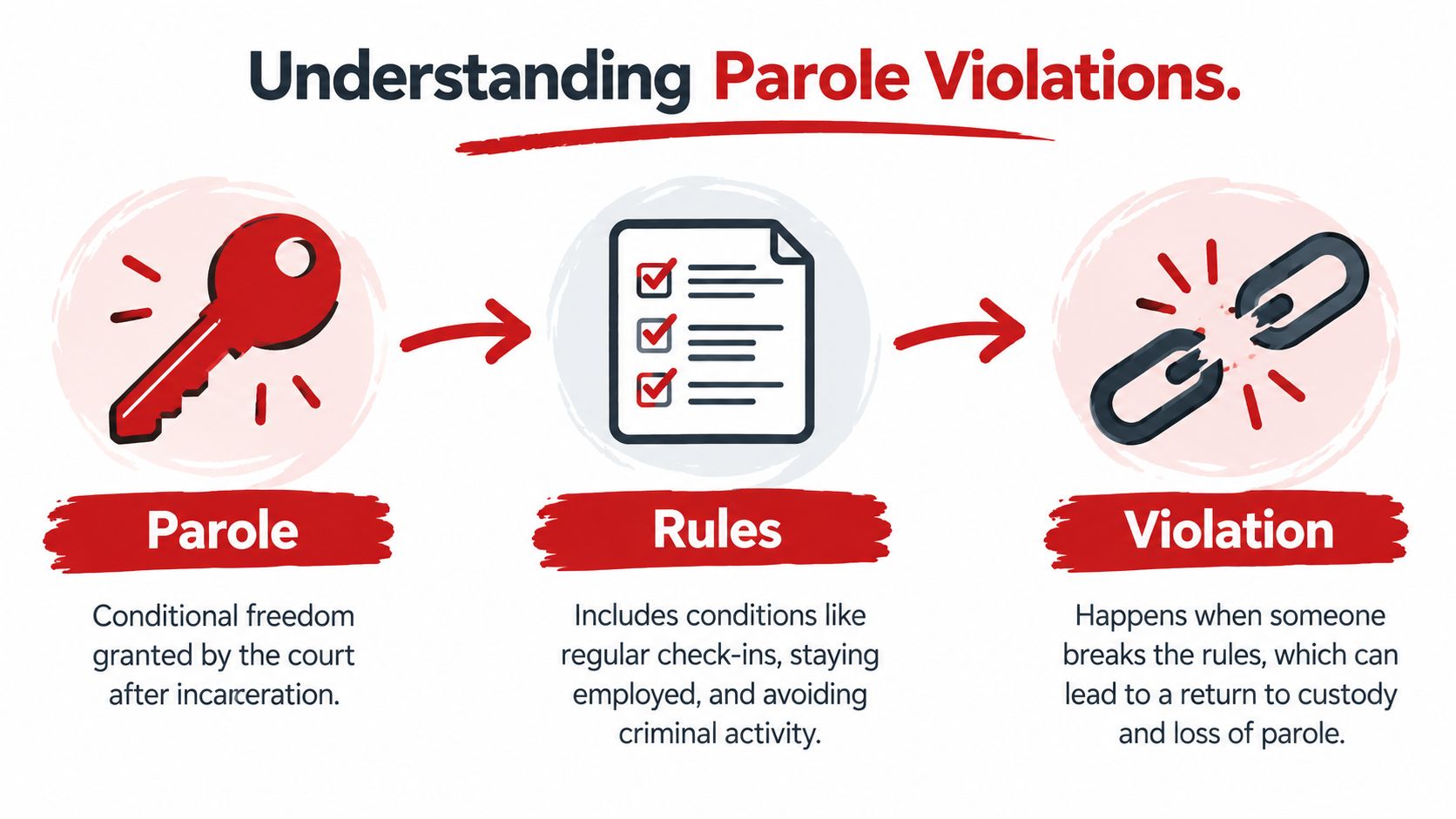
Think of parole as conditional freedom. A person has left prison and returned to the community, but release comes with a written set of rules. The person must follow those rules while remaining under supervision.
A parole violation occurs when the person allegedly breaks one of those conditions. The breach might involve conduct that would be a crime, but it might also involve conduct that wouldn't normally lead to a criminal conviction. Missing a required meeting, failing a drug test, leaving an approved area, or breaking curfew can all create a parole problem when those conditions apply.
Parole isn't unrestricted freedom. It's freedom tied to ongoing compliance with supervision rules.
The distinction between parole and probation also matters. Both involve community supervision, but they arise at different points in the criminal process and can use different procedures. Families who are unsure which type of supervision applies can review this explanation of probation versus parole in California, then confirm the answer with the supervising agency or a lawyer.
A violation is still an allegation until the responsible authority reviews the facts. The officer's report may describe what happened, identify the condition involved, and recommend a response. A commissioner or parole board then determines whether the matter requires a warrant, summons, hearing, continued supervision, or another sanction.
Why the wording matters
The phrase “parole violation” can describe very different circumstances. A technical violation usually concerns a supervision rule. A new-offense violation involves an allegation that the person committed another crime. The evidence, risk assessment, prior compliance, and seriousness of the conduct can all influence the response.
People also confuse a parole violation with an ordinary arrest. An arrest may lead to a criminal case, while a parole violation proceeding asks whether the person breached a release condition. One event can create both matters, but the proceedings aren't identical.
The practical lesson is to identify three facts before drawing conclusions:
- The condition: What exact written rule allegedly was breached?
- The conduct: What does the report say happened?
- The status: Is the person facing a summons, warrant, parole hold, criminal booking, or more than one of these?
Those details provide a clearer picture than the label alone.
Common Types of Parole Violations With Real Examples
Parole violations generally fall into two broad groups. Technical violations involve supervision conditions. New-offense violations involve an allegation of new criminal conduct, whether or not the person has already been convicted.
Consider a person required to meet a parole officer every week. Missing one appointment after a transportation problem may be treated differently from repeatedly refusing to report. The same applies to a failed drug test. The supervising authority may examine whether the result reflects a single lapse, an ongoing treatment issue, or conduct connected to a new offense.
Technical violations
Common examples include:
- Missing a required supervision meeting.
- Failing a drug or alcohol test.
- Traveling outside an approved area without permission.
- Breaking a curfew.
- Failing to attend required treatment.
- Not following reporting, employment, housing, or communication conditions.
Pennsylvania's official parole guidance describes similar examples and explains that responses may be proportional to the alleged conduct, including increased supervision, treatment, community service, short confinement, or revocation. California cases must be evaluated under their own rules, but the distinction helps explain why a technical allegation doesn't automatically equal a new criminal conviction.
New-offense violations
A new-offense allegation may involve a new arrest or conduct that prosecutors treat as criminal. The person could face a separate criminal case while the parole authority reviews whether the same conduct violated parole.
| Violation Type | Examples | Typical Response |
|---|---|---|
| Technical violation | Missed meeting, failed test, unauthorized travel, curfew breach | Increased supervision, treatment, other graduated sanction, or a revocation review |
| New-offense violation | Alleged theft, assault, drug offense, or other new crime | Separate criminal process and possible parole revocation or reincarceration |
The table shows general categories, not a guaranteed result. A technical violation can still lead to custody, especially when the person has repeated problems or presents a serious supervision concern. A new arrest also isn't the same as a conviction, so families should distinguish the criminal allegation from the parole decision.
For an additional explanation of how alleged criminal conduct can affect parole, families can review this discussion from the Law Office of Bryan Fagan PLLC on robbery and parole violations. The legal rules in that resource concern another state, so use it for general context rather than as a substitute for California advice.
Don't confuse a failure to appear with every parole violation. A missed court date can create a warrant or separate court problem, and what FTA means in law enforcement may help families understand that terminology. Confirm whether the alleged issue concerns court attendance, parole supervision, or both.
How Parole Conditions Are Set in California
California parole conditions come from the person's release and supervision requirements. Some conditions are common across parole cases, while others respond to the underlying offense, the person's history, treatment needs, residence, employment, or release plan.
The written paperwork matters most. A family shouldn't rely on a general statement such as “stay out of trouble.” The actual conditions may include specific reporting instructions, geographic limits, testing requirements, curfew terms, treatment obligations, contact restrictions, or search conditions.
Standard and special conditions
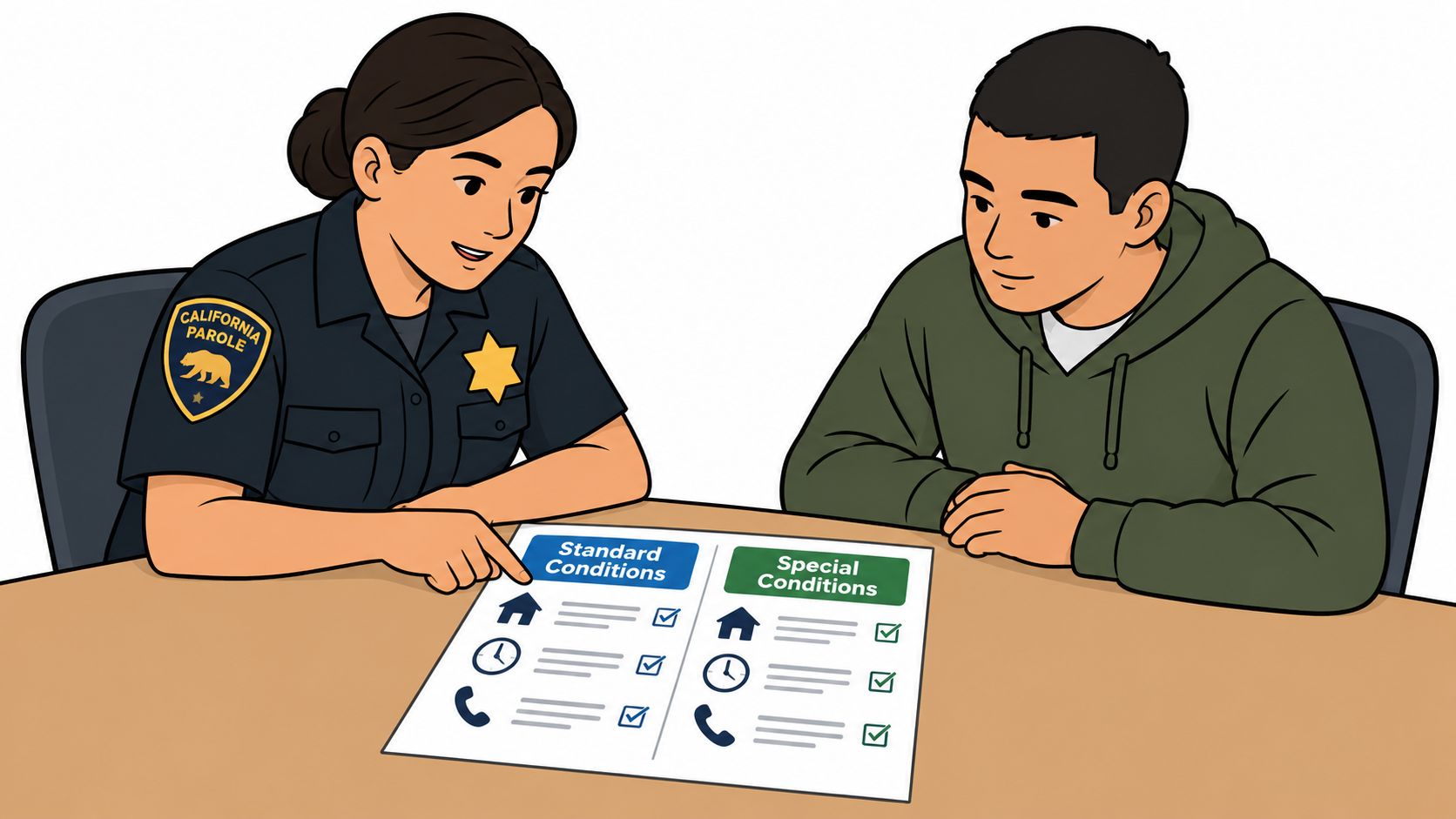
Standard conditions create the basic structure for supervision. Special conditions address circumstances that require closer monitoring or particular restrictions. A person may have conditions connected to substance use, mental health treatment, contact with certain people, residence, weapons, travel, or the conduct underlying the sentence.
Conditions can also create practical obstacles. Someone may be required to attend treatment but lack transportation, or may be unable to report after a housing change. Those circumstances don't erase the condition, but they can be important facts for the supervising officer and decision-maker. Prompt communication is safer than missing a requirement without notice.
A family member can help by keeping a copy of the conditions, recording appointment dates, saving messages from the parole office, and documenting transportation or treatment problems. That record won't decide the case by itself, but it can help clarify whether the person tried to comply and what prevented compliance.
Families dealing with substance use or behavioral health barriers may also find it useful to review this California behavioral health services guide from Addiction Resource Center LLC. Treatment support can be relevant to future compliance, although it doesn't replace legal advice or a required parole response.
Local custody questions can overlap with parole conditions when a person is arrested in Ventura County. People may search for bail bonds Ventura or Ventura County bail bonds after a booking, but the release rules depend on the specific hold, charge, and authority involved. A local bail agent can explain the booking side, while a lawyer or parole representative should address the parole conditions and hearing.
The Parole Violation Process in California From Report to Hearing
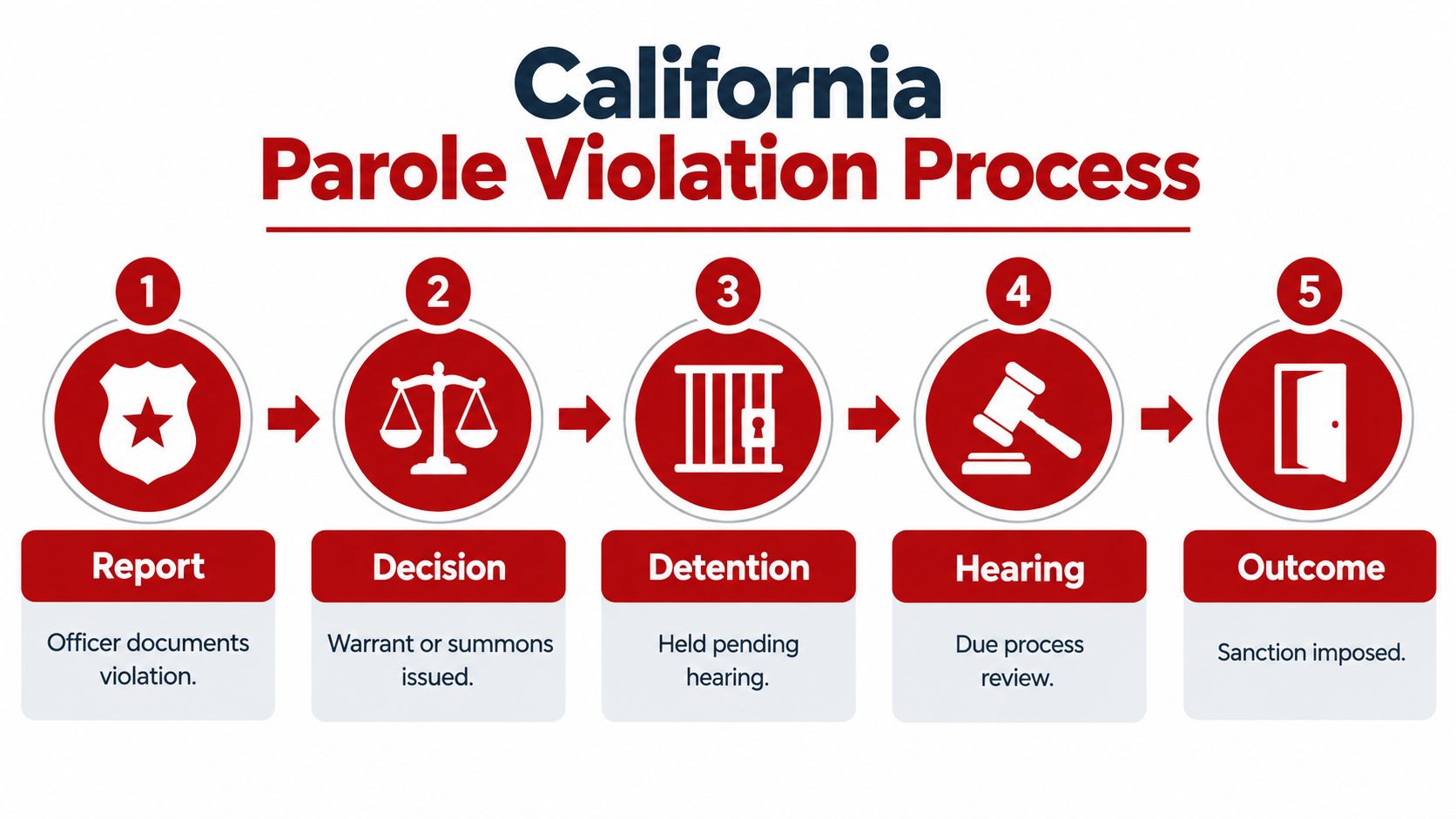
California doesn't treat every alleged violation as an instant final punishment. The process normally moves through reporting, a custody decision, and formal review. Families should ask which stage the case has reached instead of assuming that an arrest means revocation has already occurred.
The initial report and custody decision
A supervising officer documents the alleged violation. The report may identify the condition, describe the conduct, summarize supporting information, and recommend a response. The responsible parole authority then decides whether to issue a warrant or summons.
A warrant can result in custody. A summons may direct the person to appear or respond without the same immediate detention. The choice depends on the circumstances and the governing procedures. If the person is held, the family should verify the facility, booking basis, and hearing information rather than relying only on an informal message.
California's two-stage review
California law gives a parolee 15 days after arrest to receive a probable-cause hearing and 45 days after arrest to receive an evidentiary revocation hearing, according to California Penal Code Section 3044. The revocation decision must use a preponderance of the evidence standard. That means the decision-maker evaluates whether the alleged violation is more likely than not supported by the evidence.
The first stage is the preliminary inquiry. The California Supreme Court describes it as a prompt review near the place of arrest to determine whether probable cause exists. If the matter proceeds, the final hearing provides broader procedural protections.
At the evidentiary hearing, the person receives written notice, disclosure of the evidence, and an opportunity to present witnesses and evidence. The person can confront adverse witnesses unless good cause supports an exception, and a neutral decision-maker must provide a written explanation of the reasons for the outcome. Counsel at state expense may be available when the parolee is indigent and cannot adequately defend against the allegations because of case complexity or limited capacity.
This guide to what to do after a probation arrest offers general practical context for families dealing with supervision-related custody. California parole and probation procedures differ, so local legal guidance remains important.
Use the video below as an additional visual explanation of the process.
Consequences and Sanctions After a Parole Violation
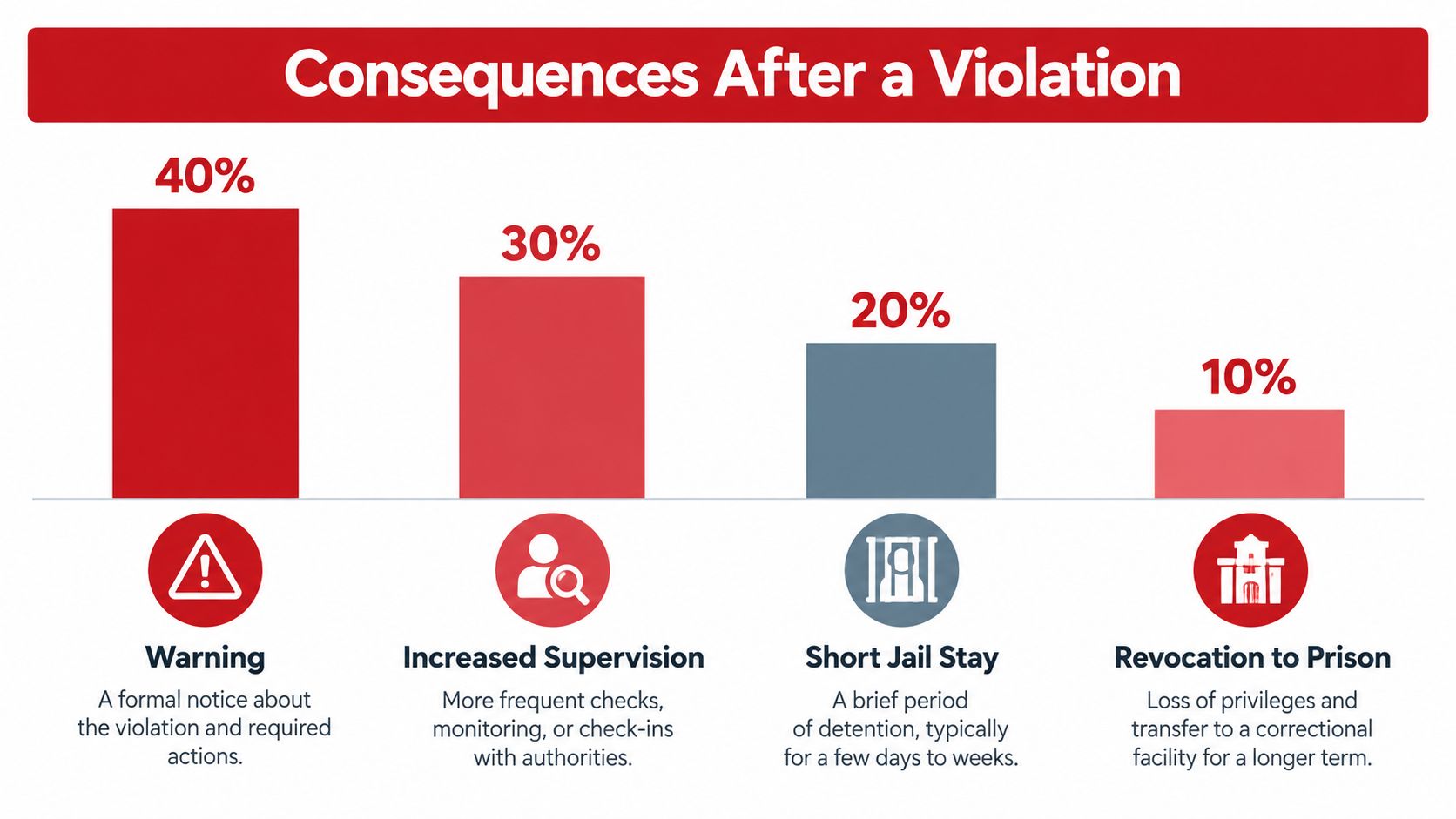
The outcome depends on the alleged conduct, the evidence, the person's compliance history, the seriousness of the risk, and the available sanction options. A technical violation may lead to a warning, additional reporting, treatment, community service, or short confinement. A new criminal offense can lead to a separate prosecution and full parole revocation.
California's parole system illustrates why families should take even a technical allegation seriously. A U.S. study of California parolees found that 49% had at least one formal parole violation report, 24% had multiple reports, and the sample produced 296,958 total violation reports. The same source notes that California's prison term for a parole violation is 12 months. These figures come from the federal courts' published study materials, not from a prediction about any individual case. Read the California parole violation study.
Why the issue matters beyond one case
Parole violations have shaped incarceration trends over time. In the late 1970s, 16% of U.S. state and federal prison admissions stemmed from parole violations and some types of probation. By 1999, parole violators accounted for more than 35% of all state prison admissions, and in four states they made up more than half of admissions. A later analysis found that parole violations accounted for 60% of the increase in the nation's prison population between 1992 and 2001. Review the historical analysis of parole and mass incarceration.
A separate national report says at least 125,000 people were incarcerated for technical probation or parole violations, and those violations represented 27% of all admissions to state and federal prisons in its latest 2026 reporting. See the technical violation incarceration analysis. These numbers explain the system-wide impact, but they don't determine what will happen in Ventura County or in a particular parole case.
Street time and delinquent time
Some jurisdictions distinguish street time from delinquent time. Time spent in the community while a violation is pending may not count toward completion of supervision, which can extend the period of exposure to supervision and affect the custody term after revocation. Families should ask how time is being calculated rather than assuming every day outside custody receives credit.
For a broader explanation of possible probation violation consequences, focus on the difference between a court case and a supervision response. A person may need help with both, but one proceeding doesn't automatically resolve the other.
Practical Steps for Families in Ventura County After an Alleged Violation
Start with facts, not conclusions. Write down the person's full legal name, date of birth, booking location, alleged violation, parole officer's contact information, custody status, and any scheduled hearing. Ask whether the person is held on a parole warrant, a new criminal charge, a court warrant, or multiple holds.
For families in Ventura, Oxnard, Camarillo, Port Hueneme, Thousand Oaks, Santa Paula, Moorpark, Fillmore, Ojai, and Santa Barbara, verify information directly with the relevant jail and court. Ventura County Jail procedures and court calendars can change, and an online result may not show every parole-related detail.
A practical checklist
- Preserve the paperwork: Keep the parole conditions, notices, release documents, and court information together.
- Confirm the hearing: Ask where and when the preliminary or evidentiary review will occur.
- Separate the proceedings: Identify which issue belongs to parole and which belongs to a new criminal case.
- Document compliance efforts: Save proof of appointments, treatment attendance, messages, transportation problems, and approved travel.
- Ask about release limits: A criminal bail amount may not remove a parole hold.
For a separate arrest or warrant question, families can review warrant arrests and bail bonds in Ventura County. Ventura County's bail schedule lists unlisted misdemeanors at $2,500 and unlisted felonies at $10,000, according to this Ventura County bail schedule reference. Those figures are reference points for the county schedule, not a prediction of the amount in a specific case.
If the issue involves a new booking, searches for 24-hour bail bonds Ventura, bail bonds Oxnard, or bail bonds Thousand Oaks may help locate after-hours custody assistance. Ask directly whether the person is eligible for a bond and whether a separate parole hold remains active. Clear answers about the hold can prevent a family from expecting a release that the agency can't authorize.
You don't need to solve the entire case in one phone call. Confirm the custody basis, protect the hearing date, gather the written conditions, and seek qualified legal advice about the alleged violation and available defenses.
Bada Bing Bail Bonds provides 24/7 booking verification, explains California bail and custody information in plain English, and coordinates with Ventura County facilities when a new charge accompanies a parole-related hold. For immediate help understanding the booking and release questions, visit Bada Bing Bail Bonds.