
A knife arrest can begin with something that feels completely ordinary. You’re driving through Oxnard with a work knife in the vehicle, or you’re entering a Ventura courthouse with a pocketknife you forgot was in your bag. A deputy finds it, measures the blade, examines how it opens, and suddenly your family is searching for CA knife length laws while trying to learn where you’ve been taken.
The legal question and the custody question are separate. A knife may be lawful in one setting but restricted in another, and an arrest still triggers booking, identification, financial review, and a release decision. If the arrest occurs in Ventura, Thousand Oaks, Camarillo, Port Hueneme, Santa Paula, Moorpark, Fillmore, Ojai, or nearby Santa Barbara, local jail procedures matter immediately.
Table of Contents
- When a Routine Stop Turns Into a Weapons Charge
- Decoding the 2-Inch Switchblade Threshold
- Location-Based Limits for Schools and Public Buildings
- Navigating the Ventura County Jail Booking Process
- Understanding Bail Schedules and Bond Premiums
- Practical Compliance and Immediate Next Steps
- Clearing Up Common Knife Law Misconceptions
When a Routine Stop Turns Into a Weapons Charge
A traffic stop in Oxnard can change direction quickly. The officer may ask whether there are weapons in the vehicle, find a knife in a center console, and focus on its blade, locking mechanism, opening method, and location. The driver may believe it’s only a tool. The officer may view the same item as a prohibited switchblade, a concealed dirk or dagger, or a knife restricted in a sensitive location.
A similar problem can arise at a Ventura courthouse. A folded pocketknife that’s ordinarily lawful may still create a screening issue, while a fixed blade or a locking knife can raise a more serious concern. The important point is that California regulates knife type, carry method, and location together. Blade length alone doesn’t answer every question.
Families usually experience the next stage as confusion. One person is trying to find the arresting agency, another is calling the jail, and nobody knows whether the person has completed booking or whether bail has been set. That’s when a reliable explanation of what to do when someone gets arrested becomes more useful than online speculation.
Why the first call matters
During booking, the person in custody may not be able to provide complete information. The family should gather the person’s full legal name, date of birth, arresting city or agency, suspected charge, and any booking or case number available. Even partial information helps a local bail professional identify the correct facility and determine whether the person is eligible for release.
A 24-hour bail bonds Ventura provider can also explain whether the jail has finished intake, whether the court has imposed a scheduled amount, and what documents a co-signer needs. Calling early doesn’t decide the criminal case, but it can prevent avoidable delays in arranging release.
Practical rule: Don’t argue the knife law with the jail desk. Confirm custody, obtain the booking details, and let a defense attorney address the facts of the charge.
A person arrested in Ventura County may be processed at the main Ventura detention facility or through the East County system in Thousand Oaks. The right release plan depends on the facility, the charge, and the status of booking. Families looking for Ventura County bail bonds should treat the process as a time-sensitive logistics problem, not just a legal research project.
Decoding the 2-Inch Switchblade Threshold
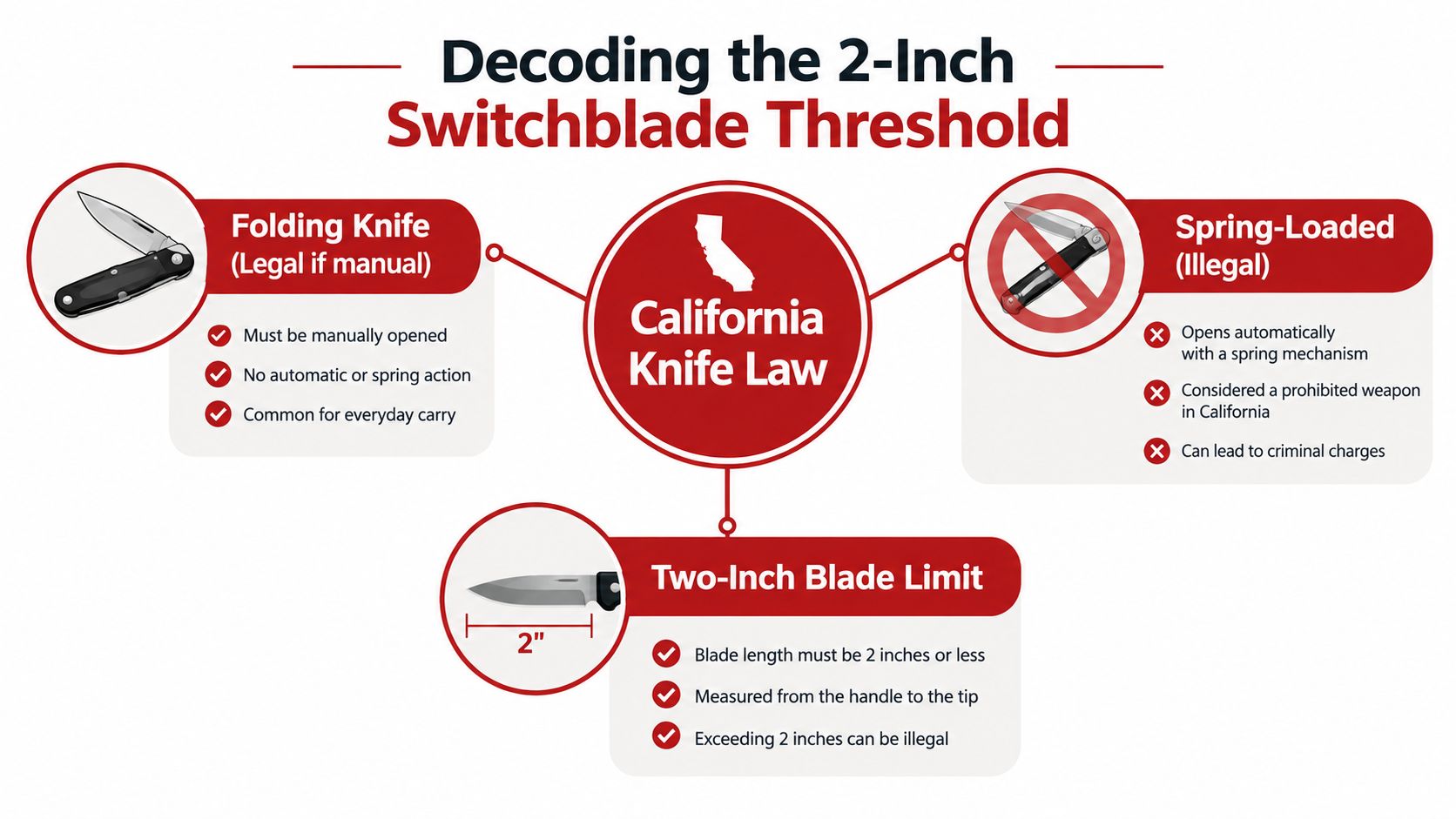
California’s most recognizable knife-length rule concerns switchblades. Penal Code section 17235 defines a switchblade as a pocketknife-like knife with one or more blades that are at least two inches long and can be released automatically by a button, pressure on the handle, a flip of the wrist, gravity, or a similar mechanism. California Penal Code section 21510 makes it a misdemeanor to carry, possess in the passenger or driver area of a vehicle, or transfer that type of knife when the blade reaches the statutory threshold.
The practical line is direct. A switchblade under two inches falls outside that specific prohibition, while a switchblade at two inches or above falls within the banned category under the statute. That doesn’t mean every folding knife near that length is illegal. The opening mechanism remains decisive.
Automatic opening versus manual opening
A manual folding knife generally opens through deliberate pressure applied by the user. California’s definition also recognizes an important exclusion for some one-hand thumb-open knives. A thumb stud or similar feature doesn’t automatically make a knife a switchblade when the design includes sufficient detent resistance or another mechanism that keeps the blade from opening automatically.
That distinction is easy to misunderstand during a roadside encounter. A spring-assisted feel, a loose pivot, a gravity action, or a wrist flick can create questions about whether the knife opens automatically. The safest evaluation looks at the actual mechanism, not the product label or what a seller calls it.
California’s switchblade rule remains an actively tested area of law. A 2026 Ninth Circuit opinion concerning the switchblade ban addressed a facial challenge and reflects that the prohibition continues to receive judicial scrutiny. Court litigation doesn’t turn an arrest into a legal carry permit. It reinforces the need to examine the statute and the specific knife.
How to check a knife before carrying it
Measure the blade according to the relevant legal and manufacturer descriptions, then inspect how it opens. Don’t rely on the knife’s marketing category, and don’t assume that a small appearance means the law treats it as harmless.
- Check the mechanism: Determine whether a button, handle pressure, gravity, wrist movement, or similar action releases the blade automatically.
- Check the blade length: A switchblade at or above the two-inch threshold creates the specific Penal Code section 21510 problem.
- Check the detent: A one-hand thumb-open folder may be treated differently when resistance prevents automatic deployment.
- Check the setting: A knife that avoids the switchblade definition can still be restricted at a school, public building, courthouse, or transportation terminal.
The best recommendation is simple. If you can’t confidently explain the knife’s opening mechanism and the place where you’ll carry it, leave it at home or obtain advice from a California weapons attorney before carrying it.
Location-Based Limits for Schools and Public Buildings
California doesn’t use one universal maximum blade length for every knife and every public place. Instead, the law changes with the location and the knife’s design. That patchwork is the central feature of California knife rules, and it’s why a knife that’s acceptable during an outdoor activity near Ojai may create a problem at a school, courthouse, government office, or airport terminal.
For certain K-12 and higher-education settings, summaries of the Penal Code identify a 2.5-inch threshold for relevant knives, along with restrictions involving fixed blades and locking folders. Public buildings and certain airport or vessel-terminal areas use a 4-inch threshold for knives that are fixed or capable of being locked in an unguarded position. The location must be checked before entry, not after screening begins.
The same knife can produce different results
Consider a folded knife carried during ordinary errands in Camarillo. Outside a special restricted zone, California has no single statewide maximum length for many folded pocketknives, and openly worn fixed blades aren’t subject to one blanket statewide length ceiling in ordinary settings. Entering a school campus or public building changes the analysis.
A knife’s locking characteristic also matters. A folder that remains closed may be treated differently from one that can be locked open. For a courthouse visit in Ventura, the safest decision is not to bring a knife at all. Security screening is the wrong place to test a borderline interpretation.
| Location Type | Maximum Legal Blade Length | Key Restrictions |
|---|---|---|
| Certain K-12 and higher-education grounds | 2.5 inches for relevant restrictions | Fixed blades, dirks, daggers, and certain locking knives can be restricted |
| State or local public buildings | 4 inches for covered fixed or lockable knives | Rules apply to knives fixed or capable of being locked in an unguarded position |
| Certain airport sterile areas and vessel terminals | 4 inches for covered knives | The knife’s fixed or lockable characteristics matter |
| Ordinary settings outside special zones | No single statewide maximum for many folded pocketknives or openly worn fixed blades | Knife type, concealment, local rules, and conduct still control |
The table’s figures and location distinctions come from California knife-law guidance on blade limits and venues and California legal summaries addressing schools, public buildings, and concealed knives.
A travel rule worth following
Before traveling between Thousand Oaks, Santa Paula, Moorpark, Fillmore, and neighboring cities, assess the destination rather than only the knife. Schools, colleges, public buildings, airports, and terminals deserve a separate check. Local ordinances may also add restrictions, so state-law compliance isn’t always the end of the analysis.
Navigating the Ventura County Jail Booking Process
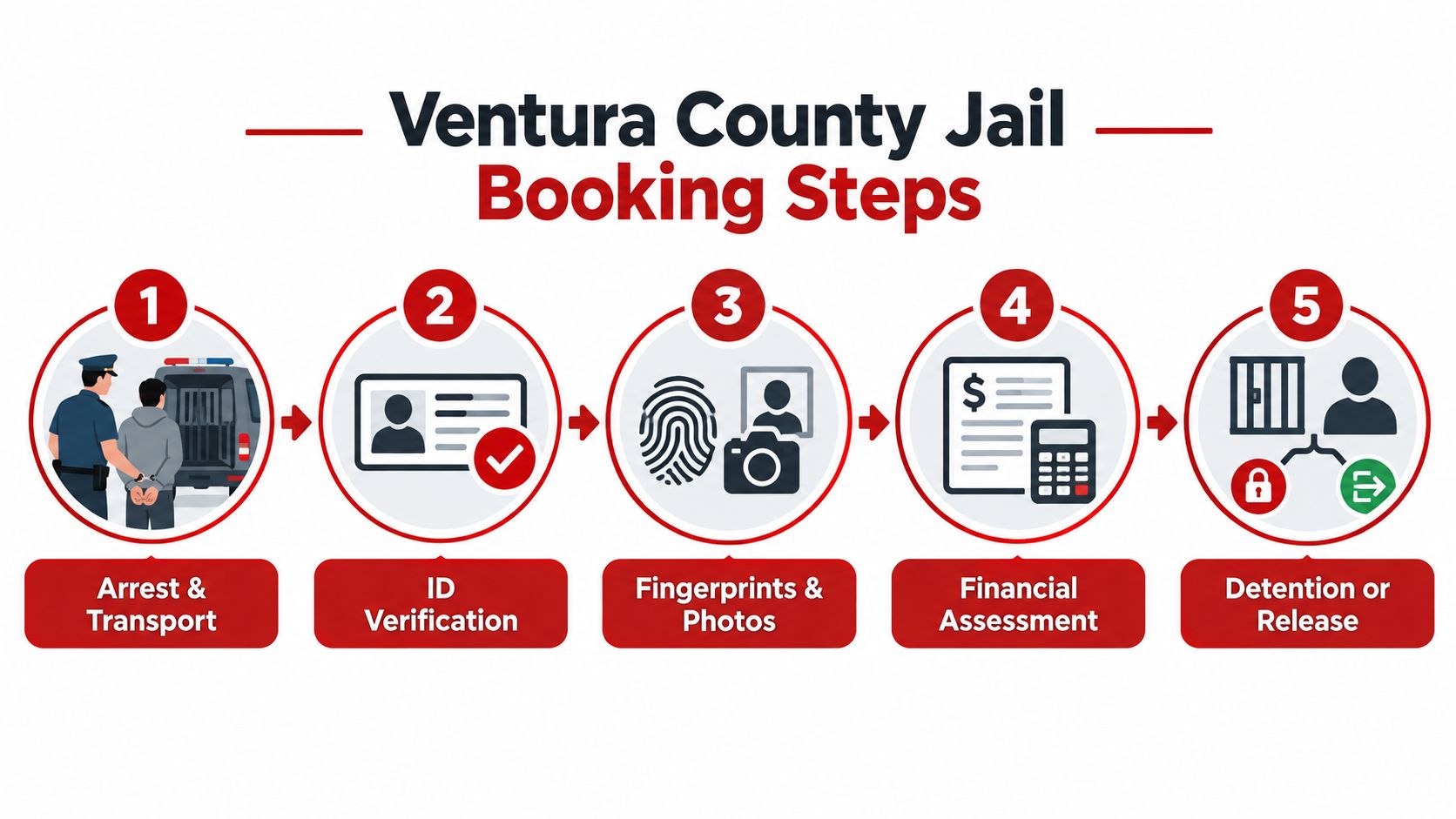
An arrest doesn’t lead straight to release. The person must first be transported, identified, photographed and fingerprinted as required, entered into the custody system, and evaluated for the applicable release process. A family can save time by treating each stage as a separate checkpoint.
Start with the correct facility
The Ventura County Sheriff identifies the main bail-posting location as the Pre-Trial Detention facility at 800 South Victoria Avenue in Ventura. The Sheriff states that the facility accepts cash in the exact amount, cashier’s checks payable to the Ventura County Superior Court, bail bonds, and credit or debit card payments through GovPayNet or by phone using PLC number 6404. Those instructions appear on the Sheriff’s official Ventura County bail-posting page.
East County matters for families in Thousand Oaks and surrounding communities. The Sheriff lists the East County Jail at the Ventura County Sheriff East County Patrol Station, 2101 E. Olsen Road, Thousand Oaks, and states that it operates 24 hours a day. The listed custody contact number is 805-494-8242, as shown on the East County Jail information page.
Follow a practical sequence
- Confirm custody: Identify the arresting agency and determine whether the person is at the Ventura facility or East County Jail.
- Wait for usable booking information: A person may not appear in the system immediately after transport. Ask whether booking is complete rather than assuming the person has been released or transferred.
- Obtain the charge and bail status: Ask whether a scheduled amount applies, whether a hold exists, and whether a court appearance is required before release.
- Choose the payment route: Direct payment requires compliance with the facility’s accepted forms. A bond requires a licensed agent and a financially responsible co-signer.
- Prepare for release conditions: Release may include court dates, restrictions, or other orders. The person must follow them after leaving custody.
A family can also review the Ventura County jail booking process before calling. The point isn’t to bypass the jail’s rules. It’s to provide accurate information quickly, avoid repeated calls to the wrong location, and keep the release paperwork moving.
Understanding Bail Schedules and Bond Premiums
California bail schedules don’t use one flat figure for every arrest. The amount depends on the offense classification, the county schedule, the charge details, and facts such as prior history. A weapons arrest may therefore require a different financial response than a DUI arrest or another offense, even when the booking circumstances look similar to the family.
The 2026 Uniform County Bail Schedule generally sets misdemeanor violations of the Penal Code, Business and Professions Code, and Health and Safety Code at $5,000 unless otherwise noted. The schedule also includes mechanically defined higher amounts for repeat and aggravated DUI situations, including $100,000 for DUI with three or more prior DUI convictions within 10 years. The schedule is available through the 2026 California Uniform County Bail Schedule.
Scheduled bail isn’t the final legal outcome
A bail schedule is an administrative starting point for release. It doesn’t determine guilt, the eventual sentence, or whether a defense attorney can seek a different order. The charge, prior record, court action, and custody status can all affect what happens next.
A co-signer should ask for the total financial obligation before signing anything. The family should understand what collateral is being pledged, when payments are due, what happens after a missed court date, and how the agreement ends. Clear paperwork is more valuable than a rushed verbal promise.
What a bond changes
A bail bond allows a family to use a licensed agent rather than delivering the entire scheduled amount directly to the jail. The agent handles the bond paperwork, while the co-signer remains responsible under the agreement. Payment plans, co-signer arrangements, and collateral may be available depending on the bond and the applicant’s circumstances.
For Ventura County families comparing options, the Ventura County bail schedule offers a place to review the local process. Don’t calculate a premium from a guessed bail amount. Confirm the actual amount, charge, facility, and any court-imposed conditions first.
Financial safeguard: Ask for a written breakdown of the premium, payment terms, collateral requirements, and obligations before authorizing a bond.
Practical Compliance and Immediate Next Steps
The safest knife strategy is boring and consistent. Carry a tool that you’ve evaluated under the state rule, keep it in the appropriate position, and remove it before entering a sensitive location. Don’t rely on a store description, a forum comment, or a friend’s experience in another city.
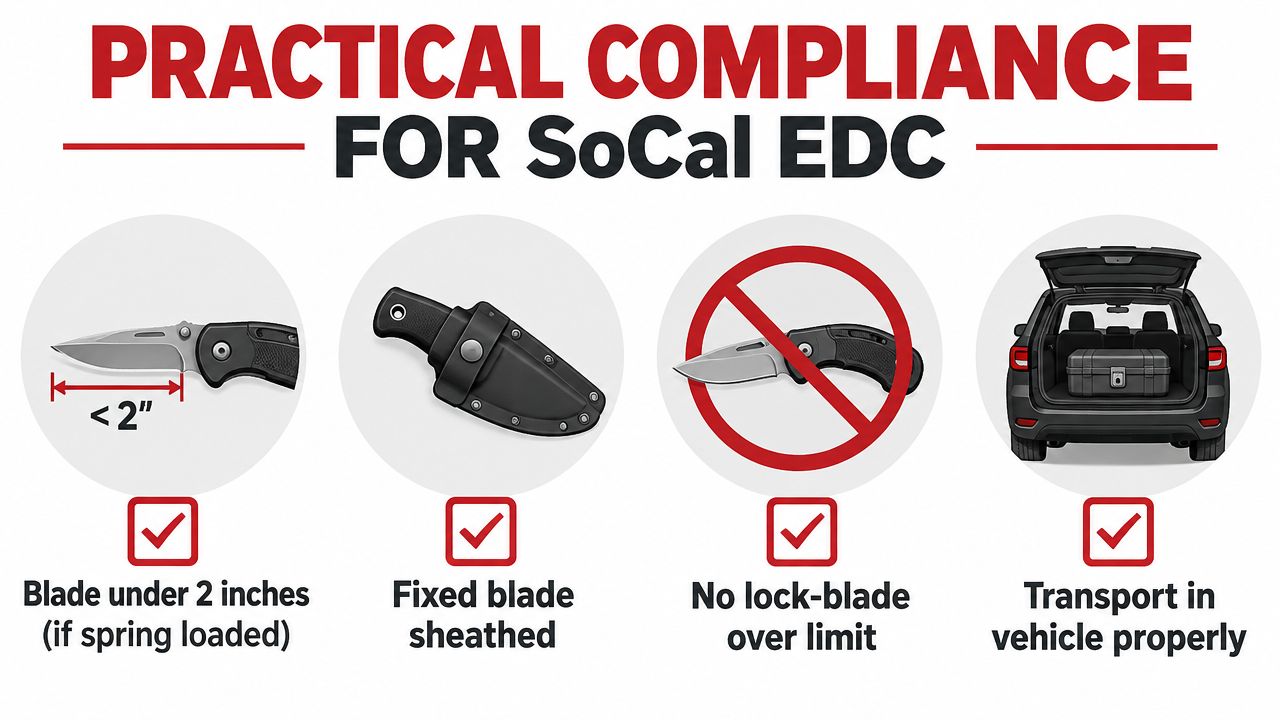
For ordinary carry in Southern California, use this checklist:
- Inspect the mechanism: Confirm whether the knife opens manually or through an automatic action.
- Keep fixed blades visible when carried: Use a proper sheath and avoid covering the knife with clothing.
- Keep folders closed when concealed: An open and locked folder can raise a different legal issue than the same knife carried folded.
- Remove knives before courthouse or school visits: Screening areas are not the place to debate whether a knife falls within an exception.
- Secure work tools during travel: Store them so they aren’t loose in a passenger area, and check destination rules before entering a restricted facility.
- Avoid threatening conduct: Even a lawful knife can create serious problems if displayed aggressively or used during a confrontation.
If someone has already been arrested
Call the jail or a local bail professional as soon as you know the person’s name and arresting city. Tell the representative whether the arrest occurred in Ventura, Oxnard, Camarillo, Port Hueneme, Thousand Oaks, Santa Paula, Moorpark, Fillmore, Ojai, or another jurisdiction. That location helps identify the likely facility and court path.
Gather the following information:
- Full legal name and date of birth.
- Arresting agency and city.
- Booking number, if available.
- Reported charge or suspected Penal Code section.
- Whether the person has medical, employment, or transportation concerns.
- The co-signer’s identification and financial information.
The guide to posting bail can help a family organize the immediate paperwork. After release, preserve the knife, packaging, receipts, photographs, and any messages about where it was carried. Don’t alter or discard potentially relevant evidence, and don’t discuss the facts publicly before speaking with a defense attorney.
Clearing Up Common Knife Law Misconceptions
The most dangerous misconception is that California has one statewide blade-length maximum. It doesn’t. California’s system uses different rules for switchblades, schools, public buildings, fixed blades, folders, and local settings. The result is a context-specific framework rather than a single number that answers every carry question.
Another common error is treating every one-hand-opening folder as an automatic knife. A manual thumb-stud folder with meaningful detent resistance can be legally distinct from a knife that deploys through a button, handle pressure, gravity, wrist movement, or a similar automatic mechanism. The mechanism must be examined, not guessed from how quickly the blade opens.
Folding knives and fixed blades aren’t interchangeable
A folded pocketknife and a fixed blade follow different carry principles. A fixed blade that’s lawful to own may create a concealed-carry problem if hidden, while a folding knife can be analyzed by its closed or open-and-locked position. A knife that can be legal on an ordinary street may still be restricted at a school, public building, airport sterile area, or courthouse.
People also assume that state law overrides every city ordinance. That assumption is unsafe. California’s framework can leave room for local restrictions, so a carry decision in Ventura County shouldn’t be based only on what was permitted somewhere else.
Internet certainty is not legal advice
Forum posts often flatten complicated statutes into slogans such as “all pocketknives are legal” or “anything over a certain length is banned.” Neither statement answers the actual questions about mechanism, concealment, location, conduct, and local rules. A recent federal appellate decision addressing a facial challenge to California’s switchblade ban also demonstrates that the issue remains subject to active legal testing, not casual online interpretation.
If an arrest occurs, don’t contact witnesses to coordinate stories, don’t explain the knife’s history to strangers, and don’t assume posting bail resolves the case. Release is only the beginning of the defense process. Families should also understand the consequences of missed court dates and review how bond revocation works before signing a bond agreement.
The practical standard is straightforward: verify the knife, verify the location, and obtain advice from a qualified California criminal defense attorney when the facts are close. If someone is already detained, focus first on accurate booking information and lawful release procedures.
For immediate help with a Ventura County weapons arrest, Bada Bing Bail Bonds provides 24-hour assistance, verifies booking details, explains the release process, and coordinates paperwork with local facilities. Call now with the person’s full name, arresting city, and any booking information so the team can help move the Ventura County bail process forward.