

At 2 a.m., the phone rings and someone you love says they’ve been arrested. They may sound cold, confused, or frightened. They may give you a facility name, a booking number, or only a rough location before the call ends. Then you’re left searching for the Orange County Intake Release Center, trying to understand bail, and wondering whether anyone can help before morning.
I’ve taken hundreds of late-night family calls across Southern California. The first rule is simple: slow down enough to collect accurate information, then move quickly on the steps that matter. Write down the facility name, booking number, full legal name, date of birth, and the charge as it was described. If you need a broader emergency checklist, keep this guide to what to do after an arrest available.
The IRC isn’t just a place where someone waits for release. It’s an intake, classification, transfer, and release hub. Once you understand that system, you can stop treating every delay as a mistake and start asking the right questions.
Table of Contents
- When the Phone Rings at 2 A.M.
- What the Orange County Intake Release Center Actually Does
- Address, Hours, and the Rules That Shape a Same-Day Release
- Cash Bail vs a Bail Bond in California
- The First 24 Hours After an Orange County Arrest
- Common Delays at the IRC and How to Avoid Them
- How a Local Orange County Bondsman Fits Into the Release
- Families Ask These Questions Next
When the Phone Rings at 2 A.M.
The call usually starts with incomplete information. A spouse says, “They took me to the IRC.” A parent hears a booking number but misses a digit. A friend knows the arrest happened in Santa Ana or Anaheim but doesn’t know whether the person is still at the police station, has reached the jail, or has already been transferred.
Write everything down before calling anyone else:
- Facility name: Confirm whether the person is at the Orange County Intake Release Center or another county facility.
- Booking number: Copy every digit exactly. Don’t rely on memory.
- Legal name and birth date: Nicknames and shortened names can create confusion during a custody search.
- Listed charge: Record the charge as stated, without guessing at a more serious or less serious label.
- Arresting city: The city can help identify the agency and possible court path.
Your loved one may still be waiting for booking, medical screening, or identification processing. They may not know the bail amount yet. That’s normal in the early part of the process, and it doesn’t mean the jail has lost the person or that a bond can be posted immediately.
At 2 a.m., accurate information beats frantic driving. Get the booking details first, then decide whether a bondsman, defense attorney, or court contact is the right next call.
Don’t promise the defendant that they’ll be out by sunrise. Release depends on booking completion, court action, holds, paperwork, and jail processing. A family that understands those moving parts makes better decisions and avoids paying for a bond before checking whether another jurisdiction has placed a hold.
What the Orange County Intake Release Center Actually Does
The Orange County Intake Release Center, commonly called the IRC, opened in January 1988 as part of the Central Jail Complex, in response to severe jail overcrowding in Orange County, according to an Orange County grand jury report. The larger Central Jail Complex had an overall capacity of 2,659 inmates, while the IRC was built to process arrestees through booking, medical screening, identification, classification, and transfers.
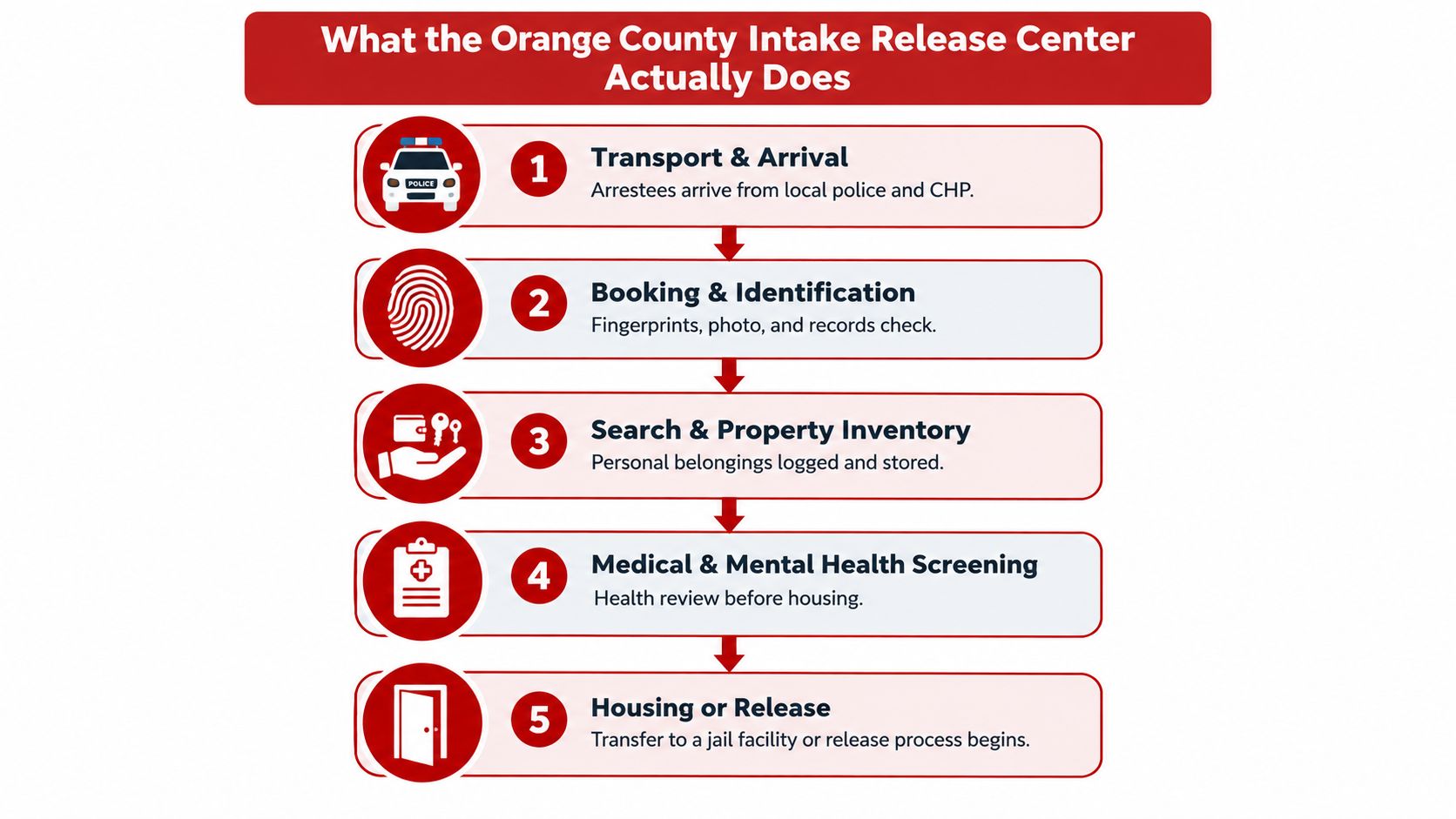
The IRC works like a controlled handoff point. An arrested person arrives from a local law-enforcement agency, including local police or the California Highway Patrol, and staff begin creating the custody record. The process has several separate checks, and release can’t move ahead until the necessary checks are complete.
Booking comes before the release decision
Staff collect identifying information, take photographs and fingerprints, search records, and check for warrants or other custody issues. Personal property is searched, inventoried, and stored. Medical and mental-health screening helps determine whether the person can enter ordinary housing or needs additional attention.
Classification follows intake. Staff consider the nature of the alleged offense, safety concerns, medical needs, and other custody factors when deciding where the person should be housed. Some people remain at the IRC, while others may transfer to Theo Lacy or Central Men’s Jail.
The IRC was rated for 407 inmates and had a listed maximum capacity of 905, according to the grand jury material linked above. The sheriff also describes the facility as having more than 800 beds for long-term housing in addition to its intake duties on its IRC transportation page.
Release is a separate chain of work
After bail is posted or a court orders release, staff still need to verify identity, confirm the legal authority for release, process the bond or court paperwork, coordinate with the arresting agency when necessary, and return stored property. A bond payment doesn’t hand the defendant directly to the family. It starts the release review.
The facility handles substantial volume. Public jail data reports an average daily custody population of 2,664 at the Orange County Jail Intake Release Center and about 4,521 bookings each year. The same guide reports that 40% of inmates turn over each month, 30% every 90 days, 20% every six months, and about 10% remain incarcerated for six to twelve months. Those figures explain why the IRC functions as more than a booking station. It also supports ongoing housing and release operations.
Address, Hours, and the Rules That Shape a Same-Day Release
Don’t drive to the IRC with incomplete information and assume someone at the front desk can solve everything. Visiting, paperwork, bond acceptance, attorney access, and release pickup can follow different procedures. Confirm the current rule with the sheriff or the licensed agent handling the bond before you leave.
The sheriff’s published guidance lists public visiting from Friday through Monday, 8:00 a.m. to 5:00 p.m., and says detainees aren’t summoned during meal periods. Visiting times can also change during lockdowns, as explained in the official visiting-hours information. Those hours aren’t a promise that a defendant can be visited, bonded, or released at any moment inside that window.
Orange County IRC Quick Reference
| Detail | Information |
|---|---|
| Facility | Orange County Intake Release Center |
| Public visiting | Friday through Monday, 8:00 a.m. to 5:00 p.m. |
| Meal periods | Detainees aren’t summoned during meals |
| Lockdowns | Visiting times can vary |
| Visitor identification | Bring valid government photo identification |
| Personal items | Expect restrictions and a no-weapons rule |
| Minors | Must be accompanied by a parent or legal guardian |
| Best first move | Confirm the current procedure before traveling |
Bring valid government photo identification if you’re entering the lobby. Leave weapons and unnecessary personal items at home. If a minor is coming with you, a parent or legal guardian must accompany that child.
Public visiting hours aren’t the same thing as a guaranteed release window. A family can arrive during visiting hours and still need to wait for booking, bond verification, a hold review, or property processing.
The IRC’s capacity and operational role make timing important. The facility combines intake with substantial holding functions, so a release request may compete with booking, classification, transport, and court-related work. Families looking for a location overview can review this Orange County jail information for Santa Ana, then call ahead before making the trip.
Cash Bail vs a Bail Bond in California
California families generally face two financial routes when a court makes money bail available. They can post the full amount directly with the court, or they can use a California-licensed bail bondsman and pay the regulated premium for a bond.
Full cash bail
With cash bail, the family must produce the entire court-ordered amount. The payment goes through the court’s accepted process, not to a bondsman. If the defendant follows the case requirements, the court generally returns the bail at the end of the case, subject to lawful deductions such as fines or other amounts ordered by the court.
Cash bail can be straightforward when the family has the full amount available. It can also tie up a large amount of money and require the correct form of payment. Confirm the receiving court’s current rules before relying on a credit card, personal check, or an informal payment arrangement.
A bail bond
A bond lets a licensed agent guarantee the court’s required amount in exchange for a premium and a contractual promise that the defendant will appear. The California Department of Insurance says the consumer cost is most commonly 10% of the total bond amount, plus actual, necessary, and reasonable expenses, as explained in its consumer guide to bail bonds.
For example, a $20,000 bond would produce a $2,000 premium at the commonly used 10% rate. That premium isn’t a refundable deposit. The agent may also require an indemnitor, collateral, or additional documentation depending on the bond and the family’s circumstances.
Payment methods and plans vary by agency. A family may be able to use cash, debit, credit, Zelle, Venmo, or a payment plan, but don’t assume every agency accepts every method or offers identical terms. Ask for the total cost, required signer, collateral terms, and cancellation conditions before signing.
Comparing the two paths
| Factor | Full Cash Bail | Bail Bond, 10% Premium |
|---|---|---|
| Up-front requirement | Entire bail amount | Premium, plus any approved costs or security |
| Who receives the payment | Court or authorized court process | Licensed bail bondsman |
| Refund treatment | May be returned at case conclusion under court rules | Premium is generally nonrefundable |
| Family responsibility | Provide full funds and complete court paperwork | Provide information, sign agreements, and support court compliance |
| Release timing | Starts after court accepts and verifies payment | Starts after the agent completes and submits the bond |
| Main concern | Access to the full amount | Understanding premium, collateral, and signer obligations |
A bond doesn’t erase the IRC’s verification steps. Cash and bond payments both require processing, and neither option overrides an out-of-county hold or a court order that keeps the defendant in custody. For a plain-English explanation of the broader process, see how bail works in California.
The First 24 Hours After an Orange County Arrest
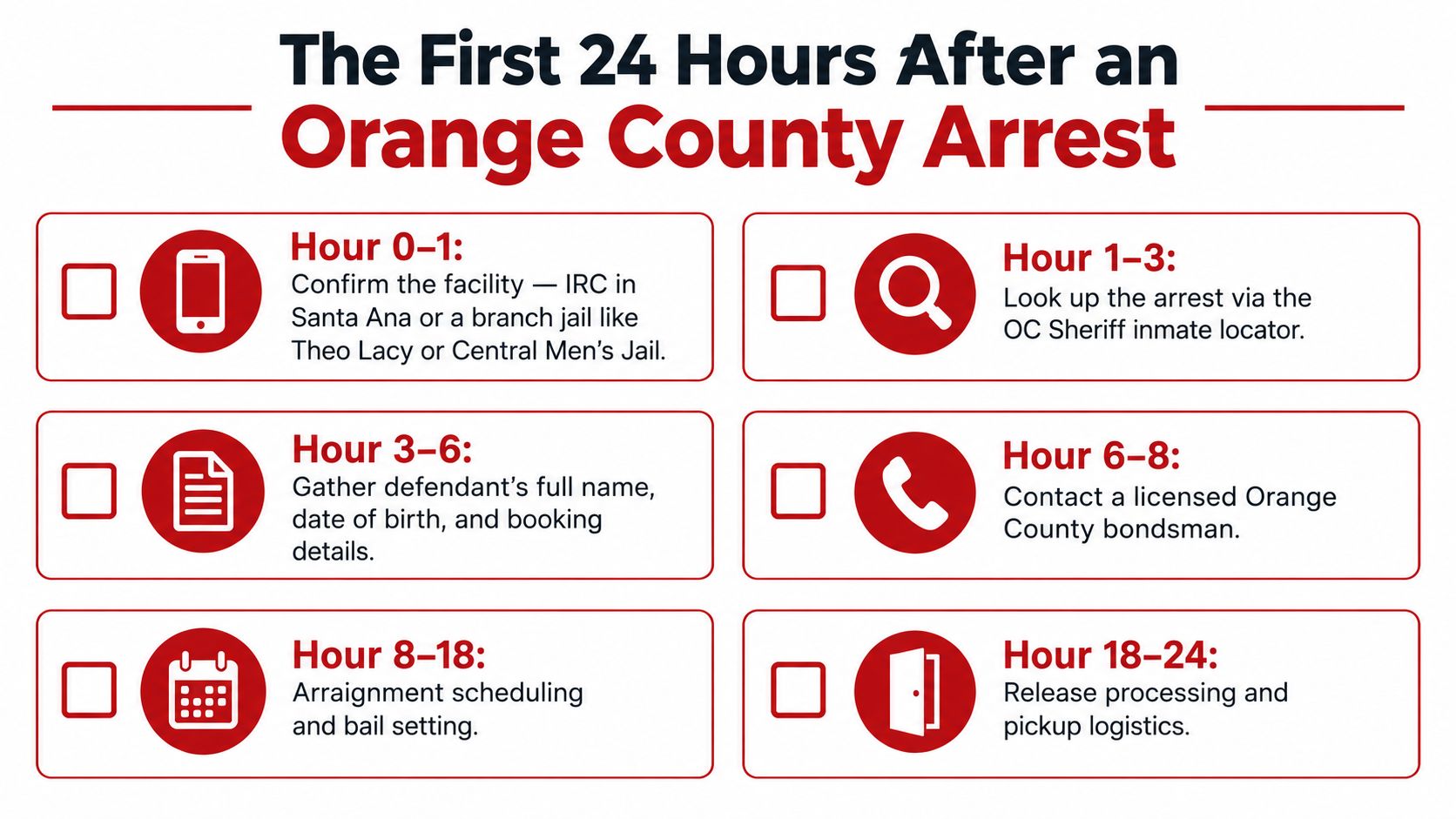
The first day goes better when the family treats it as an information-gathering problem, not a guessing game. Start with the location, then build the file a bondsman or attorney needs.
Start with custody confirmation
Confirm whether the person is at the IRC in Santa Ana or at another county facility, such as Theo Lacy or Central Men’s Jail. Ask for the booking number and write it down exactly. If the person doesn’t appear in a custody search yet, the booking process may still be underway, so keep checking through official channels rather than assuming the arrest record is wrong.
Gather the defendant’s full legal name, date of birth, arrest city, listed charges, and any information about holds, prior warrants, probation issues, or another county’s involvement. These details help the agent identify problems before the family commits to a bond.
Call before you travel
A licensed Orange County bail bondsman can explain whether the person appears bondable, what documents may be needed, and whether an outside hold could prevent immediate release. Calling first is more efficient than arriving at the jail with no booking number and no confirmed payment plan.
Prepare valid identification for the defendant if available, proof of residence when requested, and the payment method agreed with the agent. The defendant’s identity must match the booking record and bond paperwork.
Use the legal name, not the nickname everyone uses at home. A spelling mistake or wrong birth date can force corrections after the bond has already been prepared.
Families often lose time by refusing to share the listed charge, guessing at a booking number, or calling several agencies with different versions of the same story. Be direct. You don’t need to solve the criminal case during the first call, but you do need accurate custody facts.
For a way to check whether someone has entered the custody system, families often begin with an Orange County custody search guide. Use official custody information as the controlling source, and treat a phone report from a frightened defendant as a starting point rather than a complete record.
Common Delays at the IRC and How to Avoid Them
Families often expect the phrase “bail posted” to mean “defendant walking out.” That assumption causes unnecessary anger and bad decisions. The bond can be correct while release remains delayed by another agency, medical review, court scheduling, or a paperwork problem.
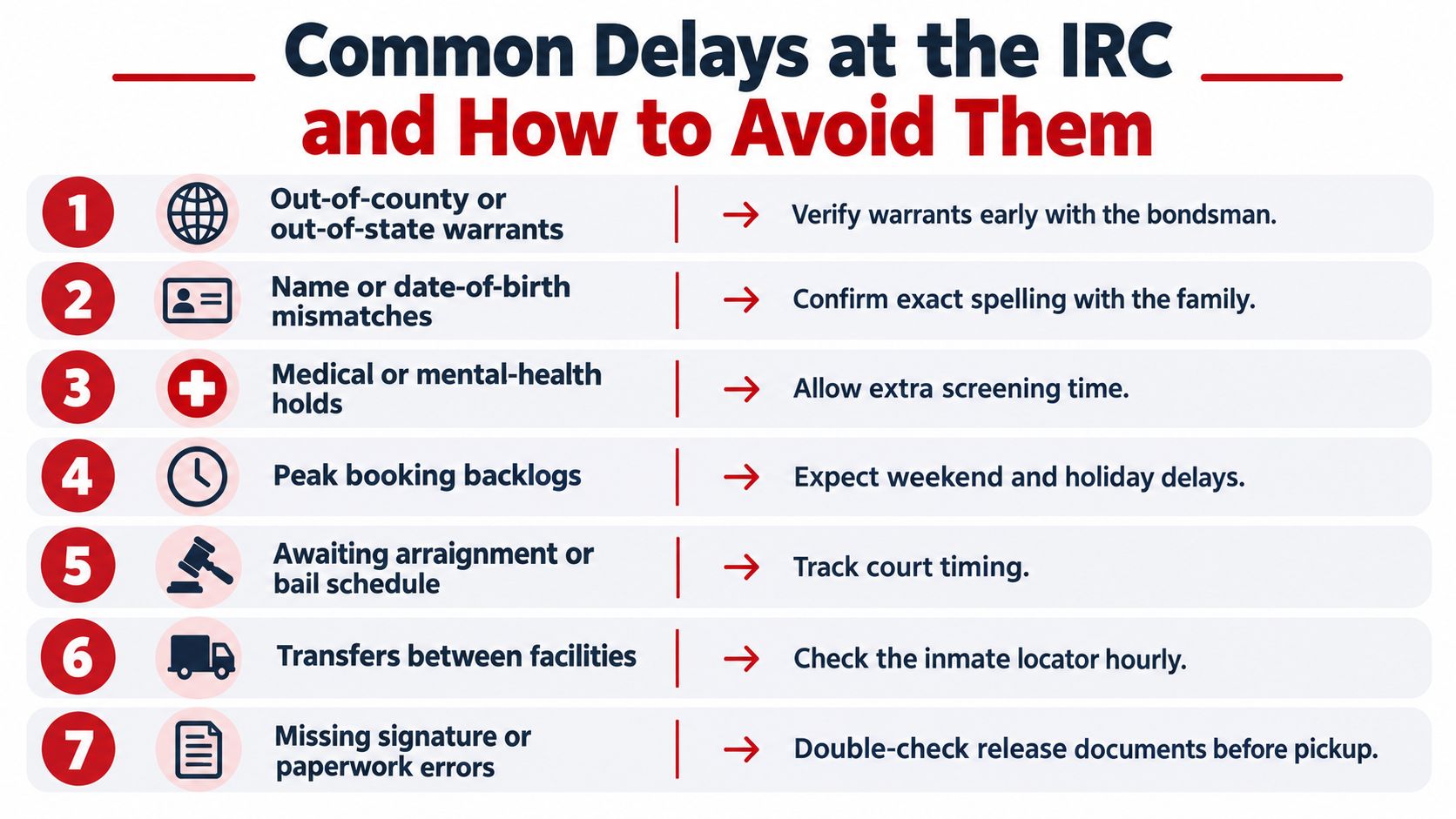
Seven problems worth checking early
- Out-of-county or out-of-state warrants: Ask the bondsman to check for outside holds before posting. A local bond may not release someone wanted elsewhere.
- Name or birth-date mismatches: Compare the booking record with the defendant’s government identification. Correct errors before the agent submits final documents.
- Medical or mental-health screening: An injury, intoxication, or health concern can require additional evaluation. Give the jail time to complete the review and don’t treat it as a routine paperwork delay.
- Booking backlogs: Weekends, holidays, overnight work, and heavy arrival periods can slow intake. Confirm that booking is complete before asking for a release estimate.
- Arraignment or bail scheduling: Some defendants must wait for a court appearance or a bail decision. Ask whether the next step is a bond payment or a court hearing.
- Transfers between facilities: A person moved to Theo Lacy or Central Men’s Jail may no longer be released through the same physical workflow. Check the inmate locator and confirm the current facility before pickup.
- Missing signatures or bond errors: A wrong charge, misspelled name, missing signer, or incomplete document can send the paperwork back for correction. Review every page before submission.
Protective orders and no-contact conditions can create another serious problem after arraignment. A defendant may be released but still prohibited from contacting an alleged victim or returning to a residence. The family needs to follow the court’s written conditions, not rely on what anyone remembers hearing at the jail.
Lockdowns and court closures can also change timing. Ask the agent what has been verified, what remains pending, and whether the delay comes from the IRC, a court, or another agency. Don’t post a bond blindly when a hold may control the outcome.
How a Local Orange County Bondsman Fits Into the Release
A local agent’s first job is not to promise a release time. It’s to identify the defendant, confirm the facility, determine whether a bond is available, and find obstacles before the family signs.
The handoff starts by phone
A 24-hour intake call should collect the defendant’s full name, date of birth, booking number, arrest city, listed charges, and facility location. The family explains what it knows. The bondsman verifies the details, discusses the premium, reviews any payment plan or collateral requirement, and identifies the person who can legally sign the agreement.
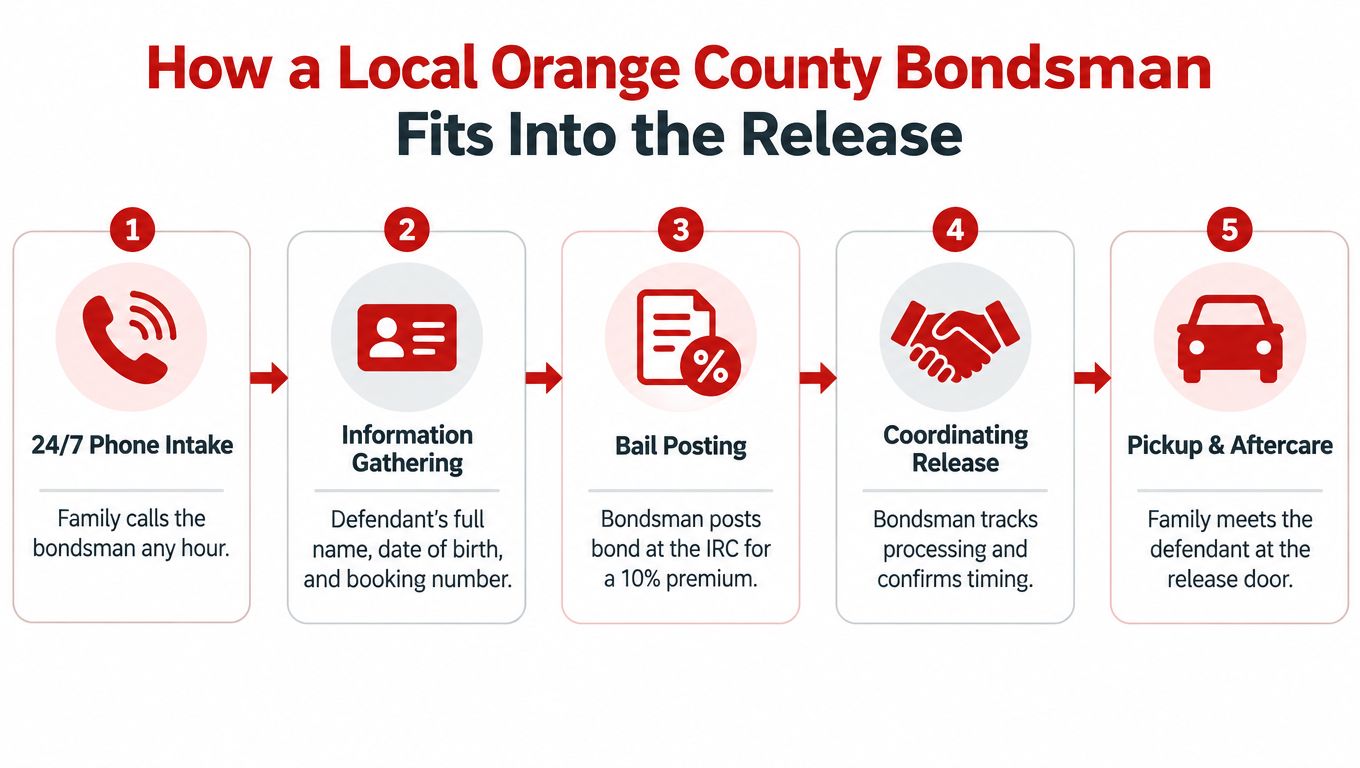
A licensed agent handles the bond paperwork and submits the guarantee through the proper jail or court process. The family still has responsibilities. Someone must provide truthful information, sign the indemnity agreement, arrange payment, provide requested collateral, and make sure the defendant understands every court date and release condition.
Bada Bing Bail Bonds is one local option that describes 24/7 support for Orange County IRC bail bonds, direct posting at the Santa Ana facility, payment plans, co-signer options, and collateral solutions for larger or higher-risk bonds. Families should still ask any agency to explain the total cost and obligations in writing.
What support looks like after the paperwork
The practical value of round-the-clock service is access when the arrest happens, not just a phone number printed on a website. A responsive agent can take a late-night call, verify whether booking is complete, explain why release is waiting, coordinate documents, and update the family when the jail accepts the bond.
That support may continue through holiday pickups, release-door instructions, and court-date reminders. It doesn’t replace a defense lawyer, and it can’t remove a warrant or override a judge. It does give the family a single person tracking the bond side of the process instead of sending relatives to different counters with conflicting information.
Ask one question before signing: “What exactly is preventing release right now?” The answer should identify a missing step, not hide behind a vague promise.
For a clearer explanation of the agent’s role and responsibilities, review what a bail bond agent does. Then decide whether the proposed premium, collateral terms, and communication plan fit your situation.
Families Ask These Questions Next
How long will release take?
There isn’t one reliable answer. Booking, identification, screening, classification, court review, holds, bond acceptance, and property return can all affect the timing. The only useful estimate comes from the current status of the defendant, not from a general promise made before the facility confirms the record.
What if the defendant transfers?
The person may move from the IRC to Theo Lacy or Central Men’s Jail for housing or classification reasons. Once that happens, confirm the new facility and ask where the release paperwork must be processed. Don’t send a family member to the original location based on an old phone call.
What if bail is too high or denied?
Ventura County families may encounter a separate court process when dealing with an arrest there. Ventura Superior Court’s schedule applies presumptive bail to warrantless arrestees until a judge reviews the case under Penal Code §1269b. The 2024 schedule lists $10,000 for unlisted felonies, $2,500 for unlisted 17(b) misdemeanors, and $2,500 for other misdemeanors, as shown in the Ventura County bail schedule.
If a judge sets an amount the family can’t afford, ask a defense attorney or public defender about a bail reduction request, release conditions, or a detention hearing. California bail law is changing, and a bondsman can’t substitute for legal advice about whether detention or release is lawful in a particular case.
Can family members visit or call immediately?
Not necessarily. Public visiting is time-windowed, meal periods can interrupt access, and lockdowns can change the schedule. Call the facility or your agent before traveling, and keep the booking number ready.
What happens after release?
Make a written record of the next court date and every condition of release. Follow no-contact orders exactly, arrange transportation, retrieve property through the proper process, and tell an employer only what is necessary. If the defendant misses court, ignores a protective order, or changes address without updating the required parties, the family can create a new crisis after solving the first one.
For Ventura, Oxnard, Camarillo, Port Hueneme, Thousand Oaks, Santa Paula, Moorpark, Fillmore, Ojai, and Santa Barbara families, the same practical rule applies. Search terms such as bail bonds Ventura, Ventura County bail bonds, 24-hour bail bonds Ventura, bail bonds Oxnard, Ventura County Jail bail bonds, and bail bonds Thousand Oaks may lead you to an agent, but the quality of the call depends on accurate booking information, clear costs, and a realistic release plan.
If someone you love is being processed through the Orange County Intake Release Center, Bada Bing Bail Bonds offers 24/7 phone intake, booking verification, bond paperwork coordination, payment-plan discussions, and release updates. Call with the defendant’s legal name, birth date, booking number, and facility location so an agent can identify the next practical step without making your family wait for business hours.