
At 2 a.m., the phone rings. Someone you love is in custody after a domestic violence arrest, and the family is trying to answer three questions at once: Where are they, how much is the bond, and why can't they come home immediately? In Ventura County, the dollar amount often gets all the attention. In practice, the release conditions, protective-order processing, booking status, and jail paperwork frequently create the delay.
A bond for domestic violence is the financial mechanism that can allow a defendant to leave custody while the criminal case continues. It isn't a finding of guilt or innocence. Posting it doesn't erase the charge, cancel a protective order, or give the defendant permission to return home or contact the alleged victim.
Table of Contents
- When a Domestic Violence Arrest Hits Your Family
- How Ventura County Sets Bail on Domestic Violence Cases
- Protective Orders and No-Contact Conditions
- What Information You Need Before You Call a Bondsman
- Paying for the Bond Premium and Collateral Options
- Release Timelines and What Happens at the Jail Door
- Communication Tips and Common Questions
When a Domestic Violence Arrest Hits Your Family
The first call rarely contains reliable details. A relative may say, “They arrested him in Oxnard,” while another person says it was only a citation. Someone else may have heard that bail was set, but nobody has a booking number or knows which facility has custody.
Start by identifying what happened. A citation and release, a field arrest followed by booking, and a full jail booking can lead to very different timelines. Domestic violence allegations commonly result in booking so the arresting agency and jail can complete identification, records checks, risk screening, and release-condition processing. The seriousness of the allegation isn't determined solely by whether visible injuries were reported.
The first mistake families make: calling about a bond before confirming that the person is actually booked, where they're held, and what charge appears in the jail record.
For Ventura, Oxnard, Camarillo, Port Hueneme, Thousand Oaks, Santa Paula, Moorpark, Fillmore, and Ojai arrests, the custody location may depend on the arresting agency and the jail's intake process. A person arrested by Oxnard Police Department may be processed through Ventura County systems, while another defendant may be held elsewhere because of an agency hold, warrant, medical issue, or transfer.
A bond is a promise backed by money. The court sets an amount or authorizes release under conditions, and a licensed bail agent can post a surety bond on the defendant's behalf. The family generally pays the lawful premium and signs an agreement that requires the defendant to appear and follow the court's rules.
That agreement doesn't change the criminal case. The defendant still needs a defense attorney, must attend required court dates, and must obey every release condition. If a criminal protective order prohibits contact, posting bail doesn't override it. A text message, phone call, social media message, or request sent through a relative can create a serious new problem.
Families who need a plain-language overview of the first steps can review what to do when someone gets arrested, then focus on verifying the booking details before authorizing paperwork. Don't send money based on hearsay. Confirm the custody record first.
How Ventura County Sets Bail on Domestic Violence Cases
Ventura County uses local bail references alongside California's statewide framework. The operative materials include the Ventura Superior Court bail schedule and Judicial Council references, rather than one universal number for every domestic violence arrest.
The charge controls the starting point
A common charge is Penal Code section 273.5, corporal injury to a spouse or cohabitant. Other cases may involve Penal Code section 243(e)(1), a domestic battery allegation, or Penal Code section 166, which can involve an alleged protective-order violation. Those charges don't automatically produce the same bail figure.
The local schedule can also apply a domestic-violence enhancement. For listed felony or misdemeanor domestic violence offenses, the court schedule says bail is doubled when there's reasonable cause to believe the arrestee has a prior conviction identified on the Domestic Violence Enhancement List. The Ventura County 2024 bail schedule gives an example in which a prior Penal Code section 273.5 conviction doubles a normal $5,000 bail amount to $10,000. A felony probation component can add another $10,000, producing a total of $20,000 in that example.
The schedule is a starting point, not a guarantee of the final release terms. At arraignment, a judge can follow the schedule, raise bail, lower it, or order release with conditions when legally appropriate. A prior record, an alleged violation, an outstanding warrant, another agency hold, or safety concerns can change what happens after booking.
Local examples
| Charge | Base Bail | With Enhancement |
|---|---|---|
| Listed domestic violence offense with no qualifying prior | Schedule amount | Schedule amount |
| Example involving a prior Penal Code section 273.5 conviction | $5,000 | $10,000 |
| Example with felony probation component | $10,000 after prior-related enhancement | $20,000 total |
The precise figure must be verified against the current custody record and applicable schedule. Don't assume the amount from an older online post applies to today's arrest.
A cite-and-release decision is different from a full booking. In a cite-and-release situation, the person receives a court appearance instruction without remaining in jail. A booked defendant must complete intake and release processing before a bond agent can finish the jail-side procedure. For practical guidance on domestic violence bail amounts, give the agent the exact charge and booking information, not just “domestic violence.”
My recommendation: know the schedule figure, the charge, and any enhancement issue before you compare bond quotes. Otherwise, you may be discussing the wrong amount from the start.
Protective Orders and No-Contact Conditions
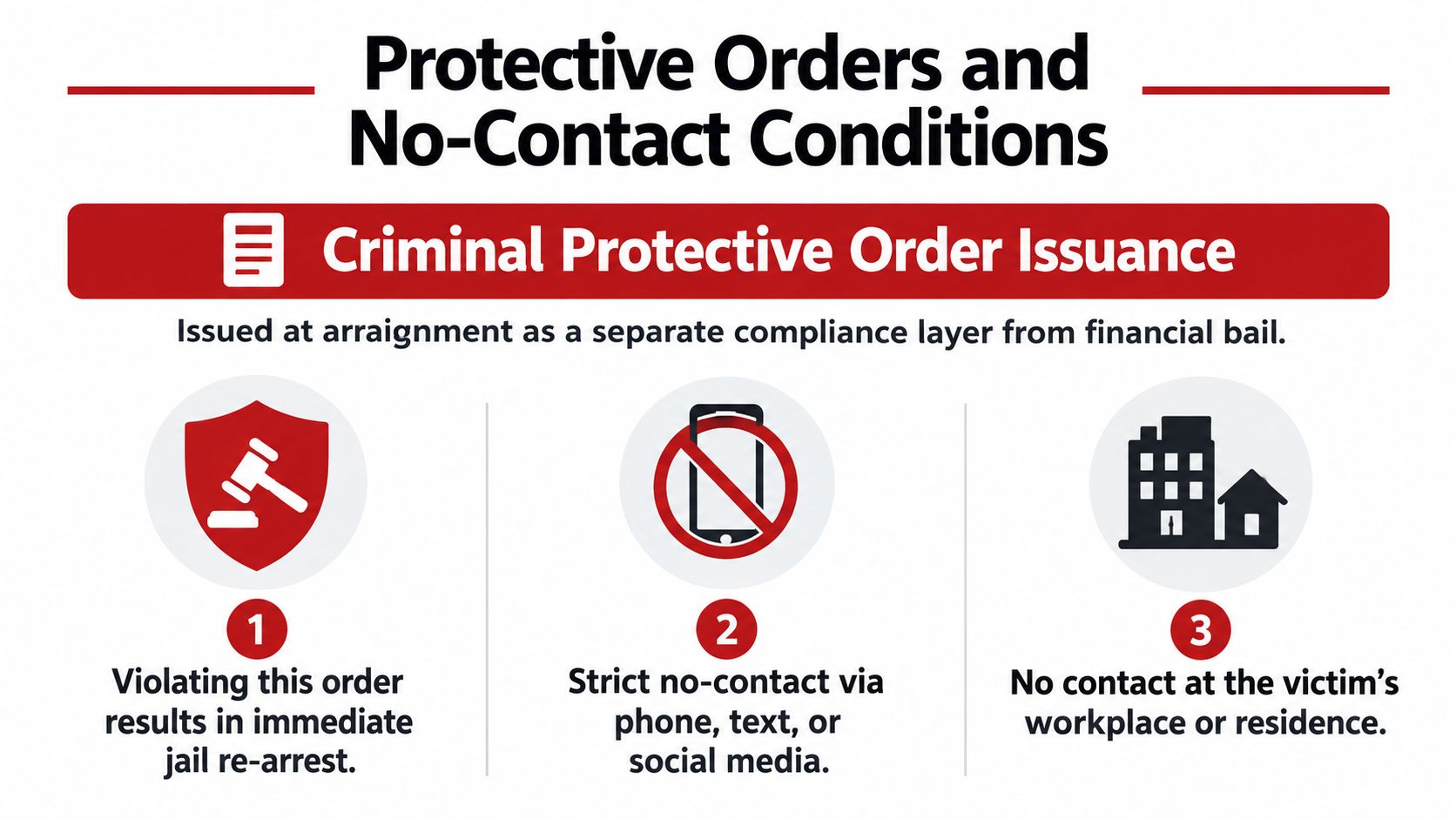
At an Oxnard booking, the financial bond is only one part of the release plan. The court may also restrict where the defendant goes, whom they contact, and what property they can access. Those conditions can slow release more than the bond payment itself.
A criminal protective order may prohibit direct contact with the alleged victim, including calls, texts, email, social media messages, and in-person meetings. It may also bar indirect contact through children, relatives, friends, or anyone asked to deliver a message.
The order can control the release plan
California Penal Code sections 136.2 and 646.9 allow a judge to issue protective and stay-away orders in domestic violence cases. A violation may create a separate criminal charge under Penal Code section 166. The order can keep the defendant away from a shared home, the alleged victim's workplace, a child's school, or another location listed by the court.
The bondsman can post the financial bond, but can't lift, rewrite, or suspend a protective order. Only the court, usually after a request handled by a defense attorney, can modify those terms. Read the exact order before anyone attempts contact or returns to a shared residence.
Release may still require extra jail review after the bond is posted. A prior protective-order violation, outstanding warrant, probation issue, or hold from another agency can delay the jail-side process. Families should ask what remains pending instead of assuming the delay means the bond failed.
A violation can trigger re-arrest even without a new assault. Treat every condition as enforceable, including indirect-contact rules and location restrictions. For a practical explanation of domestic violence bond conditions, review the order itself and ask a defense attorney about any unclear language.
Families dealing with emotional abuse or coercive control may also need support beyond the criminal case. Be Your Best Self Thrive Counseling healing is a separate counseling resource. Counseling does not replace legal advice or emergency protection, but it can support safety planning and recovery.
My recommendation: before posting bond, identify every no-contact, stay-away, and residence restriction. The money gets the bond moving. Compliance determines whether release finishes cleanly.
What Information You Need Before You Call a Bondsman
At 2 a.m., preparation beats panic. Gather the information below before calling a Ventura County bondsman.
Start with identity and custody details
Have the arrested person's full legal name, date of birth, and booking number if the jail has issued one. Check the Ventura County Jail inmate locator or confirm the information directly through the appropriate custody channel. Make sure the person is in the Ventura County Jail system, not another facility or under another agency's control.
The charge matters. A Penal Code section 273.5, 243(e)(1), or 166 allegation can produce different release questions and different bail calculations. Don't describe every arrest as “a domestic violence charge” and expect the agent to quote accurately.
Also record:
- Arresting agency: This may be Oxnard Police Department, Ventura County Sheriff, CHP, or another agency.
- Booking time: Processing status can matter when the jail hasn't finished entering the record.
- Current facility: Confirm whether the person is at the Ventura County Pre-Trial Detention facility or elsewhere.
- Known holds: Mention probation, warrants, immigration, or other agency information if the family knows about it.
Prepare the signer
The person arranging the bond should have government-issued identification, proof of address, and employment information available. A signer may need to explain the relationship to the defendant, provide contact information, and review the indemnity agreement.
The jail's official posting options include cash, a cashier's check payable to the Ventura County Superior Court, a bail bond, and card payments through GovPayNet. The Ventura County Sheriff posting-bail page identifies the Pre-Trial Detention facility at 800 South Victoria Avenue, Ventura, and lists GovPayNet phone processing using PLC #6404. For agency-specific paperwork questions, review the bail bond requirements before signing.
Paying for the Bond Premium and Collateral Options
California regulates the consumer cost of a bail bond. The California Department of Insurance says the cost is most commonly 10% of the total bond, with actual, necessary, and reasonable transaction expenses handled under the applicable rules. The California Department of Insurance bail-bond guidance also confirms that the court, not the bondsman, sets the bond amount.
Calculate the premium before discussing payment
If the court sets a $20,000 bond, the commonly charged premium is $2,000. If the bond is $50,000, the commonly charged premium is $5,000.
| Total Bond Amount | Premium (10%) | Payment Plan Available |
|---|---|---|
| $20,000 | $2,000 | Ask the licensed agent about available terms |
| $50,000 | $5,000 | Ask the licensed agent about available terms |
A premium is not the same as the full bail amount. The agent guarantees the court the stated bond, while the family pays the regulated premium and accepts contractual responsibility for the defendant's appearance and compliance.
Payment arrangements in Oxnard and throughout Ventura County may include cards, cashier's checks, wire transfers, or structured installments when the agent approves them. A payment plan is a contract, not an automatic right. Read the schedule carefully and ask what must be paid before posting.
Collateral and co-signers
Higher or more complicated bonds may require collateral. Depending on the agent's underwriting decision, that can involve a residential deed, a vehicle pink slip, or a lien against savings. Collateral should be documented clearly, and the release process after the case closes should be confirmed in writing. The collateral guide explains the documents families commonly need to discuss.
The indemnitor, or co-signer, generally needs valid identification, verifiable residence, and sufficient financial responsibility. A person living outside California may be declined because the agent needs practical access to the signer if the defendant fails to appear. The exact decision depends on the bond, the defendant's history, and the agent's underwriting rules.
The refund issue surprises families. The premium is generally non-refundable once the bond is posted, even if charges are later reduced, dismissed, or resolved favorably. Ask about the total cost before authorizing the bond.
Release Timelines and What Happens at the Jail Door
Families often expect the defendant to walk out immediately after the bond is accepted. Ventura County jail release usually takes two to eight hours after posting, depending on shift changes, medical clearance, paperwork, housing-unit movement, and protective-condition processing.
The release sequence is administrative, not theatrical. The bond is delivered through the accepted jail process, the file is routed to the appropriate housing unit, staff bring the inmate to release, belongings are returned, and final paperwork is completed. Each handoff can add waiting time, especially when the jail is processing several releases at once.
Why a completed bond can still sit
A domestic violence release may require verification of an emergency protective order, risk-related interview or assessment steps under Penal Code section 13700, and confirmation that the defendant understands the restrictions. A person brought in without personal clothing may also need a dress-out process before leaving.
The jail doesn't release on your family's schedule. A paid bond starts the release process. It doesn't bypass medical, records, safety, or property procedures.
The Ventura County Sheriff identifies the Pre-Trial Detention facility at 800 South Victoria Avenue, Ventura as a bail-posting location and lists the payment methods accepted there. Confirm current counter access and processing details directly before driving to the facility, because a payment method accepted by the jail may involve separate verification steps.
The pickup plan matters. Decide who will drive, where the released person will go, and how they'll obtain clothing, medication, identification, or other essentials without violating a protective order. If the order bars contact with someone at the home, don't send the defendant there to collect belongings. Ask the defense attorney about a lawful retrieval plan.
Families searching for Ventura County Jail bail bonds, 24-hour bail bonds Ventura, or bail bonds Oxnard usually need two things at once, a licensed agent who answers and accurate custody information. Calm communication won't eliminate jail delays, but it prevents avoidable stalls caused by missing names, incorrect charges, or an unsafe pickup arrangement.
Communication Tips and Common Questions
One family member should act as the point person. That person can collect the booking details, speak with the bondsman, track documents, and update relatives without creating three conflicting versions of the same arrest.
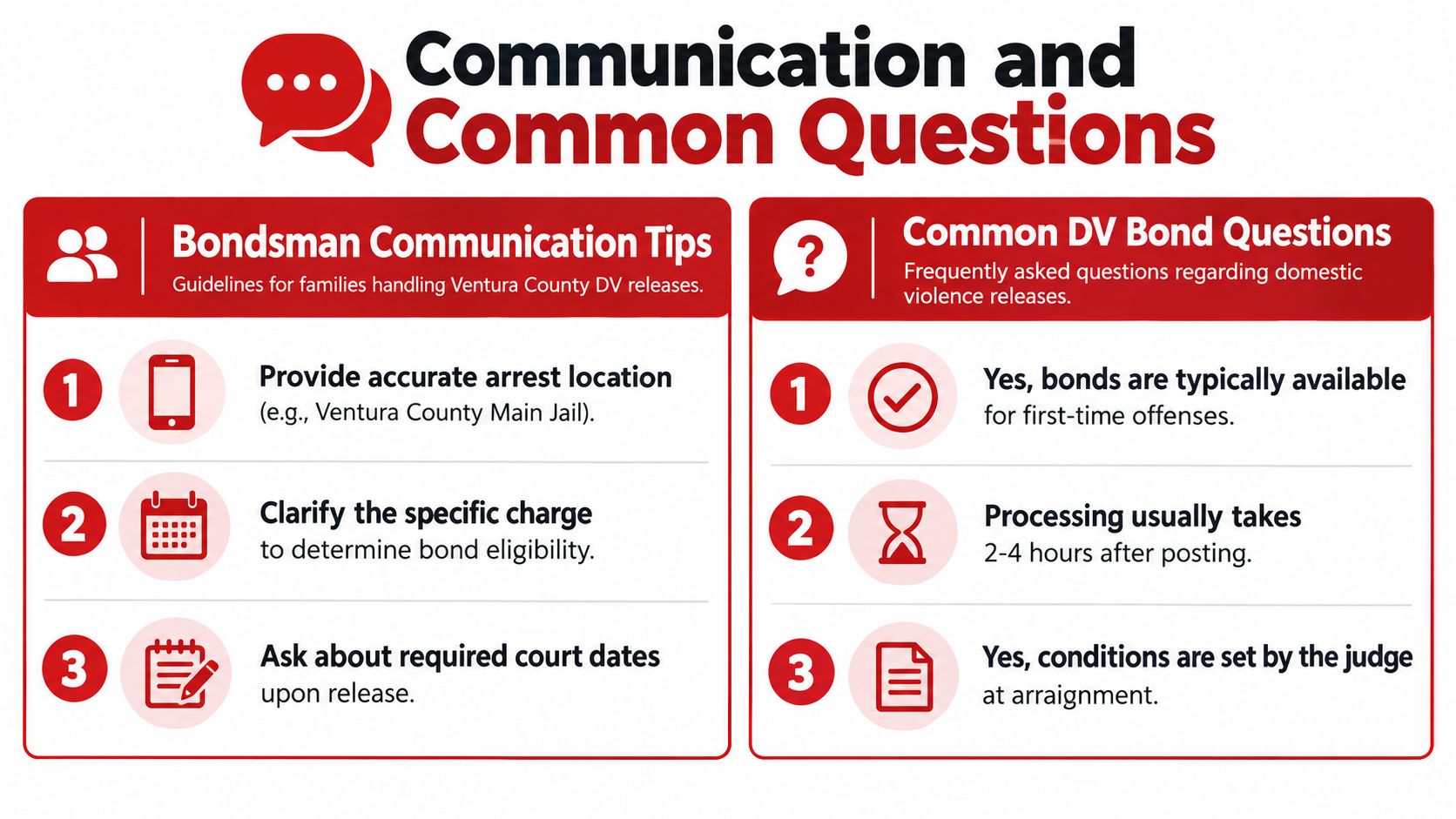
Give the agent the defendant's full legal name, date of birth, booking number, facility, arresting agency, and listed charges. If the charge changes after booking, report the update rather than assuming the original description is still accurate. For people looking for bail bonds Thousand Oaks, Santa Paula, Moorpark, Fillmore, Ojai, Camarillo, Port Hueneme, or Santa Barbara, the same rule applies: location helps, but the booking record controls.
Keep the instructions consistent
Don't tell the defendant that the alleged victim “just wants to talk” or that a family member can pass along a message. If the release order says no contact, everyone should treat that restriction as absolute until a court changes it.
Keep copies of the bond agreement, release paperwork, court notices, and protective order. Ask the agent which court dates are already known, but remember that the defense attorney and court clerk are the proper sources for legal advice and official scheduling.
Can the defendant contact the alleged victim after release?
Not if a no-contact condition prohibits it. That includes calls, texts, social media, direct messages, and indirect messages through relatives or friends. A claimed invitation from the alleged victim doesn't automatically change the order.
How do GPS or ankle-monitoring conditions work?
Electronic monitoring can be imposed as a release condition in some cases. The defendant must follow the monitoring instructions, remain within approved locations, observe exclusion zones, and respond to equipment or compliance issues as directed. The bondsman doesn't control the monitor or authorize exceptions.
What happens if the protective order is violated?
The defendant may be re-arrested, and the court may reconsider release. The alleged violation can create a separate criminal problem even when no new physical assault is alleged.
How soon will court dates arrive?
The release paperwork should identify required appearances when dates are available. Check every document, keep the court information accessible, and have the defendant's attorney confirm what must happen next. Missing a date can place the bond at risk.
Can the defendant return home?
Only if the release order allows it. A stay-away term may prohibit returning to a shared residence, workplace, school, or other listed location. Arrange lawful access to clothing, medication, documents, and personal property through an attorney or another approved process.
Is the bond premium refundable if charges are dropped?
Usually not. Once the bond is posted, the premium generally remains earned under the bond agreement. Confirm the terms before signing.
Will a first-time offense qualify for a bond?
A bond may be available in a first-time case, but availability and conditions depend on the charge, court action, records, holds, and safety concerns. Never promise release before the custody record and court requirements are verified.
How long does processing take after posting?
The infographic's practical estimate is two to four hours, but actual timing can be longer when the jail has shift changes, medical clearance, protective-order verification, or other unresolved processing steps. Treat any estimate as a planning range, not a guarantee.
Who sets the release conditions?
The judge sets court-ordered conditions, including protective restrictions addressed at arraignment. A bondsman can explain the financial agreement and coordinate the posting process, but can't change judicial conditions.
Bada Bing Bail Bonds handles 24/7 Ventura County bail bond assistance, verifies booking details, explains charges and schedules, offers payment-plan and collateral discussions, and coordinates paperwork with the jail. Families dealing with a domestic violence arrest should bring accurate information, follow every release condition, and use Bada Bing Bail Bonds when they need a licensed agent to explain the bond process and move the paperwork forward.
If someone you love is in custody after a Ventura County domestic violence arrest, contact Bada Bing Bail Bonds with the full legal name, date of birth, facility, and booking details. An agent can verify the bond, explain the premium and paperwork, and help coordinate release while your family follows the protective-order requirements.