A signature bond is a written promise to appear in court, with no money or collateral paid up front. In California, a judge can still attach conditions before approving that release, so “no money tonight” doesn’t mean “no legal responsibility.”
At 2 a.m., a call from the Ventura Pre-Trial Detention Facility often starts with a simple question: “How do we get them home?” The answer may be a release on personal recognizance, often called a PR bond or signature bond. It may also be a cash payment or a surety bond arranged through a licensed bail bondsman.
The confusing part is that a signature bond looks free at the jail window, but the signed promise has legal weight. If the defendant misses court, the court can pursue the bond obligation, issue a warrant, and impose new release conditions. The exact process depends on the court and the terms written in the release order.
Table of Contents
- What a Signature Bond Actually Means
- Where the Signature Bond Idea Comes From
- Signature Bond vs Cash Bond vs Surety Bond
- Who Qualifies for a Signature Bond in California
- Common Conditions Attached to Signature Bonds
- Real California Examples of Signature Bonds in Action
- When a Signature Bond Is Denied and How a Bondsman Helps
- Quick Takeaways and Next Steps for Ventura County Families
What a Signature Bond Actually Means
At 2 a.m. at the Ventura Pre-Trial Detention Facility, a family may hear that release could happen without paying cash at the counter. A signature bond means the defendant signs a written promise to return to court instead of depositing money or property before release. The judge may still attach conditions, and the signed promise can carry financial or legal consequences if the defendant fails to appear. Local court rules control the details. Colorado’s explanation of bond types illustrates why the label can mean slightly different things in different jurisdictions.
In California, people often use signature bond, personal recognizance bond, and PR bond to describe release based on the defendant’s own promise. The wording on the order matters more than the label. A judge may require court appearances, compliance with a protective order, travel limits, or other conditions connected to the case.
A signature bond works like an unpaid tab with rules attached. The defendant does not hand over the stated amount at release, but the obligation is still part of the agreement. Missing court can lead to a warrant, a demand for the bond amount, or additional release consequences allowed by the court.
Why the signature matters
The practical question is whether the court trusts the defendant to return and follow the order. A stable address, transportation plan, family support, communication with counsel, and a record of appearing in court may help the court evaluate that decision. None of those factors guarantees approval.
A PR release can be denied. If that happens during the early morning hours, the family may need to arrange a cash payment or contact a licensed bondsman for a surety bond. That decision is different from a signature bond because a bondsman becomes involved when the court requires a financial bond. Families comparing bail bonds Ventura with release without a cash payment can review how release without bail works and then confirm the actual release order with the court or defense lawyer.
The defendant and family should write down every court date, confirm transportation, keep attorney contact information available, and read each condition before leaving custody. General bilingual arrest guidance Connecticut may help explain what follows an arrest, but it does not replace California legal advice.
Practical rule: A signature bond is a conditional promise with real consequences, not a free pass.
Where the Signature Bond Idea Comes From
At 2 a.m. at the Ventura Pre-Trial Detention Facility, a family may hear that release without paying cash is possible, then learn that personal recognizance, or PR release, was denied. Understanding the history of a signature bond helps explain what happens next. The court is weighing a written promise, not offering a casual favor.
The idea comes from common-law recognizance, an older form of release in which a person promised to appear before a judge and accepted a financial penalty for failing to do so. The person’s word supported release, but breaking that promise carried consequences. Modern unsecured or appearance bonds follow the same basic pattern: the defendant signs for a stated amount and does not deposit cash unless the obligation is triggered. A plain-language history of recognizance and personal release provides background on that development.
The word “signature” therefore has a specific meaning. The court creates a formal release agreement. The defendant leaves custody before trial, while the court receives an enforceable commitment to appear and follow the order.
The California version
In a Ventura County case, the judicial officer considers whether the person is likely to return, whether release raises safety concerns, and whether conditions can address those concerns. The defendant’s community ties, past court attendance, charge, and personal circumstances may influence the decision, but none guarantees approval.
A signature bond is not a product a family purchases from a bail office. It is a court-ordered release arrangement. If PR release is denied and the court requires a financial bond, a licensed bondsman may become the realistic path out, especially during the early morning hours. The agent helps arrange a surety bond, but the court decides whether signature-based release is available.
For a plain explanation of the broader process, review how bail works in California. The release order controls whether the family signs a promise, deposits cash, or arranges a surety bond.
Signature Bond vs Cash Bond vs Surety Bond
At 2 a.m. at the Ventura Pre-Trial Detention Facility, a family may hear three possible release terms and assume they mean the same thing. They do not. A signature bond rests on the defendant’s written promise to appear and follow court orders. A cash bond requires money to be delivered to the court or an authorized facility. A surety bond involves a licensed bondsman who guarantees the court’s required bail amount.
California law generally sets bail bond premiums at 10% of the total bail amount. A $10,000 bail amount typically produces a $1,000 premium, while a $50,000 bail amount typically produces a $5,000 premium, as described in California’s 10% bail bond premium rule. The family can then compare paying the entire bail amount directly with using a bondsman.
| Feature | Signature Bond (PR) | Cash Bond | Surety Bond |
|---|---|---|---|
| Upfront payment | Usually no money or collateral at release | The full court-set amount is paid | A 10% premium is generally charged under California law |
| Main promise | The defendant signs an agreement to appear | The deposited money supports the release obligation | The bondsman guarantees the court’s required amount |
| Who decides availability | The judge or authorized court process | The court sets the required bail | The court sets bail, then a licensed agent handles the bond |
| Family’s immediate task | Understand and follow every written condition | Arrange the full amount and confirm posting instructions | Provide information, sign paperwork, and discuss payment or collateral terms |
| Main risk | A missed court date can lead to a warrant and financial liability | The deposited amount can be at risk if obligations are not met | The signer remains responsible under the agreement if the defendant fails to comply |
A cash bond may suit a family that can provide the full amount without disrupting housing, bills, or other obligations. The payment process also varies by facility. Before sending anyone to jail, confirm whether the location accepts cash, which payment forms it allows, and whether the amount must be exact. What a cash bond means explains the direct-payment option in plain language.
A surety bond may be more workable when the family cannot tie up the full bail amount. The premium pays for the bond service. Depending on the circumstances, the agent may discuss payment arrangements or collateral.
The practical decision often becomes clear after a PR release is denied. If the court requires a financial bond and the family cannot post the full amount, a licensed bondsman may be the realistic path out of the Ventura facility. The court still controls the release terms. The bondsman handles the surety paperwork under those terms.
Who Qualifies for a Signature Bond in California
At 2 a.m. at the Ventura Pre-Trial Detention Facility, a family may hear that the defendant could be released on a signature bond, then learn that the judge denied PR release. That decision is based on the facts before the court, not on a single statewide checklist. California judicial officers consider the local process, the alleged offense, and the defendant’s history before deciding whether release without an upfront financial deposit is reasonable. This overview of personal recognizance release explains the connection between appearance risk, criminal history, and community ties.
The questions behind the decision
The judge may ask whether the defendant has stable local ties, reliable housing, work, family support, and a history of appearing in court. A record showing compliance can support release. Repeated missed appearances, an outstanding warrant, or prior failures to return to court can work against it.
The current allegation also matters. The court may consider public-safety concerns and whether specific conditions could reasonably address them. Two people accused of similar conduct can receive different release terms because their records, court history, residence, and case facts differ. Local court procedures can affect the result as well.
A pretrial assessment or recommendation may give the court useful information, but the judge makes the release decision. Prosecutors may raise concerns about safety or appearance. The defense can respond with accurate details about the defendant’s identity, residence, employment, family, and community connections. Families can provide that information, but they cannot promise that a signature bond will be approved.
When release on a signature bond is less likely
Serious allegations, documented threats, repeated failures to appear, active warrants, or facts suggesting danger to another person may lead the court to deny PR release. A judge may also decide that monetary bail is needed when available conditions do not adequately address those concerns. Local ties and a limited record help, but they do not guarantee release.
If PR release is denied at the Ventura facility, the family may face a financial-bond decision while trying to understand the order in the middle of the night. A licensed bondsman can become the realistic path out when the family cannot post the full amount. The court still sets the release terms, and the written order controls. It may require no contact, travel limits, testing, check-ins, or other conditions. Read those requirements carefully rather than relying on a phone call or memory. See this guide to pretrial release for more context on how the court’s release decision works.
Common Conditions Attached to Signature Bonds
A signature bond can come with a detailed list of requirements. For example, a Ventura misdemeanor release might prohibit contact with an alleged victim or require the defendant to stay away from a particular address. A DUI-related release in Thousand Oaks might include alcohol restrictions, testing, driving requirements, or an ignition interlock order if the court imposes those terms.
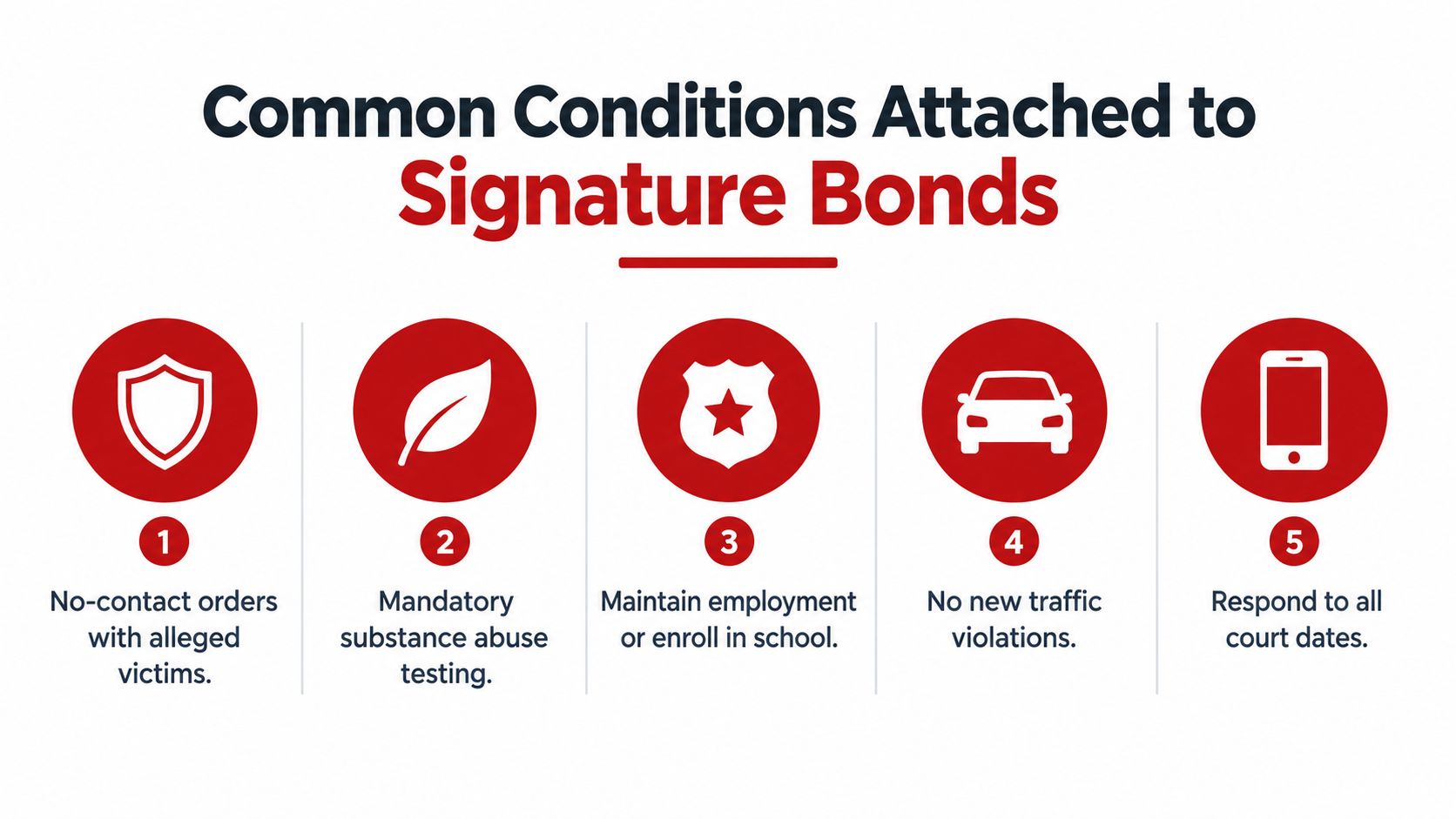
Common conditions can include:
- No contact: The defendant may be barred from contacting an alleged victim, witness, or co-defendant.
- Stay-away terms: The order may identify a residence, workplace, school, or other location the defendant must avoid.
- Travel limits: The defendant may need permission before leaving the permitted local area, which can include Ventura, Santa Barbara, or Los Angeles County depending on the order.
- Testing or treatment: The court may require substance testing, counseling, education, or a treatment program.
- Monitoring: Electronic monitoring, reporting, or other supervision may be ordered when the judge believes it is necessary.
- Property surrender: The order may require surrender of a passport or firearms.
- Administrative charges: Some jurisdictions add administrative or booking fees even when the full bond amount isn’t paid at release. The examples described in the verified bond guidance show why “signature” doesn’t always mean zero cost.
What happens after a violation
The court order is the controlling document. If the defendant violates a no-contact order, misses testing, leaves a restricted area, or fails to appear, the court can respond with a warrant, bond forfeiture, stricter conditions, or a return to custody. The response depends on the alleged violation and the judge’s order.
Conditions can sometimes be changed, but a defendant generally needs formal court action, usually through the defense. A family shouldn’t assume that a verbal agreement, text message, or permission from another person cancels a written condition.
Real California Examples of Signature Bonds in Action
The following examples are hypothetical illustrations, not predictions about a particular case. A judge may reach a different result after reviewing the complete record, the allegation, and the defendant’s history.
A first-time, nonviolent shoplifting allegation in Simi Valley might involve a defendant with a local job, stable housing, and no known history of missed court dates. The court could consider release on recognizance, perhaps with a stay-away condition involving the store. The important point is not the store condition itself. It is that the defendant’s release depends on following the order and returning to court.
A DUI allegation in Thousand Oaks can raise different concerns. A defendant with one prior conviction might receive a monetary bond or a signature-based release with conditions addressing driving and alcohol use. Those terms could include an ignition interlock requirement, education or counseling, restricted travel, or testing if the court orders them. The existence of a vehicle, insurance, or local employment doesn’t guarantee release, but the information may be relevant to the overall assessment.
Domestic-violence allegations can produce another result even when the defendant has a clean record. A judge may deny PR release because of safety concerns or a custody requirement tied to the case. The family may then need to arrange a surety bond through a licensed Ventura County bondsman after the court sets monetary bail.
| Scenario | Charge and location | Defendant profile | Release decision | Typical conditions |
|---|---|---|---|---|
| One | Hypothetical shoplifting allegation in Simi Valley | Local work, stable ties, no known missed appearances | PR release may be considered | Stay-away order, court appearances |
| Two | Hypothetical DUI allegation on Thousand Oaks Boulevard | Prior conviction and driving-related concerns | Signature or monetary release may be considered | Driving restrictions, testing, education, or interlock if ordered |
| Three | Hypothetical domestic-violence allegation in Ventura County | Clean record but safety or custody concerns | PR may be denied | Monetary bail, protective terms, and no-contact conditions |
The phrase signature bond meaning should therefore be understood as “release based on a written promise,” not “release without consequences.” No cash changes hands at the start, but the court still controls the defendant’s freedom.
When a Signature Bond Is Denied and How a Bondsman Helps
At 2 a.m. at the Ventura Pre-Trial Detention Facility, a denied signature bond changes the family’s immediate decision. The defendant cannot leave on a written promise alone. If the judge has set monetary bail, the family must either pay the full amount or arrange a surety bond while the defendant remains in custody.
The facility is at 800 South Victoria Avenue in Ventura. Before anyone drives there, confirm the current booking status, court paperwork, accepted payment method, and posting instructions. Those details can affect whether cash payment or a bail bond can be processed at that time.
The surety bond process
A surety bond works like a financial bridge. A licensed bondsman guarantees the court’s bail, and the family signs an agreement accepting specific responsibilities. The agent typically needs the defendant’s legal name, booking information, known charges, and the bail amount set by the court.
The agent then explains the lawful premium, payment schedule, co-signer duties, and any collateral requirement. The premium is based on the total bail amount, so the family pays only the agreed premium for the bond rather than depositing the entire bail amount directly with the court. Ask for the figures in writing before signing.
A co-signer may have duties if the defendant misses court or violates the agreement. Collateral may also be discussed for a larger or higher-risk bond. Read every term carefully, including what happens after a missed appearance, how payments are handled, and when collateral can be released.
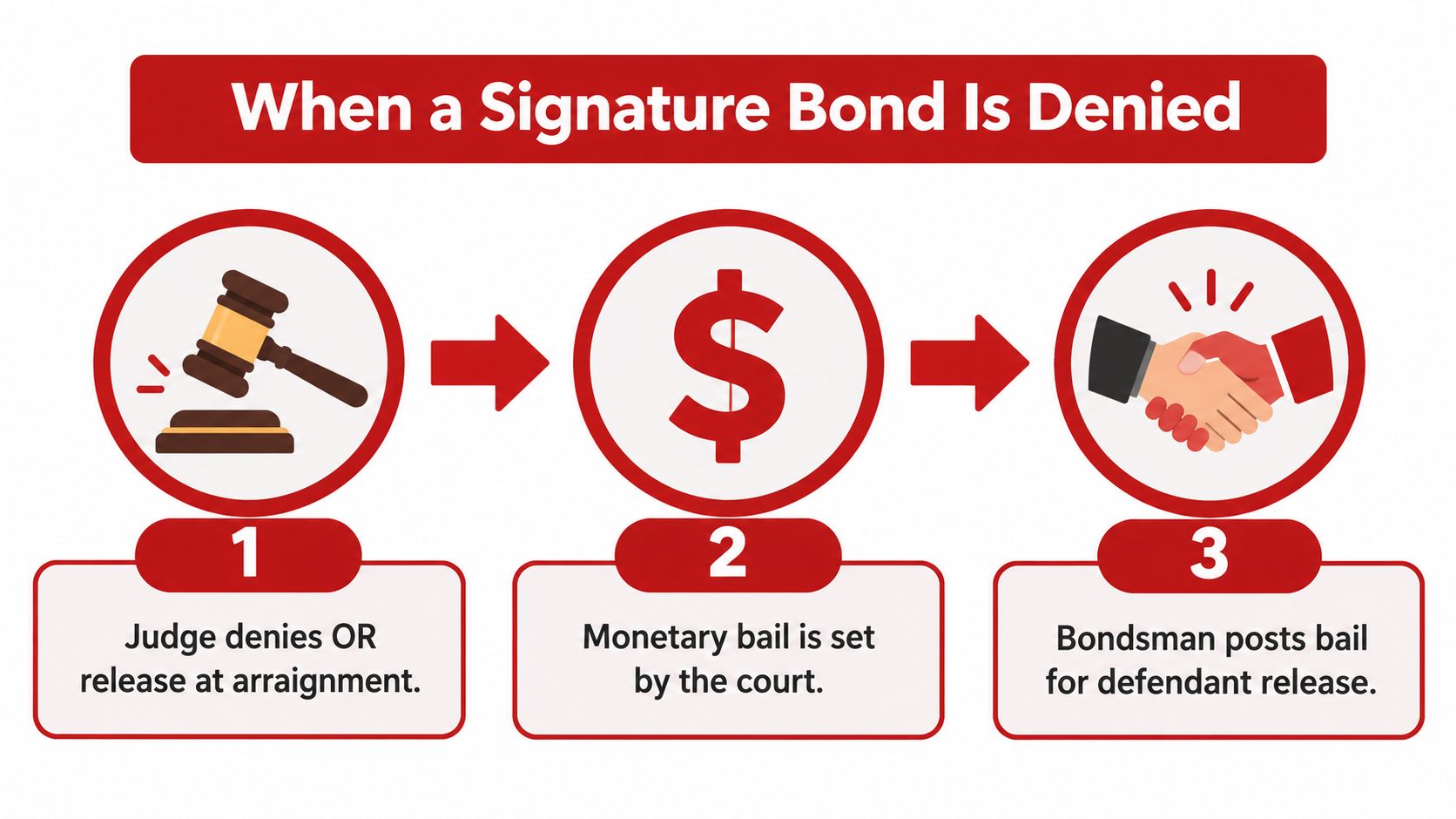
Release may still take time after the agreement is completed. Booking status, court documents, facility processing, and accurate information all matter. Calling a licensed local agent while the defendant is being processed gives the family time to gather identification, contact information, and payment details.
That call is often the realistic path when PR release has been denied and the family cannot pay the full bail amount. It can also help families seeking 24-hour bail bonds Ventura, Ventura County Jail bail bonds, or service near Oxnard, Camarillo, Port Hueneme, and Santa Paula.
For a practical explanation of the paperwork and posting steps, read how to post bail. A clear sequence can make the late-night decision easier: confirm the bail amount, compare direct payment with a surety bond, review the agreement, and submit the required information.
Quick Takeaways and Next Steps for Ventura County Families
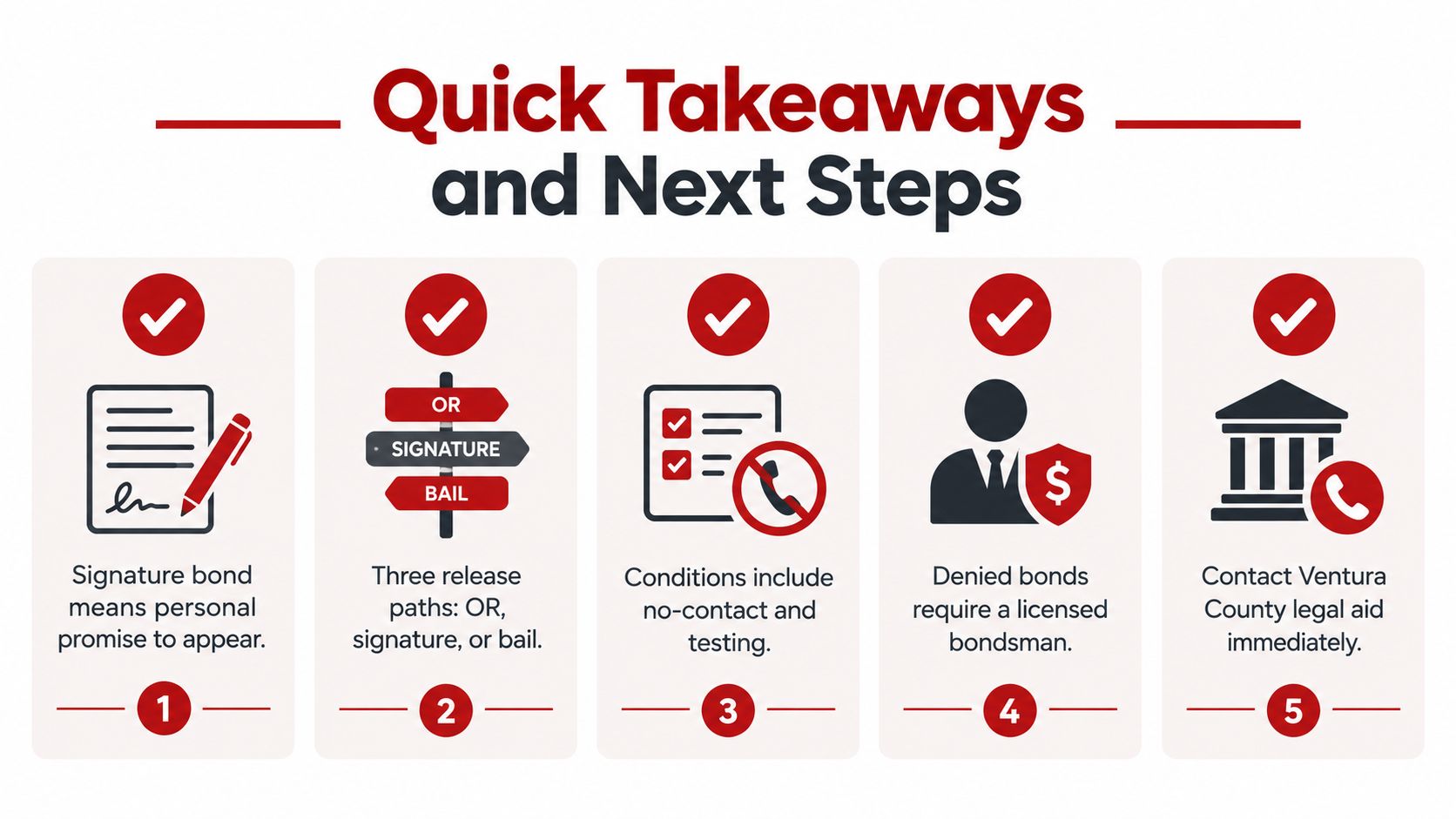
The practical definition is straightforward. A signature bond, also called a PR bond, releases a defendant based on a written promise to appear rather than an upfront cash deposit. The judge may attach conditions, and missing court can create serious legal and financial consequences.
Families generally face three release paths:
- Personal recognizance: The defendant signs the court’s promise and follows its conditions.
- Cash bail: The family pays the full amount required by the court or facility.
- Surety bond: A licensed bondsman guarantees the court’s bail after the family completes the agreement and pays the lawful premium.
A calm checklist
- Stay organized: Write down the facility, court, arresting agency, and every name provided by staff.
- Confirm identity: Gather the defendant’s full legal name, date of birth, and booking number if available.
- Ask about PR status: Confirm whether the defendant is eligible for release on recognizance and whether a judge has already set bail.
- Call for a surety option: If monetary bail is set, contact a licensed bondsman and ask about the premium, payment plan, co-signer duties, and collateral.
- Track every date: Put court appearances, testing, check-ins, and attorney appointments on a shared calendar.
These steps apply whether the family is in Ventura, Oxnard, Camarillo, Port Hueneme, Thousand Oaks, Santa Paula, Moorpark, Fillmore, Ojai, or Santa Barbara. Local procedures can differ, so confirm facility instructions and court conditions rather than relying on general online explanations.
Bada Bing Bail Bonds answers families 24/7, serves Ventura and Santa Barbara and nearby Southern California counties, and can explain the difference between a signature bond and a surety bond while paperwork is being prepared. Visit Bada Bing Bail Bonds to request help with release information, premium options, and the next practical step.