In California, a bail bond premium is commonly 10% of the total bail amount, so a $50,000 bail means roughly a $5,000 premium. That 10% is the industry-standard filed rate, not a number written directly into statute.
At 2 a.m., a family member in Oxnard, Ventura, or Thousand Oaks may be staring at a bail amount that feels impossible to pay in cash. The first question is usually simple: How much will getting someone released cost?
A bail bond usually costs a percentage of the full bail amount, not the full amount itself. The jail holds the full bail as security when someone pays cash, while a licensed bondsman posts a bond on the family’s behalf and charges a premium for that service.
This guide explains how bond pricing works for Ventura County bail bonds, including the premium calculation, California bail rules, payment plans, co-signers, collateral, and the questions worth asking before signing anything. It also covers posting bail at the Ventura County jail and what the first call to a bondsman typically sounds like. For readers comparing how different states structure bail costs, this guide to pricing for Colorado bail bonds offers useful background.
Table of Contents
- What Bond Pricing Means When Someone Is in Jail
- The 10% Premium and California Law
- Factors That Affect How a Bail Bond Is Priced
- Sample Premium Calculations for Common Bail Amounts
- Payment Plans, Co-Signers, and Collateral Options
- Fees a Reputable Bondsman Should Never Charge
- What to Expect When You Call a Ventura County Bondsman
What Bond Pricing Means When Someone Is in Jail
Suppose a loved one has been arrested in Ventura and the county bail schedule lists bail at $50,000. The family has two basic paths. They can try to pay the entire amount directly to the appropriate facility, or they can contact a licensed bail agent who may post the full bond for a premium.
With cash bail, the person posting bail provides the full bail amount. That money is held under the court’s rules and may be returned according to the applicable process if the defendant appears as required and the court releases the funds. The family must have access to the entire amount at the time of posting.
With a bail bond, the bondsman provides the financial guarantee to the court. The family generally pays the premium instead of producing the full bail amount in cash. The bondsman may also require a co-signer, payment arrangement, or collateral, depending on the circumstances and risk involved.
Practical rule: Ask for two separate figures. One is the total bail set by the court. The other is the premium and any agreed security needed to obtain the bond.
The distinction matters in searches for bail bonds Ventura, Ventura County Jail bail bonds, and bail bonds Oxnard because a family may hear a large bail figure and assume that amount must be paid immediately to a bondsman. That isn’t usually how the premium is calculated. The premium is based on the full bail amount, while the bond itself is the guarantee submitted to the court.
The rest of the cost conversation depends on the charge, the county schedule, the defendant’s history, the likelihood of appearing in court, and whether collateral is needed. A clear agent should explain those points before asking you to commit.
The 10% Premium and California Law
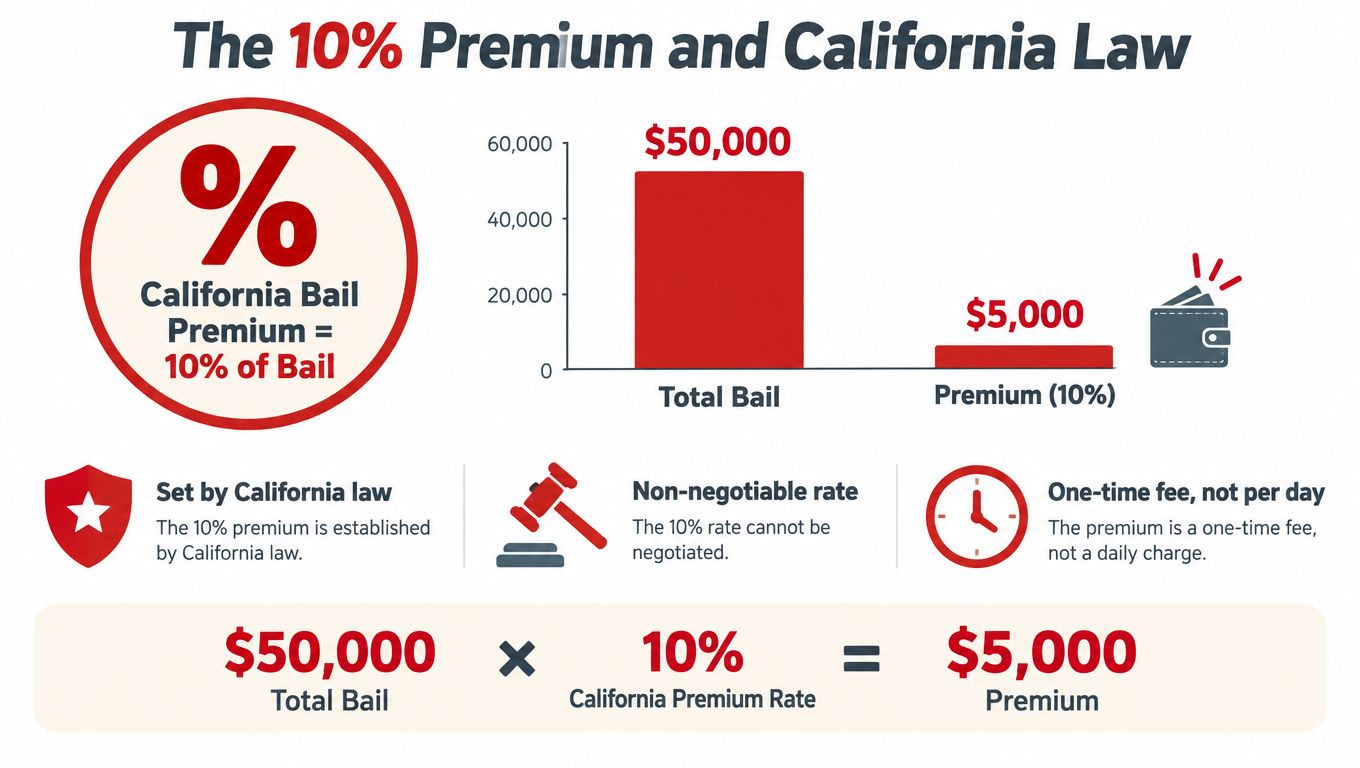
The commonly quoted California bail bond premium is 10% of the total bail amount. For example, a $50,000 bail amount produces an approximate $5,000 premium when calculated at that filed rate. The calculation is straightforward: $50,000 × 10% = $5,000.
Think of the premium like an insurance premium. It pays for the surety-backed service and the risk associated with guaranteeing that the defendant appears in court. It isn’t a deposit, and it generally isn’t refunded because the criminal case later ends.
What California law actually controls
The 10% figure isn’t set directly by statute. The California Department of Insurance explains that surety companies file their rates with the state, and bail agents must charge the filed rates. That distinction matters because people often hear that California law states every bond costs 10%.
California law also allows bail schedule rules to be adopted at the county level. Judges adopt countywide schedules for local cases, so the same general charge can produce a different bail amount in Ventura County than it might elsewhere.
The premium is only one part of the financial arrangement. A family may also discuss installment terms, a qualified co-signer, or collateral for a larger or more difficult bond. Those arrangements should be explained separately from the premium rather than folded into vague language.
For another plain-language explanation of the basic calculation, see this guide to how much bail bonds cost. Read the agreement carefully, and ask whether the quoted figure is the complete premium or only the amount due at signing.
Factors That Affect How a Bail Bond Is Priced
The percentage is only the starting point. The total bail amount comes from the court and the applicable county schedule, while the bondsman evaluates whether additional protection is needed before posting the guarantee.
Charge severity
The alleged offense affects the bail amount listed in the county schedule. Families may be dealing with DUI, domestic violence, drug offenses, theft, a warrant, or a probation violation. The charge category, allegations, prior record, and court orders can all affect the amount set.
A domestic violence arrest may also involve protective orders or no-contact conditions. Those release conditions are separate from the premium, but violating them can create additional legal trouble. An agent can explain the bond paperwork, but only the court or a qualified criminal defense lawyer can answer legal questions about the underlying case.
The California bail schedule provides useful general context, but the actual amount depends on the county and the facts presented to the court.
Flight risk
A bondsman looks at whether the defendant has strong ties to the community. Local residence, employment, family connections, and a history of attending court can help explain why the person is likely to return.
A defendant with limited local ties, a history of missed court dates, or plans to leave the area may require a more cautious bond structure. That doesn’t automatically mean the bond can’t be written. It may mean the agent asks more questions or requires stronger security.
Criminal history
A first arrest can present a different risk picture from repeated arrests, prior failures to appear, or probation violations. The bondsman may ask about prior cases and court attendance because the bond remains active while the defendant must follow the court process.
Be candid. Accurate information helps the agent give a realistic answer instead of quoting a figure that later changes when important facts appear.
Collateral
Collateral is property or another asset pledged to secure the bond. It may be discussed when the bail amount is large or the risk appears higher. The agreement should describe what is being pledged, what happens if the defendant misses court, and when the collateral can be released after the obligations are satisfied.
Sample Premium Calculations for Common Bail Amounts
The math is easiest when you separate the total bail amount from the premium. Multiply the bail amount by the filed 10% rate. The examples below use that commonly filed California rate and are intended to show the calculation, not predict what bail will be for a particular charge.
| Total Bail Amount | Approximate Premium (10%) |
|---|---|
| $10,000 | $1,000 |
| $25,000 | $2,500 |
| $50,000 | $5,000 |
For a $10,000 bail amount, the calculation is $10,000 × 10%, producing an approximate $1,000 premium. At $25,000, the same calculation produces approximately $2,500. At $50,000, it produces approximately $5,000. A bail bond calculator can help you estimate the premium from the amount provided by the court.
How the charge fits into the calculation
Ventura County families may ask about a DUI, domestic violence allegation, drug offense, theft case, warrant, or probation violation. The charge helps determine the applicable bail schedule and the court’s decision, but it doesn’t create one universal price for every case.
The actual bail amount can depend on the county schedule, the specific allegations, prior history, and any court decision that changes the scheduled amount. Once the court sets bail, the premium calculation uses that total rather than the family’s preferred payment amount.
The premium is a flat cost for the bond service, not a daily charge. It also isn’t returned just because the case ends, the defendant is acquitted, or the charges are dismissed. Ask the agent to identify the premium, the payment schedule, and any security requirements as separate items before you sign.
Payment Plans, Co-Signers, and Collateral Options
A family may understand the premium and still not have the entire amount available at once. That doesn’t answer the question of whether a bond can be arranged, but it does make the payment structure important.
| Option | How It Works | Best For |
|---|---|---|
| Payment plan | The agreed premium is divided into scheduled installments | Families with reliable income but limited cash immediately |
| Co-signer | A responsible adult guarantees the agreement and accepts obligations connected to the bond | Families with someone who has stable finances and a close relationship with the defendant |
| Collateral | Property or another asset secures the bond under written terms | Larger or higher-risk bonds requiring additional protection |
Payment plans
An installment arrangement spreads the premium across agreed payments instead of requiring the entire amount at signing. The written agreement should state the amount due initially, the remaining balance, payment dates, and what happens if a payment is late. Review the terms before paperwork is completed, not after.
Families researching installment payment plans should ask whether the plan changes the total cost or only changes when the cost is paid.
Co-signers
A co-signer takes responsibility for the agreement if the defendant fails to appear or violates the bond conditions. The bondsman may consider the co-signer’s identity, relationship to the defendant, financial stability, residence, and willingness to help the defendant attend court.
Being a relative doesn’t automatically make someone a qualified co-signer. The person should understand the obligation and should never sign only because everyone is frightened or rushing.
Collateral
Collateral can include property or other assets accepted under the bond agreement. The paperwork should explain how the asset is valued, what could happen after a missed appearance, and what conditions must be met before its return.
A reputable agent won’t describe collateral as an informal promise. The terms should be written clearly, and the family should keep copies of every document.
Fees a Reputable Bondsman Should Never Charge
A worried family shouldn’t have to decode a bill filled with unexplained labels. The premium should be stated plainly, and any separate requirement should be identified before money changes hands.
Be cautious about charges described only as a “processing” fee, “file” fee, or “administrative” cost when those amounts weren’t disclosed at the start. Surprise interest or a new charge that appears after signatures are collected also deserves a direct explanation.
A transparent agency should tell you:
- The exact total: Ask what amount is required today and what amount remains later.
- Included services: Ask what the premium covers and whether anything else is being charged.
- Late-payment terms: Ask what happens if an installment is late or missed.
- Collateral conditions: Ask how the collateral is documented and when it can be returned.
- Court obligations: Ask who will explain check-ins, court dates, and communication requirements.
Ask for the complete number in writing before signing. If a fee matters to the decision, it belongs in the agreement, not in a hurried verbal explanation.
That approach protects families looking for 24-hour bail bonds Ventura service at a difficult hour. A calm explanation is more useful than pressure, and a written agreement gives everyone a clear record of what was accepted.
What to Expect When You Call a Ventura County Bondsman
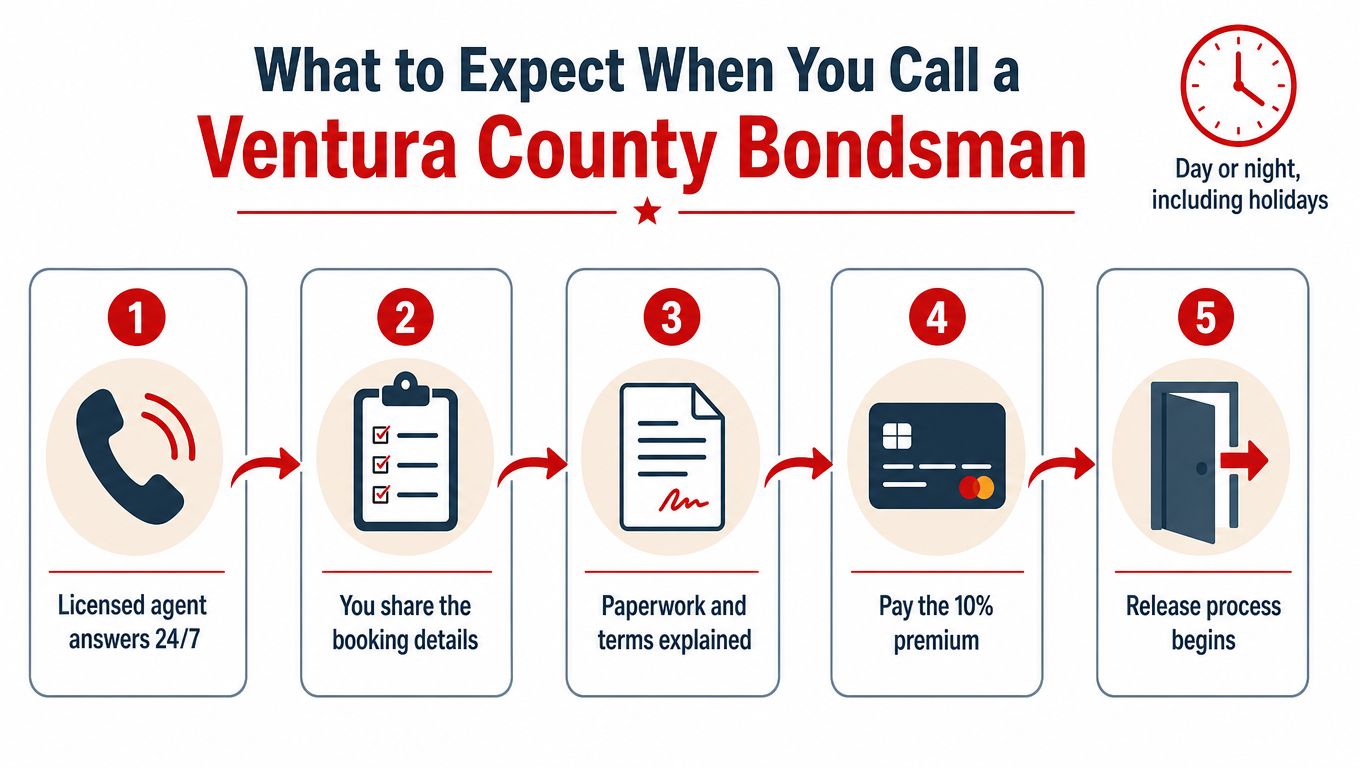
A late-night call should start with basic facts, not a sales pitch. A licensed agent answers 24 hours a day, including nights and weekends, and first verifies the defendant’s name, booking location, charge information, bail amount, and custody status.
The agent then explains the premium, possible payment arrangements, co-signer expectations, collateral questions, and the applicable bail schedule in plain English. You can ask questions before deciding whether to proceed, and you should receive the terms clearly before signing.
The Ventura County posting process
The Ventura County Sheriff’s Office says bail can be posted at the Pre-Trial Detention Facility in Ventura. Cash must be for the exact amount, and cashier’s checks must be payable to the Ventura County Superior Court. The official guidance also allows bail bonds and card payments through GovPayNet or by phone, as described in the sheriff’s posting-bail guidance.
After the family agrees to proceed, paperwork is coordinated with the jail and the release window is tracked. The timing can vary by facility and circumstances, so an agent should give updates rather than promise an exact release time. Information about documents and bail bond requirements can help you prepare for the call.
Families commonly contact Bada Bing Bail Bonds for service across Ventura, Oxnard, Camarillo, Port Hueneme, Thousand Oaks, Santa Paula, Moorpark, Fillmore, Ojai, and Santa Barbara. The agency offers payment plans, co-signer arrangements, and collateral solutions, coordinates paperwork with local facilities, and provides court-date reminders and check-ins after release.
If you’re trying to arrange bail bonds Thousand Oaks, bail bonds Oxnard, or a Ventura County Jail bond in the middle of the night, gather the booking details and the bail amount first. Then call with direct questions about the total premium, payment terms, collateral, and the expected release process.
For clear pricing, payment-plan options, and help with Ventura County bail bonds, visit Bada Bing Bail Bonds to review the process and contact an agent. You can ask about a DUI, domestic violence case, warrant bail bond, probation violation, or another arrest without pressure, and get plain-English answers before deciding what to do.