A credit for time served calculator in California is an educational estimate under Penal Code § 2900.5, not a release prediction. The sentencing court, not the calculator, issues the final credit on the abstract of judgment.
If your phone rang after midnight because someone got booked in Ventura County Jail after an Oxnard or Camarillo arrest, this is the part that matters: the number on a bail schedule and the number of days in custody are not the same thing. Families use a credit for time served calculator to get their bearings, but the central question is whether those jail days are legally tied to the same case, the same conduct, and the same sentencing structure.
Table of Contents
- Why a Credit for Time Served Calculator Matters Right Now
- Inputs a Reliable Calculator Must Collect
- The Actual California Formula Without a Plug
- Two Worked Examples From a Ventura County Case File
- How Posting Bail Affects the Credit Estimate
- A Credit Eligibility Checklist Families Can Run Tonight
- What a Calculator Cannot Do and Where to Verify
Why a Credit for Time Served Calculator Matters Right Now
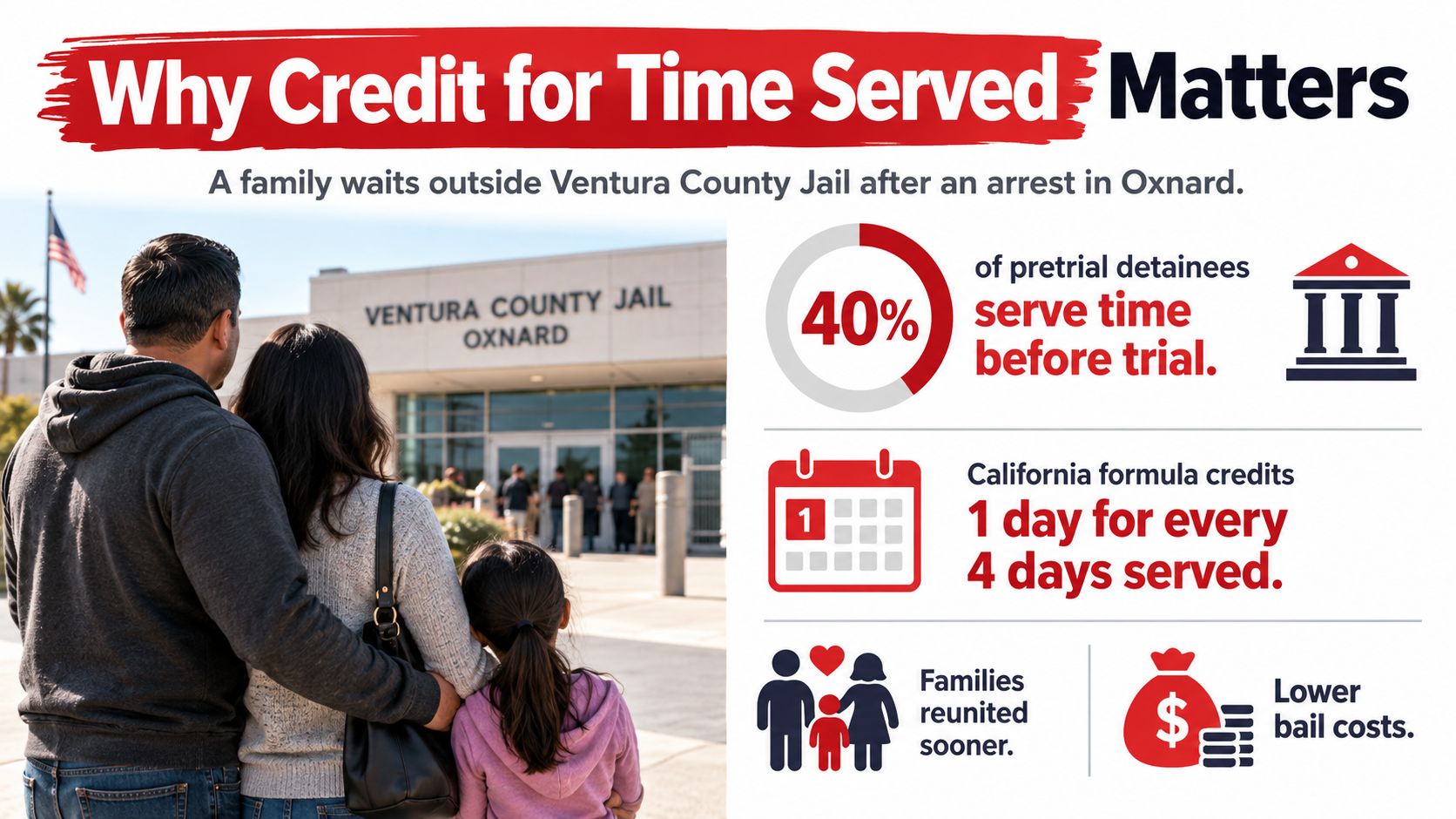
When a family calls about bail bonds Ventura, the core question is simple. Will the jail days already served count toward the sentence, and do those days legally belong to this case? Under California Penal Code § 2900.5, presentence custody can be credited toward confinement when the custody qualifies, and the court makes that call, not an online widget California Penal Code § 2900.5.
A useful calculator forces the right checklist. It separates the arrest date from the release date, then asks whether the jail time attaches to the conviction at issue. That matters in Ventura County, where one booking can turn into multiple case files, multiple court dates, and multiple custody records.
A calculator that only asks for “days served” and “sentence length” is guessing.
Bail and credit are different problems. The Ventura Superior Court bail schedule sets the starting bail amount after arrest, but that number does not decide the custody credit outcome Ventura Superior Court bail schedule. Families using Ventura County Jail bail bonds services should keep those issues separate, because bail gets someone home sooner, while credit for time served is about what the court later counts on the sentence. For a plain-English explanation of the bail side of the equation, read how bail works in California.
That distinction matters late at night, when someone is booking out of the jail and the family is trying to make a fast decision. A calculator is useful only if it helps them ask the right question first: does this custody legally count?
Inputs a Reliable Calculator Must Collect

A calculator that ignores context is dangerous. Two people can spend the same number of nights in custody and end up with different credit totals because one case is a misdemeanor, the other is a felony, or because one case runs into another case with consecutive sentences. That's why a serious credit for time served calculator has to collect more than a start date and an end date.
The facts that change the number
- Booking and release dates. The calculator needs exact dates, not an estimate of “about a week.”
- Continuous custody or interrupted custody. Release on bail or own recognizance can break the chain.
- Offense classification. A misdemeanor, felony, and qualifying violent felony do not use the same credit rules.
- Sentence structure. Concurrent and consecutive sentences change whether a custody period can be used once or twice.
- Overlapping cases or holds. If another matter is responsible for the jail time, the credit can shift.
California law is blunt about this point. Penal Code § 2900.5 ties credit to custody related to the same conduct and limits double counting when consecutive sentences are imposed California Penal Code § 2900.5. That's why a family in Oxnard dealing with a DUI booking and a family in Thousand Oaks dealing with a domestic violence case can't rely on the same formula without checking the charge details.
A good estimate also has to account for qualifying custody served as a probation condition, as well as certain home detention periods. Those facts don't show up in a simple online form unless the tool asks for them directly. If it doesn't, it's leaving out the parts that can move the number.
For families comparing bail bonds Oxnard options, this is the right mindset: get the booking paperwork, get the charge, get the custody timeline, then calculate. Don't do it backwards. If you want to understand how bail amounts are set before you even get to the sentencing question, the county's California bail schedule guide is the practical place to start.
The Actual California Formula Without a Plug
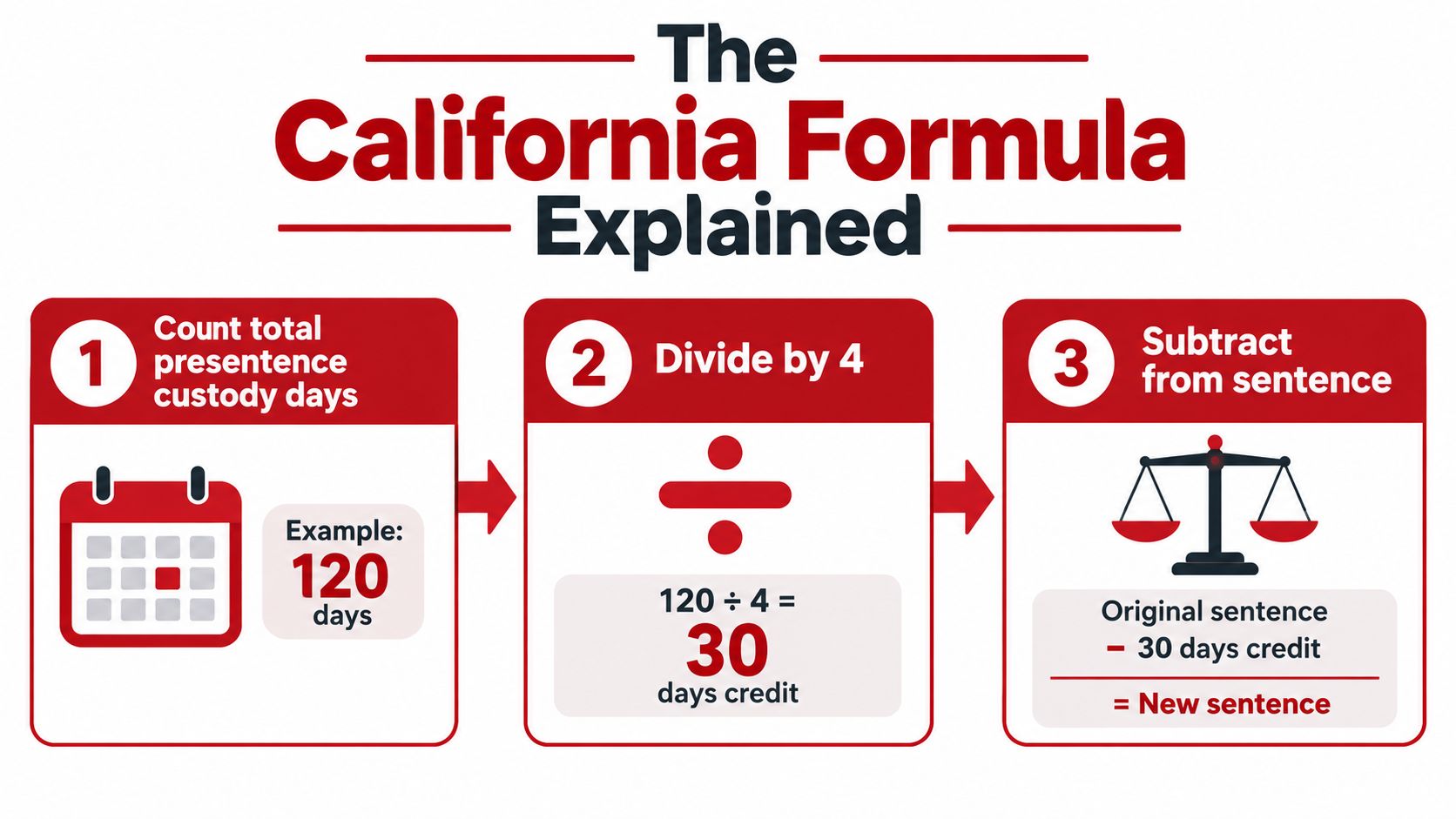
California's standard custody-credit math isn't magic. For qualifying presentence custody under the usual formula, the California Courts explain that you divide the actual custody days by four, drop any remainder instead of rounding up, multiply the whole-number result by two, and add that conduct credit to the actual days. That's the basic framework families keep hearing about, and it's why a calculator has to do more than subtract dates California Courts guidance.
Where the formula stops
The catch is that offense type can shut the usual formula down fast. For qualifying violent felonies, Penal Code § 2933.1 caps presentence worktime credit at 15% of actual presentence confinement, even if the normal custody-credit math would look better Penal Code § 2933.1. Murder has separate restrictions under the same statutory scheme.
That's the part families miss when they ask, “How many days do I get?” The answer depends on the charge category first, then the dates, then the court's calculation. If a calculator applies the ordinary formula to a capped offense, it gives a polished wrong answer.
A reliable calculator should show the statute it's using before it shows a total.
It should also separate presentence credit from later county-jail credit after sentencing. California regulations treat those as different stages, with different authorities handling them. A calculator that blurs those stages is not helping, it's creating false confidence.
This is why bail bonds Thousand Oaks families, and families anywhere in Ventura County, should treat any estimate as provisional until the court records the actual number. If you're trying to understand the timing of the case itself, the jail side and the court side don't always move together, and that timing can shape when the sentence-credit issue even becomes relevant. A useful companion page on the custody timeline is the Ventura overview of how long police can hold someone without charges.
Two Worked Examples From a Ventura County Case File
A family does not need theory at 1 a.m. They need the number to change the right way when the charge changes. That is what the credit estimate does, because 60 actual days can land in very different places depending on the statute.
Side-by-side comparison
| Input | Standard formula (§ 4019) | Violent-felony cap (§ 2933.1) |
|---|---|---|
| 60 actual days in custody | 90 total days credited | 69 total days credited |
| Reason | Actual days plus standard conduct credit | 15% cap on presentence worktime credit |
| What changes the result | Ordinary presentence credit rules | Offense classification and statutory limit |
In a misdemeanor Ventura case, the calculator follows the ordinary presentence credit formula. Sixty actual days can produce 90 credited days because conduct credit is added to actual custody time under the standard California rule. That is the result families expect when they hear “time served.”
A qualifying violent felony changes the math. Sixty actual days do not get the ordinary formula, they get the statutory cap under Penal Code § 2933.1, which cuts the estimate to 69 total credited days. Same jail time. Different legal regime. Different number.
Why consecutive sentences matter
The second trap is duplication. If one custody period covers multiple offenses and those offenses receive consecutive sentences, that same jail time cannot be counted more than once under Penal Code § 2900.5. Families often assume every day in jail automatically applies to every count. It does not.
That is why local bail conversations need to include the case structure, not just the arrest story. A person booked in Ventura, Oxnard, Camarillo, or Thousand Oaks can have one detention period and still end up with a different credit result once the sentencing order is written. If you want a local view of the booking-to-release timeline, the county guide on Ventura County inmate release times and bail information is worth reading.
How Posting Bail Affects the Credit Estimate
Posting bail does not increase custody credit. That's the misconception that burns families, especially when they're deciding whether to use bail bonds Ventura or bail bonds Thousand Oaks to get someone home fast. The credit calculation is about time already spent in custody, not the act of getting out.
California regulations treat time spent on bail, own recognizance, or bond pending appeal as excluded dead time for custody-credit purposes. Once release happens, those days stop adding to the presentence credit calculation. So if you bond out quickly, you may help the person get home sooner, but you're also stopping the clock on jail credit.
That tradeoff is real, and families should be honest about it. Getting out can reduce stress, protect jobs, and make court compliance easier. It can also reduce the amount of qualifying custody time that later counts against the sentence. Both things can be true at once.
Practical rule: don't confuse a bail decision with a credit decision. They solve different problems.
The premium a bondsman charges doesn't affect the credit math either. The court credits actual custody served, not the fee paid to secure release. Families sometimes expect the bond payment to somehow influence sentencing credit. It doesn't.
If you're weighing whether to post bond after a Ventura County Jail booking, keep the question narrow: do we want immediate release, or do we want more in-custody days to potentially count later? That's the calculation behind Ventura County Jail bail bonds, not a promise of extra credit. For a plain explanation of what happens after a bond is posted, this page on what happens after bail is posted is the right next read.
A Credit Eligibility Checklist Families Can Run Tonight
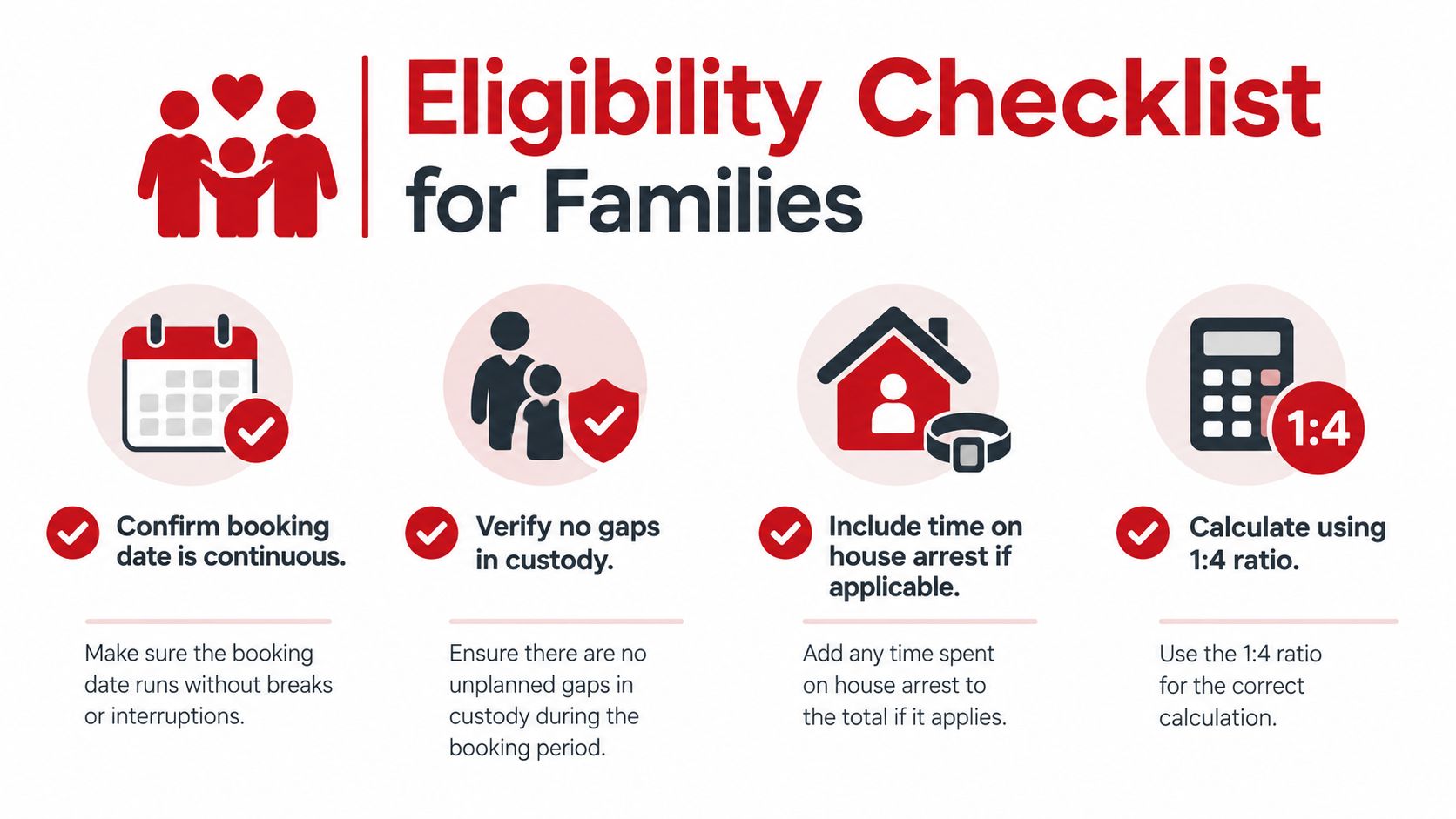
A family can sort a lot of confusion out in ten minutes if they check the right papers. The point isn't to become a lawyer. It's to spot the facts that decide whether the days in custody are creditable.
Run these checks in order
- Confirm the booking date is continuous. Look for any release gap that breaks custody.
- Verify the custody relates to the same conduct. A separate case can absorb the jail time.
- Check for overlapping holds or probation issues. Those can change which case gets the credit.
- Identify consecutive sentences. One custody period can't be counted twice.
- Confirm the statute that applies. Some offenses trigger a cap, and that cap controls the estimate.
The right documents are usually the booking record, the jail timeline, the complaint or information, and the sentencing paperwork. If the case is still pending, probation or another designated official may also need to report custody information before sentencing. That's not busywork. That's what the judge uses.
Families using Ventura County Jail bail bonds can save themselves a lot of bad guesses here. The jail record tells you what happened in custody, but only the court can make the final award. A calculator is useful when it helps you ask, “What case does this time belong to?” That's the question that matters.
What a Calculator Cannot Do and Where to Verify
A credit for time served calculator can't predict the physical release hour. It can't erase charges, fix another case's hold, or replace defense counsel. It also can't override the Ventura County Superior Court clerk or the sentencing judge.
Use it as a sorting tool, then verify the details. Pull the booking timeline from Ventura County Jail, confirm the current bail status if you're still deciding whether to post bond, and review the probation report or custody paperwork before you assume the number is final. If you want a separate framework for legal and financial planning, the legal fee calculator tools resource can help organize the money side while you sort out the custody side.
A good credit for time served calculator narrows the question. It tells you which days might count, which ones won't, and what paperwork still needs confirmation. That's the whole job.
If you need straight answers on bail bonds Ventura, Ventura County bail bonds, or a late-night jail release in Oxnard, Camarillo, Thousand Oaks, Santa Paula, Moorpark, Fillmore, Ojai, or Santa Barbara, Bada Bing Bail Bonds is ready to help. We move fast, keep the process plain, and stay focused on the paperwork that gets families through the night and back to court on time.