At 2 a.m., a family member calls from an unfamiliar number. Someone has been arrested in Newport Beach, nobody knows whether they're still at the police department, and the first bail quote sounds simple until questions about the court, payment, paperwork, and release timing start piling up. The safest response isn't to guess. It's to identify who has custody, what charges were booked, and whether bail has been set.
Newport Beach bail bonds involve more than handing over a premium and waiting by the door. The Newport Beach Police Department, Orange County Superior Court, county detention facilities, and a licensed surety each control different parts of the process. A clear understanding of those handoffs can prevent wasted trips, rejected payments, and false expectations about when someone will walk out.
Table of Contents
- What to Do in the First Hour After a Newport Beach Arrest
- How Bail and Bail Bonds Actually Work in Orange County
- The Step-by-Step Release Timeline After a Newport Beach Arrest
- Typical Bail Amounts for DUI, Domestic Violence, and Other Common Charges
- Premium, Payment Plans, and Collateral Explained
- How Protective Orders and No-Contact Conditions Affect Release
- Red Flags and How to Choose a Reliable Newport Beach Bondsman
- Putting It All Together and Getting Help Right Now
What to Do in the First Hour After a Newport Beach Arrest
The first call often comes with incomplete information. A spouse may know only that officers took someone away from a hotel, a visitor may have been arrested after an incident near the waterfront, or a parent may have heard that a loved one was booked but not where. In that moment, calling every bail office you find online can create more confusion unless you first establish the basic custody facts.
Start with the three facts that control everything
First, confirm the custody location. Ask whether the person is still held by the Newport Beach Police Department or has been transferred into Orange County custody. Newport Beach Police Department says people currently in its custody may be bailed out at the front desk 24 hours a day, and it directs families to the department for case-specific bail information. Use the department's official bail information rather than relying on an unverified arrest listing.
Second, obtain the exact charges. “DUI,” “domestic violence,” or “warrant” may be shorthand, not the complete booking description. The charge level, any enhancement, the existence of a warrant, and prior case information can affect the applicable amount and release conditions.
Third, ask whether bail has been set. An arrest does not automatically mean a bond is ready to post. The booking process, court review, or a specific hearing may still be pending. A bondsman can help verify the status, but can't make a court-set amount appear before the responsible agency has entered it.
Practical rule: Don't authorize a bond until someone confirms the facility, booking information, current bail amount, and court jurisdiction.
Write down the booking number, the spelling of the defendant's legal name, the arresting agency, and the name of the person providing the information. Keep your phone available because a facility may need additional identification or paperwork before accepting a bond. Families looking for a plain-language explanation of what happens after an arrest can also review this Orange County arrest and custody guide.
How Bail and Bail Bonds Actually Work in Orange County
California doesn't use one statewide bail amount for every offense. Judges in each county adopt a countywide schedule based on the jurisdiction and alleged offense, so a Newport Beach arrest is generally evaluated under the applicable Orange County Uniform Bail Schedule. The California Department of Insurance advises consumers to contact the court where the case is filed for local bail information, which is why both the arrest location and the court handling the case matter. See the California bail bond consumer guidance before signing a contract.
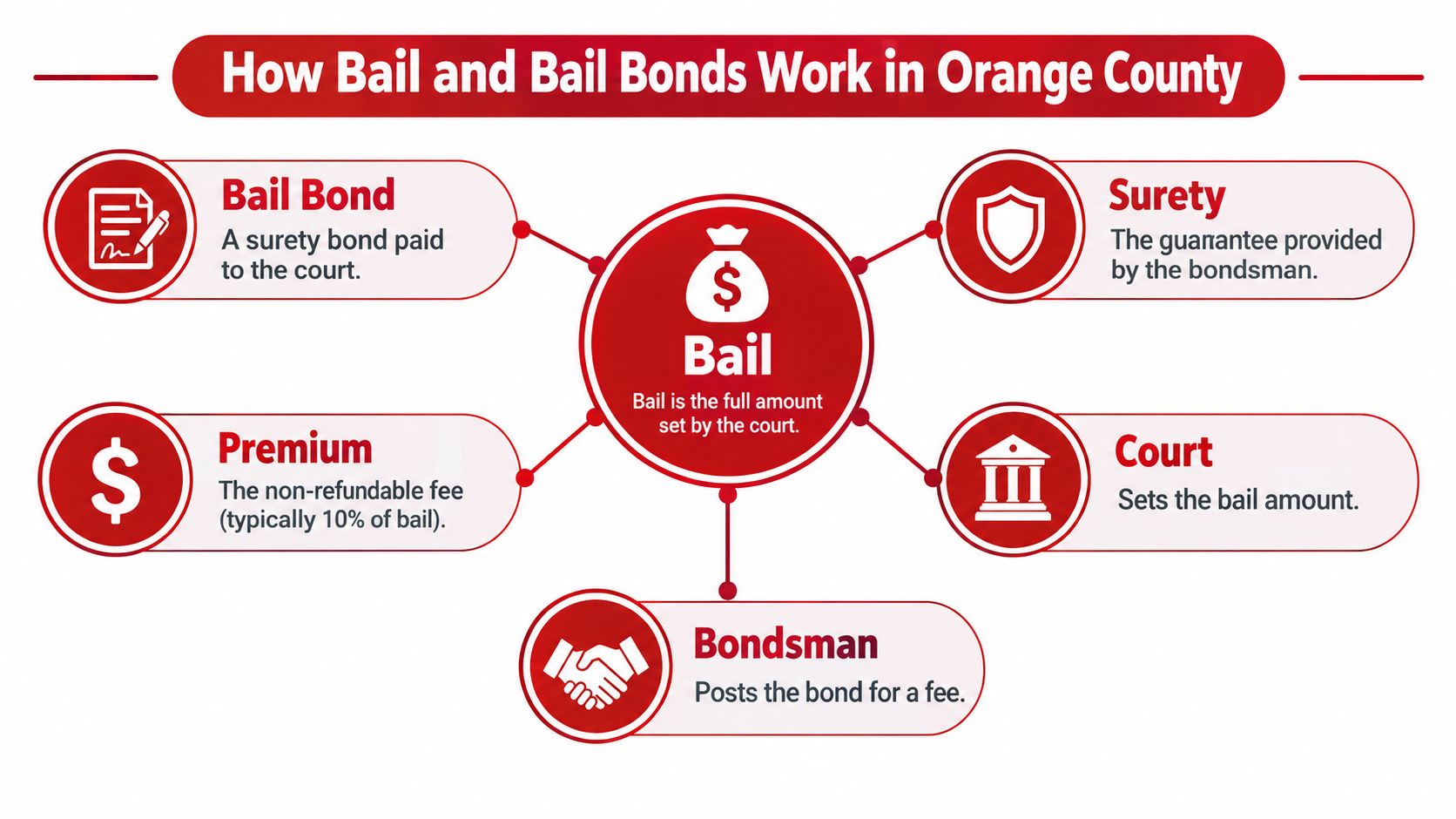
The basic terms are easier to understand when separated:
- Bail is the amount the court requires for release, subject to the applicable schedule and judicial decisions.
- A bail bond is a surety's promise to the court that the defendant will comply with the release obligation.
- The surety is the licensed company backing that promise.
- The premium is the consumer's charge for obtaining the bond.
- The bondsman acts for the surety, completes the agreement, verifies information, and submits the bond to the appropriate facility or court.
The court controls the bond amount. The bondsman doesn't reduce a judge's figure, erase a warrant, or guarantee a particular release condition. Instead, the agent helps the family use a commercial surety bond rather than depositing the full bond amount directly with the court or detention facility.
Where the Newport Beach bail desk fits
Newport Beach Police Department states that it accepts cash, checks, money orders, cashier's checks, traveler's checks, and bonds at its front desk for people in its custody. Payment methods can't be combined, so a family that has gathered several different instruments may still need a bond or a single acceptable payment method for the exact amount.
The usual commercial surety premium is 10% of the total bond amount, plus actual, necessary, and reasonable transaction expenses, subject to the surety's filed rates and contract terms. A $25,000 bond ordinarily means a $2,500 premium before permitted expenses, while a $100,000 bond ordinarily means a $10,000 premium. Those examples come from the state's consumer guidance and illustrate the difference between the court's bond amount and the family's usual premium. The Orange County bail bond process provides additional practical context for families arranging release.
The Step-by-Step Release Timeline After a Newport Beach Arrest
Release is a chain of events, not a single transaction. A family can sign paperwork promptly and still wait while the facility verifies the booking, accepts the bond, processes the release, or moves the defendant to another custody location.
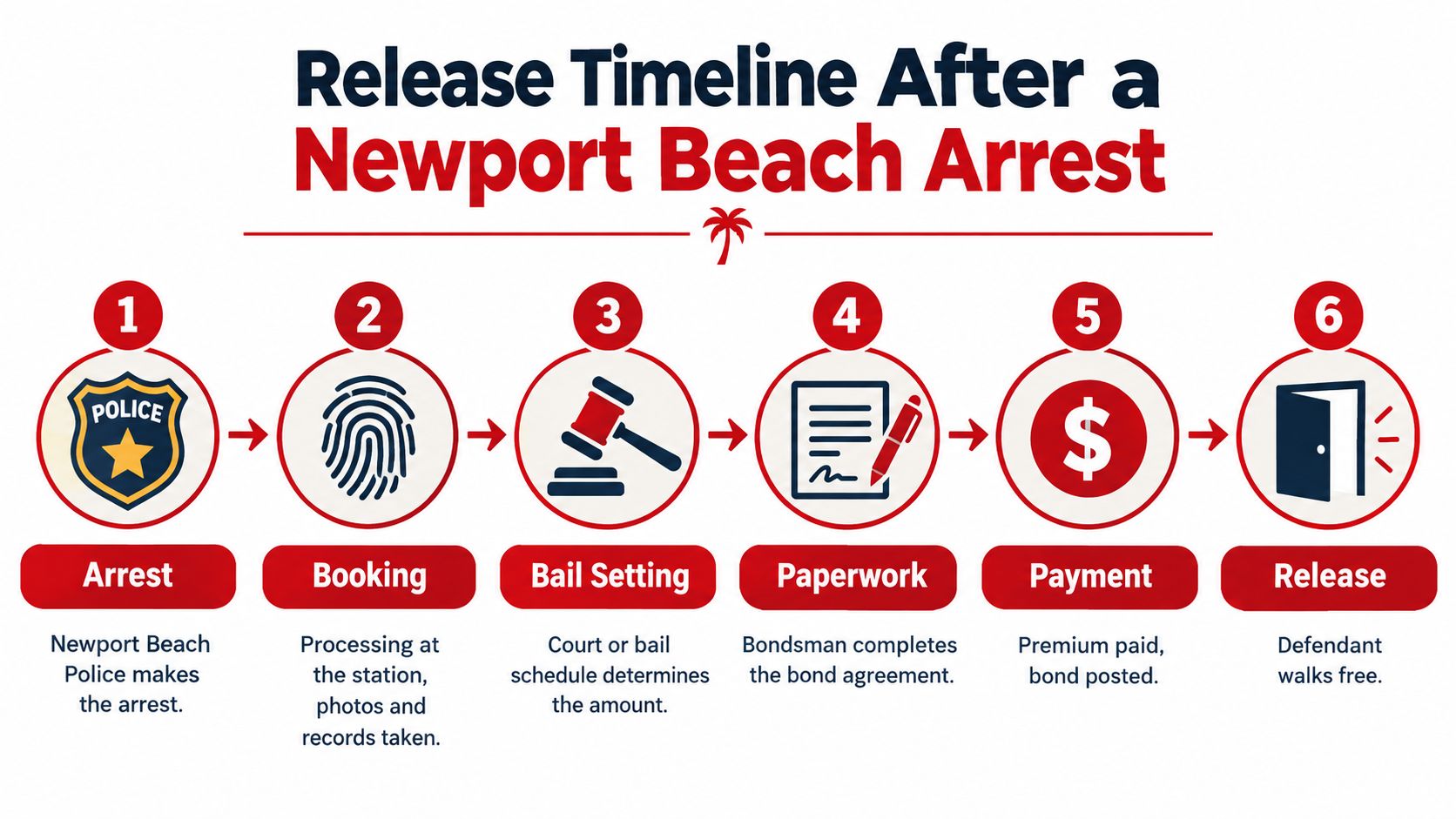
The six stages families should expect
Arrest and transport. Newport Beach Police may take the person into city custody, but another agency may control the booking if the arrest occurred under a different jurisdiction. Ask who made the arrest and where the person is being held now.
Booking. Officers and custody staff record identifying information, charges, fingerprints, photographs, property, and other required records. Bail may not be available for immediate posting until booking information has been entered and checked.
Bail setting or verification. The county schedule may provide a starting reference, but a judge or magistrate can increase or reduce the amount based on case-specific facts. Warrants, enhancements, prior record, charge classification, and release conditions may change the result.
Bond paperwork. A licensed agent gathers information from the indemnitor, explains the premium and payment obligations, reviews collateral terms when applicable, and prepares the surety agreement. The paperwork has to identify the correct defendant and match the custody and court information.
Bond submission and facility acceptance. Posting the bond doesn't mean the person is already outside. Staff must receive and validate the bond, update the custody record, and complete the facility's release procedures.
Release. The defendant receives property that can legally be returned, receives instructions or documents, and leaves custody when the facility finishes its work. The bondsman can coordinate the transaction, but the facility controls the final release step.
Why custody location changes the experience
Newport Beach Police Department says bail may be processed at its front desk around the clock for people currently in its custody. That doesn't mean every Newport Beach arrest remains there. A person may later be transferred into Orange County custody, and the receiving facility will then control acceptance, processing, and release.
This distinction matters at night. A family that drives to the police department after a transfer may be told the person isn't there. A family that posts a bond may still wait because the county facility must process the release independently. The correct question isn't “How fast can someone guarantee release?” It's “Which facility has custody, has bail been verified, and what processing steps remain?” Families can review the Orange County intake and release information while confirming the current location.
Typical Bail Amounts for DUI, Domestic Violence, and Other Common Charges
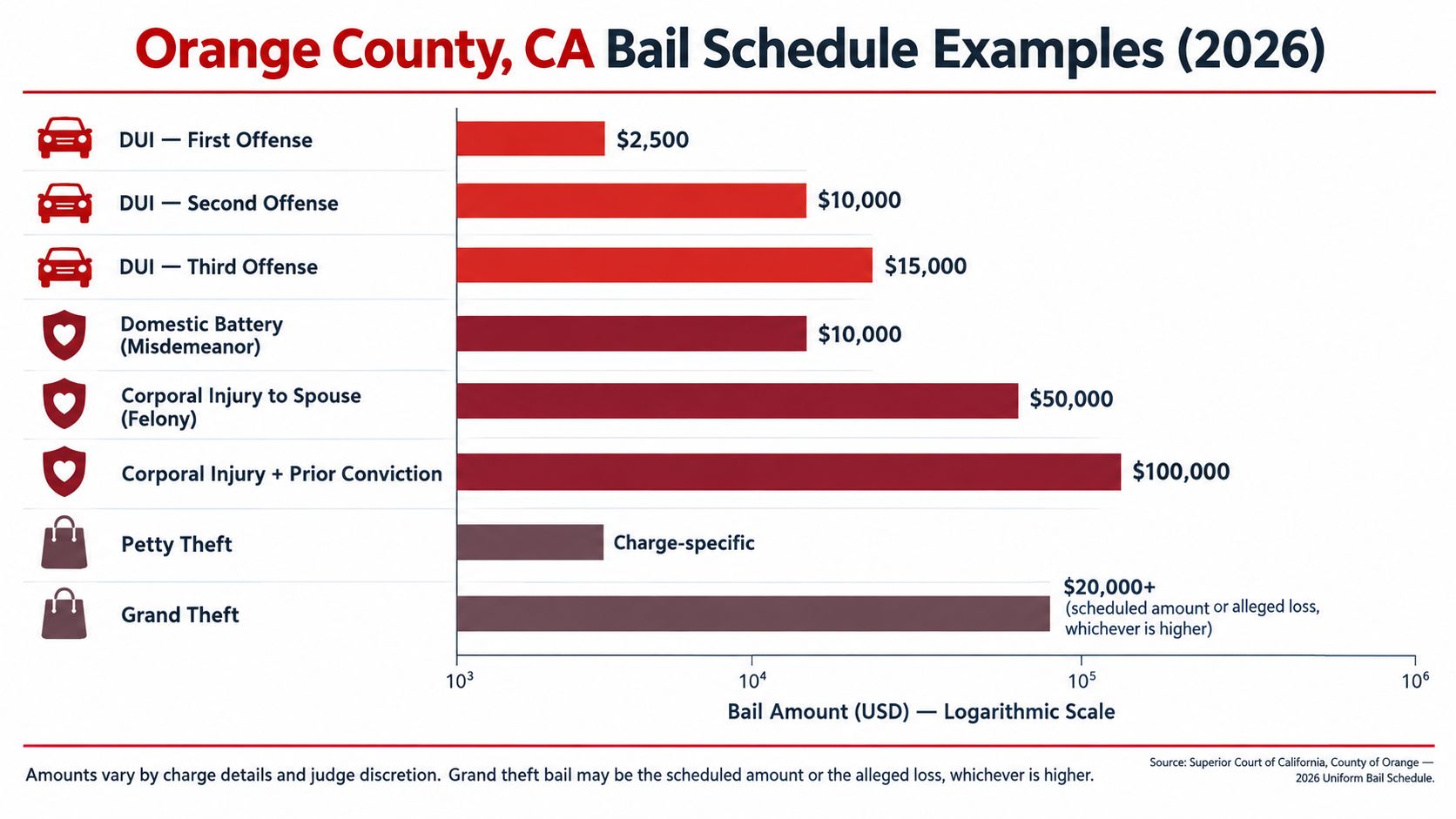
The 2026 Orange County Uniform Bail Schedule, effective January 1, 2026, applies throughout Orange County to warrantless arrests for bailable felony offenses. It is useful for orientation, but it isn't a promise that the final amount will match a number found in a chart. The exact statute, alleged conduct, prior record, enhancements, warrant status, and judicial orders can all matter.
DUI cases show why a single “DUI bail amount” is unreliable. The available 2026 schedule summary lists different amounts for first, second, third, fourth, and injury-related DUI allegations. A first allegation isn't treated as interchangeable with a repeat or injury-related allegation, and the booking description may include circumstances that change the applicable figure.
Domestic-violence cases require another layer of caution. California Penal Code section 1270.1 can require an open-court hearing before certain felony domestic-violence or protective-order cases receive release terms different from the published schedule. Notice and an opportunity for both sides to be heard may affect timing, and a bondsman can't bypass that hearing.
How to use a schedule without treating it as a promise
The schedule can help a family identify whether a quoted amount deserves verification. It can't replace confirmation from the jail or court. For drug possession, theft, and warrant cases, ask for the exact charge and whether the amount reflects one count or multiple allegations.
A practical verification request should include:
- The statute and charge level, not just a nickname such as “theft” or “DUI.”
- Any enhancement or prior-offense information used to calculate the amount.
- The warrant status, including the issuing court and whether the warrant is within Orange County.
- The hearing status, especially if domestic-violence or protective-order allegations are involved.
- The release conditions, including whether the court has ordered restrictions beyond the monetary bond.
The Orange County Superior Court identifies the Harbor Justice Center in Newport Beach and explains that felony and misdemeanor amounts appear in the county's Uniform Bail Schedule, while judges may increase or reduce the scheduled figure based on case-specific circumstances. Families should treat a schedule lookup as a reference point, not a guarantee of release.
Premium, Payment Plans, and Collateral Explained
The premium is tied to the face value of the bond, not to how long an agent spends processing the release. California's Department of Insurance states that the consumer charge is most commonly 10% of the total bond, plus actual, necessary, and reasonable transaction expenses, and that surety companies must file their rates with the department. Agents representing a surety must charge the filed rates.
| Bond Amount | Typical 10% Premium | Common Payment Plan | Collateral Often Required |
|---|---|---|---|
| $25,000 | $2,500 | Initial payment followed by scheduled installments | May be requested based on underwriting |
| $50,000 | $5,000 | Written installment schedule | May be requested for larger or higher-risk bonds |
| $100,000 | $10,000 | Negotiated schedule documented in the contract | Often reviewed separately from the premium |
These examples reflect the usual premium calculation before permitted expenses. A family should ask whether the quoted figure includes transaction expenses, whether the premium is being paid in installments, and whether any separate collateral is required. The bail bond pricing explanation can help families prepare those questions.
What payment arrangements really change
A payment plan changes when the premium is paid. It doesn't eliminate the contractual obligation. The agreement should identify the amount due at signing, each later installment, payment dates, late-payment consequences, and the person responsible for the balance.
A co-signer or indemnitor may also be responsible for the defendant's appearance obligations and for losses if the defendant fails to appear. That responsibility is separate from the premium itself. Ask the agent to explain the difference in writing rather than assuming the initial payment is the full financial exposure.
Collateral needs its own explanation
Collateral may involve a property interest, vehicle title, or another accepted form of security. It isn't the same thing as the premium, and the contract should describe how it is valued, documented, held, released, and handled if the bond is forfeited.
Premiums are generally nonrefundable even if criminal charges are later dropped. A refund may apply when the bailee is surrendered, less administrative costs. Before signing, request an itemized agreement covering the premium, actual transaction expenses, payment schedule, co-signer duties, collateral terms, surrender rules, and the process for returning collateral after the case obligations are satisfied.
How Protective Orders and No-Contact Conditions Affect Release
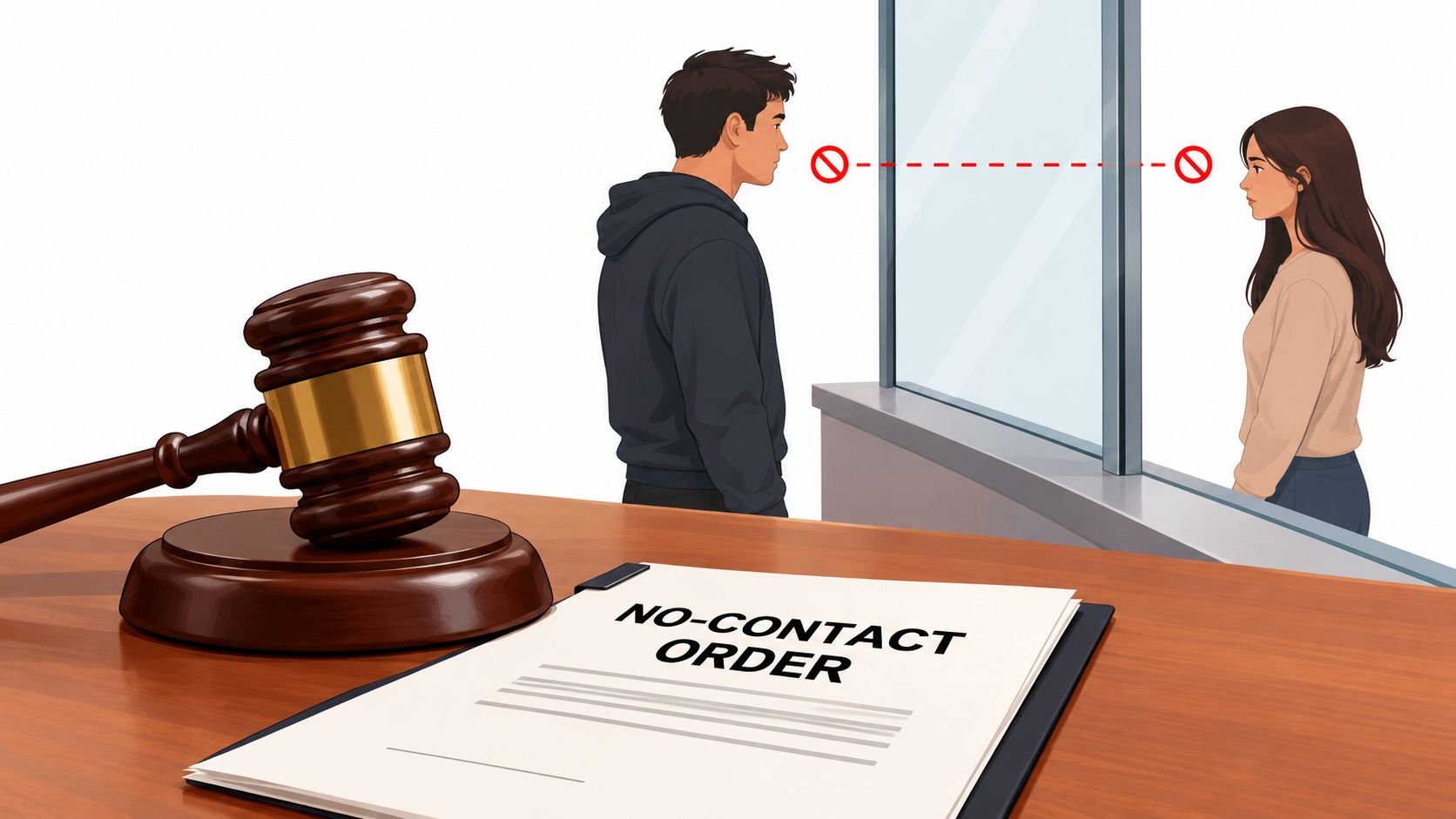
Posting a bond releases someone from custody. It doesn't cancel a protective order, erase a no-contact condition, or give the defendant permission to return to a shared home. In a domestic-violence matter, the court may restrict direct communication, indirect communication through relatives, visits, messages, or contact involving children.
The division of responsibility
A bondsman can verify the bond, complete surety paperwork, submit the bond, and explain the administrative steps connected with release. A bondsman can't modify, interpret, suspend, or cancel a court-imposed protective order. Only the court can change a court order, usually through the proper legal process and with guidance from defense counsel.
Families should avoid treating an informal text message or a private conversation as permission to resume contact. Even if the protected person initiates communication, the defendant may still face consequences for violating the order. The protective-order guide explains why release and protective-order compliance must be handled as separate issues.
A safer first day after release
Keep the release papers, booking documents, and every court notice together. Confirm the next court date and location, and ask defense counsel to explain the exact terms in language everyone understands. If the defendant needs belongings, housing, medication, transportation, or child-related arrangements, handle those needs without violating a no-contact restriction.
A practical checklist includes:
- Read every condition before leaving custody.
- Do not return to a restricted residence without legal guidance.
- Do not use relatives or friends to pass messages.
- Ask counsel about permitted communication and child-exchange procedures.
- Keep proof of court appearances and required check-ins.
The agent can help the family understand the bond obligations, but legal advice about the criminal case and protective orders belongs with defense counsel.
Red Flags and How to Choose a Reliable Newport Beach Bondsman
A legitimate California bail transaction should be explainable before anyone signs. The Department of Insurance requires surety companies to file their rates, and agents representing a surety must charge those filed rates. That makes licensing and written disclosure more useful than a vague promise of “the lowest price.”
Questions to ask before sending money
Ask the agent to confirm:
- Custody location: “Is the person still with Newport Beach Police Department, or has Orange County taken custody?”
- Bail verification: “Who confirmed the amount, and does it reflect the current booking information?”
- Total cost: “What is the premium, what expenses are separate, and what balance remains after the initial payment?”
- Collateral: “Is collateral required, how is it documented, and when is it released?”
- Missed court dates: “What happens if the defendant fails to appear, and how will you notify the co-signer?”
Warning signs that deserve a pause
Be cautious if an agent refuses to provide a written agreement, pressures you to sign before reading it, won't explain collateral, or quotes a price that doesn't match the filed rate. A promise of instant release also deserves scrutiny because booking, bond acceptance, transfer status, and facility processing remain outside the agent's control.
A professional call should leave you knowing where the defendant is, what has been verified, what you owe, what you are guaranteeing, and what the next court obligation is. If the agent can't answer those questions clearly, don't hand over money because the call is urgent.
Putting It All Together and Getting Help Right Now
The two decisions that matter first are where the person is being held and which licensed agent you trust to handle the bond. Newport Beach Police custody, Orange County custody, court review, paperwork, and facility release each operate on their own clock, so no responsible agent should promise a fixed walkout time.
Bada Bing Bail Bonds offers 24-hour service, transparent 10% premiums, payment plans, co-signer options, and collateral solutions for qualifying bonds in Newport Beach, Orange County, and surrounding Southern California. Keep the booking details, payment agreement, court date, and post-release compliance requirements together, because court appearances and check-ins affect the bond until the obligations are complete.
Call Bada Bing Bail Bonds now with the defendant's full name, custody location, booking number, and charges. A licensed agent can verify the bond, explain the paperwork and payment options, and coordinate the next release step without promising what only the court or facility can control.