You’ve probably got the phone in your hand already, half-ready to call, half-dreading what comes next. Maybe it’s 2 a.m., maybe it’s after a fight near Knott’s, or maybe it’s a stop on Beach Boulevard that turned into a night no one in the family expected.
The first thing to know is simple, buena park bail bonds are about speed, but they’re not magic. The court sets the bail amount, the jail controls the booking timeline, and a licensed surety agent helps post the bond so your family doesn’t have to cover the full cash amount up front. California has regulated that structure for decades under the state’s Bail Bond Regulatory Act, and the Department of Insurance treats the filed premium as the benchmark for what you should be charged, not whatever number someone throws out on the phone California Department of Insurance guidance.
Table of Contents
- What Happens in the First Hour After a Buena Park Arrest
- Information to Gather Before You Call Anyone
- How California Sets the Premium You Will Pay
- The Realistic Buena Park Release Timeline
- Special Cases Worth Watching For
- Staying Compliant After Release
- Choosing a Buena Park Bondsman with the Right Judgment
What Happens in the First Hour After a Buena Park Arrest
A family’s first hour is usually part panic, part paperwork, part waiting on information that isn’t available yet. The arrest may have started with a traffic stop, a disturbance call, or a warrant check, but the next steps are usually the same. Someone gets booked, fingerprints are taken, the charge gets logged, and only then does the release conversation start to matter.
The bond is not the same thing as bail
Bail is the amount the court sets. A bond is the commercial promise that a licensed surety makes to the court for that amount, while the customer pays the filed premium instead of paying the whole bail in cash. In California, that premium is most commonly 10% of the total bond, plus actual, necessary, and reasonable transaction expenses, and the surety company must charge the filed rate California Department of Insurance guidance.
That distinction matters because families often think the agency is “setting” the price. It isn’t. The court sets the bail figure, and the agency works within that figure under insurance rules.
Practical rule: If someone says they can lower the court’s bail amount, they’re describing something they can’t control.
The family’s job in that first hour is to get the right details, not to guess at the outcome. A licensed agent can tell you whether a bond is available, what the premium will look like under the filed rate, and what paperwork has to happen next. What the agent cannot do is override the jail, change the court’s number, or promise a same-hour release.
For a person booked in Buena Park, the safest first call is usually to a bail agent who can verify the booking information and explain the next step clearly. If you’re trying to keep your footing while all this is unfolding, start with the basics and keep the conversation factual. A useful local reference for families comparing next steps is what to do when someone gets arrested.
Information to Gather Before You Call Anyone
Most delays start before anyone even signs a form. Families call with the right instinct but the wrong information, and that slows verification because the agent can’t match the person to a booking record. If you can collect the right identifiers up front, you usually cut out a lot of back-and-forth.
The details that matter most
Start with the defendant’s full legal name and date of birth. Add the booking number if you have it, because that’s the cleanest way to match the person to the jail record. Then get the charges and the custody location, even if one of those is still being confirmed.
A booking number is gold because it helps separate the right person from everyone else with a similar name.
If you’re talking to the defendant by phone, ask only for facts they know for sure. Don’t guess at the charge, don’t round off the date of birth, and don’t assume the custody location is the same place where the arrest happened. Buena Park arrests may move through county facilities, so the pickup location can be different from the street where the arrest started.
Here’s a simple working checklist you can copy during the call.
| Information | Why It Matters | Required or Optional |
|---|---|---|
| Full legal name | Matches the booking record | Required |
| Date of birth | Confirms identity | Required |
| Booking number | Speeds exact verification | Required if available |
| Charges | Helps confirm bail eligibility | Required if available |
| Custody location | Tells the agent where to post | Required |
| Arrest time | Helps estimate booking stage | Optional |
| Jail phone update | Confirms if bail is posted yet | Optional |
| Family contact number | Lets the agent update you | Optional |
If the charge is still being confirmed, say that plainly. A good agent can work with incomplete information, but they need to know what’s verified and what isn’t. That’s also why the jail’s automated line matters, because it can fill in the gaps before anyone starts promising a timeline they can’t control.
For a quick reminder of the first steps families should take, keep this arrest response guide handy while you’re making calls.
How California Sets the Premium You Will Pay
California uses a regulated bail premium, not a free-form quote. The Department of Insurance says the customer cost is most commonly 10% of the total bond, plus actual, necessary, and reasonable transaction expenses, and surety companies must file their rates with the state California Department of Insurance guidance. A straight answer on the premium is a basic sign the agency knows the rules.
The math families need
If the court sets bail at $25,000, the common premium would be $2,500 before any legally permitted expenses. If bail is $50,000, the common premium would be $5,000 before those expenses. Those are the numbers families should budget around, because that is how the filed rate works in California.
Payment plans, co-signers, and collateral can still come up. For larger bonds, some agencies may ask for more documentation or security because the risk is higher, but the premium itself still follows the filed rate. If someone says they can beat the legal premium, that is a warning sign.
Good sign: the agent explains the premium, any permitted expenses, and any collateral terms in plain English before asking for signatures.
Families should also separate the premium from any payment arrangement. The premium is the regulated cost. A payment plan only changes how that amount gets paid, and the agency should spell out every term tied to it.
For a clearer look at how the quote is built, read how bond pricing works. That is the money conversation families need, open and plain.
The Realistic Buena Park Release Timeline
A 24/7 answer line doesn’t mean a 24/7 release. That’s the part families need to hear early, because the jail controls the actual release window, not the person answering the phone. Orange County Sheriff guidance says bail information may take roughly 2 to 6 hours after booking, and the average bail-or-bond release takes about 4 hours, with a range of 2 to 6 hours Orange County Sheriff FAQ.
What actually slows the clock
The release process usually moves through a chain of steps. Fingerprinting and booking have to finish first, then classification and paperwork review, then bond acceptance, then jail processing, then transport if needed, then medical clearance, then a release window that depends on workload and shift timing.
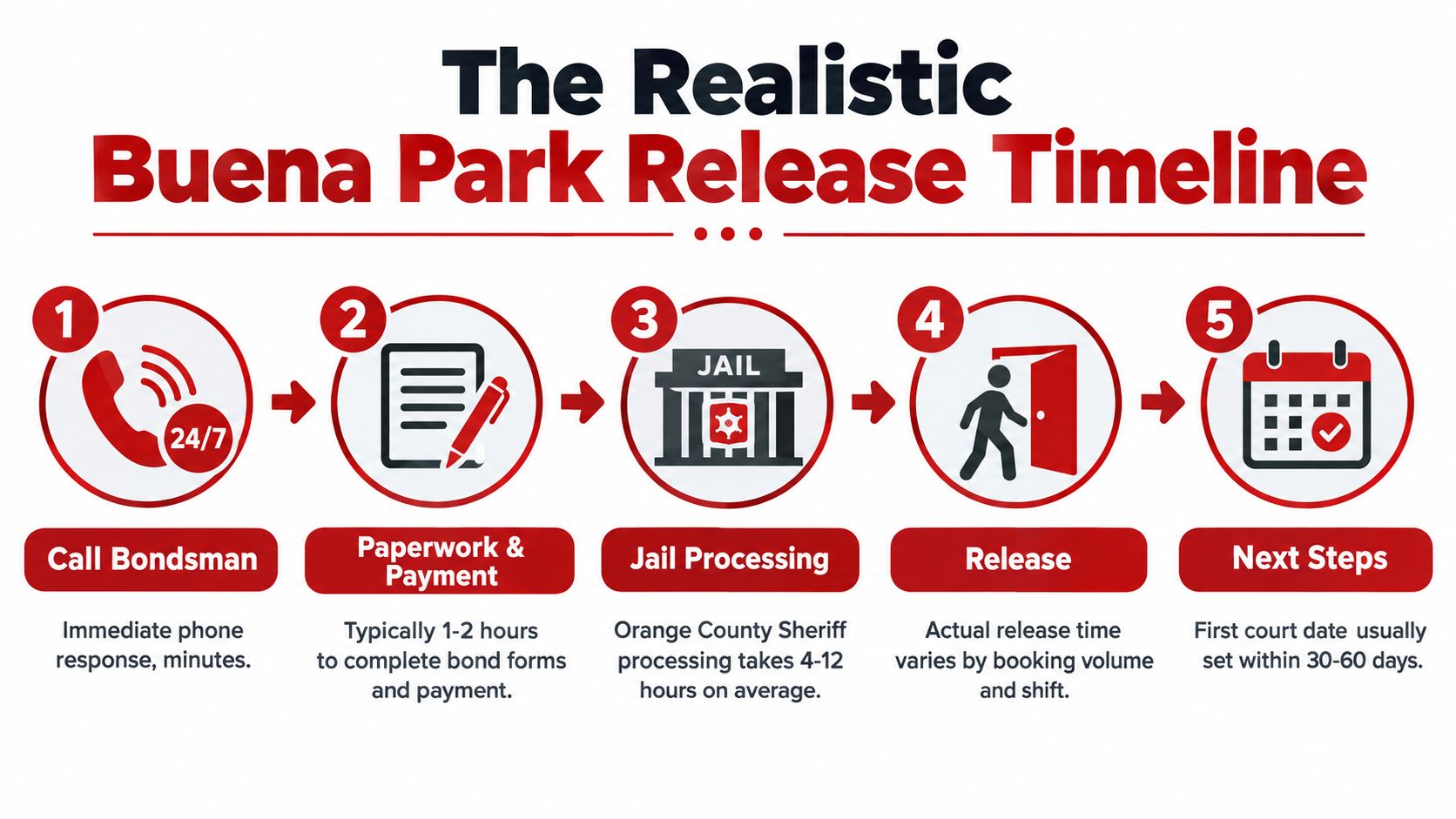
A midnight call can absolutely start the process, but it doesn’t erase the jail’s queue. In Buena Park cases, the person may end up in an Orange County facility rather than a local holding cell, so the family has to think in terms of custody location, not just where the arrest happened. That’s why release coordination feels slower than the phone call itself.
For families trying to picture the path, the sequence is usually this:
- Call and verify, the agent confirms the booking details and premium.
- Sign and pay, the bond paperwork is completed.
- Post the bond, the agency delivers the surety or payment as required.
- Jail processing continues, staff finish release steps on their timeline.
- The person walks out, once the facility clears the release.
If you need facility-specific help, the Orange County Intake Release Center information page is worth checking so you’re not assuming the wrong jail handles the release. And if you’re comparing timing across custody settings, a practical guide to bond release for ICE detainees is a useful way to see how different detention systems control different clocks.
Special Cases Worth Watching For
Not every arrest follows the same path. Some cases move through the system quickly once the paperwork is complete, while others need a court decision, a hold check, or attorney input before a bond even makes sense. Families save time when they sort the case correctly instead of assuming every arrest is a standard bond situation.
When the answer isn’t just “post bail”
A DUI arrest can come with release conditions that affect driving, treatment, or ignition-related requirements after release. A domestic violence case can trigger no-contact conditions that are fully enforceable, not optional advice. A warrant can lead to a hold that changes where the person is processed, and a probation violation can raise the stakes or change the release path entirely.
California also has a pre-arraignment limit that matters in serious or violent cases. A California Law Revision Commission memorandum says pre-arraignment release generally can’t occur through a method other than the scheduled bail amount or own-recognizance release until an open-court hearing, typically arraignment California Law Revision Commission memorandum. That means the family may not be able to solve the problem with money alone.
A simple comparison helps:
- Routine booking with set bail, a bond may be available once the jail posts the amount.
- Own-recognizance possibility, no premium may be needed if the court allows release without cash or bond.
- Hold, warrant, or serious-charge review, the family may need to wait for court action before any release option exists.
If the person is still before arraignment and the charge category is serious or violent, don’t assume a commercial bond will fix it instantly. Ask the jail, the court, or defense counsel whether there’s a hold, a warrant issue, or a hearing requirement. That question can save a family from paying a premium when the case isn’t bondable yet.
Staying Compliant After Release
The bond isn’t really finished when the door opens. It’s finished when the person keeps every court date and follows every release condition the court imposes. California’s pretrial research points to a practical reality, reminders matter, because court reminders can reduce failure-to-appear rates, and the Judicial Council’s analysis of more than 422,000 defendants across 17 superior courts found measurable changes in pretrial outcomes California Judicial Council news release.
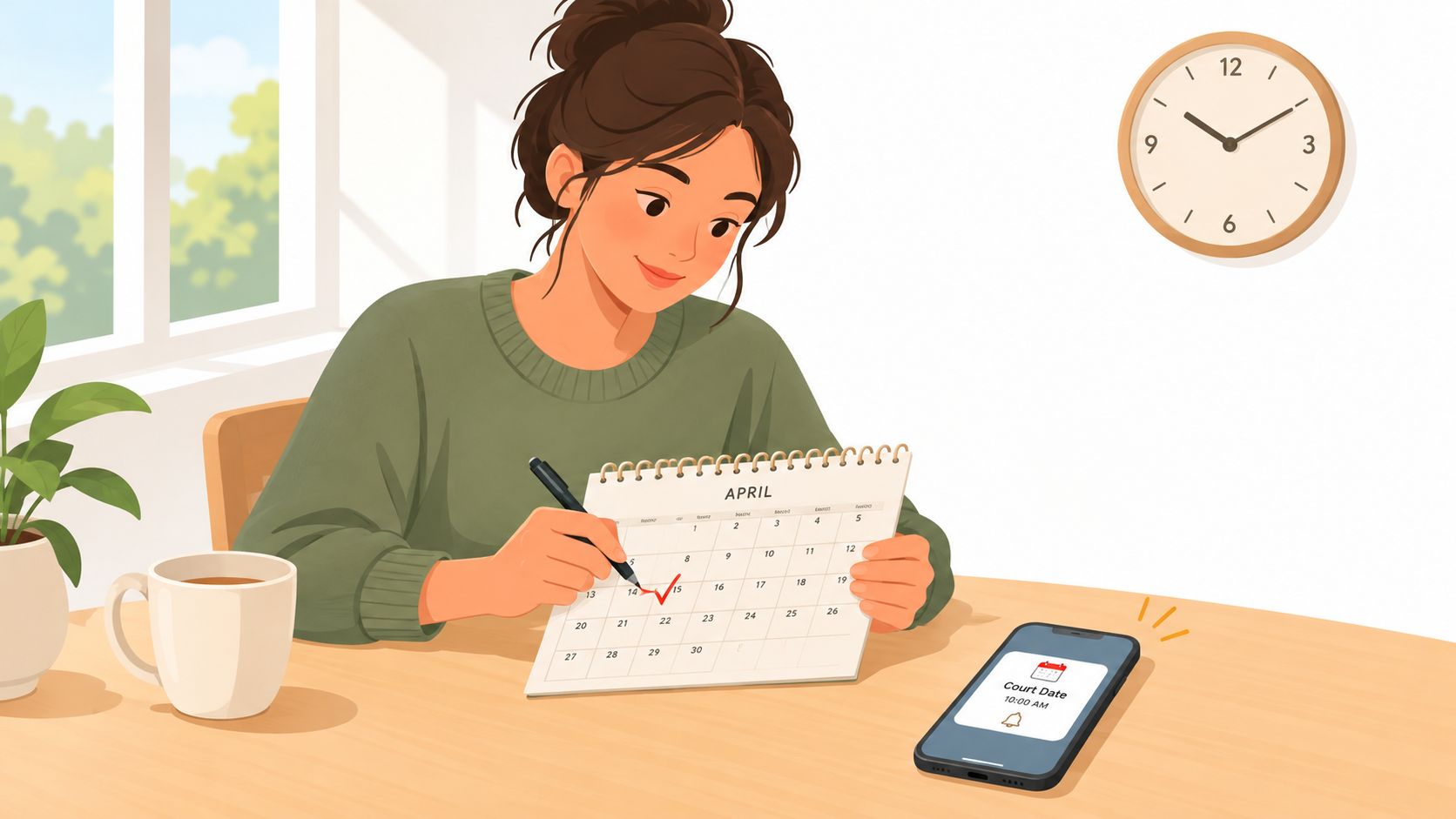
A good post-release routine is blunt and simple. Write down every court date before leaving custody, get the conditions in plain English, set both phone and text reminders, confirm who’s driving, and update the bail agent if the address changes. In domestic violence cases, no-contact orders are enforceable. In DUI cases, driving restrictions, treatment terms, and equipment requirements are part of the release picture, not side notes.
Here’s the working rule I give families: if it matters to the court, treat it like a deadline. Don’t leave it in one phone, one memory, or one person’s head.
The jail release might feel like the finish line, but compliance starts the same day. A responsible agent can help with reminders and communication, but legal advice still belongs with counsel or the court. That line matters because no one wants a missed date to turn a hard day into a worse one.
Choosing a Buena Park Bondsman with the Right Judgment
At 2 a.m., speed gets the attention, but judgment decides whether the call helps. The person who answers should know how Orange County custody works, should explain the premium without hedging, and should be willing to say when a bond isn’t the right answer yet. That honesty matters more than a flashy promise.
What to verify before you sign
A real 24/7 agent should answer questions directly, not send you into a maze of callbacks. The contract should spell out the premium, any collateral terms, and how communication will work while the case is open. If someone rushes you past the paperwork, that’s a sign to slow down, not speed up.
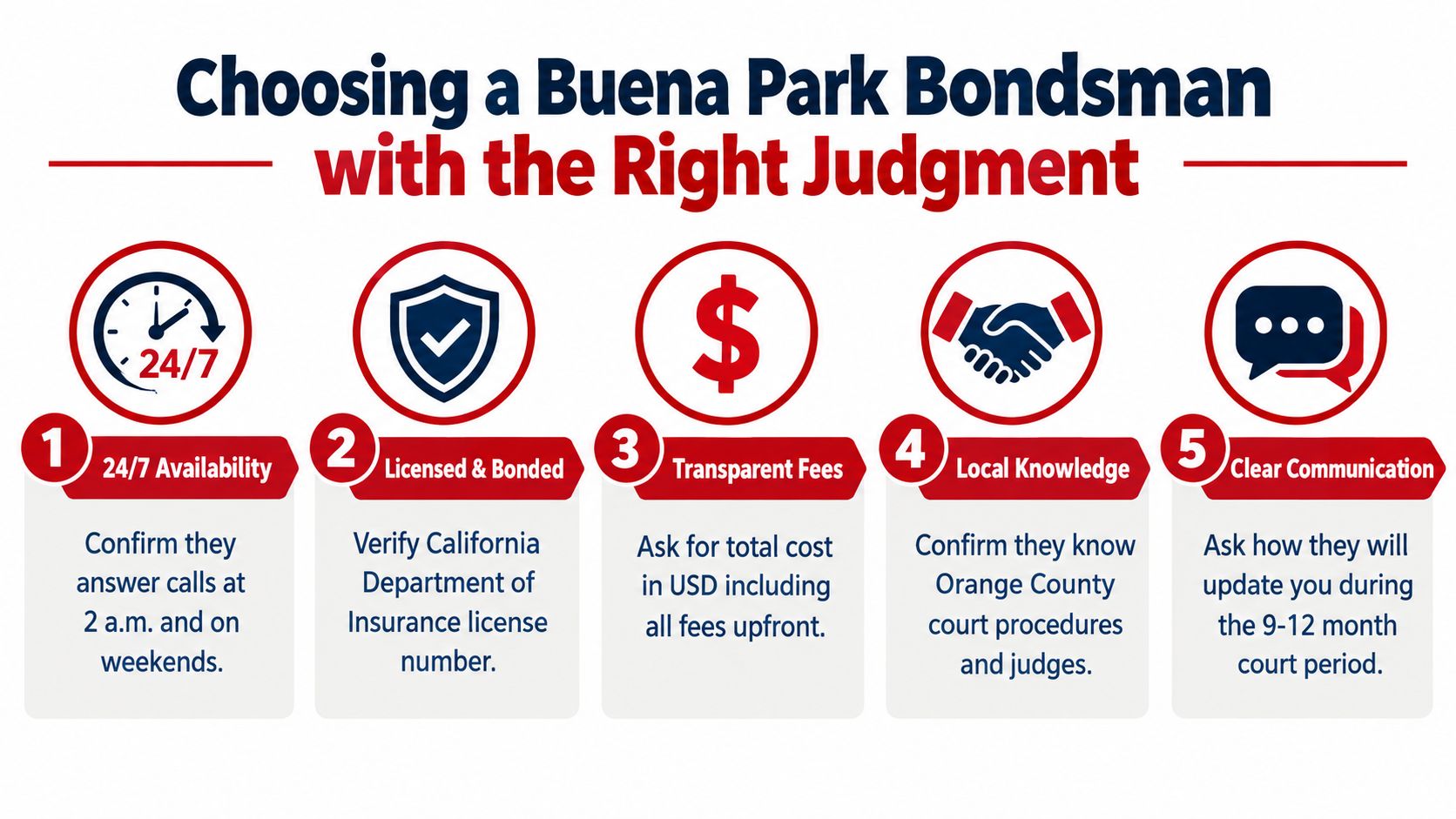
For a practical checklist, use the basics:
- 24/7 Availability, confirm someone answers at night and on weekends.
- Licensed & Bonded, ask for the California Department of Insurance license number.
- Transparent Fees, get the total cost in writing before you commit.
- Local Knowledge, make sure they understand Orange County jail and court procedures.
- Clear Communication, ask how updates will happen until the case closes.
A family should also be cautious about vague promises of discounts or instant release. Those phrases can sound reassuring in the moment, but they don’t tell you who controls the jail queue, who sets the bail, or how the bond terms are written. The better question is whether the agent’s judgment matches the stress level of the case.
If you want a plain explanation of what the agent does, this guide to a bail bond agent is a helpful place to start. It’ll give you a better read on the person you’re about to trust.
If you need a team that answers quickly, explains the numbers plainly, and stays with you through the court dates that follow, Bada Bing Bail Bonds can help you through the process with clear communication and steady judgment. Visit the site, make the call, and get real support from people who understand how these cases work in California.