You've probably heard the popular advice. Find someone in your vacant house, call the police, and they'll be gone that afternoon. Or the opposite warning, wait too long and the person inside owns your home.
Both versions mislead worried owners. California law separates two very different questions. One is ownership, which turns on a demanding doctrine called adverse possession. The other is removal, which is urgent, procedural, and handled by a court when possession is disputed.
If you're asking What are squatter rights in California, start by sorting those questions apart. The answer changes based on what the occupant claims, what paperwork exists, and whether anyone ever gave permission.
Table of Contents
- The Squatter Myth Most Owners Believe
- How Adverse Possession Actually Works in California
- The Five-Year Tax Rule That Changes Everything
- Three Types of Occupants and What Each One Means
- How California Property Owners Remove an Occupant Legally
- Self-Help Mistakes That Make the Problem Worse
- Preventing Squatters Before They Ever Set Foot on Your Property
- Your 48-Hour Decision Checklist as a California Owner
The Squatter Myth Most Owners Believe
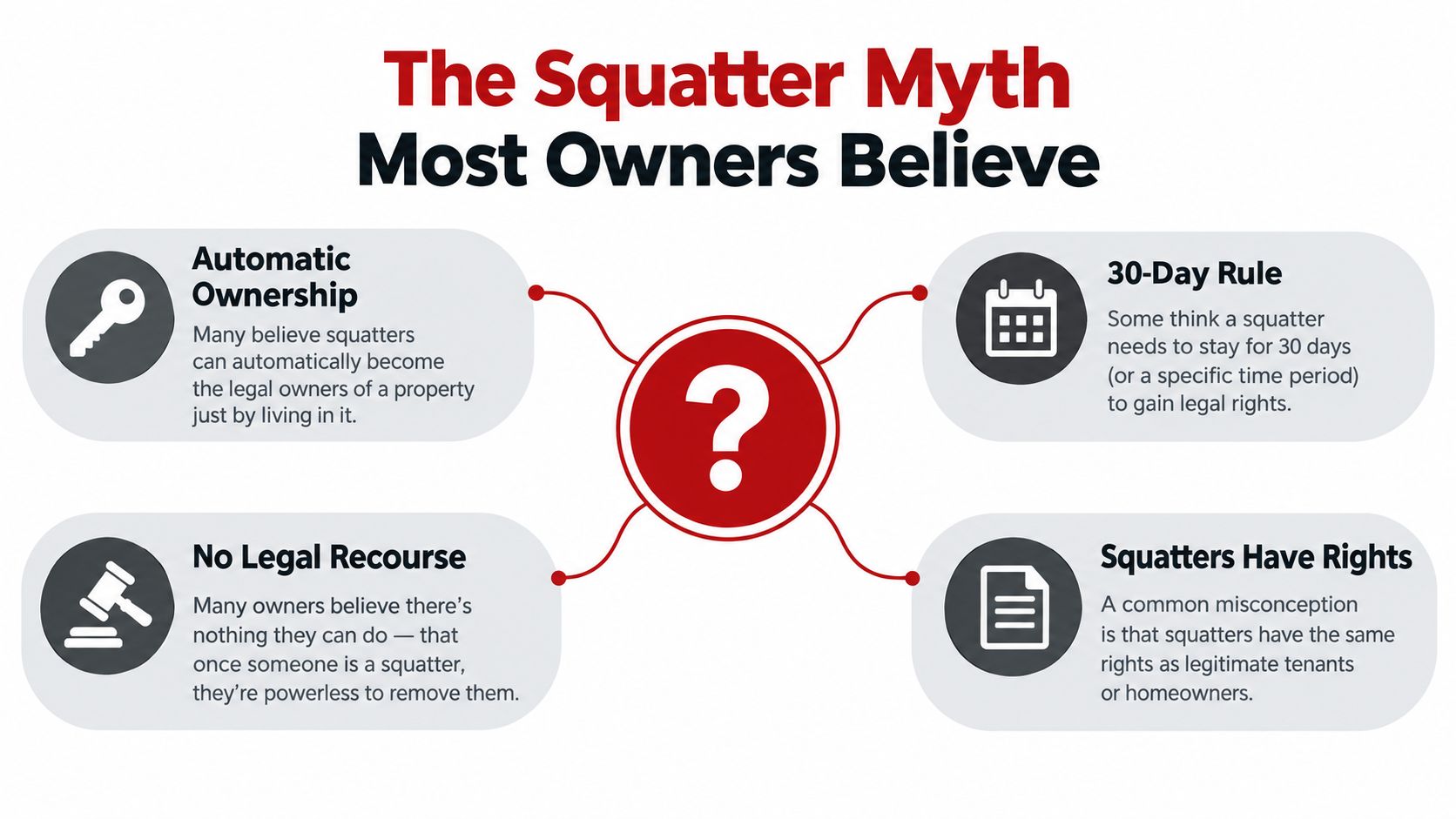
The viral version goes like this. A stranger moves into an empty home, changes the locks, gets mail delivered, stays 30 days, and somehow becomes the owner. California doesn't work that way.
California does not give a person ownership merely because they occupy an empty home or remain there for 30 days. Changing a lock, receiving mail, or maintaining the premises doesn't automatically create ownership or a legal right to stay. Those facts may matter in a removal dispute, but they're not a deed.
Why the Myth Persists
Social media compresses three ideas into one scary phrase. Possession means someone is physically there. Tenancy means someone may claim a legal right to be there under an agreement. Adverse possession is a narrow path to seek title after strict statutory conditions are met over years, not days.
Confusing those buckets leads owners to panic about the wrong risk. Most owners facing a stranger in a Ventura rental or an inherited home in Oxnard don't have an ownership emergency on day one. They have a removal problem, an evidence problem, and a question about which legal process fits.
Practical rule: Don't ask first whether the occupant owns your house. Ask what they're claiming, what proof they have, and what proof you can preserve today.
What California Law Actually Frames
The phrase squatter's rights is a nickname, not a free pass to occupy property. The underlying ownership doctrine requires a continuous claim for years and payment of property taxes, among other conditions. Failure to prove even one required condition defeats the claim.
Owners who want a broader landlord focused overview can compare this framing with a landlord guide to squatter laws, then return to the California statute for the controlling test. That comparison helps because general explainers often blend state rules together. California has its own demanding elements, and those elements decide whether an ownership claim is even plausible.
For a homeowner, an inheritor, or a landlord with a vacant unit, the calm starting point is simple. No calendar trick transfers title. The work is identifying the occupant's category and choosing a lawful path to recover possession.
How Adverse Possession Actually Works in California
Think of adverse possession as a finish line with several gates. An occupant doesn't win by passing one gate. They must pass every gate, in order, for the full period the statute requires.
The image below maps those gates before we walk through them in plain English.
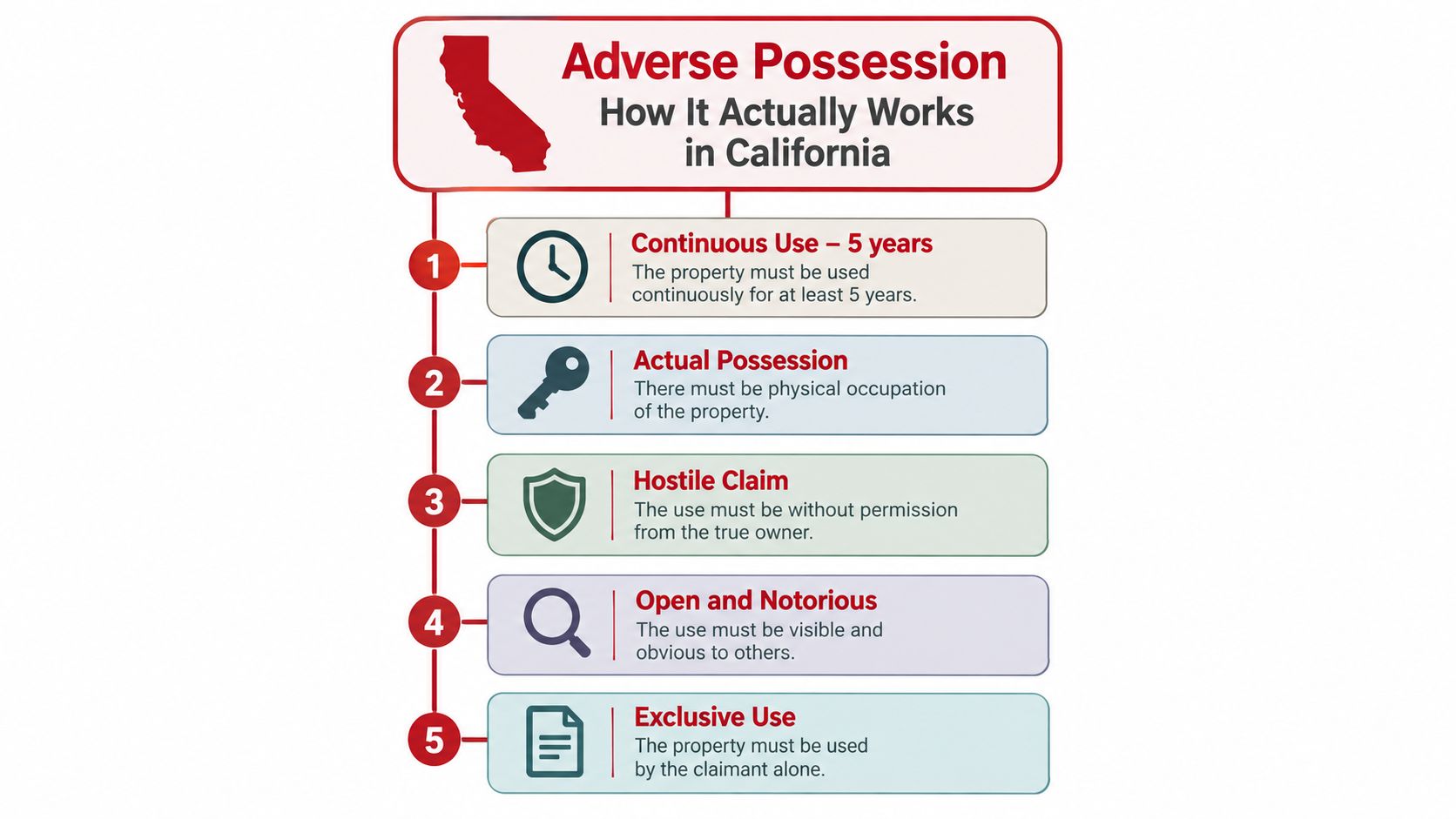
Under California Code of Civil Procedure section 325 on adverse possession, a claimant generally must show possession and a claim to the land for five continuous years, together with timely payment of all state, county, and municipal property taxes assessed during that period. The California Board of Equalization summary in the verified materials lists five cumulative requirements, and each one has a purpose.
The Five Elements in Plain English
- Claim of right or color of title: The person possesses the land as if claiming it, not as a guest who asked to crash for a weekend.
- Actual, open, and notorious possession: The use is real and visible enough to give reasonable notice to the record owner. Hiding in a back room doesn't fit.
- Exclusive and hostile possession: The occupant controls the property against the owner's title, rather than sharing it with the owner or occupying with permission.
- Continuous for at least five years: The possession continues without interruption for the statutory period. Coming and going like a seasonal visitor undermines continuity.
- Payment of all taxes: The occupant pays the taxes levied during that same period, proven through certified county records.
Hostile confuses readers because it doesn't mean angry or threatening. In this setting, it means possession that's adverse to the owner's title and not based on permission. A helpful analogy is a runner who takes over a lane and treats it as their own without ever asking the track owner for entry. If the owner handed them a pass, the run isn't hostile in the legal sense.
This short video walkthrough can help you hear the elements described as a connected test rather than isolated terms.
Permissive occupancy changes the analysis. If someone lived there as a tenant, a guest, or under an informal family arrangement, that permission generally undermines hostility. The case may still involve removal, but it isn't a strong adverse possession case.
That's why people who describe themselves as squatters often won't meet the test. They may be present, they may even be difficult to remove quickly, but presence alone isn't title. Courts look for the full combination, including notice, exclusivity, continuity, claim, and taxes.
The Five-Year Tax Rule That Changes Everything
Tax payment is the requirement many short explainers rush past. In California, it's central. An occupant must pay all state, county, and municipal property taxes assessed during the five year period, and those payments must be proven through certified records from the county tax collector.
That proof rule matters because it creates an objective paper trail. A claimant can't rely only on saying, I lived there, I fixed things, everyone saw me. The county record either supports timely tax payment or it doesn't.
Two Scenarios Owners Understand Quickly
Consider an occupant in Camarillo who paints a fence, mows the lawn, and keeps the house tidy. That care may help show actual and visible possession. If the occupant didn't pay the property taxes for the full period, or can't prove payment with certified records, the statutory test still fails.
Now consider an owner of an empty lot near Santa Paula who keeps paying the taxes and keeps those records. Occasional passersby, parked vehicles, or short unauthorized use don't become ownership because land sits vacant. The tax history and the absence of continuous exclusive possession point the other way.
Paying a utility bill isn't the same as paying property taxes. The statute focuses on taxes assessed against the property, proven through the tax collector.
The table below separates common claims from what the statute counts.
Adverse Possession Requirements in California
| Element | What Counts | What Does Not Count |
|---|---|---|
| Claim of right | Possession asserted as a claim to the land | Staying as a guest or tenant with permission |
| Open and notorious | Visible use giving reasonable notice to the owner | Secret or concealed occupancy |
| Exclusive and hostile | Sole control adverse to the owner's title | Sharing control with the owner or occupying by consent |
| Continuous period | Uninterrupted possession for the required period | Sporadic visits or interrupted occupancy |
| Tax payment | Timely payment of all assessed taxes with certified records | Paying utilities, doing repairs, or receiving mail |
Owners should preserve title records, tax payment history, utility information, notices, and communications. Those documents help a court see who treated the property as theirs in the ways the statute measures. Owners should also avoid words or conduct that could be read as granting permission after a dispute begins.
If an occupant stopped paying taxes, or never paid them, that gap is not a minor detail. It's a missing gate. And in adverse possession, one missing gate defeats the entire claim.
Three Types of Occupants and What Each One Means
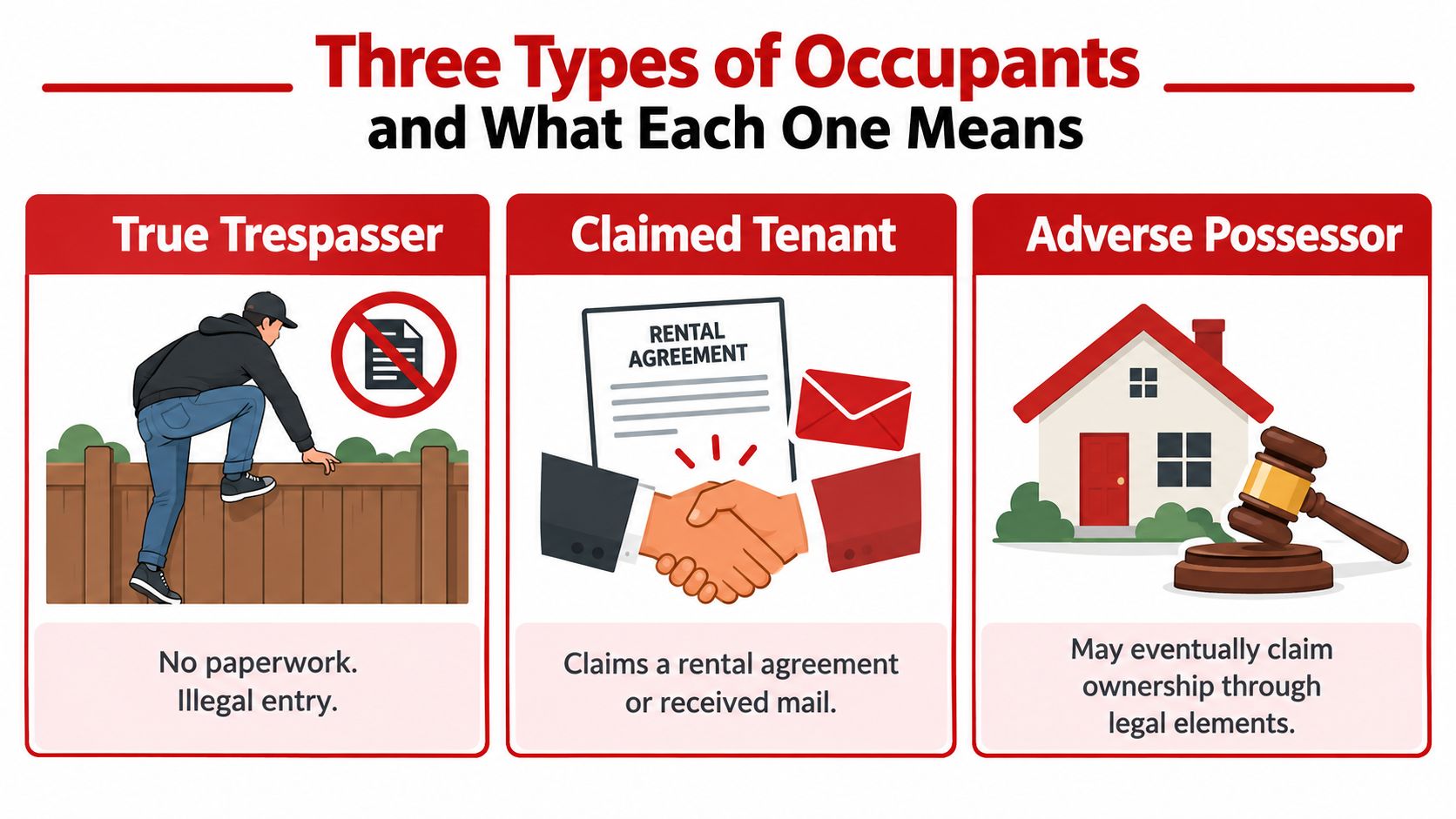
A lock changed overnight can mean three different legal problems. Start with what the occupant claims, because California routes a no-permission intruder, a disputed renter, and a former guest down different tracks.
Ask Three Questions Before You Choose a Track
Who entered, and did anyone ever say yes? If the facts point to forced or secret entry with no lease, no rent history, and no permission, treat it first as a trespass and document the entry before contacting law enforcement, especially where safety or suspected burglary is involved.
If the person answers with paperwork, mail, rent receipts, an old lease, or a story about paying for the room, the dispute may belong in civil court even when the story sounds false. California courts describe unlawful detainer as the civil case used to recover possession from someone occupying without a legal right, and typical cases require written notice before filing, according to Sutter County Superior Court guidance on unlawful detainer. A badge at the door usually cannot settle a paper-based possession claim.
The third path begins with permission that later ran out: a tenant holding over, a relative who stayed after an agreement ended, or a guest whose weekend became months. Past consent matters twice, since it undercuts hostility for adverse possession and it changes the notice an owner may need.
When the facts are still muddy, freeze the record instead of guessing. Save texts, leases, payment screenshots, utility accounts, camera footage, and title papers, then decide whether the next call is police, a notice, or counsel. Forced entry in places such as Port Hueneme or Thousand Oaks can create a separate criminal question, so some owners read the California burglary statute explained in plain English to understand why a police report and a possession case can move at different speeds.
Mislabeling is where owners lose ground. Calling a claimed tenancy a simple trespass invites the wrong notice or an unlawful lockout, while treating obvious forced entry like a landlord dispute burns time that could document the break-in.
How California Property Owners Remove an Occupant Legally
A Ventura owner flies home from a work trip and finds a stranger living in the guest house. The first instinct is a locksmith and a deadline. That instinct is how owners end up sitting on the defendant's side of the courtroom.
Lawful removal works like a relay race. The owner runs the first leg, the court runs the middle legs, and only the sheriff finishes. Skip a handoff and the race is void, no matter how obvious the trespass looks.
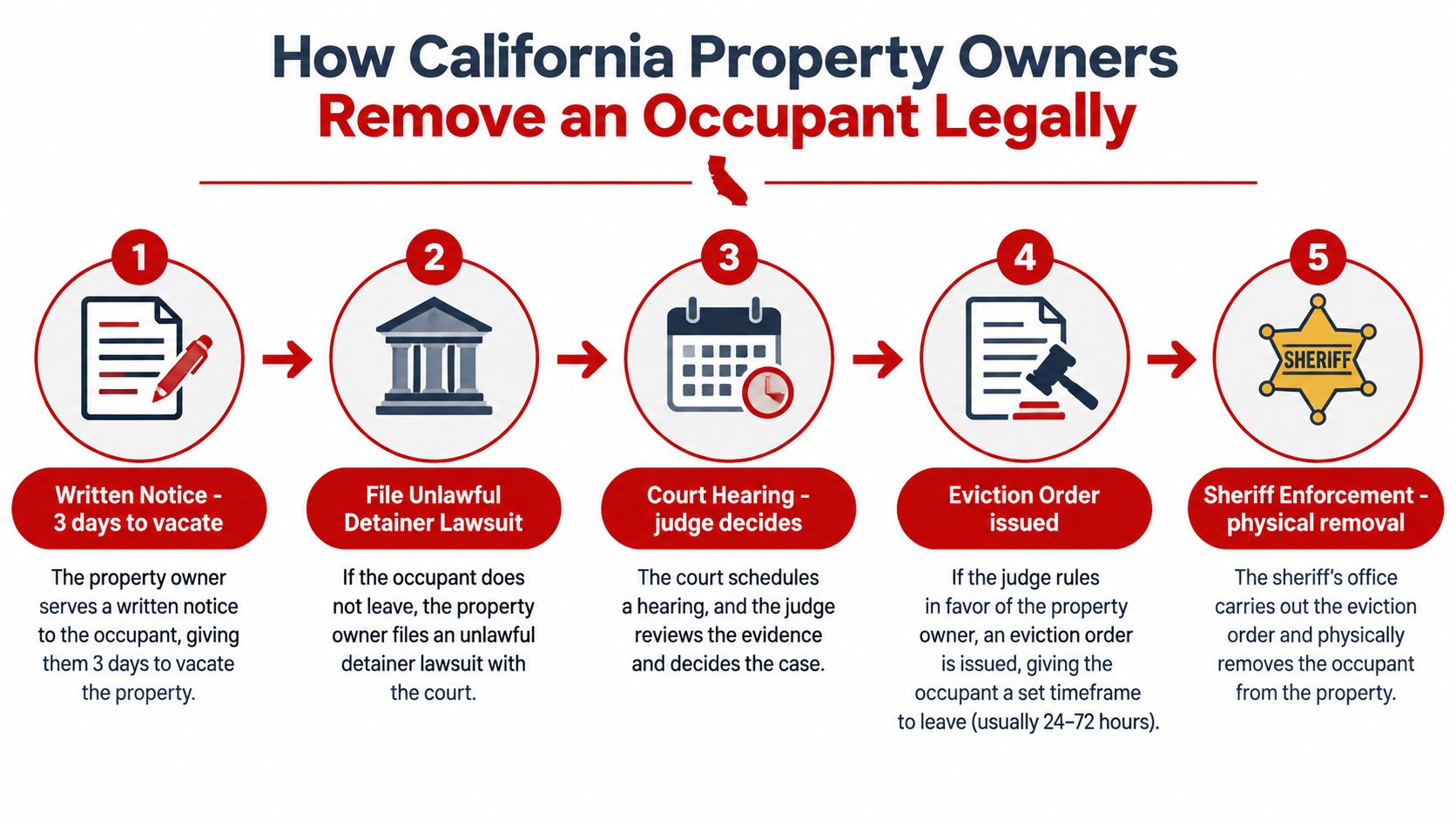
Leg one is notice. The owner serves a written notice matched to what the occupant claims, then waits out the full notice period. Generic online forms are risky because the wrong notice restarts the clock from zero.
Leg two is the case itself. If the occupant stays after the notice expires, the owner files an unlawful detainer and serves it properly. Response deadlines vary by court description, with some materials stating five days to answer and others stating ten business days after personal service, according to San Francisco Superior Court eviction self help guidance.
Leg three belongs to the sheriff. A winning owner receives judgment and a writ of possession, and the sheriff or marshal carries out enforcement. One California court description notes the sheriff may post a notice to vacate with five days before physical removal. The owner never performs the removal personally, even when the occupant looks like a textbook squatter. The court decides whether a tenancy or possession claim is legally valid.
Which leg even exists depends on what the occupant claims. Documented forced entry may belong on a police report rather than a notice, while a claimed lease or history of payments pushes everything onto the notice track.
Local procedure controls how fast legs two and three move. Ventura County owners can orient themselves with our overview of the Ventura County court system, then confirm filing, service, and sheriff details for their specific case. Owners comparing notice and filing steps can also find eviction requirements for landlords as general background, though California and county rules still control.
Court counters run on business hours. The Ventura Superior Court Criminal and Traffic Department at 800 South Victoria Avenue, Ventura, California 93009 lists walk up payment windows Monday through Friday from 8:00 a.m. to 4:30 p.m., excluding holidays, and (805) 289-8545 for criminal and traffic information, per Ventura Superior Court criminal and traffic information. Families searching for 24-hour bail bonds Ventura or Ventura County Jail bail bonds after a related arrest in Ventura, Oxnard, Moorpark, Fillmore, Ojai, or Santa Barbara sometimes assume court counters keep the same hours as jails. They do not. A squatter dispute that turns criminal can touch all three systems at once, and each one answers the phone on its own schedule.
Self-Help Mistakes That Make the Problem Worse
An owner in Oxnard drives past a vacant property, notices the occupant's car is gone, and swaps the deadbolt in twenty minutes. It feels like reclaiming what is already theirs. By the end of the week, the occupant is describing that afternoon to a lawyer, and the owner's clean possession case now shares a file with an illegal lockout claim.
That impulse is understandable. It is also expensive. California authorities treat lock changes, utility shutoffs, physical removal, and dumping someone's belongings as a self-help eviction, and the California Attorney General's housing resources describe the lawful route differently: unlawful detainer, judgment, writ, then sheriff enforcement. Every shortcut at the property hands the occupant something they did not have before, which is their own claim.
Each move below solves the visible problem while creating a second legal one:
| What the owner does | What the occupant gains |
|---|---|
| Changes locks or removes a door | An illegal lockout claim, even with a weak possession story |
| Shuts off water, power, or gas | Evidence of coercion they can raise in court |
| Confronts or threatens the occupant | A doorway dispute that can escalate into criminal allegations or injuries |
| Hauls belongings to the curb | A property damage dispute and control over a narrative the owner can no longer verify |
| Blocks movement or holds someone in place | Detention questions that pull focus from the real estate dispute entirely |
That last row deserves a slower look. An owner who blocks a doorway, stands between an occupant and the exit, or holds someone until police arrive is stepping into territory our overview of false imprisonment under California law explains in detail. Reading it before any in-person encounter is the cheaper version of the lesson.
Then comes the consequence owners almost never price in. When a confrontation in Oxnard, Ventura, or Thousand Oaks produces an arrest of an owner, an occupant, or a family member, relatives start searching for bail bonds Ventura, bail bonds Oxnard, or bail bonds Thousand Oaks before the house question is anywhere near resolved. Bail amounts are not guessed at the jail window. Ventura County's bail schedule sets presumptive amounts by offense, directs users to check the felony schedule before the misdemeanor schedule, and sets a minimum of $10,000 for an out-of-county hold when no amount was previously established, per the Ventura Superior Court 2024 bail schedule. The court lists (805) 289-8521 for bail schedule questions, and booking records, charge classification, and warrant status all need verification before anyone assumes a standard figure for Ventura County bail bonds.
So photograph the damage from a safe distance. Save every communication. Write down dates. Then let counsel and the sheriff carry out the steps that require legal authority, because a fraudulent possession claim never licenses a separate wrong of your own.
Preventing Squatters Before They Ever Set Foot on Your Property
Prevention works best in layers. No single sign, camera, or lock makes a vacant property invisible. Combined habits make unauthorized entry harder, discovery faster, and your paper trail stronger if a dispute ever reaches court.
Start With Visibility and Access
Keep the property visibly maintained. Trim landscaping, collect flyers, forward or hold mail, and use timed lighting so the home doesn't advertise vacancy. Secure every entry point after tenants, contractors, or guests leave, and don't assume a side gate or garage door is a minor weakness.
Schedule regular checks. If you live far from a property in Santa Barbara, Moorpark, or Ojai, ask a trusted neighbor, house sitter, or licensed property manager to document visits with dated photos. Early discovery matters because the occupant category is easier to establish before mail, utilities, and conflicting stories accumulate.
- Cameras with offsite storage: Footage helps show entry, timing, and who accessed the property.
- Neighbor communication: Neighbors often notice unfamiliar vehicles or broken windows before an absentee owner does.
- Posted boundaries: Clear no trespassing signage supports the message that entry isn't permitted.
- Prompt repairs: Boarding a broken window quickly reduces both safety risk and repeat entry.
Paper Habits That Prevent Confusion
Use written leases for tenants and written guest agreements for extended stays. State who may occupy the property, when permission ends, and that permission doesn't transfer to other people. Keep tax receipts, title documents, insurance records, utility accounts, and contractor invoices in one file you can hand to an attorney.
Safety planning sometimes overlaps with prevention. If a former guest, estranged family member, or threatening occupant is involved, owners may need to understand types of restraining orders in California in addition to property remedies. A restraining order addresses personal safety and contact, while unlawful detainer addresses possession, so the tools serve different purposes.
Traffic and court deposit rules offer a small but useful analogy for paper discipline. Ventura court materials state that contesting certain traffic matters by mail requires a written not guilty plea and the total amount of bail owed, and a trial by written declaration likewise requires the total bail amount and proper forms, per Ventura Superior Court frequently asked questions. Posting that amount doesn't resolve the charge by itself. Courts care about correct forms, deadlines, and complete submissions, whether the issue is a traffic deposit or a possession case. Families asking common bail questions should apply the same lesson. Partial paperwork creates delay.
The cheapest layer is attention. A maintained, lit, checked property tells a casual trespasser to keep walking. It also tells a court, if needed, that the owner never abandoned control.
Your 48-Hour Decision Checklist as a California Owner
When you first suspect unauthorized occupancy, don't try to solve ownership, removal, safety, and court procedure in one doorway conversation. Use the first two days to classify, document, and get advice.
- Classify the occupant: True trespasser, claimed tenant, former tenant or guest, or unknown.
- Document without confrontation: Save photos, video, texts, mail evidence, utility records, title documents, and tax payment history.
- Avoid self-help: No lock changes, utility shutoffs, threats, physical removal, or disposal of belongings.
- Match contact to facts: Call law enforcement for emergencies, suspected criminal conduct, or clear unauthorized entry with no possession claim.
- Prepare for court if possession is disputed: Ask a California real estate attorney about notice, unlawful detainer, and local filing steps before serving anything.
- Track deadlines early: If a related criminal or court matter emerges, learn how to schedule a court date and confirm county specific instructions rather than relying on memory.
That checklist won't remove someone by itself. It will keep you from damaging the removal case while you choose the right legal lane.
If a property dispute escalates into an arrest in Ventura County or nearby Santa Barbara and Southern California communities, Bada Bing Bail Bonds offers licensed, around the clock help verifying booking details, explaining bail schedules and costs in plain English, and coordinating release paperwork with local jails. When your family needs clear answers fast about Ventura County bail bonds, visit Bada Bing Bail Bonds to connect with a local agent who can walk you through the next step.