A family member calls at 2 a.m. after an arrest, and the first question is usually simple: “What do we have to put up?” In Ventura County, that answer may involve more than the premium paid to a bail bond agent. A home, vehicle, savings account, jewelry, or another valuable asset may be requested as bail bond collateral, especially when the bond amount is substantial or the agent needs additional security.
Collateral can help a loved one leave the Ventura County Pre-Trial Detention facility while the case continues, but it also creates a serious financial obligation. Before pledging anything, you should understand what the asset secures, how its value is determined, what paperwork you’ll sign, and how its release works after the bond is discharged.
Table of Contents
- What Bail Bond Collateral Actually Is and Why It Gets Requested
- Common Assets Families Pledge in California
- How a Bondsman Values the Asset You Want to Pledge
- Paperwork and Process When You Pledge Collateral
- Risks, Forfeiture, and When Collateral Is the Wrong Choice
- Getting Your Collateral Back After the Case Ends
- Making the Right Call for a Ventura County Case
What Bail Bond Collateral Actually Is and Why It Gets Requested
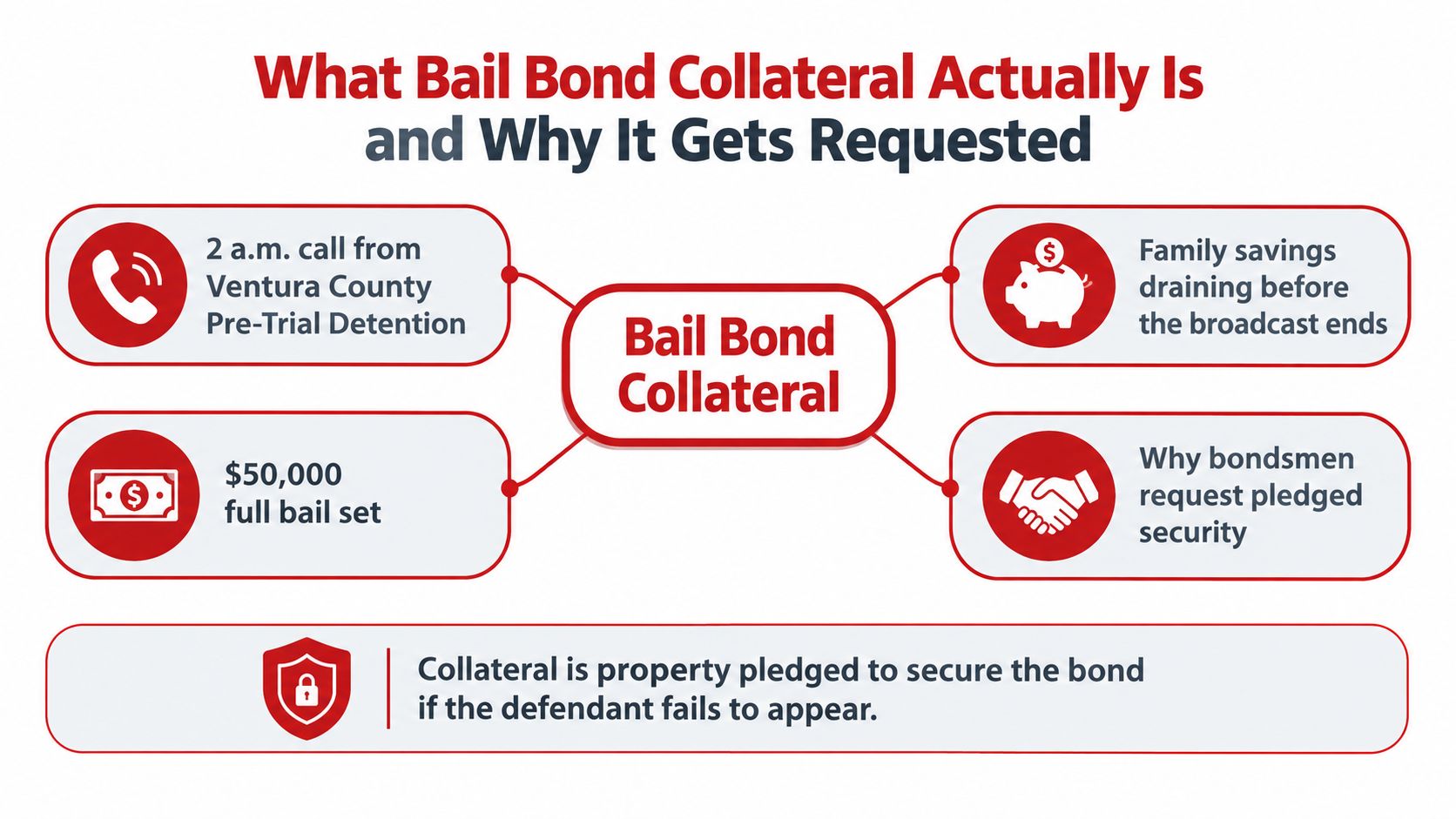
At 2 a.m., a family may hear that bail has been set at $50,000 and realize that paying the entire amount directly to the court isn’t realistic. They may watch their available savings disappear before they’ve even spoken with a lawyer. A licensed bail agent can post a bond for the defendant, but the agent may ask the family to pledge an asset as an additional safeguard.
Collateral is separate from the premium. The premium is the charge for arranging and maintaining the bond. In California, the consumer cost is most commonly 10% of the total bond amount, plus actual, necessary, and reasonable transaction expenses, according to the California Department of Insurance explanation of bail bonds. On a $50,000 bond, the 10% figure would be $5,000, but the exact transaction should always be explained in writing.
Collateral serves a different purpose. It’s property pledged to help protect the surety if the defendant fails to appear and the bond is forfeited. The New York Department of Financial Services describes collateral as cash, property, a home deed, or another asset given to a bail agent, and explains that collateral should be reasonable, such as 10% of the bond amount in the example provided by that agency’s consumer guidance. Read the California bail bond process overview before signing, because the premium and the collateral obligation are not interchangeable.
Two different financial exposures
The premium generally isn’t returned after the bond is posted. Collateral is conditional. If the defendant attends required court proceedings and the bond is discharged, the pledged property should be released according to the agreement and applicable rules.
That distinction matters to a family in Ventura, Oxnard, Camarillo, or Thousand Oaks. You’re not just paying for a service. You’re also giving the agent a legal interest in an asset that could be used to address a forfeited bond.
Practical rule: Never pledge an asset until you know exactly what happens if the defendant misses court, who can sign for its release, and what document proves the lien has ended.
The rest of the decision turns on the asset itself. Real estate, vehicles, cash accounts, jewelry, and investment property each require different ownership records and valuation methods. A careful agent should explain those requirements before anyone signs under pressure.
Common Assets Families Pledge in California
The strongest collateral usually has three characteristics: clear ownership, verifiable value, and a practical way to sell or recover it if the bond is forfeited. Families seeking Ventura County bail bonds often start with the asset that can be documented most quickly.
Real estate
A homeowner in Oxnard may offer equity in a residence. The agent will need ownership records and information about existing loans or liens. If the property qualifies, the owner may sign a deed of trust or another security document that gives the surety a recorded interest.
A home with substantial equity can be useful, but a family shouldn’t assume that owning a house automatically makes it acceptable. Co-owners, unresolved probate, bankruptcy concerns, tax liens, and an outstanding mortgage can prevent approval or reduce the usable value.
If foreclosure or property disposition is already a concern, families may benefit from reviewing general California foreclosure sale help before placing a residence at risk. That information doesn’t replace advice about the bail agreement, but it can help explain why a recorded lien deserves careful attention.
Vehicles
A vehicle may qualify when the signer has a clean title and can prove ownership. A lender’s lien, salvage history, missing title, or disputed ownership can make the vehicle difficult for a surety to accept. A leased vehicle generally isn’t the signer’s asset to pledge.
A family in Santa Paula might have a paid-off vehicle but still need to provide the title, registration, identification, and information about its condition. The agent may also consider whether the vehicle can be sold efficiently if the bond is forfeited.
Cash and accounts
Cash, savings accounts, and certificates of deposit can be easier to verify than personal property. The account holder may need to provide recent statements, identify every owner, and sign an authorization or hold-harmless agreement. An account owned by a relative who won’t participate doesn’t solve the collateral problem.
Jewelry and valuables
Jewelry, precious metals, collectibles, and similar items require more than a verbal estimate. Serial numbers, photographs, purchase records, and an appraisal can help establish identity and value. Retail replacement cost isn’t the same as quick-sale value, so an agent may credit only part of an appraisal.
Other property
Some arrangements may involve investment accounts, business receivables, or other valuable property. Acceptance depends on ownership, liquidity, documentation, and the surety’s underwriting rules. Rental furniture, leased cars, property owned by a non-participating relative, and anything without clean title paperwork almost never provides dependable security.
| Asset Type | Ownership Proof Needed | Typical Acceptance |
|---|---|---|
| Real estate | Deed, title information, lien details, and signatures from required owners | Considered when equity and ownership are verifiable |
| Vehicle | Certificate of title, registration, lender information, and owner identification | Considered when title is clear and the vehicle has usable resale value |
| Bank account or CD | Account statements, account ownership records, and authorization documents | Considered when funds are available and all owners cooperate |
| Jewelry or precious metals | Appraisal, photographs, serial numbers, and purchase or ownership records | Considered when identity and resale value can be established |
| Investment or business asset | Account statements, contracts, and proof of authority to pledge the asset | Reviewed individually because liquidity and control vary |
How a Bondsman Values the Asset You Want to Pledge
A bail agent doesn’t value collateral by asking what the asset originally cost. The relevant question is how much dependable value remains after debts, ownership problems, sale costs, and market uncertainty are considered.
Real estate equity
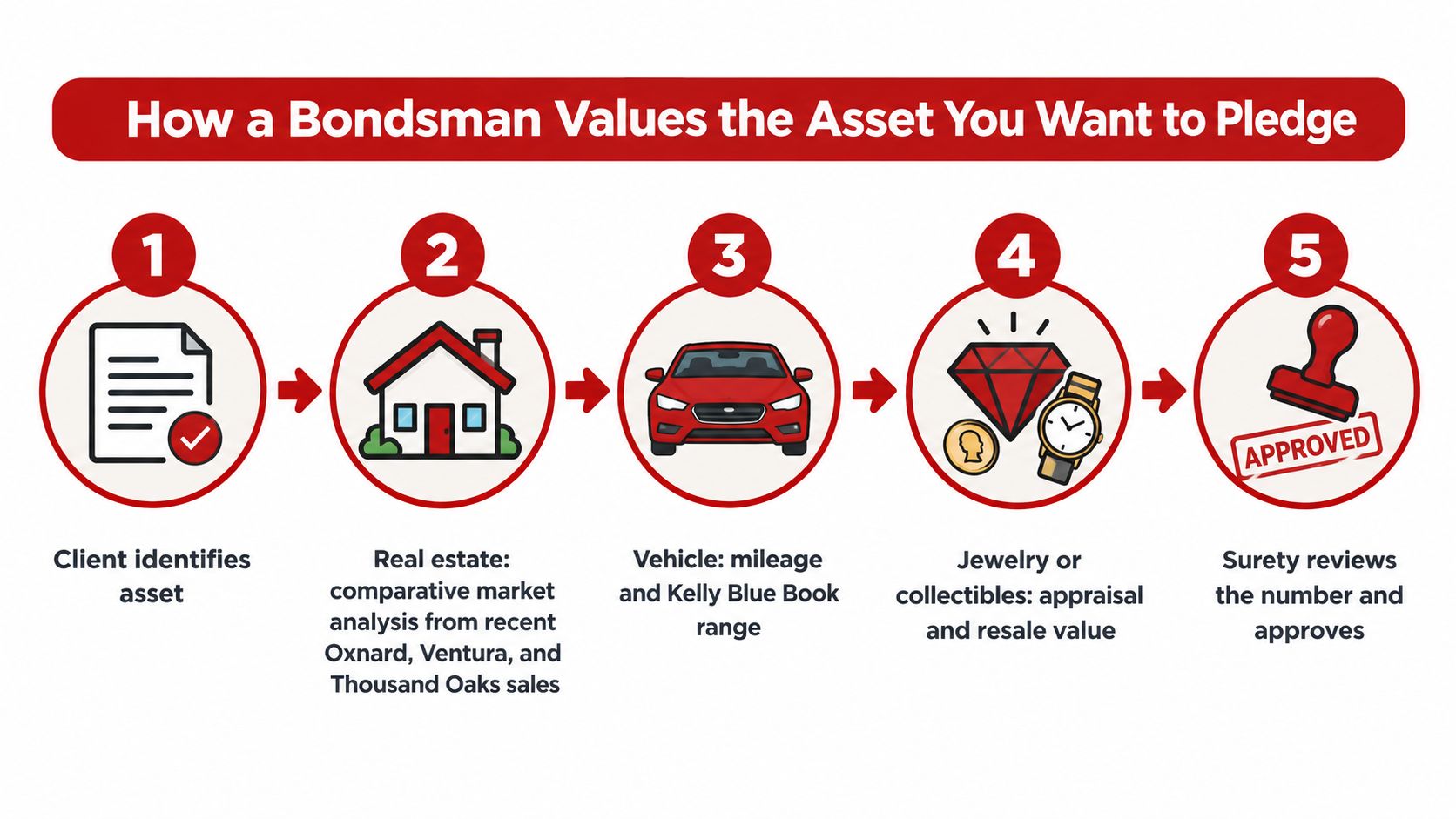
For a home in Ventura, Oxnard, or Thousand Oaks, the agent may review comparable sales, current market information, the recorded mortgage balance, and other liens. The usable figure is based on equity, not the property’s full market price. A home valued favorably on paper may still fail review if a lender’s balance consumes most of the equity or another owner refuses to sign.
A surety also needs to know whether the security document can be properly recorded. Clear title and cooperation from every required owner may matter more than an optimistic estimate of the home’s value.
Vehicles and personal property
Vehicle valuation usually begins with a recognized private-party market range, then adjusts for mileage, condition, accidents, title history, unpaid loans, and demand. A costly aftermarket stereo may matter to the owner but add little resale value. Families can prepare by gathering title records and learning how to prove your car’s true worth with documentation rather than relying on an informal estimate.
Jewelry is treated differently. An appraiser may identify the piece, weigh its materials, examine its condition, photograph it, and estimate a resale amount. Insurance replacement value often exceeds what a buyer would pay quickly, so the agent may apply a conservative figure.
Ownership can end the review
An asset can look valuable and still be unusable. Co-owners may need to sign. A bankruptcy filing may restrict transfer. A lien may leave too little equity. The account or title may belong to someone who isn’t willing to become part of the agreement.
Ask for the calculation: What value did the agent assign, what debt was deducted, and what documents support the final collateral figure?
The guide to getting collateral can help families organize documents before contacting an agent. Preparation won’t guarantee approval, but it can reveal ownership problems before everyone is waiting on a release decision.
Paperwork and Process When You Pledge Collateral
A collateral transaction should never rest on a handshake or a promise that someone will “just hold the pink slip.” The family needs a written record showing what was pledged, who owns it, what the bond covers, and what happens after discharge.
The signing sequence
A typical appointment may begin with identification and a bail bond application. Each signer should understand whether they’re acting as an indemnitor, property owner, co-signer, or another responsible party. The premium agreement then addresses the charge for the bond and any permitted transaction expenses.
The collateral document is separate. For real estate, it may be a deed of trust or another recorded security instrument. For a vehicle, it may identify the title and authorize a lien. For money in an account, it may describe the hold, withdrawal authority, and release conditions.
A W-9 may also be requested for reporting and identification purposes. Don’t sign a blank form or leave property descriptions incomplete. The bail bond requirements checklist can help you gather identification and ownership documents before the appointment.
What the packet should answer
The paperwork should make these points clear:
- Asset identity: The document should describe the property precisely, including a vehicle identification number, account information, or a legal property description where applicable.
- Ownership: Every person whose signature is required should be identified and should understand the obligation.
- Security interest: The agreement should explain whether a lien, deed of trust, pledge, or other interest is being created.
- Release condition: The family should know what document or notice starts the return process after the bond is discharged.
- Storage and custody: Physical property should have a written receipt and a stated location. Louisiana rules provide an example of regulated handling, requiring written collateral agreements, separate custody, fiduciary treatment, and receipts identifying the property and estimating non-cash value. Louisiana’s collateral regulation illustrates why detailed records matter.
Keep a complete copy of every signed page, receipt, title document, and payment record. Write down the bond number, the agent’s license information, the office contact details, and the steps for obtaining a release or reconveyance.
Risks, Forfeiture, and When Collateral Is the Wrong Choice
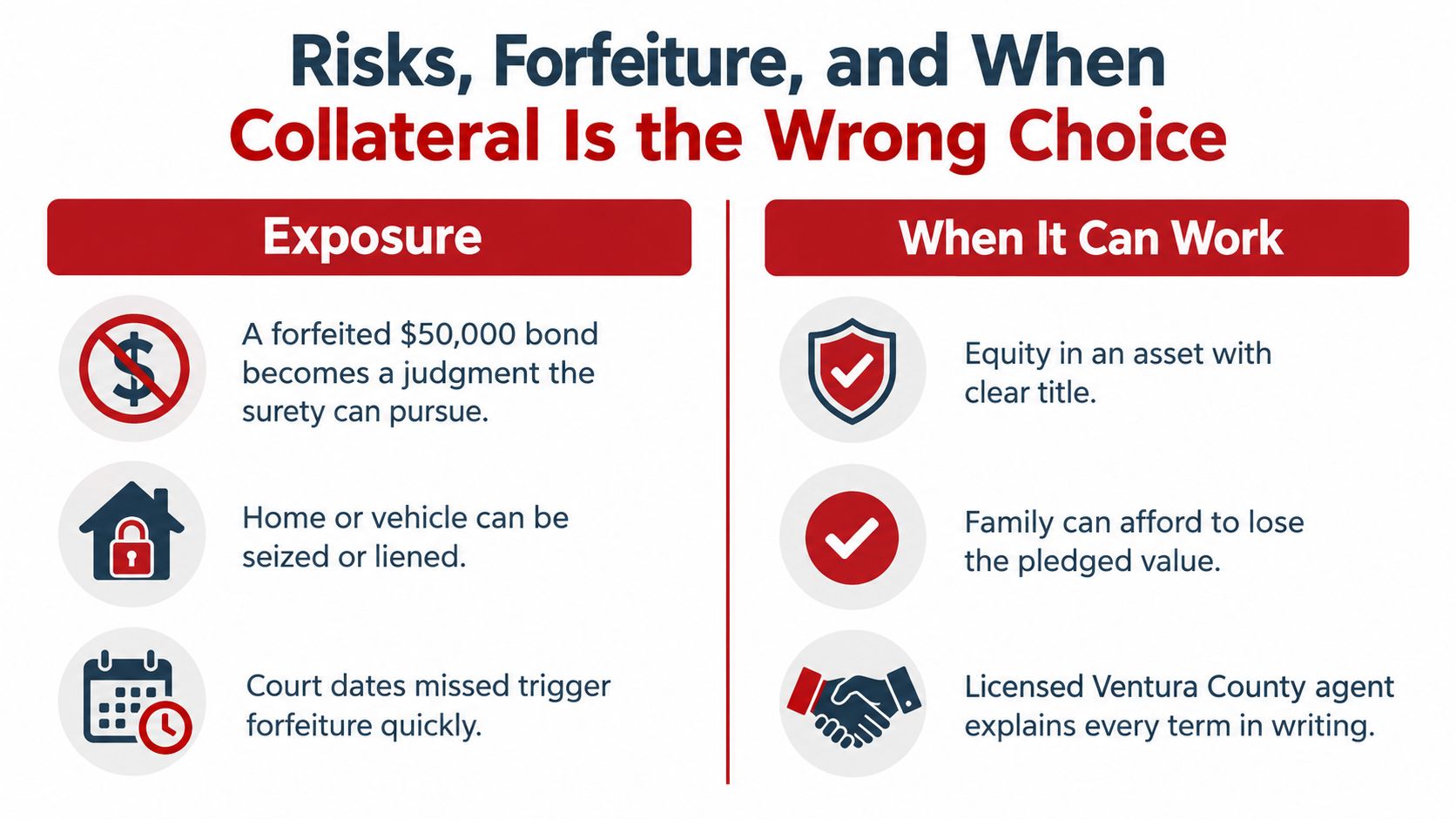
Pledging a house or vehicle changes the consequences of a missed court date. If a hypothetical $50,000 bond is forfeited, the surety may pursue the obligation against pledged property under the signed agreement and applicable law. The family could face a lien, repossession, sale, or foreclosure risk instead of merely losing the premium.
The defendant’s release also comes with continuing duties. Court appearances, communication with the agent, and compliance with release conditions are not optional. A missed appearance can lead to a warrant and a forfeiture process, while the surety may take steps to protect its financial position.
When collateral creates too much exposure
Collateral may be the wrong choice when the pledged asset is the family’s only home, when the defendant has a history of missing court, or when no one can reliably monitor upcoming hearings. It’s also a poor fit when the owner doesn’t understand the documents or would be unable to absorb the loss of the asset’s equity.
Consider these questions before signing:
- Can the family withstand the loss? If losing the asset would threaten housing, transportation, or essential savings, look for another structure.
- Is the defendant dependable? A strong history of appearing and staying in contact supports a more measured risk assessment.
- Is ownership clean? Disputed title or reluctant co-owners create danger without providing dependable security.
- Has every term been explained? If the agent won’t explain forfeiture, release, or lien procedures in writing, stop before pledging property.
A stronger indemnitor with verifiable income may reduce the need for property collateral. A payment arrangement may also be available, but its terms must be documented and understood. Don’t assume a lower upfront payment makes the overall obligation smaller.
A sound decision leaves the family with a way to recover if the case becomes difficult. If the only way to post bail is to risk the family home without a reliable compliance plan, that option deserves serious reconsideration.
Read about what bail forfeiture means before you decide. The goal isn’t merely to get someone out of custody. It’s to do so without creating an avoidable crisis for everyone who signs.
Getting Your Collateral Back After the Case Ends
“Collateral returned” doesn’t always mean the asset is physically handed back that same day. The bond must first be discharged or exonerated, and the agent must complete the steps needed to release a lien, return a title, reconvey a deed of trust, or release held funds.
At the end of a Ventura County case, the family should confirm the outcome with the court and the bail agent. A dismissal, acquittal, sentencing, or another final resolution may affect the bond status, but the paperwork still needs to show that the surety’s liability has ended.
What the family should request
Ask for written confirmation of the bond’s discharge and keep copies of every release document. Then request the specific action tied to the asset:
- Real estate: A reconveyance or other document showing that the recorded security interest has been released.
- Vehicle: The returned title or lien-release documentation.
- Bank funds: Written confirmation that the hold has been removed and the money is available.
- Jewelry or valuables: A signed receipt confirming the items were returned in the recorded condition.
State rules show why timing can’t be assumed. Minnesota consumer guidance requires cash collateral to be deposited within 7 business days and returned within 21 days after proof that the bond was discharged, as described by the New York Department of Financial Services bail guidance. Florida guidance says collateral should be returned within 21 days after the agent is notified of discharge, while Idaho guidance provides a 14-day return period after notice. Those rules apply to their respective jurisdictions, not automatically to every California transaction, but they demonstrate why the written agreement and local requirements matter.
If the agent delays
Start with a written request that identifies the defendant, bond number, collateral, discharge date, and exact release document needed. Give the agent copies of the court or surety confirmation and keep proof that your request was delivered.
If the response is unclear or the delay continues, ask the agent to identify the remaining issue in writing. You can also contact the California Department of Insurance and submit a written complaint, particularly if the agent won’t account for the collateral or explain the delay.
The meaning of bail exoneration is important here. Exoneration means the bond obligation has ended, but the family should still verify that every related lien and custody record has been closed.
Making the Right Call for a Ventura County Case
Start with facts, not assumptions. Confirm the current booking and bail information through the Ventura County Sheriff’s Office, then check the official Ventura County posting bail instructions. Bail may be posted at the Pre-Trial Detention facility at 800 South Victoria Avenue in Ventura, and the Sheriff identifies cashier’s checks payable to the Ventura County Superior Court as an accepted method. The Sheriff also provides an online or phone option through GovPayNet, including a payment line and PLC number.
The Ventura County Superior Court maintains an official fee and bail schedule framework. That schedule and the actual case circumstances should guide the conversation, not an estimate from a friend or an old online post.
A practical decision filter
Use this order:
- Confirm the bond amount and facility. This matters for families searching for Ventura County Jail bail bonds, bail bonds Ventura, or 24-hour bail bonds Ventura because release logistics depend on the actual booking and facility process.
- Separate the premium from collateral. California’s commonly used premium figure is 10% of the total bond amount, as explained earlier by the California Department of Insurance. Don’t treat collateral as another fee. It’s a conditional security interest.
- Compare available structures. Ask whether a qualified co-signer, a documented payment arrangement, or an asset pledge fits the family’s finances. Never assume a payment percentage or approval condition without a written quote.
- Test the collateral against the worst outcome. If the defendant misses court, could the family lose the home, vehicle, savings, or jewelry? If the answer is yes and the family has no backup, reconsider.
- Plan for return before posting. Ask what notice the agent needs after discharge, who files the release, where documents are recorded, and how the family will receive confirmation.
The same approach applies whether the call comes from Oxnard, Port Hueneme, Camarillo, Thousand Oaks, Moorpark, Fillmore, Ojai, Santa Paula, Ventura, or Santa Barbara. Local knowledge helps with the jail and court process, but careful collateral decisions still come down to ownership, value, compliance, and written terms.
Bada Bing Bail Bonds offers 24/7 assistance with Ventura County bail bonds, payment plans, co-signer options, and collateral arrangements for qualifying larger or higher-risk bonds. Visit Bada Bing Bail Bonds to discuss the available options, required documents, and the steps for protecting your pledged property through discharge.