A revoked bail bond can be reinstated in California, but the window to act is narrow. Under Penal Code §1305, the surety typically has a statutory window from the date the court clerk mails the notice of forfeiture to bring the defendant before the court or file for relief. Miss that window, and the forfeiture converts to a money judgment against the co-signer and any collateral pledged.
The clock starts the moment the clerk enters the forfeiture in the court’s permanent minutes and mails the required notice to the surety. Before that entry happens, a judge may still have discretion to reinstate bail on the spot if the defendant appears, with no formal motion required. Once the entry is made and notice is mailed, you are in the formal statutory period and every day counts.
Immediate steps to take right now:
- Call your bail agent. They need to know immediately so they can begin locating the defendant and pulling the court minutes.
- Confirm whether the forfeiture has been entered in the permanent minutes. This determines whether you are in the oral-reinstatement window or the formal 180-day period.
- Locate the bench warrant number and the case number from the court clerk.
- Contact a criminal defense attorney, especially if the defendant is out of state or in custody elsewhere.
- Gather any documentation explaining the missed appearance: medical records, travel records, proof of custody in another jurisdiction.
Pro Tip: If the defendant can appear in court the same day the appearance was missed, ask the bail agent to contact the court immediately. A judge who has not yet signed the forfeiture order into the minutes may reinstate bail on the spot without any formal motion.
Key Takeaways
In California, bail bond reinstatement is possible within the statutory 180-day recovery window under PC §1305, but every day of delay reduces your options and increases co-signer financial exposure.
| Point | Details |
|---|---|
| The statutory clock | Starts from the date the clerk mails the forfeiture notice, not the missed court date. |
| Same-day action | If the defendant appears before the clerk enters the forfeiture in the minutes, a judge may reinstate bail immediately without a formal motion. |
| Filing requirements | The surety or defense counsel must file under PC §1305, serve the DA, and appear at a noticed hearing with supporting documentation. |
| Co-signer risk | If the window expires without relief, the court enters a summary judgment and the indemnitor’s collateral can be seized for the full bail amount. |
| Badabingbail | Serves Ventura, Santa Barbara, and Orange Counties 24/7, retrieves court documents, and coordinates reinstatement filings for families under deadline pressure. |
Table of Contents
- What is a motion to reinstate a bail bond?
- How long do you have to reinstate a bail bond in California?
- Step-by-step process to seek bail bond reinstatement
- What happens at a reinstatement hearing?
- Possible outcomes and what each means for you
- How a local licensed bail agent can help with reinstatement
- What to do immediately after learning a bond was revoked
- Why acting fast in local California courts changes everything
- Bada Bing Bail Bonds is available right now to help you act
- Sources
What is a motion to reinstate a bail bond?
A motion to reinstate a bail bond is a formal legal request asking the court to undo a forfeiture and restore the bond to its original active status. It is filed under California Penal Code §1305 and is typically brought by the surety (the bail bond company) or by defense counsel on the defendant’s behalf.
Understanding how this differs from related terms matters, because courts treat each one differently:
- Reinstatement: The forfeiture is vacated and the bond is restored. The surety remains on the hook for the original bail amount if the defendant fails to appear again.
- Exoneration: The court releases the surety’s obligation entirely, usually because the defendant’s nonappearance was excused or the case resolved. Exoneration removes the financial obligation whereas reinstatement keeps it active.
- Forfeiture: The court declares the bond forfeited when the defendant misses a required appearance. This begins the statutory clock.
- Recall or quash of a bench warrant: A separate action under PC §978.5 that cancels the arrest warrant. Recalling the warrant does not automatically reinstate the bond, though the two actions often happen together.
Who can file matters too. The surety or its licensed bail agent has standing to file a motion to vacate forfeiture and reinstate the bond. Defense counsel can file on the defendant’s behalf. The defendant acting alone, without counsel, rarely succeeds because the procedural requirements under PC §1305 are specific.
Timing determines the procedural path. If the clerk has not yet entered the forfeiture in the permanent minutes, a judge may reinstate bail without formal notice to the surety. Appellate case law confirms that this discretion depends entirely on whether the clerk’s entry and mailing of notice have occurred. Once those steps are complete, the formal noticed-hearing process applies.
Pro Tip: Ask the court clerk specifically whether the forfeiture has been “entered in the permanent minutes” and whether the notice was mailed. Those two facts determine which legal path you are on.
How long do you have to reinstate a bail bond in California?
Speed is the single most important factor in bail bond reinstatement. California law sets a statutory recovery window under PC §1305 that runs roughly 180 days from the date the clerk mails the notice of forfeiture to the surety. Some practice guides cite 185 days to account for the five-day mailing presumption under California law. Either way, the window is finite and courts enforce it strictly.

Here is how the timeline breaks down in practice:
Day 0: Defendant misses the court appearance. The judge orders forfeiture orally.
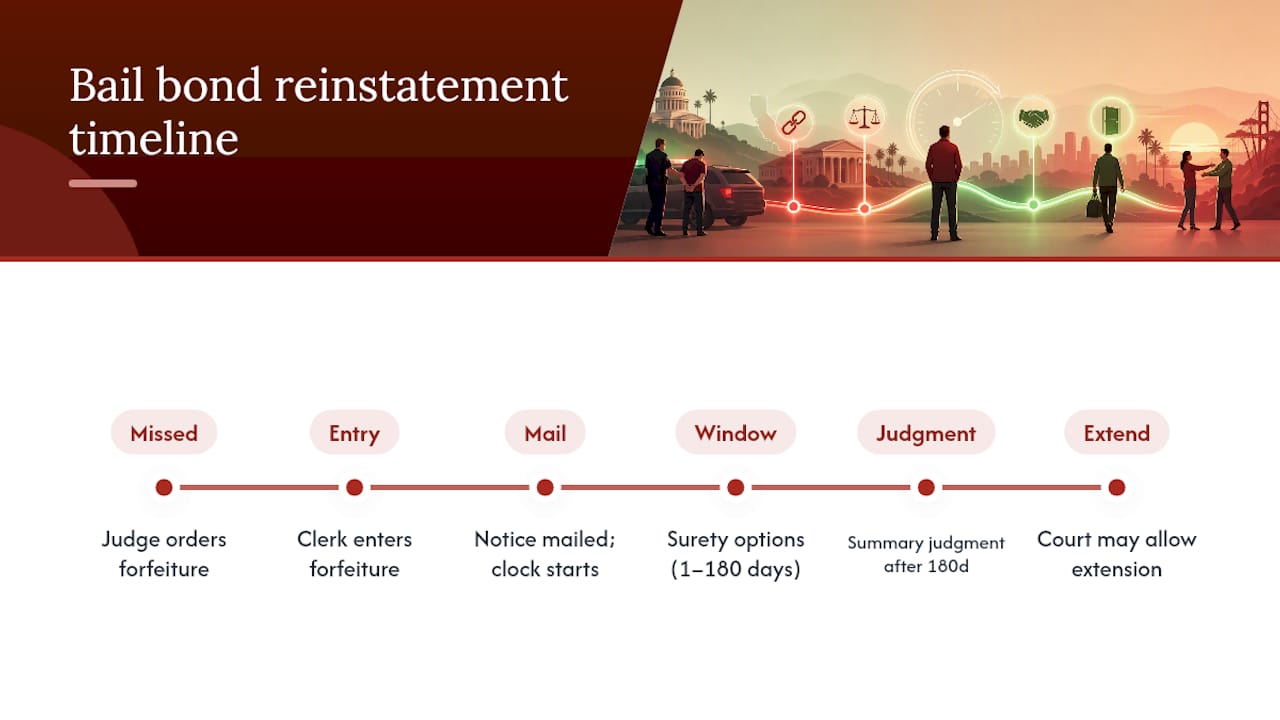
Day 0–1 (same day or next morning): The clerk enters the forfeiture in the permanent minutes. This is the critical dividing line. Before entry, a judge may reinstate bail immediately if the defendant appears. After entry, the formal statutory process governs.
Within days of entry: The clerk mails the notice of forfeiture to the surety. The 180-day clock starts on the date of mailing, not the date of the missed appearance.
Days 1–180: The surety has this window to either return the defendant to custody, obtain a court order excusing the nonappearance, or file a motion for relief under PC §1305. The California Department of Insurance flow chart enumerates the specific statutory grounds for relief and the administrative steps a surety must follow during this period.
Day 180+: If no relief has been granted, the court may enter a summary judgment against the surety under PC §1306. At that point, the co-signer’s collateral is at serious risk.
Statutory note: Courts have occasionally allowed extensions beyond 180 days when the defendant is in custody in another jurisdiction or when the surety can show good cause, but these extensions are discretionary and not guaranteed.
Pro Tip: Do not count from the date of the missed appearance. Count from the date on the notice-of-forfeiture letter mailed by the clerk. That date is your actual deadline.
Step-by-step process to seek bail bond reinstatement
Follow these steps in order. Skipping one can forfeit your rights under PC §1305.
-
Confirm the forfeiture was ordered and entered. Call the court clerk and ask whether the judge ordered forfeiture and whether it has been entered in the permanent minutes. Get the case number, the forfeiture date, and the date the notice was mailed to the surety.
-
Notify the bail agent immediately. The surety (bail bond company) has statutory standing to file for relief. Your bail agent needs the forfeiture date and notice date to calculate the filing deadline. If you used Bada Bing Bail Bonds for the original bond, contact them directly.
-
Locate the bench warrant. The court issues a bench warrant at the same time it orders forfeiture. Get the warrant number from the clerk. The warrant must be recalled as part of the reinstatement process.
-
Gather documentation explaining the absence. Medical records, hospital discharge papers, proof of out-of-state custody, travel records, or any communications showing the defendant did not willfully skip court. Courts look for evidence that the nonappearance was excusable.
-
File the motion under PC §1305. The surety or defense counsel files a written motion to vacate the forfeiture and reinstate the bond. The motion must be served on the court and the district attorney. The California Department of Insurance flow chart lists the specific statutory grounds for relief, including PC §1305©(1)–(4) and §1305(d).
-
Set the noticed hearing. The court schedules a hearing at which the surety and the DA can present arguments. The defendant’s presence may or may not be required depending on whether the warrant has been recalled and whether the matter is a felony or misdemeanor.
-
Appear at the hearing with all documentation. Bring originals and copies of every document gathered in step 4, plus the bail bond agreement, the notice of forfeiture, and any proof of the defendant’s current location or custody status.
-
If the defendant is in custody elsewhere: File under PC §1305(d), which provides relief when the defendant is in custody in another jurisdiction. Attach a certified copy of the out-of-jurisdiction custody record. This is one of the strongest grounds for reinstatement.
Pro Tip: Bring a certified copy of the notice of forfeiture to the hearing. Courts have dismissed reinstatement motions because the surety could not prove the mailing date, which determines whether the motion was timely filed.
What happens at a reinstatement hearing?
The judge’s primary concern at a reinstatement hearing is whether the defendant poses a continued flight risk and whether the reason for the missed appearance is credible. A defendant who missed court because of a medical emergency looks very different from one who left the state and stopped responding to the bail agent.
Evidence that consistently helps:
- Affidavits from the defendant or family members explaining the absence
- Medical records or hospital documentation
- Proof of custody in another jurisdiction (certified booking records)
- Travel records showing the defendant was not attempting to flee
- Communications between the defendant and the bail agent showing ongoing contact
- Proof of voluntary surrender or immediate return once the defendant learned of the warrant
Common arguments that succeed:
- Excusable absence due to medical emergency or incapacitation
- Defendant was in custody elsewhere and physically unable to appear
- Clerical error or miscommunication about the court date
- Immediate voluntary return to court after learning of the missed date
The district attorney will typically oppose reinstatement in serious felony cases and may argue the defendant is a flight risk. The surety’s bail agent or attorney counters by showing the defendant’s ties to the community, employment history, family relationships, and any prior record of appearing as required.
Courts have sometimes recalled first-time bench warrants in misdemeanor cases without requiring the defendant to be physically present, while felony matters more often require the defendant to appear in person. Shouse Law Group’s guidance on bench warrants notes that a written motion can be sufficient in lower-stakes cases, but felony defendants should plan to appear.
For out-of-state reinstatement procedures, the general process shares similarities with other jurisdictions. A comparative look at bail reinstatement in Ohio illustrates how surety obligations and filing requirements differ by state, which underscores why California-specific guidance matters.
Possible outcomes and what each means for you
The hearing produces one of four results, and each carries different financial and legal consequences for the defendant, the co-signer, and any collateral pledged.
-
Bond reinstated: The forfeiture is vacated, the bond is restored to active status, and the defendant is released (or remains released) under the original conditions. The co-signer’s collateral is safe, but the surety remains liable if the defendant misses court again.
-
Forfeiture vacated, bond exonerated: The court excuses the nonappearance entirely and releases the surety’s obligation. The co-signer owes nothing further, and any collateral is returned. This is the best financial outcome for the indemnitor.
-
Motion denied, forfeiture stands: The court declines to reinstate. The surety has until the end of the 180-day window to try again or return the defendant. If the window expires, the court enters a summary judgment under PC §1306.
-
Summary judgment entered: The forfeiture converts to a money judgment against the surety, which then pursues the co-signer under the indemnity agreement. Collateral pledged at the time of the original bond, such as real property or vehicles, can be seized to satisfy the judgment.
The financial exposure for co-signers is real. California’s bail forfeiture rules make clear that once a summary judgment is entered, the surety has the right to pursue the full bail amount from the indemnitor.
Pro Tip: If the motion is denied and you are still inside the 180-day window, the surety can file again if new grounds arise, such as the defendant being located or taken into custody. The window does not close after one failed motion.
Warning: Do not wait to see if the court “forgets” about the forfeiture. Courts enter summary judgments routinely once the statutory period expires, and the co-signer’s collateral is at risk from that moment forward.
How a local licensed bail agent can help with reinstatement
A licensed bail agent does more than post the original bond. During reinstatement, their role shifts to investigator, document retriever, and procedural guide. Here is what a local agent typically handles:
- Locating the defendant: Bail agents have access to skip-tracing tools and local law enforcement contacts that most families do not.
- Pulling court records: Agents retrieve the clerk’s minutes, the notice of forfeiture, and the bench warrant details, which are the documents the motion depends on.
- Filing support: While only an attorney can sign a legal motion, a bail agent coordinates with defense counsel and provides the surety’s documentation.
- Local court relationships: An agent who regularly appears in Ventura County Superior Court or Santa Barbara County Superior Court knows the clerks, the typical timelines, and the procedural preferences of individual judges.
- Financing: If a new bond is required after reinstatement, bail bond financing options through Bada Bing Bail Bonds include low down payments for qualifying clients, which reduces the immediate burden on co-signers already under financial stress.
When to involve an attorney versus relying solely on the bail agent depends on the charge. For misdemeanors and straightforward FTAs with a clear excuse, a bail agent coordinating with the surety’s in-house counsel often handles the motion. For felonies, cases with prior FTAs, or situations where the DA is actively opposing reinstatement, a criminal defense attorney should lead the motion. Attorney-coordinated bail bonds in Ventura County are a practical option when both legal and surety representation are needed simultaneously.
Pro Tip: Ask your bail agent for the exact date on the notice-of-forfeiture letter before you do anything else. That date, not the missed court date, is the one that controls your deadline.
What to do immediately after learning a bond was revoked
The first 48 hours after a revocation are the most consequential. Here is the ordered checklist:
- Confirm the court entry. Call the clerk’s office and verify whether the forfeiture has been entered in the permanent minutes and whether notice has been mailed.
- Contact your bail agent. Provide the case number, the defendant’s name, and the court date that was missed. Ask the agent to pull the minutes immediately.
- Locate the bench warrant. Get the warrant number. This is needed for any motion to recall and for the reinstatement filing.
- Secure an attorney if the charge is a felony. Do not wait to see how the hearing goes. Felony reinstatement hearings are adversarial, and the DA will be prepared.
- Arrange voluntary surrender if the defendant is reachable. A defendant who voluntarily returns to court before the hearing significantly strengthens the reinstatement argument.
- Document everything. Save all communications with the bail agent, the court, and the defendant. Timestamps matter in reinstatement proceedings.
For prevention going forward, the simplest habits make the biggest difference. Set calendar reminders for every court date, including a reminder three days before. Establish a communication plan between the defendant, the co-signer, and the bail agent so that any scheduling change is caught immediately. If the defendant needs to travel, notify the bail agent in writing before the trip. Missing a court date in Ventura County triggers consequences that are far easier to prevent than to reverse.
If the defendant cannot be located and the reinstatement window is closing, posting a warrant bail bond may be the faster path to getting the defendant back before the court. Waiting for a reinstatement hearing while the defendant remains at large risks losing the entire bond amount.
Pro Tip: Preserve collateral by acting before the 180-day window closes, not after. Once a summary judgment is entered under PC §1306, the surety’s right to pursue the indemnitor’s assets is immediate and enforceable.
Why acting fast in local California courts changes everything
Courts in Ventura, Santa Barbara, and nearby counties each have their own administrative rhythms. Ventura County Superior Court tends to process forfeiture entries quickly, which means the formal 180-day clock often starts sooner than families expect. Santa Barbara County courts are similarly efficient. The practical lesson: do not assume you have the full 180 days from the missed appearance. The clock may already be running from a mailing date that happened days ago.
Same-day action genuinely changes outcomes here. A bail agent who calls the court the morning of a missed appearance can sometimes reach a clerk before the forfeiture order is entered in the minutes. At that point, a judge still has discretion to reinstate bail if the defendant appears or if a compelling explanation is offered immediately. That window closes the moment the clerk’s entry is made.
County practice also varies on how aggressively the DA’s office opposes reinstatement motions. In cases involving serious felonies or defendants with prior FTAs, expect opposition. In first-time misdemeanor cases with a credible excuse, the path is often smoother. Assuming uniform practice across counties is a mistake that costs defendants and co-signers money. Contact a local bail agent or criminal defense attorney who knows the specific court before drawing conclusions about how a hearing will go.
Bada Bing Bail Bonds is available right now to help you act
When a bail bond is revoked and the clock is running, the fastest path forward is a licensed local agent who knows the courts, the clerks, and the filing requirements by name.

Badabingbail serves Ventura, Santa Barbara, and Orange Counties 24 hours a day, seven days a week. The team retrieves court minutes, coordinates with defense counsel on reinstatement motions, and walks co-signers through every document they need before the hearing. Flexible financing and low down payment options are available for qualifying clients, so financial stress does not have to delay action when time is the one thing you cannot afford to lose.
Get immediate help bailing someone out fast or reach the local team directly through the Southern California bail bonds service page. Have the case number, the court name, and the missed appearance date ready when you call.
Sources
These primary sources back the guidance in this article. Bring the relevant citations to your attorney or bail agent before any filing.
- People v. Surety Ins. Co. (1983) | Justia
- Memorandum regarding Bail Forfeiture (flow chart) | California Department of Insurance
- California Bail Forfeiture: Rules, Deadlines, and Relief – LegalClarity
- I have a bench warrant in California. How do I get it recalled? | Shouse Law Group
This article is general information, not a substitute for advice from a qualified lawyer. Consult a qualified legal professional about your own circumstances before acting on anything here.