The call usually comes late. A short sentence, a lot of noise in the background, and then the question every family asks next: “How do I get them out?”
If your loved one was arrested in Ventura, Oxnard, Camarillo, Port Hueneme, Thousand Oaks, Santa Paula, Moorpark, Fillmore, Ojai, or Santa Barbara, the first job is to slow the panic down and get the right facts in the right order. Bail bond requirements feel confusing when you’re half-awake and trying to help someone from the outside. They don’t have to stay confusing.
This guide is built for that exact moment. It walks through what you need right now, who can co-sign, what paperwork matters, what financial risk you’re taking on, and how Ventura County Jail bail bonds usually move from booking to release.
Table of Contents
- What to Do After a Call from a Ventura County Jail
- Who Can Get a Bail Bond in California
- Your Bail Bond Application Checklist
- Co-signer Liability and Collateral Explained
- The Cost of a Bail Bond and Payment Options
- Navigating the Release Process from Ventura and Oxnard Jails
- Answering Your Questions on Special Bail Cases
What to Do After a Call from a Ventura County Jail
A family in Ventura gets a call after midnight. The person in custody doesn’t always know much. They may know the arresting agency, maybe the jail, maybe the charge, and sometimes only that bail has been mentioned. The instinct is to start calling everyone at once. A better move is to gather a few key details and get one clear path moving.
In Ventura County, the starting point is often the bail schedule. If the alleged offense isn’t specifically listed, the Ventura County 2024 Bail Schedule sets the default bail at $10,000 for unlisted felonies and $2,500 for unlisted misdemeanors according to Ventura County Jail bail bonds information. That doesn’t answer every question, but it gives families a starting frame when the booking sheet isn’t yet in hand.
The first five things to confirm
When you’re dealing with bail bonds Ventura families usually need the same facts first:
- Full legal name: Spelling matters. A wrong middle name can slow verification.
- Date of birth: This helps separate your loved one from anyone with a similar name.
- Where they were taken: Ventura, Oxnard, Camarillo, or another local agency matters because release logistics change by location.
- Booking number if available: If they have it, write it down immediately.
- Any next court date or hold mentioned: Even a partial detail can help identify the case status.
Practical rule: Don’t wait to have every answer before making the call. Get the process started with the basics, then fill in the gaps as booking updates come in.
What helps right away
A local bondsman can usually verify booking, check the bail amount, and tell you whether the case looks straightforward or whether there may be a hold, a warrant issue, or a court review coming. That’s where local knowledge matters. Ventura County bail bonds don’t move the same way as a generic statewide call center script.
If you need immediate help at any hour, start with 24 hour bail bonds Ventura County. That kind of direct contact matters most when someone is sitting in a local facility and the family wants movement, not vague answers.
Who Can Get a Bail Bond in California
The bail bond is for the defendant, meaning the person in custody. But the person who usually makes the bond happen is the co-signer, also called an indemnitor. That’s the person who signs the contract, provides supporting information, and agrees to take legal responsibility if the defendant doesn’t follow the release terms.
A lot of families think the co-signer’s role is simple. It isn’t. The co-signer is the person the bond company relies on to stand behind the bond and stay in contact if something starts going sideways.
The two roles that matter most
Here’s the cleanest way to frame it:
| Role | What the person does |
|---|---|
| Defendant | Gets released from custody and must appear in court as ordered |
| Co-signer | Signs for the bond, provides documentation, and guarantees compliance |
That’s true whether you’re dealing with bail bonds Oxnard calls in the middle of the night or a transfer from another local agency into county custody.
Who usually makes a workable co-signer
A workable co-signer is usually an adult with stable ties and the ability to show they can be reached, identified, and held responsible under the agreement. In plain English, that often means:
- Reliable identification: A valid ID is usually the first thing requested.
- Stable residence: The co-signer should be easy to locate and able to document where they live.
- Income or financial stability: The company needs to know the co-signer can realistically support the agreement.
- Connection to the defendant: Parent, spouse, sibling, partner, or close friend is common.
Some people can emotionally help but still aren’t the right signer. If someone has no income, no residence history, no way to verify identity, or no real relationship to the defendant, that usually creates delays instead of solving the problem.
The strongest co-signer is not always the person who cares the most. It’s the person who can document stability and stay involved until the case is finished.
For a straightforward overview of the process, Bada Bing Bail Bonds explains California bail. That can help if you’re trying to decide whether you’re in a position to co-sign or whether another family member should do it.
Your Bail Bond Application Checklist
Speed comes from preparation. Most delays in fast bail bonds Ventura cases don’t happen because the jail rejected the bond. They happen because the family is still searching for a name, a booking location, or basic co-signer paperwork.
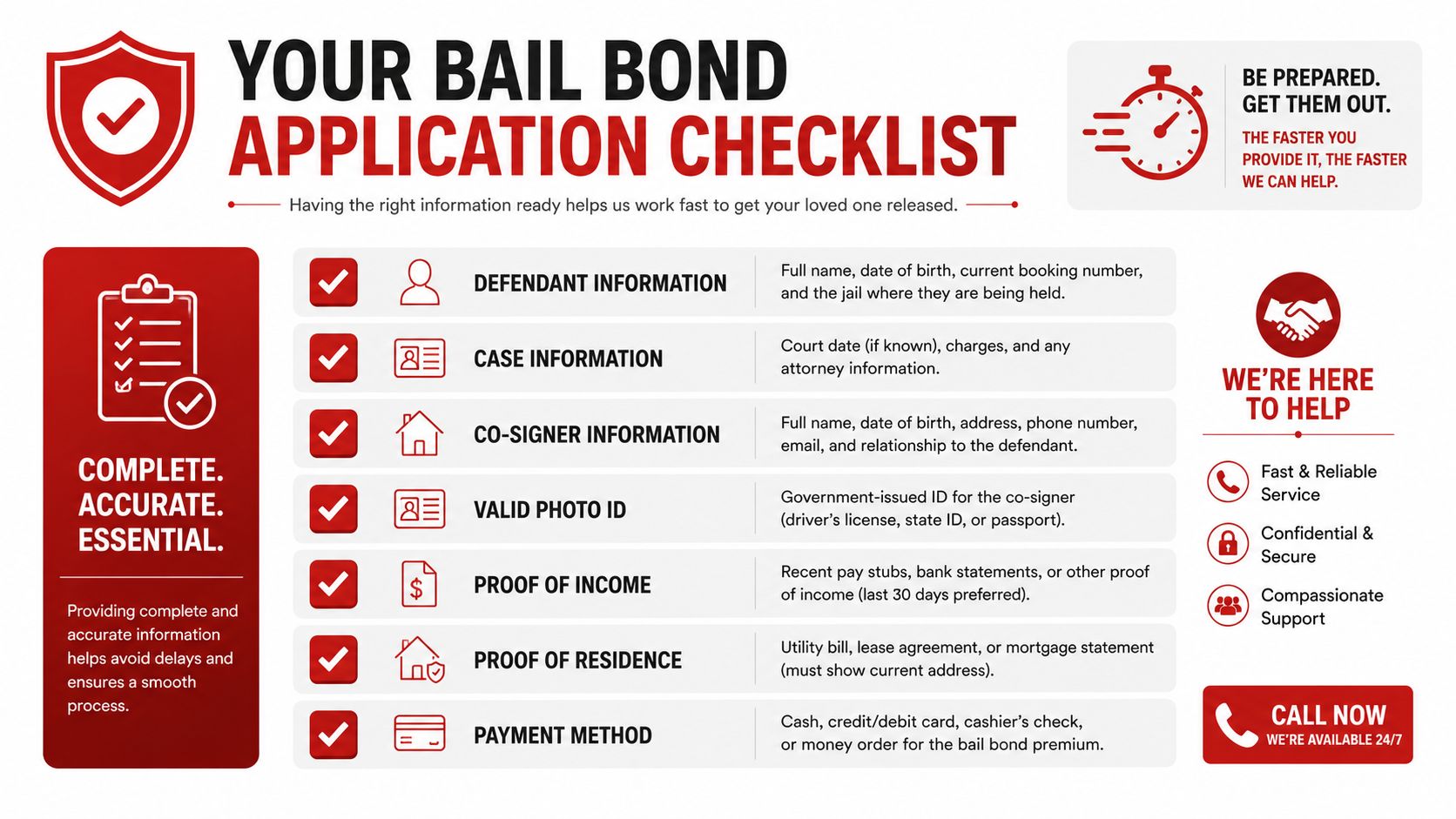
The easiest way to avoid that is to separate the checklist into two parts. One part is about the person in custody. The other is about the person signing the bond.
Information needed about the person in custody
Have as much of this ready as you can:
- Legal name and date of birth: This is the core booking lookup information.
- Booking number: If the jail has assigned one, it speeds verification.
- Jail or agency location: Ventura County Jail, a city jail, or an arresting department can each start the process differently.
- Charge information if known: Even a rough description helps identify likely release conditions.
- Any court or hold information mentioned during the call: This can change the path from immediate posting to waiting for a hearing.
If you don’t know all of it, don’t freeze. Start with the name and date of birth.
Information and documents needed from the co-signer
This part decides how quickly paperwork can be approved:
- Government-issued ID: Driver’s license or another valid photo ID.
- Proof of residence: Utility bill, lease, or similar document tied to the signer.
- Proof of income or financial stability: Pay stubs, bank records, or related documents are commonly requested.
- Contact details: Cell phone, email, and current address should all be current.
- Employment information: Employer name and work schedule can help show stability.
What families often miss
The biggest time-waster is sending partial documents that don’t match. If the ID shows one address and the proof of residence shows another, expect follow-up questions. If the signer uses a nickname for the defendant instead of the booked legal name, that can also slow the file.
For local Ventura County bail bonds, it also helps to know whether the person is at a county facility, a local police department, or waiting on transfer. That changes who has the paperwork and where release processing happens.
Co-signer Liability and Collateral Explained
Many families get blindsided. They think the risk ends with the premium. It doesn’t.
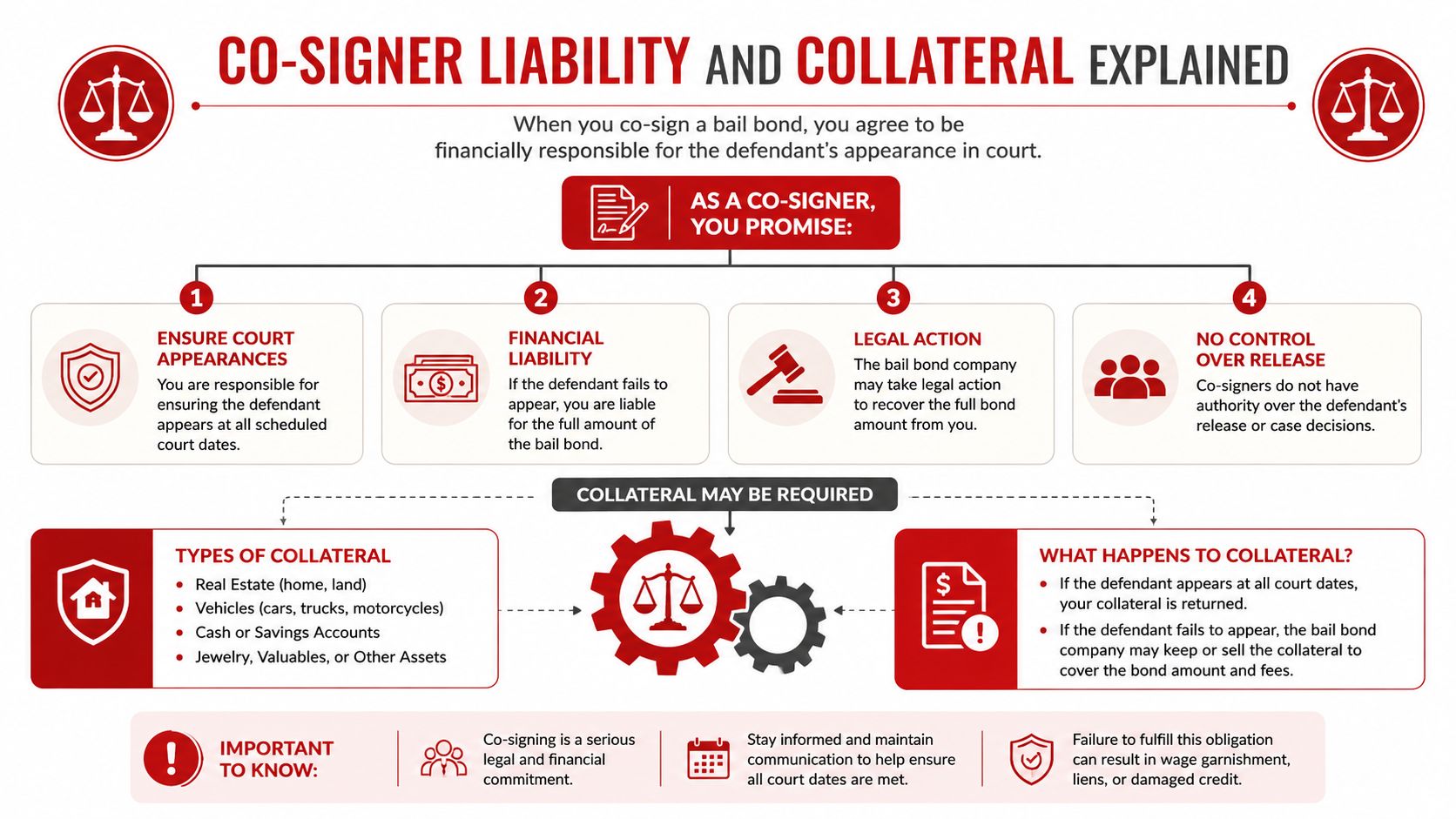
The hard truth is that a co-signer isn’t just paying a fee to get someone out. As noted in this explanation of what you need to get a bail bond, many people misunderstand this point and assume the only exposure is the 10% premium. In reality, the co-signer guarantees the entire bail amount if the defendant flees, and that liability continues even if the charges are later dropped because the premium is non-refundable.
What that liability means in real life
If the defendant appears for court, follows release terms, and the bond is exonerated at the end of the case, the co-signer’s risk usually ends there.
If the defendant disappears, misses court, or refuses to stay in contact, the problem gets very serious very quickly. The co-signer may be pursued for the full amount guaranteed under the bond agreement. That’s why bond paperwork asks so many questions about residence, employment, family ties, and reliability. Those questions aren’t filler. They’re risk control.
Don’t co-sign because you feel guilty. Co-sign because you believe the person will appear in court every time and stay reachable the entire case.
A lot of Ventura County families run into this misunderstanding in DUI, domestic violence, warrant, and probation cases. The pressure is emotional, but the contract is financial.
The video below gives a useful visual overview of how this part of the process works.
When collateral comes into play
Collateral is separate from the premium. It is security for the bond company’s risk on larger or higher-risk cases. Not every bond requires it, but when bail is high, collateral is common.
In California, high-risk or high-bail cases often require collateral valued at 150% to 200% of the bail amount, and formal property bonds ordered by the court require equity equal to twice the bail amount under this explanation of California collateral and property bond practice and California Penal Code Section 1276.5 guidance. Acceptable collateral can include real estate equity, vehicle titles, stocks, or other valuable assets, with liens disclosed and value verified.
What collateral does and does not do
Collateral does not replace the defendant’s duty to appear. It protects the bond company if the bond is forfeited.
Common forms include the types of bail bond collateral families most often ask about:
- Real property: Often the strongest option when bail is large.
- Vehicle title: Sometimes usable, depending on value and lien status.
- Financial assets: Stocks or other documented assets may work in some cases.
Collateral is typically returned after the case is resolved and the bond is exonerated, assuming the defendant met all court obligations and the co-signer met the contract terms. Families should ask exactly how release of collateral is handled before signing anything.
The Cost of a Bail Bond and Payment Options
The cost question always comes early, and it should. Families need a straight answer.
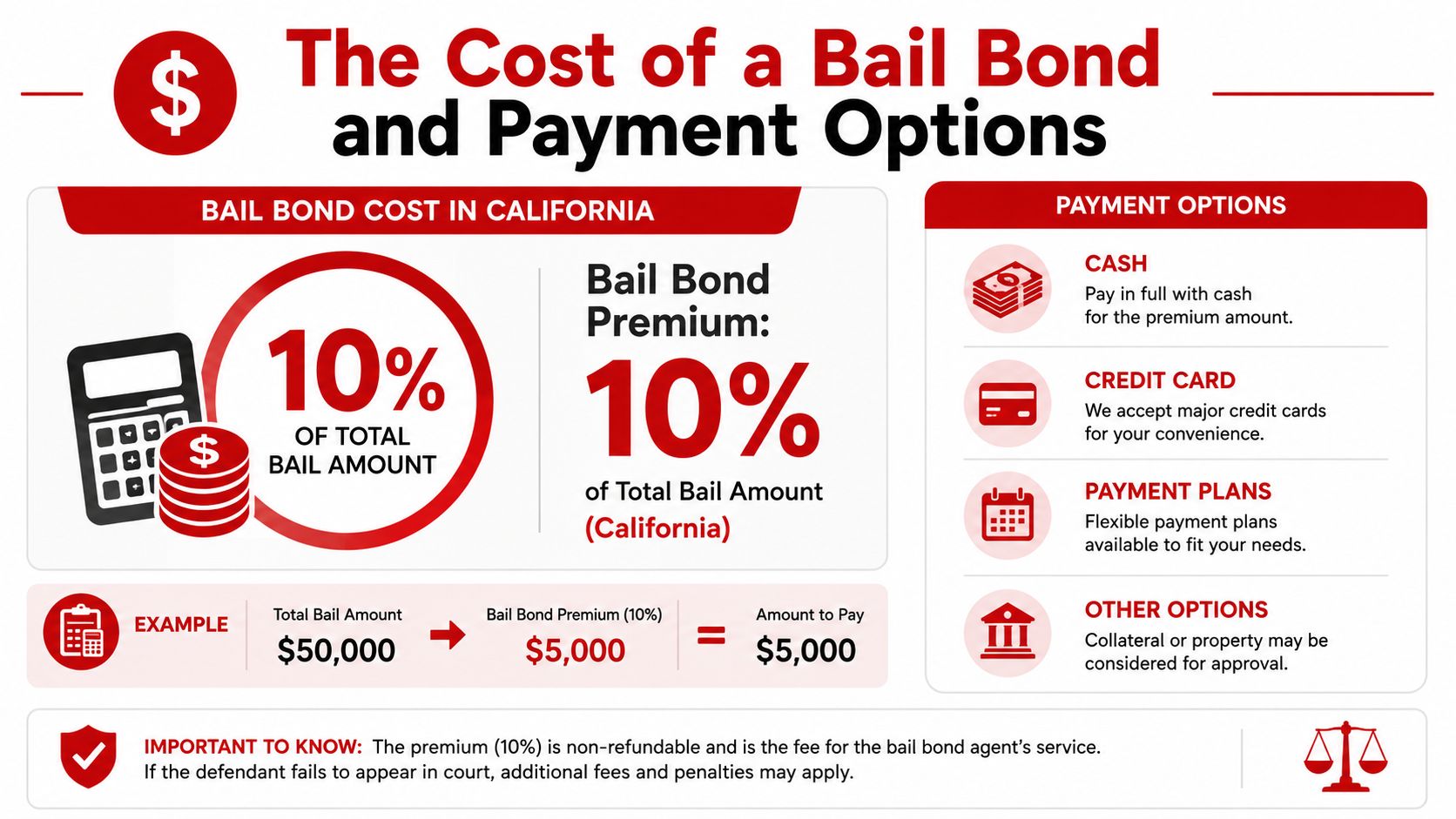
In California, the bail bond premium is 10% of the total bail amount. With the average bail amount in California at $50,000, the typical non-refundable premium is $5,000, according to the Bureau of Justice Statistics bail information. That premium is the fee for the surety bond. It is not a deposit, and it is not refunded if the case is dismissed or the defendant is found not guilty.
What the premium actually pays for
The premium pays for the bond company taking on the court risk for the full bail amount. In California, that rate is tightly regulated, and California law limits the standard premium accordingly. In some situations, discounted rates may be available under specific conditions, but families should ask for the exact terms in writing and make sure they understand whether collateral or a co-signer is also required.
Practical payment conversations
Most families calling about Ventura County bail bonds aren’t sitting on immediate cash reserves. That doesn’t mean the process stops. It means the next conversation needs to be specific.
Ask these questions:
- Can the premium be financed? Some agencies offer payment plans.
- What is due upfront? Get the immediate amount clearly stated.
- What documents support approval? Income and residence proof often matter here.
- Will collateral be required in addition to payments? High-bail cases may involve both.
For a plain-language overview, review bail bond payment methods in California. That helps families compare whether they can use a payment plan, card payment, co-signer support, or collateral-backed arrangement.
Ask for the full financial picture before you sign. Premium, payment schedule, collateral terms, and co-signer duties should all be clear on day one.
Navigating the Release Process from Ventura and Oxnard Jails
Once the bond is approved and signed, families expect the person to walk out immediately. Sometimes that happens quickly. Often, the jail still has its own internal release line to work through.
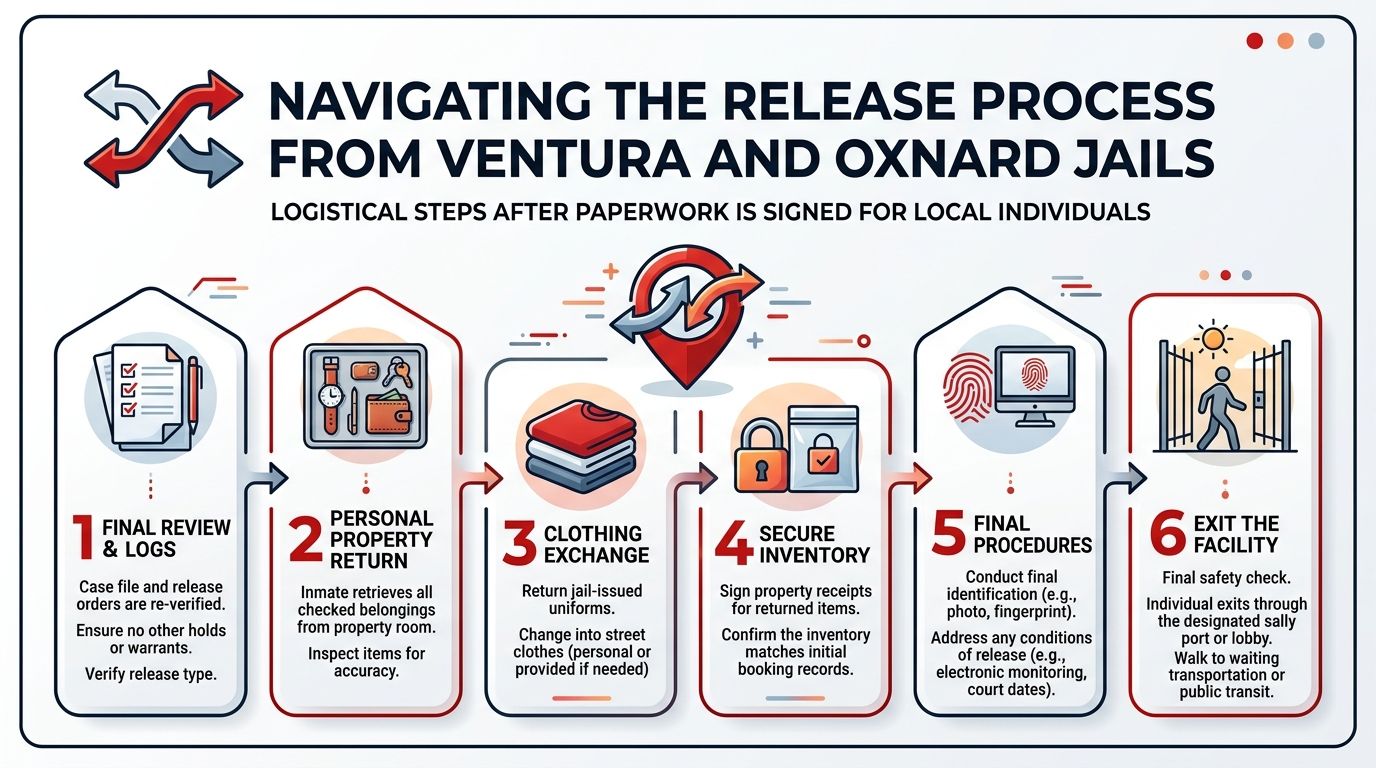
In Ventura and Oxnard cases, the release process usually has two tracks running at once. The bond side moves through paperwork, verification, and submission. The jail side moves through custody checks, internal clearance, and release processing. A bond can be posted fast and still sit in a release queue.
What usually happens after signing
Here’s the practical sequence:
- Booking is verified: The defendant’s custody status and bail amount are confirmed.
- The agreement is completed: Co-signer paperwork and supporting documents are reviewed.
- The bond is posted: The bond is delivered or filed according to the facility’s procedure.
- The jail processes the release: Staff complete their own checks before discharge.
- Pickup is coordinated: The family is told where and when to expect release.
That last step is where expectations matter. Ventura County Jail bail bonds can move efficiently, but jail staffing, shift change, medical clearance, and local workload all affect the final wait.
Why local knowledge matters
A local agent usually knows the difference between a slow booking night and a slow release night. They also know that city arrests may funnel into county custody, which changes timing and paperwork flow. That’s a big reason families looking for 24-hour bail bonds Ventura help often prefer someone who regularly works Ventura, Oxnard, Camarillo, Santa Paula, and surrounding areas.
One practical option for local release support is Bada Bing Bail Bonds assistance, which focuses on Ventura County inmate release timing and jail coordination.
How to avoid slowing the release yourself
Families sometimes create avoidable delays by:
- Leaving the phone unanswered: Jail and bond updates can be time-sensitive.
- Sending incomplete signer documents: Missing pages or mismatched names can stall approval.
- Driving to the jail too early without confirmation: Wait until release is in motion.
- Changing co-signers halfway through: That can restart review and verification.
For fast bail bonds Ventura cases, the best move is usually simple. Stay reachable, send clean documents, and let one point of contact guide the sequence.
Answering Your Questions on Special Bail Cases
Some cases don’t fit the standard overnight release pattern. That’s when families need blunt answers instead of wishful ones.
Can you get a bail bond for a federal case
Sometimes, but federal custody runs under a different system than state and county custody. Release decisions are controlled by the federal court, and some federal defendants are not bond-eligible at all. If someone says your loved one has been taken on a federal matter, confirm where they are being held and whether a bond has been set before assuming a standard Ventura County process applies.
What if there is an immigration hold
An immigration hold can change everything. A person may post the state bond and still not be released because another agency has placed a hold. In that situation, the state bail issue and the hold issue are separate. Families should ask whether the person is releasable from the jail itself, not just whether the bail has been posted.
How does a probation violation affect bail
Probation violations often create extra complications. Sometimes bail is available. Sometimes the person must wait for a court hearing. If there is a probation hold, a no-bail notation, or a pending warrant tied to the violation, the release path may be delayed or blocked until the court reviews the case.
What about a bail reduction hearing
If the set amount is too high to realistically meet, a bail reduction hearing may help. In Ventura County, defendants seeking that reduction generally need financial proof such as pay stubs and bank records, plus housing documentation, employment records, and proof of family responsibilities, according to this Ventura County bail reduction hearing overview. That kind of hearing works best when the defense can show the court a realistic release plan, not just that the family wants a lower number.
What are our responsibilities after release
The main responsibility is simple. The defendant must appear in court every time and follow every release condition.
The family’s role is to help keep that on track:
- Track court dates carefully: Missed appearances create major problems.
- Keep contact current: If the defendant changes phone numbers or address, that should be reported.
- Follow all release terms: No-contact orders, travel restrictions, or check-ins matter.
- Respond early if something changes: Work conflicts, transportation problems, or confusion about court should be handled before the hearing, not after a missed date.
Once someone is out, the goal changes. It’s no longer just getting release. It’s protecting that release all the way through the case.
If you need immediate help sorting out bail bond requirements in Ventura, Oxnard, Camarillo, Port Hueneme, Thousand Oaks, Santa Paula, Moorpark, Fillmore, Ojai, or Santa Barbara, Bada Bing Bail Bonds is a local 24/7 option that can verify booking, explain the paperwork, discuss co-signer and collateral issues, and help families move the release process forward without adding confusion.