Bail Bonds Santa Barbara
Bada Bing Bail Bonds is a licensed California bail bond agency providing 24/7 Santa Barbara bail bonds, working directly with the Santa Barbara County Main Jail to secure fast release.
When someone is arrested in Santa Barbara, every minute matters — and knowing exactly how the local system works makes the difference between a same-day release and an overnight stay. Santa Barbara arrests involve both the Santa Barbara Police Department and the Santa Barbara County Sheriff’s Office depending on where in the city the arrest occurred. All Santa Barbara arrests ultimately route to the Santa Barbara County Main Jail at 4434 Calle Real, Santa Barbara, CA 93110 — approximately three miles from downtown Santa Barbara. Bada Bing Bail Bonds has been posting bail bonds in Santa Barbara for over 15 years — we know the Santa Barbara booking process, the Santa Barbara Courthouse at 1100 Anacapa Street where all Santa Barbara criminal cases are heard, and every detail that separates a fast release from an unnecessary overnight wait. Whether it is a misdemeanor DUI on State Street, a domestic violence arrest near Santa Barbara Harbor, a drug charge in the Funk Zone, or a felony anywhere in the city — we are available 24 hours a day, 7 days a week to help your family secure release quickly. Call (805) 910-9842 the moment any Santa Barbara arrest happens — we start working immediately.
How Do I Get Someone Out of Jail in Santa Barbara?
To get someone out of jail in Santa Barbara, you’ll need to post bail through a licensed bail bond company, which typically costs 10% of the total bail amount set by the court. Nearly all Santa Barbara arrests are transferred to the Santa Barbara County Main Jail at 4434 Calle Real, regardless of whether the arrest was made by Santa Barbara Police or the County Sheriff’s Office.
Here’s how the process works:
- Confirm where they’re being held. Call the Main Jail or Bada Bing Bail Bonds to verify booking details and the exact bail amount.
- Contact a licensed bail bondsman. A bail agent posts the bond on your behalf for a non-refundable premium — by law, 10% of the total bail statewide.
- Complete the paperwork. Bada Bing Bail Bonds handles this by phone or online with e-signatures, so no office visit is required.
- Bail is posted with the jail. Once approved, the bond is posted directly with the Santa Barbara County Main Jail.
- Release typically follows within a few hours, depending on the jail’s booking and processing schedule.
Bada Bing Bail Bonds is available 24/7 in Santa Barbara and works directly with the Santa Barbara County Main Jail to move this process along quickly, with payment plans available for those who qualify.
Trusted 805 Bail Bond Team — Right Here in Santa Barbara
Santa Barbara is where we show up in person — not on a map, not on a list of cities we claim to cover. Our office is at 7 W. Figueroa Street #21 — four blocks from the Santa Barbara Courthouse on Anacapa Street and ten minutes from the Santa Barbara County Main Jail on Calle Real. That is not a forwarded 805 number. That is a real local 805 bail bond agency with real boots on the ground in Santa Barbara.
Over 15 years posting bail for Santa Barbara city arrests — working directly with the Santa Barbara Police Department, Santa Barbara County Sheriff’s Office, and UCSB Campus Police. We know State Street enforcement patterns, the SBPD booking process, and exactly what it takes to get your loved one out as fast as the system allows. A national company with a forwarded 805 number has never walked through the doors of the Santa Barbara Courthouse on Anacapa Street. We have — more times than we can count.
Whether you searched “805 bail bonds Santa Barbara“, “bail bonds near me“, “Santa Barbara bail bondsman“, or “local 805 bail agent” — you have found the real thing. Licensed by the California Department of Insurance — License #1L72726, available 24 hours a day, 7 days a week, payment plans from 1.5% down for qualifying clients.
📞 (805) 910-9842 — Available 24 Hours a Day, 7 Days a Week
7 W. Figueroa Street #21, Santa Barbara, CA 93101
Why Santa Barbara Families Trust Bada Bing Bail Bonds
- Local Santa Barbara Expertise — 15 Years in the System: We work directly with the Santa Barbara County Main Jail on Calle Real every day. We know the Santa Barbara Police Department booking process, how the Santa Barbara County Sheriff's Office handles south county arrests, when booking delays happen at the Main Jail, and exactly how to move fast when timing matters most. We know the Santa Barbara Courthouse on Anacapa Street, how the Santa Barbara County DA's south county office operates, and what the judge considers at a bail reduction hearing. Local knowledge built over 15 years — that is what you get when you call us.
- Licensed & Ready to Move Immediately: Our licensed California bail agents — CDI License #1L72726 — answer every call personally. No voicemail, no call centers, no waiting until morning. You call, we verify the booking at the Santa Barbara County Main Jail, confirm the exact bail amount, identify any holds, and begin bond paperwork immediately — all simultaneously so your loved one gets home as fast as the system allows.
- Available 24 Hours a Day — Santa Barbara Arrests Happen Around the Clock: The State Street entertainment district, Santa Barbara Harbor, UCSB corridor, Isla Vista adjacent areas, and Highway 101 generate arrests at every hour — particularly on weekend nights and during UCSB event periods. We answer every call 24 hours a day, 7 days a week, 365 days a year. When trouble hits in Santa Barbara, Bada Bing Bail Bonds is already moving.
- Flexible Payment Plans — Affordable Santa Barbara Bail Bonds: Low down payment options starting at 1.5% for qualifying clients. On a $20,000 Santa Barbara bail that is as little as $300 down to start the release process immediately. All major credit and debit cards accepted. All paperwork completed by phone and e-signature — no office visit required.
How the Santa Barbara Bail Process Works
From the moment of arrest to the moment your loved one walks out — here is exactly what happens and what we do at every step.

After an arrest in Santa Barbara, the defendant is transported to the Santa Barbara County Main Jail at 4434 Calle Real — or held briefly at the Santa Barbara Police Department before county transfer. Booking includes fingerprinting, photographing, a background check, and charge verification. This process typically takes 1–3 hours depending on staffing and booking volume. The bail amount is set automatically using the Santa Barbara County Bail Schedule — no judge required for most charges. Call Bada Bing Bail Bonds at (855) 825-2245 the moment an arrest happens — we begin working before booking is even complete.

Once booking is complete the exact bail amount is confirmed based on the charges filed. Common Santa Barbara bail amounts range from $5,000–$10,000 for misdemeanor DUI to $25,000–$100,000 or more for felony charges. Enhancements — gang allegations, prior convictions, probation status — can increase the base amount significantly. We verify the exact bail amount including any enhancements directly with the Santa Barbara County Main Jail in real time so there are no surprises before paperwork is signed.

Call (805) 910-9842 — a licensed California bail agent answers immediately 24 hours a day. Provide the person's full name and date of birth and we handle everything from there. We confirm the booking status, exact bail amount, current facility, any holds or enhancements affecting release, and all payment options available. You do not need to have all the information before calling — a name and date of birth is enough to get started. All paperwork is completed by phone and e-signature — no office visit required.

Once payment is arranged — with low down payment plans starting at 1.5% for qualifying clients — our licensed agents post the bond directly at the Santa Barbara County Main Jail. We pay the full bail amount on the defendant's behalf in exchange for a non-refundable premium of 10% of the total bail. All required paperwork is filed directly with the jail. The bond is accepted by the facility and the release process begins immediately.

After the bond is accepted the Santa Barbara County Main Jail processes the release internally. This typically takes 2–4 hours under normal conditions — 4–8 hours on weekends and holidays due to higher booking volume. We stay in contact with the facility throughout this process and provide live updates so you always know exactly where things stand. You will not be left waiting and wondering — we stay with you until your loved one is officially released.

Release is not the end — it is the beginning of the court process. Every defendant released on bail must appear at every scheduled hearing at the Santa Barbara Courthouse at 1100 Anacapa Street. Missing a single court date results in a bench warrant, bond forfeiture, and re-arrest. Bada Bing Bail Bonds sends court date reminders throughout the case, stays in contact with both the defendant and co-signer, answers questions at every stage, and remains available 24 hours a day until the case is fully resolved and the bond is exonerated. Our job does not end at the jail door.
Where Arrests Happen in Santa Barbara
Where Arrests Happen in Santa Barbara — And Where Cases Go Next
Arresting Agency
Areas Patrolled
First Stop
County Facility
Courthouse
Santa Barbara Police Department
Santa Barbara County Sheriff's Office
UCSB Campus Police
🏛 Santa Barbara County Main Jail
⚖️ Santa Barbara Courthouse
Address: 4434 Calle Real, Santa Barbara, CA 93110
Phone: (805) 934-7500 — 24/7
Operated By: Santa Barbara County Sheriff’s Office
Hours: 24 hours a day, 7 days a week
Serves: All Santa Barbara city arrests — SBPD, SBSO, and UCSB Campus Police
Bail Posted Here: Yes — cash and surety bonds accepted directly
Release After Bail: 2–4 hours under normal conditions; 4–8 hours on weekends and holidays
Inmate Search: Who Is In Custody – Santa Barbara County Sheriff’s Office— searchable by name or booking number 24/7
Visiting: By scheduled appointment — call (805) 934-7500
Directions: From US-101 North or South — take the Calle Real exit. Head east on Calle Real. The facility is on the right approximately 3 miles from downtown Santa Barbara
Parking: Free visitor parking in the lot adjacent to the facility
Address: 1100 Anacapa Street, Santa Barbara, CA 93101
Phone: (805) 882-4600
Hours: Monday–Friday 8:00 AM–4:00 PM
Cases Heard: All felony and misdemeanor criminal cases from Santa Barbara city arrests
Prosecuted By: Santa Barbara County District Attorney’s Office — south county branch
First Appearance: Arraignments for in-custody defendants may be held via video from the Main Jail or in-person at the courthouse
UCSB Note: Students arrested in Santa Barbara or on campus face both the criminal case here AND a separate UCSB student conduct process running independently
Missing Court: Results in immediate bench warrant, bond forfeiture, and a new failure-to-appear charge (PC 1320)
Directions: From US-101 — take the Anacapa Street exit toward downtown Santa Barbara. The courthouse is at 1100 Anacapa Street between Figueroa and Anapamu Streets
Parking: Paid parking structure on Anapamu Street one block away. Street metered parking also available. Arrive 15–20 minutes early for security screening
What You'll Actually Pay in Santa Barbara
- Flat 10% state-regulated rate — never higher, never padded with hidden fees
- Low down payment plans starting at 1.5% for qualifying clients — meaning a $20,000 Santa Barbara bail could require as little as $300 down to start the release process immediately
- Collateral solutions for larger bail amounts or higher-risk Santa Barbara cases
- Co-signer approval for anyone without full cash or credit ready
- Flexible payment plans matched to your financial situation — not one-size-fits-all terms
You will know exactly what you are agreeing to before anything moves forward. Our licensed Santa Barbara bail agents — CDI License #1L72726 — explain every option clearly, break down the risks, and make sure all paperwork is handled correctly with the Santa Barbara County Main Jail. Whether this is your first experience with the bail system or not — we keep it clear, fast, and fully compliant from the first call to the moment your loved one walks out.
📞 (805) 910-9842 — Available 24 Hours a Day, 7 Days a Week
Affordable Payment Options- 1.5%, 2%, 3% Down Options- Bada Bing Bail Bonds
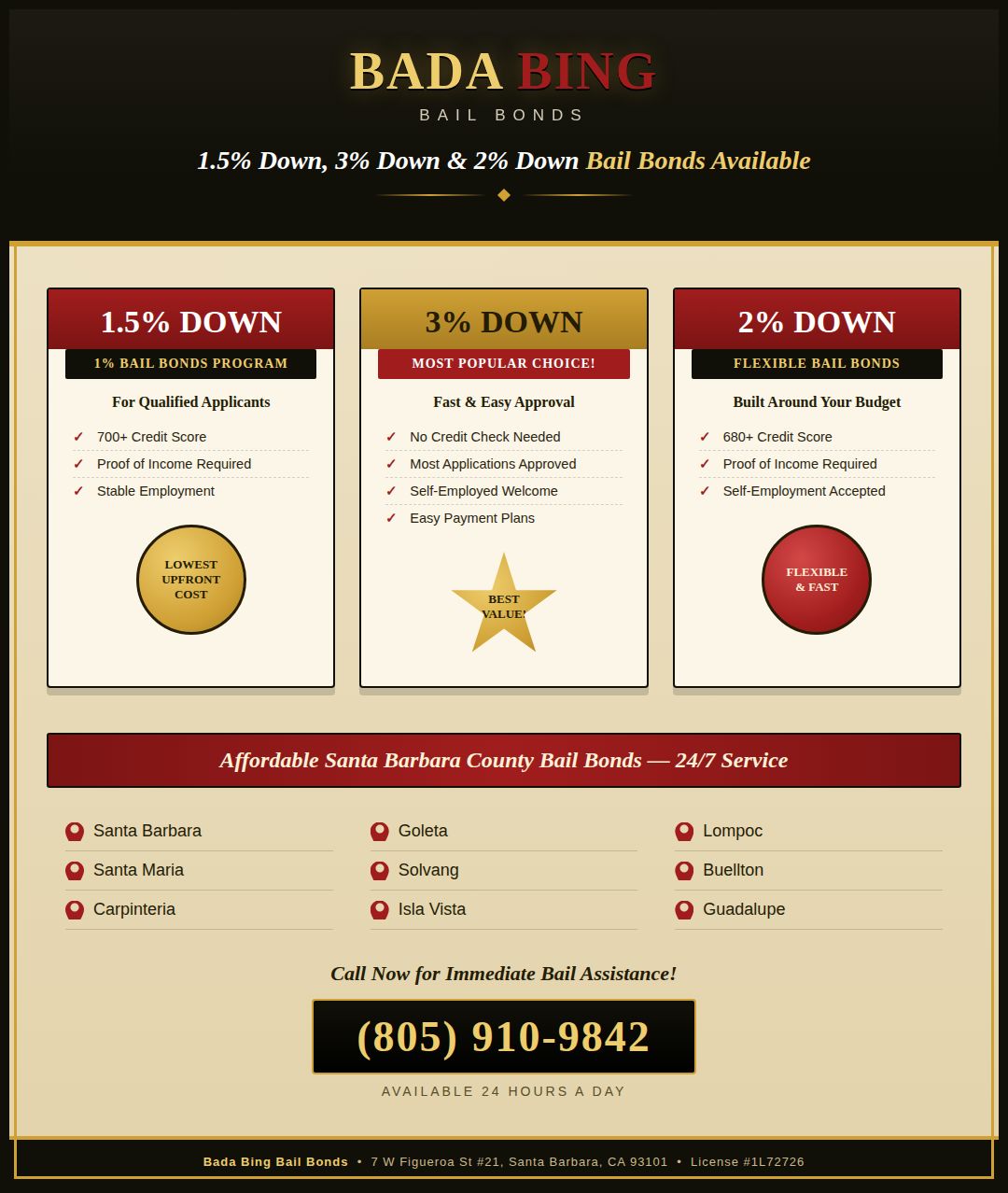
Our Down Payment Options 1.5% Down Our lowest down payment option for qualifying clients. Put down as little as 1.5% of the total bail amount to start the release process immediately. On a $20,000 bail, that’s just $300 down. Terms and qualification requirements apply. 2% Down A popular option for clients who want a lower monthly payment with a slightly higher down payment. 2% of the total bail amount gets the bond posted right away, with the remaining balance spread across a manageable payment schedule. 3% Down Our most flexible plan with the broadest qualification range. 3% down starts the release process immediately with extended payment terms tailored to your situation. Most clients qualify for this plan regardless of credit history.
Why You Shouldn’t Pay Full Amount Upfront
- What You Pay Upfront -As little as 1.5% down for qualifying clients — never more than the state-regulated 10%
- How Fast They Get Out - Typically 2–4 hours after bond is accepted at the Santa Barbara County Main Jail
- Payment Flexibility - Yes — low down payment plans, co-signer options, and collateral solutions available
- Support Through the Case - Full guidance from first call to case close — court date reminders, compliance check-ins, and 24/7 availability throughout
- Local System Knowledge - 15 years inside the Santa Barbara County jail and courthouse system — we know every step from booking at Calle Real to arraignment at the Santa Barbara Courthouse
- What You Pay Upfront - 100% of the full bail amount due immediately — $20,000 bail means $20,000 in cash before release begins
- How Fast They Get Out - Release delays are common when funds are not immediately available — every hour waiting is an hour inside the Santa Barbara County Main Jail
- Payment Flexibility - No flexibility — full lump sum required before the Santa Barbara County Main Jail begins processing release
- Support Through the Case - No guidance, no court date reminders, no check-ins — once cash is paid you navigate the Santa Barbara court system entirely alone
- Local System Knowledge - None — no agent familiar with the Santa Barbara Courthouse, the DA's south county office, or the booking process at Calle Real is involved in your case
- If your case is urgent or complex, the flexibility and speed of working with a local release agent can make a life-changing difference.
Types of Cases We Handle in Santa Barbara
No matter the situation our team knows how to move quickly, protect your rights, and guide you through every stage of the bail process in Santa Barbara until everything is handled and under control. We have extensive experience handling arrests throughout Santa Barbara city and Santa Barbara County — at the Santa Barbara County Main Jail on Calle Real, through the Santa Barbara Courthouse on Anacapa Street, and alongside every law enforcement agency operating in the city including the Santa Barbara Police Department, the Santa Barbara County Sheriff’s Office, and UCSB Campus Police.
- DUI and DWI arrests — alcohol or drug-related driving charges on State Street, Cabrillo Boulevard, and the 101 corridor
- Drug possession or distribution — from minor offenses to larger cases in the Eastside, Funk Zone, and Milpas corridor
- Theft, burglary, and property crimes — including shoplifting, vandalism, and auto theft throughout Santa Barbara
- Domestic disputes and restraining order violations — with Emergency Protective Orders issued at the Santa Barbara Courthouse
- Assault, battery, and other violent offenses
- Probation or parole violations — missed check-ins or technical violations
- UCSB and Isla Vista arrests — handled with full understanding of the student conduct process running alongside the criminal case
- White collar, financial, and fraud-related cases
Every Santa Barbara bail situation is different and at Bada Bing Bail Bonds we treat you like a person — not a case number. Whether this is your first time dealing with bail in Santa Barbara or you have been through the Santa Barbara County bail process before — our licensed Santa Barbara bail agents look at the full picture — the charges, the Santa Barbara Courthouse, the Main Jail on Calle Real, and every detail that affects how fast your loved one gets home.
We move quickly and efficiently to post bail, answer every question, and help you get life back on track. When you need bail bonds in Santa Barbara or anywhere in Santa Barbara County we are available 24 hours a day, 7 days a week — ready to act the moment you call.
📞 (805) 910-9842 — Available 24 Hours a Day, 7 Days a Week
7 W. Figueroa Street #21, Santa Barbara, CA 93101 — License #1L72726
What Comes Next After Release in Santa Barbara
- Court dates at the Santa Barbara Courthouse are assigned quickly. Missing a single scheduled hearing at 1100 Anacapa Street can trigger a bench warrant, bond forfeiture, and immediate re-arrest. Every appearance matters — we make sure none are missed by sending reminders throughout the entire case timeline.
- We handle compliance tracking from day one. That means court date reminders, follow-up check-ins, and ongoing communication to keep you ahead of every deadline and requirement set by the Santa Barbara County Superior Court. Nothing gets overlooked and you will always know exactly what comes next.
- Emergency Protective Order conditions must be followed immediately. In domestic violence cases — which are common in Santa Barbara — an EPO is issued at the moment of arrest creating no-contact and stay-away conditions that are active from the moment of release. Violating an EPO results in immediate re-arrest and bond forfeiture. We explain every condition clearly before your loved one walks out the door.
- Your bond remains secure as long as conditions are met. As long as every Santa Barbara Courthouse appearance is attended and no new charges occur — the bond stays active and in good standing throughout the case.
- Collateral is released once the case is closed. If property, vehicles, or other assets were pledged they are returned as soon as the court exonerates the bond and confirms all obligations are complete.
That is the difference between a real Santa Barbara bail bond agency and a one-call operation. We do not disappear after the release — we stay locked in until your case is fully closed, your bond is exonerated, and your family can move forward.
📞 (805) 910-9842 — Available 24 Hours a Day, 7 Days a Week
7 W. Figueroa Street #21, Santa Barbara, CA 93101 — License #1L72726
- The violent crime rate in Santa Barbara is approximately 4.36 per 1,000 residents — meaning roughly a 1 in 229 chance of being a victim of a violent crime annually — higher than many comparably sized California coastal cities
- The property crime rate runs at approximately 21.82 per 1,000 residents — roughly a 1 in 46 chance annually — driven heavily by theft, vehicle break-ins, and burglaries particularly in the downtown State Street corridor and tourist-heavy beachfront areas
- Santa Barbara's overall crime rate sits at approximately 32.72 per 1,000 residents annually — meaning in some neighborhoods the chance of being affected by crime is as high as 1 in 20 depending on location and time of year
- DUI arrests along State Street, Cabrillo Boulevard, and the 101 Freeway are among the most consistent arrest patterns in the city — particularly on weekend nights and during major events at the Santa Barbara Bowl and Earl Warren Showgrounds
- Domestic violence calls, warrant pickups, and drug-related arrests occur regularly across all areas of the city — from the Eastside and Milpas corridor to Isla Vista and the UCSB campus corridor
- Even in a city where most nights feel calm — one drink too many on State Street, one traffic stop on the 101, one altercation near the harbor — can turn into a DUI arrest, a felony charge, or a warrant before the night is over
Why It Matters:
Santa Barbara carries a reputation for being relaxed and safe — and that reputation is exactly what makes the shock of an arrest hit so much harder when it happens. Families are often completely unprepared for how fast the Santa Barbara County jail system moves and how quickly a single night can escalate into serious legal consequences. That is where having fast, local bail bond knowledge matters most. We know the Santa Barbara County Main Jail on Calle Real, the Santa Barbara Courthouse on Anacapa Street, and exactly how to cut release times, reduce family stress, and prevent one bad moment from turning into something far worse. Call Bada Bing Bail Bonds at (805) 910-9842 the moment anything happens — we move faster than the system does.
Santa Barbara arrests can involve the Santa Barbara Police Department, the Santa Barbara County Sheriff’s Office, or UCSB Campus Police depending on where in Santa Barbara the arrest occurred. All three agencies ultimately route defendants to the Santa Barbara County Main Jail on Calle Real.
If Still at the Santa Barbara Police Department
Santa Barbara Police Department: Call (805) 897-2300 — confirm if your loved one is still at the city level before transfer to the Main Jail on Calle Real.
Note: Santa Barbara PD does not maintain a public online booking roster — the phone line is the only way to confirm city-level custody status in real time.
Transfer timeline: Transfer to the Santa Barbara County Main Jail typically occurs within a few hours of the initial arrest depending on charges and booking volume.
Why acting fast matters: Posting bail while your loved one is still at Santa Barbara PD results in faster release — typically 1–3 hours versus 2–4 hours at the county jail. Call Bada Bing Bail Bonds at (855) 825-2245 immediately so we can catch this window.
Arrested in last few hours — SBPD Call (805) 897-2300 — most current real-time status
Arrested in last few hours — SBSO Call (805) 934-7500 — goes directly to Main Jail
Arrest was yesterday or earlier Search www.sbsheriff.org or call (805) 934-7500
UCSB or campus arrest Call UCSB Campus Police (805) 893-3446 first
Not sure which agency Call Bada Bing at (805) 910-9842 — we check everything
Need bail amount confirmed Call us — we verify directly with the facility in real time
Online Inmate Search:
www.sbsheriff.org — searchable 24/7 by name or booking number
UCSB Campus Arrests:
If the arrest occurred on UCSB campus property call UCSB Campus Police at (805) 893-3446 — campus arrests still route to the Santa Barbara County Main Jail for booking.
Quick Reference — Santa Barbara Arrest to Release
Arrested in last few hours — SBPD Call (805) 897-2300 — most current real-time status
Arrested in last few hours — SBSO Call (805) 934-7500 — goes directly to Main Jail
Arrest was yesterday or earlier Search www.sbsheriff.org or call (805) 934-7500
UCSB or campus arrest Call UCSB Campus Police (805) 893-3446 firstNot sure which agency
Call Bada Bing at (805) 910-9842— we check everything
Need bail amount confirmed Call us — we verify directly with the facility in real time
Information You Need Before Posting Bail:
Full legal name: Required for all bail paperwork
Date of birth: Identifies the correct booking record
Booking number: Speeds up the process significantly
Current facility: Determines where the bond is posted
Charges filed: Determines bail amount and any enhancements
Bail amount: Sets the bond premium — 10% of this figure
Any holds: 1275 PC holds, EPOs, probation holds can delay release
You do not need all of this before calling us. A name and date of birth is enough to get started.
Don't Worry About a Thing! Call Bada Bing!
Santa Barbara Bail Bonds FAQ
Where is someone taken after being arrested in Santa Barbara?
After an arrest by the Santa Barbara Police Department within city limits, defendants are first processed at SBPD headquarters before transfer to the Santa Barbara County Main Jail at 4434 Calle Real, Santa Barbara, CA 93110. Arrests by the Santa Barbara County Sheriff’s Office in surrounding unincorporated areas go directly to the Main Jail. All UCSB Campus Police arrests on university property also route to the Main Jail. Bail can be posted directly at the Main Jail. Release after bail is accepted typically takes 2–4 hours. Call Bada Bing Bail Bonds at (805) 910-9842 the moment any Santa Barbara arrest happens.
How do I find someone arrested in Santa Barbara?
If the arrest just happened call Santa Barbara PD at (805) 897-2300 — confirm if still at city level before county transfer. If transferred search the Santa Barbara County Sheriff’s inmate locator at www.sbsheriff.org by name or booking number — available 24/7. You can also call the Santa Barbara County Main Jail directly at (805) 934-7500. Fastest option: call Bada Bing Bail Bonds at (805) 910-9842— we check both facilities simultaneously within minutes any time of day or night.
What should I look for in an 805 bail bond agency in Santa Barbara?
When choosing an 805 bail bond agency in Santa Barbara look for four things. First — a physical Santa Barbara office, not a forwarded 805 number from another city or state. Second — a valid California Department of Insurance license — you can verify at insurance.ca.gov. Third — direct knowledge of the Santa Barbara County Main Jail on Calle Real, the Santa Barbara Courthouse on Anacapa Street, and the local booking process. Fourth — 24-hour availability with a real agent answering every call. Bada Bing Bail Bonds meets every standard — office at 7 W. Figueroa Street #21, CDI License #1L72726, over 15 years of Santa Barbara specific experience, and a real local 805 agent at (805) 910-9842 any time day or night.
What is the 805 bail bond number for Santa Barbara?
The local 805 bail bond number for Santa Barbara is (805) 910-9842 — Bada Bing Bail Bonds. Available 24 hours a day, 7 days a week, 365 days a year for all Santa Barbara city arrests. Our licensed 805 agents are based at 7 W. Figueroa Street #21, Santa Barbara, CA 93101 — four blocks from the Santa Barbara Courthouse on Anacapa Street and ten minutes from the Santa Barbara County Main Jail on Calle Real. We post bail at the Main Jail 24 hours a day and answer every call personally — no voicemail, no call center, no waiting until morning. Licensed by the California Department of Insurance — License #1L72726. Call (805) 910-9842 right now — a real local 805 agent answers every call.
Which courthouse handles Santa Barbara criminal cases?
All criminal felony and misdemeanor cases from Santa Barbara arrests are heard at the Santa Barbara Courthouse at 1100 Anacapa Street, Santa Barbara, CA 93101. Phone: (805) 882-4600. Hours: Monday–Friday 8:00 AM–4:00 PM. Located in the heart of downtown Santa Barbara between Figueroa and Anapamu Streets. Do not confuse this with the Santa Maria Courthouse — that handles north county cases only. Defendants released on bail must appear at every scheduled hearing here — missing any date results in a bench warrant and immediate bond forfeiture.
How long does release take after a Santa Barbara arrest?
Release from the Santa Barbara County Main Jail after a Santa Barbara arrest typically takes 2–4 hours after bail is accepted under normal conditions. Weekend and holiday periods can extend to 4–8 hours due to higher booking volume. Release from Santa Barbara PD city level before county transfer is faster — typically 1–3 hours. Call Bada Bing Bail Bonds at (805) 910-9842 immediately after any Santa Barbara arrest — the sooner the process starts the faster your loved one gets home.
How much does a bail bond cost in Santa Barbara?
California law sets the bail bond premium at 10% of the total bail amount — this is the standard rate for all Santa Barbara County arrests set by the California Department of Insurance. On a $20,000 bail the premium is $2,000. Bada Bing Bail Bonds offers flexible payment plans with low down payment options starting at 1.5% for qualifying clients — meaning a $20,000 Santa Barbara bail could require as little as $300 down to start the release process immediately. Call (805) 910-9842 for a specific quote on any Santa Barbara arrest.
What is the bail for a DUI in Santa Barbara?
A first-offense misdemeanor DUI arrest in Santa Barbara is typically set at $5,000–$10,000 per the Santa Barbara County Bail Schedule. A felony DUI involving injury starts at $15,000 and can reach $100,000 or more. Santa Barbara sees heavy DUI enforcement along State Street, Cabrillo Boulevard near the harbor, Milpas Street, and the 101 Freeway corridor — particularly on weekend nights and during events at the Santa Barbara Bowl, Earl Warren Showgrounds, and Funk Zone entertainment district. Call Bada Bing Bail Bonds at (805) 910-9842 immediately after any Santa Barbara DUI arrest.
What happens with UCSB and Isla Vista arrests near Santa Barbara?
Arrests occurring on UCSB campus property are made by UCSB Campus Police and route to the Santa Barbara County Main Jail for booking. Arrests in Isla Vista — the unincorporated community adjacent to UCSB — are handled by the Santa Barbara County Sheriff’s Office and also route directly to the Main Jail. All UCSB and Isla Vista cases are heard at the Santa Barbara Courthouse on Anacapa Street. Students face both the criminal case at the courthouse AND a separate UCSB student conduct process running independently — two separate proceedings that require separate responses. Call Bada Bing Bail Bonds at (805) 910-9842 immediately — we post bail for UCSB and Isla Vista arrests 24 hours a day.
What is the bail for domestic violence in Santa Barbara?
Domestic battery (PC 243(e)(1)) in Santa Barbara carries a base bail of $10,000 per the Santa Barbara County Bail Schedule — doubling automatically to $20,000 with a prior domestic violence conviction within 10 years. Corporal injury on a spouse or cohabitant (PC 273.5) starts at $20,000 as a felony. An Emergency Protective Order is issued in virtually every Santa Barbara domestic violence arrest — creating immediate no-contact conditions active from the moment of release. All Santa Barbara domestic violence cases are prosecuted by the Santa Barbara County DA’s south county office and heard at the Santa Barbara Courthouse. Call Bada Bing at (805) 910-9842 — we handle DV cases with speed and complete discretion.
What is a 1275 PC hold and is it common in Santa Barbara?
A 1275 PC hold is placed by a judge when the court suspects bail funds may come from illegal activity — most common in drug sales and organized crime cases. It prevents bail from being accepted until a court hearing where the co-signer proves the funds are lawful. 1275 PC holds apply to Santa Barbara County arrests and are most common in drug sales cases in the Eastside and Milpas corridor areas of Santa Barbara. Call Bada Bing Bail Bonds immediately at (805) 910-9842 if a 1275 hold is placed — we identify it early and advise on exactly what documentation the court will require.
What happens if someone misses a court date in Santa Barbara?
Missing any scheduled hearing at the Santa Barbara Courthouse results in the judge issuing a bench warrant for immediate arrest, formal bail forfeiture, and a new failure-to-appear charge under PC 1320. Call Bada Bing Bail Bonds immediately at (805) 910-9842 if a court date is missed — there is often a short window to address the warrant before the forfeiture becomes final. We send court date reminders to every Santa Barbara client throughout the case to prevent this from happening.
Does Bada Bing Bail Bonds serve Santa Barbara CA?
Yes. Bada Bing Bail Bonds posts bail for Santa Barbara arrests 24 hours a day, 7 days a week at the Santa Barbara County Main Jail at 4434 Calle Real and at the Santa Barbara PD city level before county transfer. We are licensed by the California Department of Insurance — License #1L72726 and have served Santa Barbara for over 15 years. Our Santa Barbara office is located at 7 W. Figueroa Street #21, Santa Barbara, CA 93101 — walking distance from the courthouse on Anacapa Street. Call (805) 910-9842 any time — we answer every call 24 hours a day.
Santa Barbara County City Pages
Bada Bing Bail Bonds Santa Barbara Office Location:
7 W Figueroa St #21, Santa Barbara, CA 93101
Superior Court of Santa Barbara Locations:
118 E. Figueroa Street Santa Barbara, CA 93101
(805) 568-3959
Client Reviews
Posted on Google
 Lorena Briggs
Trustindex verifies that the original source of the review is Google.
Geno was amazing, from helping with the bond to giving me reassurance and making the process less stressful for me while going through a rough time. I’d highly recommend bada bing! Thank you!Posted on Google jesseGreat guy, very reliable when you need him. Highly recommendPosted on Google
 Bonnie GriggsBada Bing Bail Bonds was extremely helpful through out my experience for the first time having to Bail out a family member. They were with me through out the process. They always picked up my calls and answered all my questions throughly. I would recommend them to anyone needing assistance with a Bail Bonds.Posted on Google
 Michael AnayaThank you, Bada Bing Bail Bonds Ventura, for your professionalism, knowledge, and willingness to take the time to explain everything throughout the process. Your helpful and educational approach was truly appreciated. We highly recommend Bada Bing Bail Bonds Ventura for their outstanding service and professionalism.Posted on Google
 Javier EsquivelWe would like to sincerely thank Bada Bing Bail Bonds Ventura for helping our family during a very difficult time. Their professionalism, compassion, and support meant so much to us.We highly recommend Bada Bing Bail Bonds Ventura to anyone in need of their services, your help was truly appreciated!Posted on Google
 GenoWe would like to express our sincere gratitude to Bada Bing Bail Bonds Ventura for being there for our family during a very difficult time. Their professionalism, compassion, and genuine support made a challenging situation much easier to navigate. We truly appreciate everything they did for us and would highly recommend Bada Bing Bail Bonds Ventura to anyone in need of reliable and compassionate bail bond services.Posted on Google
 AllysonThank You Bada Bing Bail Bonds Ventura ... You really made my day by helping me and my family outPosted on Google
 Jason AustinFast friendly service. Very knowledgeable and best of all discrete. I’ve known Geno for over 25 years and there’s nobody else I’d call if I’m ever in Ventura County and sitting in the back seat of a cruiser.Verified by TrustindexTrustindex verified badge is the Universal Symbol of Trust. Only the greatest companies can get the verified badge who has a review score above 4.5, based on customer reviews over the past 12 months. Read more
When someone’s locked up, time doesn’t wait, and neither do we. Whether it’s late at night, early morning, or the middle of a weekday, our team’s already on the line, ready to move. You don’t get voicemail. You get an actual bondsman who knows what to do.
We’ll check the booking, explain what’s real and what’s next, and start the paperwork before other offices even open. The process isn’t complicated when you’ve got the right person handling it, just fast, clear steps that get your person home. One call sets it off. The rest moves from there.
Call now to start. We’re ready.