
Bail exoneration in California means the court formally releases both the defendant and whoever posted bail from any further financial obligation on that bond. Under California Penal Code §1305 and California Penal Code §1303, the financial outcome depends entirely on how the bail was posted. Cash deposited directly with the court is refundable to the person who posted it, minus any court-ordered deductions, after a mandatory 15-day waiting period. A commercial bail bond premium paid to a bondsman, typically 10% of the total bail amount, is almost always nonrefundable even after the court exonerates the bond. The surety’s legal obligation to the court ends, but the agent keeps the fee.
Additional code sections govern the mechanics: Pen. Code §1300 covers voluntary surrender before forfeiture, §1302 addresses exoneration on terms the court finds just, §1297 covers incompetency-based exoneration, and §1538.5 can trigger exoneration through suppression rulings that end a case.
Table of Contents
- What California statutes actually govern bail exoneration
- When does a court exonerate a bond?
- Cash deposits vs. bail bond premiums: who gets money back
- The 180-day forfeiture timeline and how to vacate it
- How to request or confirm bail exoneration in California courts
- What to do when a bondsman keeps demanding money after exoneration
- Key Takeaways
- Why paperwork timing matters more than most people realize
- Badabingbail offers 24/7 bail and exoneration support in Southern California
- Useful sources and where to read the statutes
What California statutes actually govern bail exoneration
California’s bail exoneration framework lives in a cluster of Penal Code sections, and knowing which one applies to your situation tells you exactly what the court will do next.

Pen. Code §1305 is the statute most people encounter first. It governs forfeiture: when a defendant fails to appear without a sufficient excuse, the court declares the bail forfeited in open court. From that moment, a 180-day clock starts running. The surety has that window to return the defendant, move to vacate the forfeiture, or lose the money permanently. If the clerk mails a forfeiture notice (required for any bond exceeding $400, within 30 days of the forfeiture declaration), the 180-day period extends by five additional days to account for mailing time.
Pen. Code §1303 is the cash-bail refund statute. Once a case resolves and the court orders exoneration, the clerk must wait 15 days before issuing a refund check. During that window, the court checks for outstanding fines, restitution orders, or other holds before cutting the check to whoever originally posted the cash.
The exoneration article itself spans §1300 through §1304. Section 1300 lets bail or a depositor surrender the defendant voluntarily before any forfeiture, using a certified copy of the undertaking and a certified copy of the commitment. Section 1302 allows the court to exonerate on terms it finds just when circumstances warrant. Pen. Code §1297 applies specifically when a defendant is found permanently incompetent to stand trial, which triggers exoneration by operation of law. A successful suppression motion under Pen. Code §1538.5 can result in dismissal, which then triggers exoneration under Pen. Code §1384, the dismissal-exoneration statute.
When does a court exonerate a bond?
Exoneration is not automatic in every case. The court orders it when the defendant’s legal obligations under the bail agreement are fully satisfied or when the case ends in a way that makes continued bail unnecessary.
Common triggers include:
- Dismissal of all charges — under Pen. Code §1384, when the court dismisses an action, the defendant is discharged and bail is exonerated as part of the same order.
- Acquittal — a not-guilty verdict at trial ends the case and the bond obligation simultaneously.
- Sentencing — once a defendant is sentenced and taken into custody, the court typically orders exoneration of any remaining bail.
- Successful diversion completion — finishing a drug diversion, mental health diversion, or deferred entry of judgment program satisfies the court’s conditions, and exoneration follows upon proof of completion.
- Voluntary surrender before forfeiture — under Pen. Code §1300, bail or a depositor can surrender the defendant to the original custodial officer before any forfeiture is declared, which exonerates the bond.
- Prosecutorial decision not to extradite — if a defendant is arrested in another jurisdiction and the DA declines to extradite, the court may exonerate the bond under Pen. Code §1305.
- Permanent incompetency — Pen. Code §1297 requires exoneration when a defendant is found permanently unable to stand trial.
Two situations delay or complicate exoneration. First, courts often wait for documented proof before signing an exoneration order when diversion or restitution conditions are involved. Missing paperwork, a late completion certificate, or an unfiled receipt can hold up the order for weeks. Second, when bail was posted for a defendant who faces another public offense arising from the same act, the court may apply the posted bail to that related charge rather than immediately exonerating it.
Cash deposits vs. bail bond premiums: who gets money back
The financial picture after exoneration splits cleanly into two tracks, and which track you are on determines whether you see any money at all.
Cash bail refunds
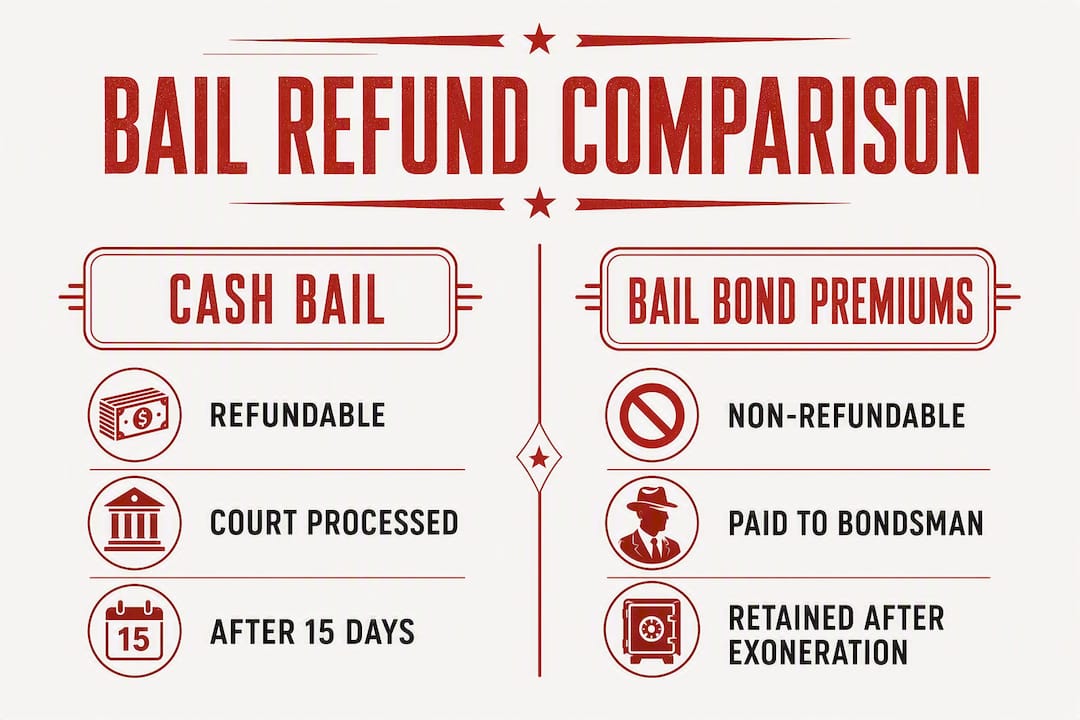
When someone posts cash directly with the court, Pen. Code §1303 controls the refund. The check goes to the person who posted the bail, not necessarily the defendant. The 15-day waiting period is mandatory; the clerk uses that time to check for outstanding fines, restitution orders, or other court-ordered financial obligations. Whatever remains after those deductions gets mailed as a check. Processing time beyond the 15-day minimum varies by county, commonly taking several weeks to months. Cash refunds are not taxable income since they are a return of collateral, not earnings.

Commercial bail bond premiums
A commercial bail bond premium is nonrefundable in virtually every case. When the court exonerates the bond, it releases the surety company from its obligation to pay the court if the defendant fails to appear. That is all exoneration does for the bondsman. The 10% premium the co-signer paid was the fee for the bondsman’s guarantee, and that fee was earned the moment the defendant walked out of jail.
Example: An example contrasting cash bail and bail bond premiums illustrates the refund difference clearly: cash bail refunds may be issued after the waiting period and deductions, while bail bond premiums generally are not refundable.
Pro Tip: Keep every receipt from the court clerk when you post cash bail. The clerk’s office will ask for proof of the original deposit when processing the refund, and a missing receipt can add weeks to the timeline. For diversion programs, file your completion certificate with the court the same day you receive it — don’t wait for the clerk to ask.
Documents to have ready when requesting a cash refund:
- Original bail receipt or court deposit confirmation
- Case number and defendant’s full legal name
- Government-issued photo ID (for the person who posted bail)
- Proof of program completion if diversion conditions applied
- Any restitution payment receipts if amounts were ordered
The 180-day forfeiture timeline and how to vacate it
Attorneys describe Pen. Code §1305 as one of the most unforgiving procedural traps in California criminal law. A single missed court date can convert posted bail into a permanent money judgment if the 180-day window closes without action.
Key statutory timeline
| Event | Deadline / Window |
|---|---|
| Defendant fails to appear | Court declares forfeiture in open court immediately |
| Clerk mails forfeiture notice (bonds > $400) | Within 30 days of forfeiture declaration |
| Mailing toll added to appearance window | +5 days if notice was mailed |
| Surety’s appearance/surrender window | 180 days from forfeiture |
| Forfeiture becomes money judgment | After 180-day window closes without vacatur |
Grounds courts commonly accept to vacate forfeiture
- Defendant appears or is surrendered in the county within the statutory window
- Defendant is arrested in another jurisdiction and returned within the window
- DA declines extradition (prosecutorial non-extradition)
- Defendant’s nonappearance was caused by permanent disability or death
- Valid legal excuse for the missed appearance, supported by documentation
Step-by-step checklist to move to vacate forfeiture
- Obtain a certified copy of the forfeiture order from the clerk.
- Confirm the exact date forfeiture was declared and whether notice was mailed (adds 5 days).
- Calculate the deadline precisely — courts reject motions filed even one day late.
- File a written motion to vacate forfeiture under Pen. Code §1305, attaching supporting declarations and evidence.
- Serve the motion on the district attorney’s office.
- Appear at the hearing with all supporting documentation (surrender records, medical records, out-of-county arrest reports, or extradition refusal letters).
- If the motion is granted, request a written order and confirm the clerk updates the case record.
Pro Tip: The most common reason forfeiture motions fail is a miscalculated deadline. Courts count calendar days, not business days, and the clock starts on the date of forfeiture, not the date the notice arrives. If you are a surety or co-signer dealing with a missed appearance, get the forfeiture mechanics reviewed by a bail attorney immediately — do not wait to see if the defendant returns on their own.
How to request or confirm bail exoneration in California courts
Exoneration sometimes happens automatically when a case resolves, but in many counties you need to take affirmative steps to get the order entered and the refund processed.
- Pull the case minutes. Log into the court’s online case lookup (most California superior courts have one) and confirm the case status. Look for language like “bail exonerated,” “bond exonerated,” or “bail ordered released.” If you see it, the order is already entered.
- Contact the clerk’s office. Call or visit the criminal division clerk. Have the case number, defendant’s full name, and your ID ready. Ask specifically: “Has an exoneration order been entered, and has a refund check been processed?”
- File a written motion if no order exists. If the case resolved but no exoneration order appears in the minutes, file a written request or motion for exoneration with the clerk. A simple one-sentence request works: “Defendant [Name], Case No. [XXXXXX], respectfully requests the court enter an order exonerating bail pursuant to Pen. Code §1303, as the case was dismissed/resolved on [date].” File it with the criminal clerk, not on the judge’s calendar, unless the clerk directs you to a hearing.
- Submit supporting documents. Attach the dismissal order, sentencing minute order, diversion completion certificate, or whatever document shows the case ended. Courts in Ventura, Santa Barbara, and Orange Counties generally process administrative exoneration faster when the paperwork is complete on first submission.
- Confirm the refund timeline. Once the order is entered, ask the clerk when the 15-day waiting period began and when to expect the check. Get that date in writing if possible.
- Follow up in writing. If the check does not arrive within the expected window, send a written follow-up to the clerk referencing the case number and the date the exoneration order was entered.
For cash bail refund questions specific to California, the clerk’s office is the right first call. Hearings are typically required only when there is a dispute about whether conditions were met or when the court wants to apply bail to fines before releasing the remainder.
What to do when a bondsman keeps demanding money after exoneration
Exoneration ends the surety’s court obligation, but it does not automatically stop a bondsman from pursuing a co-signer for indemnification under the private contract both parties signed. Those are two separate legal relationships, and knowing the difference matters.
Immediate steps:
- Obtain a certified copy of the court’s minute order showing the bond was exonerated. This is your primary document.
- Request written confirmation from the clerk that the bond is no longer active.
- Send both documents to the bondsman in writing, by certified mail, and keep a copy.
If the bondsman continues demanding payment after receiving proof of exoneration:
- Review the indemnity agreement you signed. Some agreements include clauses that survive exoneration for costs the bondsman incurred (skip-tracing fees, for example). Understand what you actually agreed to before assuming the demand is improper.
- Consult a criminal defense or bail attorney. Contested forfeiture cases and post-exoneration disputes often turn on contract language that requires legal interpretation.
- File a complaint with the California Department of Insurance if you believe the bondsman is acting in bad faith or misrepresenting your obligations. The CDI licenses bail agents and investigates complaints about improper collection practices.
Sample letter points to include when responding to a bondsman:
- Date of the court’s exoneration order and case number
- Statement that the bond obligation to the court has been terminated
- Copy of the certified minute order attached
- Request for written confirmation that the bondsman’s claim is withdrawn
- Notice that further demands will be reported to the California Department of Insurance
For contested forfeiture cases where the court has not yet vacated a forfeiture, a bail attorney is not optional. The missed court date consequences and the motion practice under Pen. Code §1305 are procedurally strict enough that a filing error can cost the full bond amount.
Key Takeaways
Bail exoneration in California ends court liability for the bond, but only cash bail posted directly to the court is refundable — commercial bail bond premiums paid to a bondsman are nonrefundable in virtually every case.
| Point | Details |
|---|---|
| Cash bail is refundable | Pen. Code §1303 requires a 15-day wait; the clerk deducts fines or restitution before issuing the check. |
| Bond premiums stay with the bondsman | The 10% premium is nonrefundable even after full exoneration; exoneration ends court liability only. |
| 180-day window is critical | Under Pen. Code §1305, a missed appearance triggers forfeiture; act within 180 days or the forfeiture becomes a money judgment. |
| Document everything | Completion certificates, receipts, and minute orders speed exoneration and protect co-signers from improper demands. |
| Badabingbail can help | Bada Bing Bail Bonds monitors exoneration status and assists clients in Ventura, Santa Barbara, and Orange Counties with paperwork and court liaison. |
Why paperwork timing matters more than most people realize
Most families focus on getting their loved one out of jail. That is the right priority. What they miss is that the exoneration process starts a second clock the moment the case resolves, and the people who lose money are almost always the ones who assumed the court would handle it automatically.
From what Badabingbail sees working across Ventura, Santa Barbara, and Orange Counties, the most common mistake is waiting. A co-signer assumes the dismissal order triggers an automatic refund. Weeks pass. Then months. Then they call the clerk and discover no exoneration order was ever entered because a diversion completion certificate was never filed. The cash is sitting there, but the clerk cannot release it without the paperwork.
County clerk practices differ more than people expect. Ventura County’s criminal clerk processes administrative exoneration requests differently than Santa Barbara’s, and Orange County’s volume means longer processing queues. Knowing which window to go to, what form to bring, and which judge’s department handles contested matters is not something you learn from a statute. It comes from showing up regularly.
The 180-day forfeiture window deserves special attention. Attorneys call it a “deadly” procedural trap, and that description is accurate. Badabingbail has seen sureties lose the full bond amount not because the defendant was gone forever, but because the motion to vacate was filed on day 181. One day. The statute has no grace period. If a defendant misses court and you have any financial exposure on that bond, the clock is the only thing that matters.
Badabingbail offers 24/7 bail and exoneration support in Southern California
When a loved one is arrested in Ventura, Santa Barbara, or Orange County, the fastest path to release runs through a licensed agency that knows the local courts. Bada Bing Bail posts bail around the clock, handles the paperwork from booking through exoneration, and stays in contact with the clerk’s office so clients are not left guessing about refund status or bond obligations.
The agency offers flexible payment plans with low down payment options for qualifying clients, making the 10% premium manageable even in a crisis. After the case resolves, Badabingbail tracks exoneration status and flags any documentation gaps before they delay a cash refund or trigger a forfeiture. For contested forfeiture matters, the agency recommends consulting a licensed attorney and can refer clients to qualified counsel. The nonrefundable premium covers the bond guarantee, not legal representation. To get someone out fast or to ask about exoneration follow-up on an existing case, call Badabingbail now — available 24/7.
This article is general information, not legal advice. Confirm current rules and your specific situation with the court clerk or a licensed California attorney.
Useful sources and where to read the statutes
The primary statutory text for every section cited in this article is available on the California Legislature’s official site. County clerk pages and the California Department of Insurance provide the procedural and oversight resources you need to act.
Primary statutes (California Legislature official text):
- Pen. Code §1305 — Forfeiture, 180-day window, notice rules: Full text of the forfeiture and vacatur provisions, including the 30-day mailing requirement and the 5-day toll.
- Pen. Code §1303 — Cash bail refund, 15-day waiting period: Governs who receives the refund check, when the clerk may issue it, and what deductions apply.
- Pen. Code §1300–§1304 — Exoneration article: Covers voluntary surrender (§1300), exoneration on just terms (§1302), and the full exoneration framework.
- Pen. Code §1384 — Dismissal and exoneration: The dismissal statute that triggers automatic bail exoneration when a case is dismissed.
Practical court and oversight resources:
| Resource | What you will find there |
|---|---|
| Your county superior court’s case lookup | Case status, minute orders, and whether an exoneration order has been entered |
| County criminal clerk’s office | Filing instructions for motions to vacate forfeiture and exoneration requests |
| California Department of Insurance | Bail agent license verification and complaint forms for improper collection practices |
| LA Superior Court criminal forms | Felony case filing instructions and motion procedures for Los Angeles County |