You may be reading this late at night because someone you love was arrested in Oxnard, Ventura, or another nearby city after an alleged fight. The booking record may show Penal Code section 245, a bail amount, and words such as “deadly weapon” or “great bodily injury,” but those entries don't tell the whole release story. Families often see the number first and miss the charge subdivision that produced it.
Bail for aggravated assault isn't one statewide price. The alleged force, weapon allegation, criminal history, county schedule, warrant status, and court review stage can all affect what happens next. In Ventura County, the fastest way to get oriented is to confirm the exact booking charge, determine whether the arrest was warrant-based, and ask whether a judge has reviewed the release decision.
Table of Contents
- What Aggravated Assault Means for Bail in California
- What Courts Consider Before Setting Bail
- How County Bail Schedules Shape the Number
- Bond vs Cash Bail in California
- A Realistic Aggravated Assault Release Timeline
- Release Conditions That Come With the Bond
- What to Do in the First Hour After an Arrest
What Aggravated Assault Means for Bail in California
A Saturday-night arrest in Oxnard can move quickly. Suppose a young adult is booked after a bar fight in which another person suffers a serious facial injury. The booking officer may refer to California Penal Code §245, but the specific subdivision matters because §245 covers both firearm allegations and assaults committed with force likely to produce great bodily injury. The statute identifies possible state-prison terms of two, three, or four years for the cited categories, along with possible county-jail time and a fine of up to $10,000. Read the California Penal Code section 245 text carefully with a defense lawyer, because punishment and pretrial release are related but separate questions.
Read the booking line first
The booking record should identify the alleged offense, subdivision, warrant information, and any additional hold. A charge involving a firearm may receive different treatment from an allegation involving force likely to cause great bodily injury. That difference can affect the initial schedule amount, whether a hearing is needed before release, and what conditions a judge considers.
The county schedule is only an initial reference point. San Francisco's official schedule, for example, listed $50,000 for one §245(a) aggravated-assault entry and $75,000 for specified deadly-weapon and firearm entries in its 2023 schedule. Its later 2025–2026 schedule also lists $50,000 for §245(a), while specified weapon entries are listed at $75,000. Those figures show why a generic statewide calculator can mislead a family, but they aren't a Ventura County quote. See the California aggravated-assault bail explanation for a plain-language starting point.
Practical rule: Don't budget from the phrase “aggravated assault” alone. Budget after confirming the code subdivision, county, warrant status, and whether a judge has reviewed the case.
Why the amount changes practical release
The national data summarized in a U.S. Supreme Court filing show how strongly financial conditions can affect release. In the Bureau of Justice Statistics study of felony defendants in the 75 largest state-court counties, covering cases processed from 1990 through 2004, 62% were released before their cases ended. About 70% were released when bail was below $5,000, compared with about 10% when bail was $100,000 or more. The same study reported a $9,000 median bail for defendants with bail set, while detained defendants had a $15,000 median, compared with $5,000 for released defendants. These figures appear in the Supreme Court filing summarizing the BJS study.
That doesn't predict an individual Ventura case. It does explain why bail for aggravated assault is more than a formal entry on a jail screen. A higher financial requirement can make release harder, while the alleged conduct, prior record, and public-safety concerns can lead to additional review rather than a simple cash transaction.
What Courts Consider Before Setting Bail
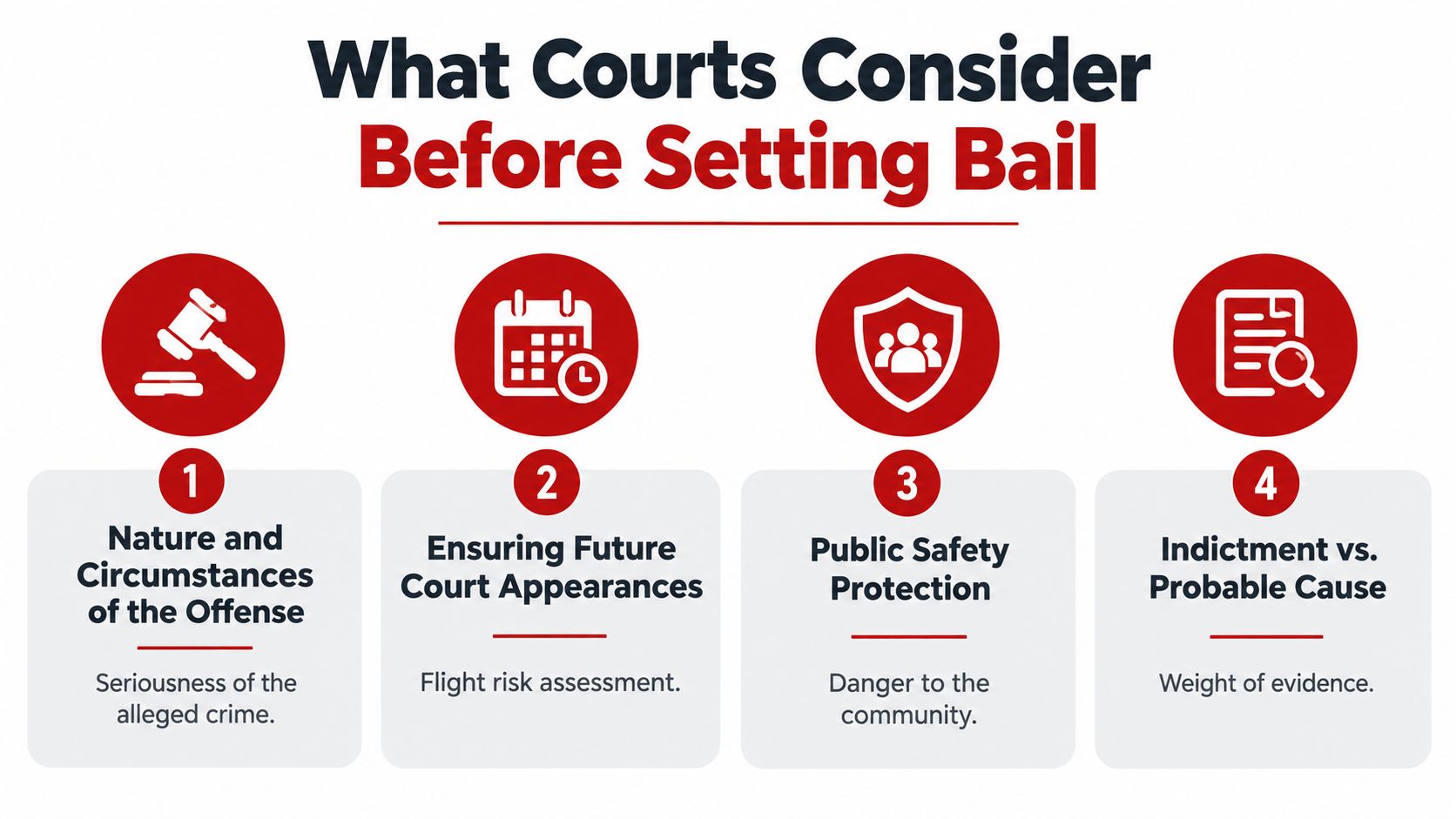
A judge, commissioner, or other authorized judicial officer doesn't look only at the dollar figure. The court weighs the alleged conduct against the person's record, likelihood of appearing, and the safety concerns raised by the police report and prosecution.
Four questions shape the review
First, what is the alleged conduct? The precise §245 subdivision matters. A force-likely-to-produce-great-bodily-injury allegation presents a different record from a firearm allegation, and the court may examine injury descriptions, alleged threats, claimed weapon use, and the relationship between the parties.
Second, what is the person's history? Prior felony cases, earlier failures to appear, probation or parole status, and open cases can make release more difficult. A clean record and a stable plan don't guarantee a lower amount, but defense counsel can use them to give the court a fuller picture.
Third, will the person return to court? Employment, housing, family connections, and local ties may help counsel present a reliable appearance plan. Outstanding warrants or unresolved cases in another jurisdiction can create delays even after a new bond is posted.
Fourth, what safety measures are needed? The court may focus on alleged weapon use, the alleged victim's vulnerability, prior protective orders, threats, and any claimed gang connection. The result may be a financial condition, supervised release, protective orders, detention, or a combination of conditions.
Prepare before the first appearance
A defense lawyer may have only a short opportunity to address release. Families can help by gathering:
- Identity details: Full legal name, date of birth, booking number, and the listed charges.
- Stability documents: Recent pay stubs, a lease, and evidence of a residence or employment plan.
- Support information: Character letters and names of people who can help with transportation and court reminders.
- Treatment records: Relevant counseling or treatment information that counsel believes can support a structured release plan.
- Compliance information: Details about probation, parole, prior court dates, and any existing protective order.
The factors that influence bail amounts can help families organize questions, but only counsel can advise on how particular facts should be presented. Don't contact the alleged victim to explain the arrest or negotiate contact. A message intended to calm the situation can become a claimed violation of a court order.
How County Bail Schedules Shape the Number
A booking record can show a $100,000 bail figure before a family ever speaks with a judge. The number may look final, but a county bail schedule works more like a posted starting menu than a permanent bill. The charging subsection, county, warrant status, and later court review can move the amount from $25,000 to $100,000 or more.
A bail schedule provides an administrative amount for certain arrests before, or around, the first court appearance. It does not replace an individualized judicial decision. The official California bail schedule material explains that a court may later consider ability to pay, less restrictive alternatives, and conditions specific to the case.
Ventura County applies its schedule under California Penal Code §1269b. For an arrest without a warrant, the listed amount generally serves as the presumptive bail figure until a judge reviews the case. A warrant booking follows a different path. The warrant amount generally controls unless a judge changes it, so the warrant itself belongs in the first document review.
Ventura County example
The 2024 Ventura County bail schedule lists Penal Code §245(a)(1), assault with a deadly weapon, at $100,000 in its felony schedule. That entry shows why reading the exact subsection matters. A booking record that says only “aggravated assault” leaves out the detail that connects the arrest to a particular schedule line.
San Francisco illustrates the county difference in one line: its published schedule listed $50,000 for a §245(a) entry and $75,000 for §245(a)(1), figures that do not set Ventura bail. County schedules can therefore produce different starting points for similar allegations.
Check four items before using any bail calculator:
- The exact Penal Code subsection, such as §245(a)(1).
- Whether the booking is a felony entry.
- Whether the arrest followed a warrant.
- Whether a hold or another court order affects release.
A family member can find the local amount by opening the Ventura PDF, going to the felony schedule, and matching the complete code section, not just the offense label. The California bail schedule guide explains common schedule terms in plain language.
A judge may later reduce or raise bail, impose nonfinancial conditions, or order detention when legally justified. Counsel should review the booking record before the first appearance, especially where it identifies a weapon allegation, warrant, hold, or serious injury claim.
Bond vs Cash Bail in California
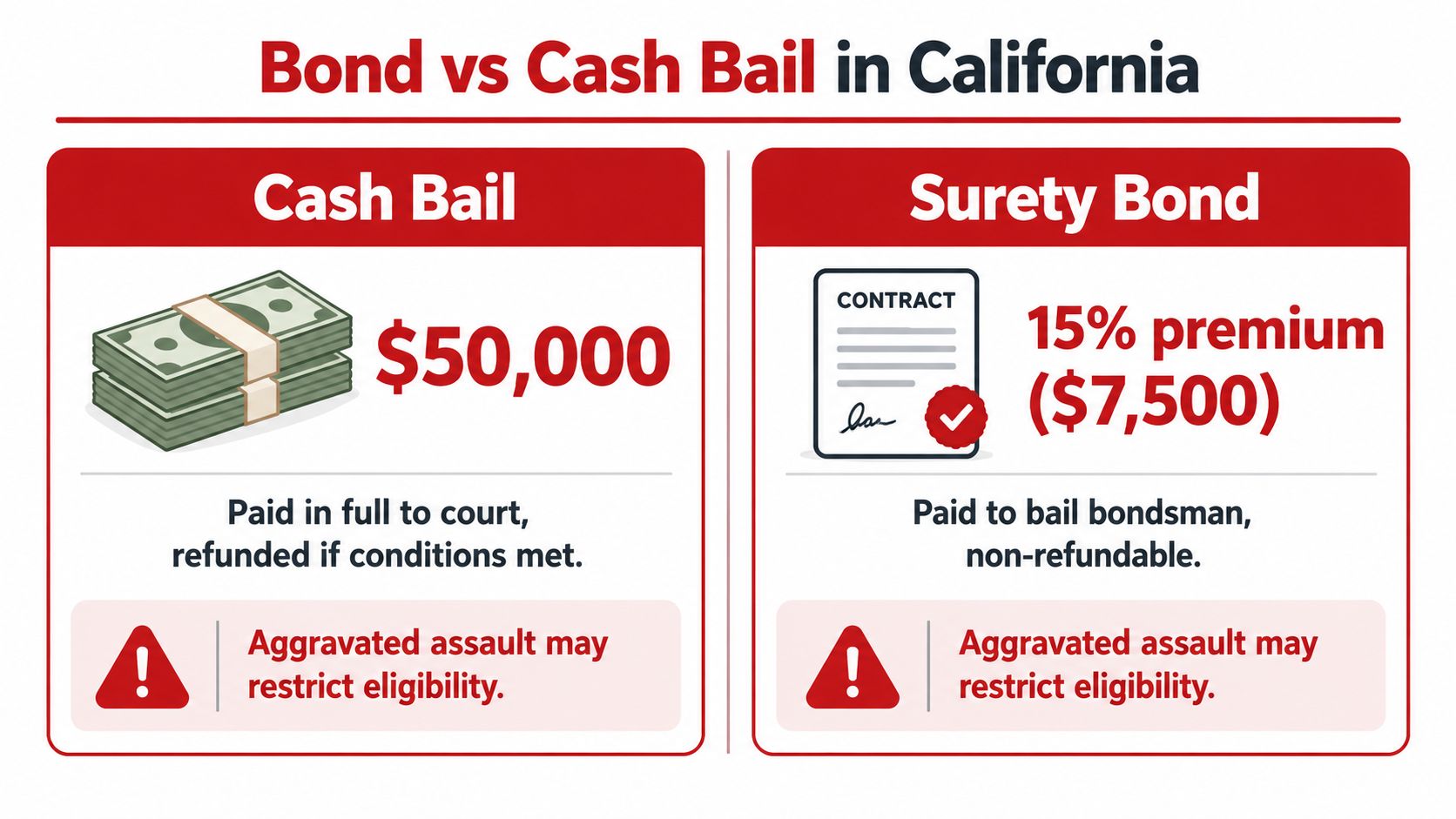
Cash bail and a surety bond solve the same immediate problem through different financial arrangements. With cash bail, the defendant or family pays the full court-set amount directly to the appropriate court or jail. If the court's requirements are satisfied, the money is generally handled under the court's refund rules at the end of the case, subject to applicable deductions and procedures.
A surety bond involves a licensed bail agent posting the full amount under a contract. The family or another indemnitor pays a premium, and the agent may require collateral or additional financial support. California's statutory premium is 10% of the total bail amount, as reflected in the publisher information provided for this service, but families should confirm the exact lawful charge and paperwork before signing.
The practical differences
| Option | What the family provides | Financial effect |
|---|---|---|
| Cash bail | The entire court-set amount | Funds remain tied up while the case proceeds, subject to court rules |
| Surety bond | A lawful premium, signed indemnity agreement, and possibly collateral | The premium isn't treated like a refundable court deposit |
| Court review | Legal advocacy and a release plan | May change the amount or conditions, but doesn't guarantee release |
A family facing a $50,000 court-set amount would need to arrange that full sum for cash bail. Under a 10% premium, the premium on a $50,000 bond would be $5,000, before any separately agreed collateral or permitted charges. Don't assume that a premium alone guarantees release. A weapon allegation, warrant, probation hold, or judicial detention order can prevent or delay release.
What the indemnitor should understand
The indemnitor is the person who signs responsibility for the bond. That person should ask about payment timing, collateral, court-date reminders, surrender procedures, and what happens if the defendant misses court. A payment plan may spread the premium, but it doesn't erase the contract or the duty to make payments.
The difference between bail and a bond is worth reviewing before signing. If the family can lawfully post cash without creating an unsafe financial situation, it may prefer that route. If the full amount isn't available, a bond may provide another path, subject to eligibility, underwriting, and court approval.
A Realistic Aggravated Assault Release Timeline
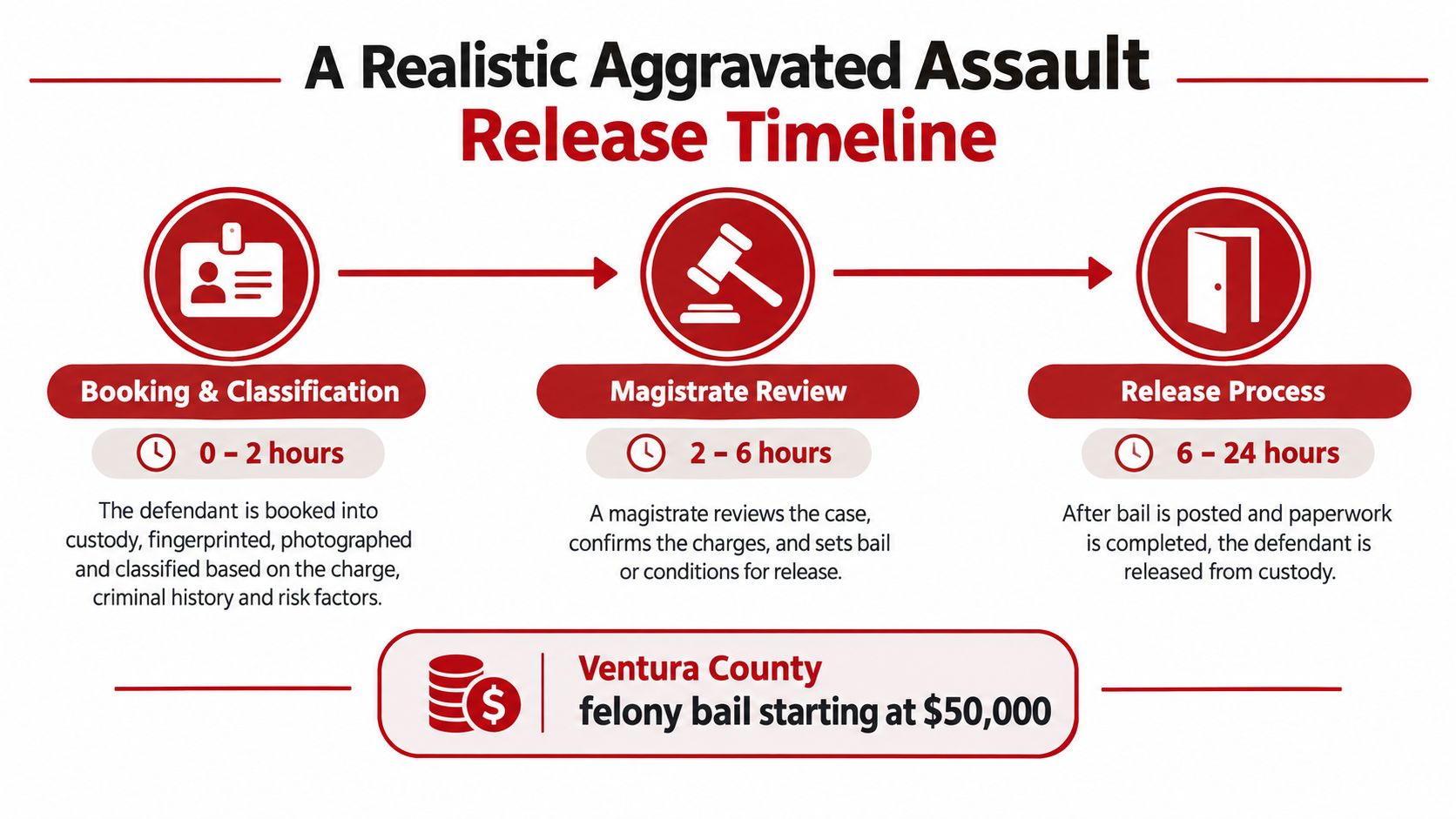
Consider a hypothetical Ventura County booking involving an alleged §245 assault and a court-set $50,000 amount. The timeline below is an example of the process, not a promise about a particular person's release time.
Booking and verification
The person arrives at the Ventura County Pre-Trial Detention Facility for identification, medical screening, classification, and housing decisions. The family should first confirm the legal name, date of birth, booking number, listed charge, bail status, warrant information, and any hold. A late booking, incomplete records, medical clearance, or another jurisdiction's warrant can change the sequence.
Counsel may need to determine whether the listed amount is a schedule figure, a warrant amount, or a judge's order. If arraignment hasn't occurred, a family may be able to prepare paperwork while waiting, but shouldn't assume an agent can bypass a required hearing.
Court review and paperwork
At the first appearance, the judicial officer may review the charge, the police allegations, criminal history, appearance concerns, and safety conditions. The court may leave the amount in place, change it, impose protective terms, or order detention when legally justified.
If a bond is available, the family can contact a local licensed agent with the booking information. The indemnitor may need government identification, proof of address, financial information, and documents supporting any collateral. The agent prepares paperwork, the indemnitor signs the agreement, and the bond is submitted to the jail or court through the required process.
Release processing
After acceptance, jail staff still must verify the bond, complete internal checks, confirm holds, and prepare the person for release. The family should arrange transportation and avoid waiting in an unsafe location or assuming the person will walk out immediately after paperwork is accepted.
A late court session, an unresolved warrant, a probation or parole issue, or a required protective-order hearing can extend the wait. The most useful questions are specific: Has the bond been accepted? Is there another hold? Has the judge imposed conditions? What release location and transportation instructions apply?
Release Conditions That Come With the Bond
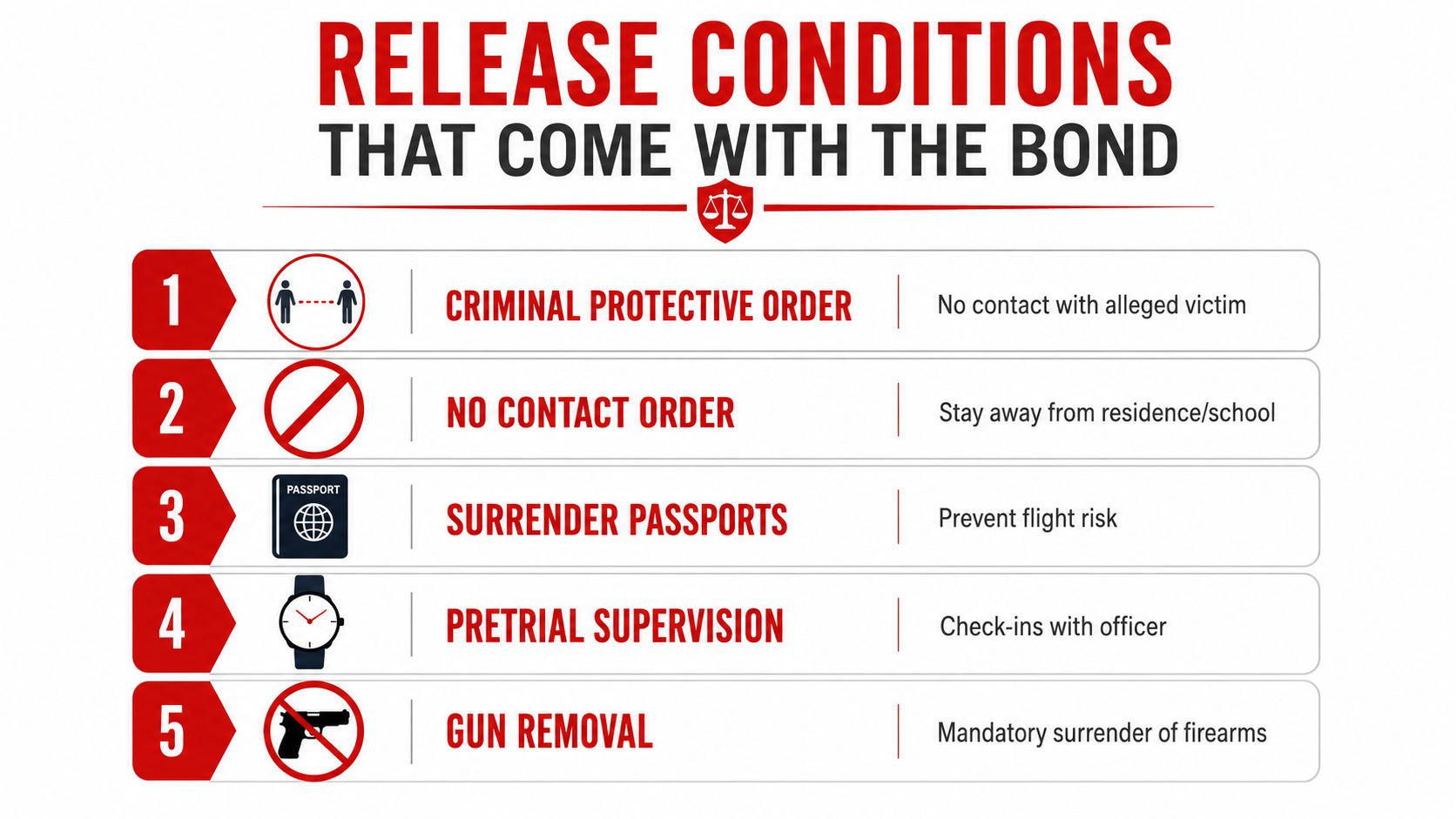
Posting a bond doesn't cancel the court's safety and appearance requirements. In an aggravated-assault case, the judge may impose a criminal protective order, a no-contact condition, weapons restrictions, monitoring, counseling, residence rules, or a requirement to attend every court date. The exact terms appear in the court's order, not in the family's assumptions.
Conditions that commonly require attention
A criminal protective order may prohibit contact with the alleged victim. That can include direct calls, texts, visits, and messages sent through friends or relatives. A separate stay-away term may apply to a home, workplace, school, or other location.
A judge may also require surrender of firearms, prohibit possession of weapons, restrict travel, require check-ins with pretrial services, or impose electronic monitoring. In some cases, alcohol or drug testing, counseling, curfew, or residence approval may become part of the release plan. The order controls, so the defendant should ask counsel to explain every term before leaving custody.
Small mistakes can have large consequences
Families often focus on the premium and overlook the order. A defendant may be re-arrested or face a bond problem after sending a single “harmless” text, returning to a shared residence, missing a monitoring appointment, possessing a firearm that wasn't surrendered, or failing to appear in court.
Compliance reminder: Treat every release condition as active until a judge changes it in writing.
Keep a copy of the orders in a safe place. Tell relatives not to contact the alleged victim on the defendant's behalf. Remove prohibited weapons promptly through a lawful process directed by counsel or the court, and ask before making travel, housing, employment, or treatment changes that could conflict with supervision.
What to Do in the First Hour After an Arrest
The first hour should be organized, not frantic. Start by calling the booking facility or checking its official custody information to confirm that the person is there. Have the full legal name and date of birth ready, then ask for the booking number, exact charges, bail status, court date, and any stated hold.
Next, speak with defense counsel or request a public defender through the court process. A bail agent can explain the bond paperwork when bail has been set, but an agent can't replace legal advice about the charge, a protective order, a detention request, or a bail-reduction argument. If the family can post the full cash amount directly and the facility accepts that method, it may not need a surety bond. If an out-of-county warrant or other hold exists, paying the new bail may not produce immediate release.
The first steps after an arrest are easier when one person keeps a written log. Record every call, name, time, document request, and promised follow-up.
Keep this checklist by the phone
- Stay calm: Avoid contacting the alleged victim or discussing the facts on recorded jail calls.
- Confirm identity: Write down the full name, date of birth, booking number, and facility.
- Read the charge: Record the exact Penal Code subdivision and any weapon allegation.
- Check the amount: Ask whether the figure comes from a schedule, warrant, or judge's order.
- Check for holds: Ask about warrants, probation or parole matters, and other jurisdictions.
- Choose the payment route: Compare lawful cash bail with a surety bond and understand the contract.
- Prepare documents: Gather identification, address information, payment details, and collateral records if requested.
- Plan transportation: Arrange a safe pickup and confirm where release will occur.
- Protect compliance: Obtain every written condition and put the first court date on multiple calendars.
For Ventura County bail bonds, Bada Bing Bail Bonds offers licensed agents who can verify booking details, explain the listed charge and bond paperwork, and coordinate with the jail at any hour. Visit Bada Bing Bail Bonds to discuss bail for aggravated assault, payment options, collateral questions, and the next practical step.