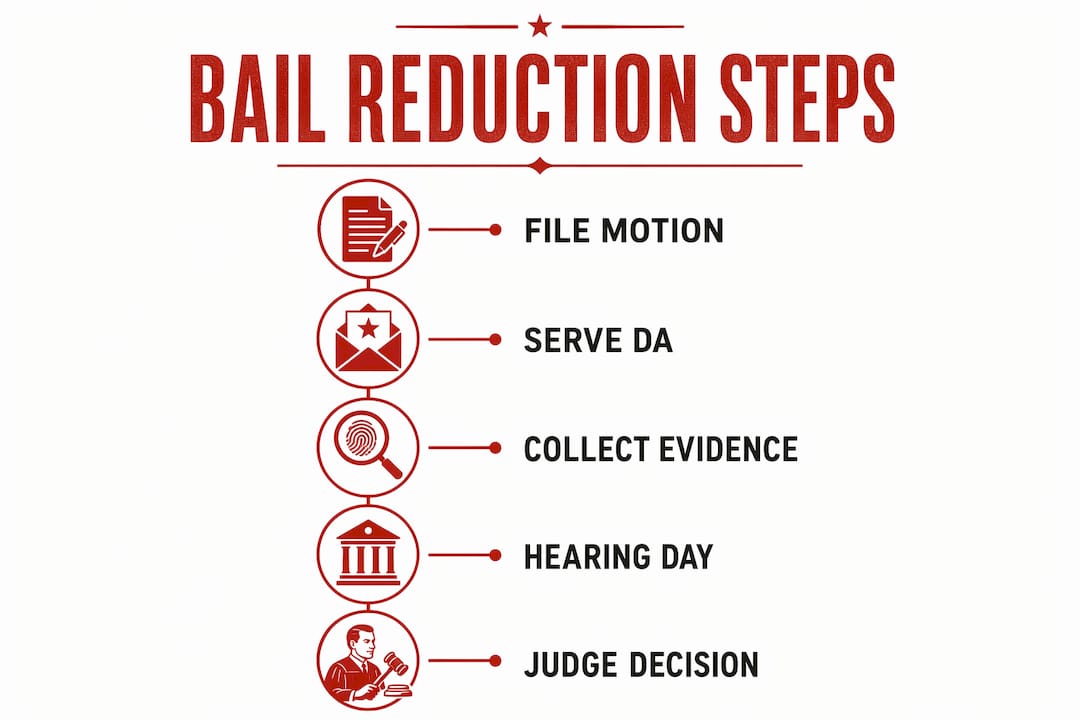
Yes, you can seek a bail reduction in California. Under Cal. Penal Code §1275, a judge must weigh public safety, offense seriousness, criminal history, and likelihood of appearance before setting or modifying bail. The California Supreme Court’s 2021 ruling in In re Humphrey added a critical layer: judges must meaningfully consider whether the defendant can actually afford bail. If they can’t, money bail cannot function as a back-door detention order.
Here’s what to do right now:
- Confirm the charge and bail amount. Get the booking number, facility name, and exact bail figure. This determines which legal standard applies.
- Check for automatic review. Under Pen. Code §1270.2, defendants who remain in custody solely because they can’t afford bail are entitled to an automatic bail review within five days. No changed circumstances required.
- Start collecting financial proof immediately. Pay stubs, bank statements, and tax returns are what judges actually look at. Vague hardship claims don’t move the needle.
- Serve the district attorney correctly. Most counties require at least two court days’ written notice; many require five. Missing this deadline often kills the hearing.
- Call a local bondsman for urgent release. Bada Bing Bail Bonds serves Ventura, Santa Barbara, and Orange Counties 24/7 and can post a bond while you prepare the motion.
Table of Contents
- What a bail reduction motion is and why California law gives you real leverage
- Timing, notice requirements, and how to avoid a procedural delay
- What judges actually weigh and how to frame your argument
- Documents and evidence to collect before the hearing
- What to expect at the hearing and the risks you need to know
- How bail bonds fit into the reduction process
- Key Takeaways
- The reality families don’t hear enough about bail reduction
- Bada Bing Bail Bonds is ready when you need release fast
- Useful sources
What a bail reduction motion is and why California law gives you real leverage
A bail reduction motion is a formal request asking the court to lower or eliminate the money bail set at arraignment. The defendant, defense counsel, or a family member acting through counsel can initiate it. As a family member or friend, your practical role is to gather evidence, fund the effort, and potentially co-sign a bond. You are not the filer, but your financial documentation and character statements are often the backbone of the motion.
The statutory vehicle is Cal. Penal Code §1275, which lists the factors every judge must weigh. A separate provision, Pen. Code §1289, allows the court to reduce bail on good cause after the defendant has already been admitted to bail. And for defendants who simply can’t pay, §1270.2 triggers an automatic five-day review without requiring any showing of changed circumstances.
In re Humphrey (California Supreme Court, 2021) changed the calculus. Courts must now follow a two-step process: first, consider whether nonfinancial conditions can reasonably assure appearance and public safety. Only if money is genuinely necessary does the court move to the second step — and even then, it must ask whether the defendant can pay without substantial hardship. Bail cannot operate as de facto detention for someone whose only problem is poverty.
One hard limit: for serious or violent felonies under §1275©, the court must make a specific finding of “unusual circumstances” on the record before reducing bail below the county-approved schedule. The statute is explicit that a clean prior court appearance record does not, by itself, qualify as unusual circumstances.
Timing, notice requirements, and how to avoid a procedural delay
Getting the timing right is where many families stumble. California requires the district attorney to receive at least two court days’ written notice before a bail reduction hearing. Many local superior courts require five business days. Miss that window and the hearing gets continued, sometimes by weeks.
| Rule | Timeframe | Source |
|---|---|---|
| Statutory minimum notice to DA | 2 court days | Cal. Pen. Code / local rules |
| Common local court practice | 5 business days | County superior court rules |
| Automatic review (§1270.2) | Within 5 days of original order | Pen. Code §1270.2 |
Practical steps: file the written motion with the clerk, serve the DA with the full motion and all exhibits, and immediately get a stamped proof-of-service copy. File that proof of service with the clerk the same day. Courts have postponed or dismissed motions solely because proof of service was missing from the file. Check your specific county’s superior court website for local rules. Ventura, Santa Barbara, and Orange County courts each publish their own procedural requirements. For county-specific procedural guidance, the Ventura County bail reduction hearing guide walks through local notice steps in detail.
What judges actually weigh and how to frame your argument
Under §1275(a), public safety is the court’s primary consideration. Everything else follows: seriousness of the offense (including victim injury, firearm use, and controlled substances), the defendant’s prior record, and the probability of appearing at trial. Post-Humphrey, ability to pay sits alongside these factors as a constitutional requirement, not an afterthought.

For the flight-risk analysis, judges look at objective anchors. How long has the defendant lived in the area? Do they own or rent locally? Are there children in local schools, an active job, or a treatment program they’re enrolled in? A defendant with no prior failures to appear, steady employment, and family in the county presents a very different picture than someone with no local ties.
For serious or violent felonies, the §1275© “unusual circumstances” bar is real. Evidence that can meet it includes documented medical or mental-health conditions requiring ongoing treatment, significant deterioration in the defendant’s circumstances since bail was set, or a substantial change in the charges themselves. Simply being a first-time offender or having appeared at every prior hearing is not enough.
Pro Tip: Present ability-to-pay evidence in concrete, documentary form. Judges expect last two years of tax returns, multiple months of pay stubs, current bank balances, and a month-by-month expense list showing rent, utilities, child support, and medical costs. A declaration that says “I can’t afford the bail” without supporting documents carries almost no weight.
Documents and evidence to collect before the hearing
A bail reduction motion lives or dies on its documentation. Organize everything into a hearing binder before you file.
Financial documentation:
- Last two years of federal tax returns
- Three to six months of pay stubs or proof of public benefits
- Current bank statements (all accounts)
- Monthly expense list: rent or mortgage, utilities, child support, medical bills
Community ties and stability:
- Employment verification letter from the employer
- Lease or mortgage statement showing local residence
- School enrollment records for the defendant or their dependents
- Character letters from employers, clergy, or community members (specific, not generic)
- Membership records from treatment programs, counseling, or community organizations
Medical and mental-health records (when applicable):
- Prescriptions and pharmacy records
- Clinician letter explaining treatment needs or incapacity
Procedural documents:
| Exhibit | Purpose | Where to obtain |
|---|---|---|
| Written motion | Formal request to the court | Defense counsel drafts |
| Sworn declaration | Ties exhibits to specific paragraphs | Defendant or family member signs |
| Proof of service | Shows DA was served on time | Clerk stamps after filing |
| Filing receipt | Confirms motion is in the record | Court clerk’s office |
Pro Tip: Prioritize certified or clearly dated records. A bank statement printed from an app with no account number or institution header is weak. Handwritten notes without supporting documents are weaker still. Certified copies and official letterhead carry far more credibility with judges.
What to expect at the hearing and the risks you need to know
The hearing typically runs a short duration. Defense counsel presents first, walking the judge through financial records, community ties, and any changed circumstances since the original bail was set. The prosecutor responds, usually emphasizing charge severity, criminal history, or specific facts suggesting flight risk or danger. The judge then rules on the record.
Possible outcomes:
- Denial: Bail stays the same. The defendant remains in custody. You can refile when circumstances meaningfully change.
- Reduction: New bail order is entered. The defendant can post the lower amount and be released.
- Release on own recognizance (OR): No money required. Conditions may apply (check-ins, GPS monitoring, travel restrictions).
- Detention without bail: Rare, but possible for serious violent felonies with a strong public-safety showing.
One outcome families rarely anticipate: judges may raise bail or impose stricter conditions if new information surfaces at the hearing suggesting greater danger or flight risk. If the prosecutor presents facts the defense wasn’t prepared to counter, the motion can backfire. This is why preparation matters as much as filing.
For co-signers, the stakes are concrete. If the defendant fails to appear after you’ve posted a bond, the court enters a forfeiture. The bondsman has a set period to return the defendant before the full bail amount is owed. Missing court also triggers a bench warrant. Understanding what happens if you miss court before you co-sign is not optional.
How bail bonds fit into the reduction process
You don’t have to wait for a hearing to get your loved one out. Posting a bond before the reduction hearing secures release now. Pursuing the motion afterward can lower the cost retroactively. Posting bail does not waive the right to seek a reduction later.
Financing options families commonly use:
- Cash bail: Full amount paid directly to the court. Returned after the case concludes (minus fees), assuming all appearances are made. Requires significant liquid assets.
- Surety bond (bail bond): A licensed bondsman posts the full bail in exchange for a non-refundable premium, typically 10% of the bail amount. A $50,000 bail costs $5,000 in premium.
- Payment plans with a bondsman: Many agencies, including Bada Bing Bail Bonds, offer low down payments for qualifying clients, spreading the premium over time.
- Short-term loans or credit: Personal loans or credit lines can cover a premium but carry interest costs.
- Community fundraising: Crowdfunding platforms can help, but timing is unpredictable.
Pro Tip: When a reduction is likely and custody time is short, posting a temporary bond plus filing the motion quickly can be the lowest-cost path. If bail drops substantially, the non-refundable premium for a bondsman falls proportionally. The savings often exceed the cost of the motion itself.
For a full breakdown of how bail bond mechanics and co-signer obligations work in California, that’s worth reading before you sign anything.
Key Takeaways
A bail reduction motion in California succeeds when families act fast, serve the DA correctly, and bring concrete financial evidence to a judge who is legally required to consider ability to pay.
| Point | Details |
|---|---|
| Automatic review right | Pen. Code §1270.2 entitles defendants who can’t afford bail to a review within five days, no changed circumstances needed. |
| Notice deadline | California law requires at least two court days’ notice to the DA before the hearing; many counties require five business days. Check local rules for exact deadlines. |
| Serious/violent felony bar | Under §1275©, courts must find “unusual circumstances” on the record to reduce bail below the county schedule. |
| Ability-to-pay standard | Post-Humphrey, judges must meaningfully evaluate whether the defendant can pay without substantial hardship. |
| Badabingbail option | Bada Bing Bail Bonds serves Ventura, Santa Barbara, and Orange Counties 24/7, with low down payments for qualifying clients, so families can secure release while the motion is prepared. |
The reality families don’t hear enough about bail reduction
Most guides frame a bail reduction motion as a legal procedure. It is. But the families who get the best results treat it as a documentation project first and a courtroom argument second.
Judges in California superior courts see dozens of these motions. A motion that arrives with a complete binder, certified financial records, a specific community-ties declaration, and clean proof of service reads as credible before the attorney says a word. One that arrives with a vague hardship letter and no exhibits reads as unprepared, regardless of how sympathetic the facts are.
The Humphrey decision gave defendants a genuine constitutional hook. But that hook only catches if the defense puts a real record in front of the judge. The ability-to-pay argument is not self-executing. It requires the same documentary specificity as every other part of the motion.
One more thing: the risk of a hearing going sideways is real. If the prosecutor has information the defense hasn’t seen, or if the defendant’s record is more complicated than the family realized, the hearing can produce a worse outcome than the status quo. That’s not a reason to avoid filing. It’s a reason to prepare thoroughly and consult a licensed attorney before you do.
Bada Bing Bail Bonds is ready when you need release fast
When bail is set and your loved one is sitting in a Ventura, Santa Barbara, or Orange County jail, the fastest path to release is a licensed bondsman who knows the local courts. Bada Bing Bail Bonds has been doing exactly that for over 15 years, available around the clock, with Spanish-language support and flexible financing that includes low down payments for qualifying clients.
Posting a bond now does not close the door on a bail reduction motion later. You can pursue both, and Badabingbail can help you coordinate the timing. To get started, have the defendant’s full name, booking number, jail location, and bail amount ready, then reach out directly. For immediate help, visit the fast release page or explore bail bond financing options if the premium is a barrier.
Useful sources
Verify current rules directly with your county superior court before filing. Local notice requirements vary.
| Source | What it covers |
|---|---|
| Cal. Penal Code §1275 | Statutory bail factors: public safety, offense seriousness, criminal history, appearance probability, and the §1275© unusual-circumstances rule |
| Cal. Penal Code §1270.2 — FindLaw | Automatic five-day bail review for defendants who cannot afford bail |
| In re Humphrey summary — David P. Shapiro Law | Ability-to-pay standard and post-Humphrey two-step court inquiry |
| How to file a bail reduction motion — LegalClarity | Step-by-step filing guidance, document checklist, and hearing walkthrough |
| Bail review hearing in California — LegalClarity | Procedures and the nonfinancial-conditions-first framework |
Check your county’s superior court website for local rules on service deadlines. Some counties, including those in Southern California, apply five-day local rules that are stricter than the statutory minimum.
This article is general legal information, not legal advice. Confirm current rules with your county superior court or a licensed California attorney before filing.