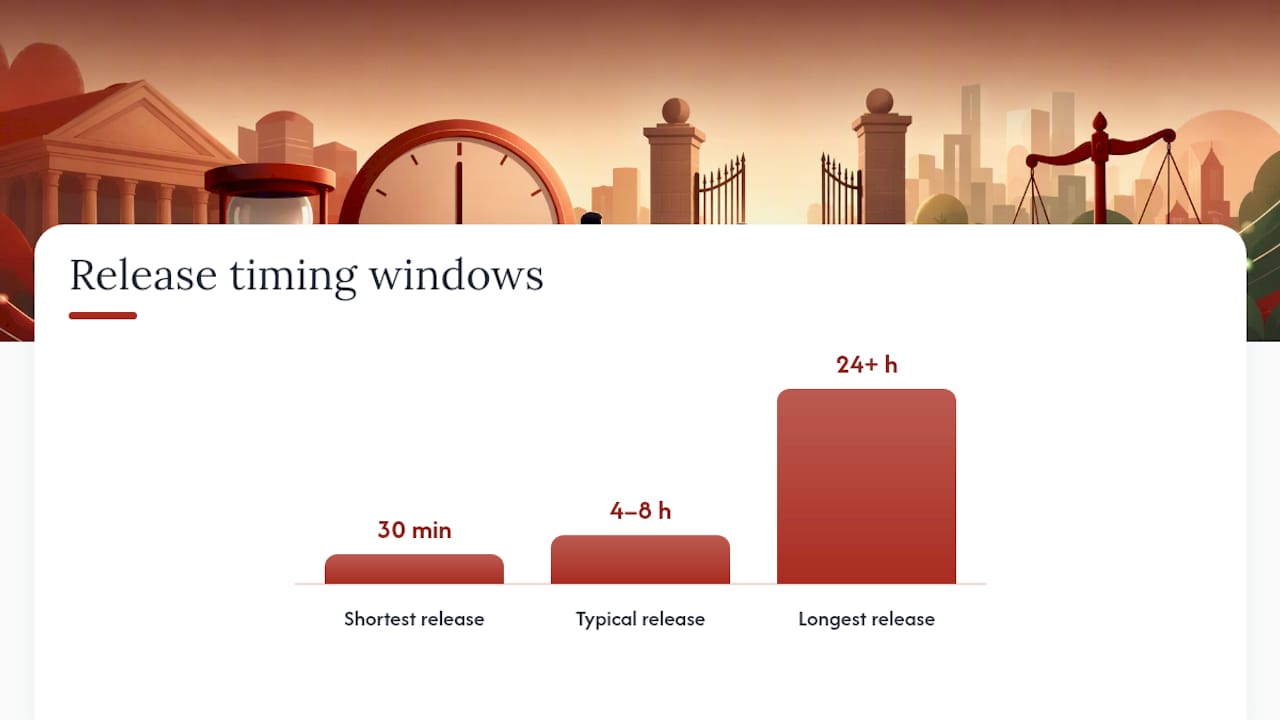
Most people get released within a few hours of posting bail. The realistic window runs from about 30 minutes in a quiet, well-staffed facility to 12 hours or more in a busy county jail, and some cases stretch past 24 hours when holds or paperwork backlogs get in the way. The single best move right now: call the jail’s booking desk or your bail agent and confirm they’ve actually received the bond paperwork, not just the payment.
- Best case: 30 minutes to 2 hours (small jail, daytime, no holds)
- Typical case: 4 to 8 hours (average county facility, normal staffing)
- Extended case: 12 to 24+ hours (large jail, night/weekend booking, or an active hold)
Key Takeaways
Release timing after bail depends more on jail staffing, holds, and booking completion than on the payment method itself, and most releases clear within 4 to 8 hours.
| Point | Details |
|---|---|
| Typical release window | Most releases happen in 4 to 8 hours, with a realistic range of 30 minutes to 24+ hours. |
| Holds override payment | Warrants, probation holds, and immigration detainers block release even after bail is fully posted. |
| Booking must finish first | Fingerprints, warrant checks, and medical screening have to close out before discharge paperwork can be signed. |
| Timing shifts by release type | Recognizance releases often move fastest; cash and surety bonds vary more with jail workload. |
| Badabingbail speeds the paperwork side | Badabingbail handles cosigner documents and jail coordination 24/7 with flexible financing for qualifying clients. |
This article is general information, not a substitute for advice from a qualified lawyer. Consult a qualified legal professional about your own circumstances before acting on anything here.
Table of Contents
- Factors Affecting Bail Release Time
- Typical Timelines by Release Type
- What Happens at the Jail After Bail Is Posted
- How to Speed Up Bail Release
- When Release Takes Longer Than Expected
- How County Jail Release Windows Vary
- What National Data Says About Time to Release
- Sources
Factors Affecting Bail Release Time
Jail staffing levels drive more of the delay than anything else. A facility running a full day shift can clear a bond in under two hours; the same jail at 2 a.m. on a Saturday might take three times as long because fewer clerks are working the release window.
Three operational factors matter most:
- Staffing and shift changes — release paperwork often gets set aside during shift handoffs
- Time of day and day of week — nights, weekends, and holidays slow everything down
- Facility backlog — a jail processing a mass booking event (a DUI checkpoint sweep, for example) pushes every other release back
Legal holds are a different problem entirely, and money doesn’t fix them. An outstanding warrant in another county, a probation or parole hold, or an immigration detainer will block release regardless of how the bond is paid until that specific hold is cleared through its own channel.
Bail amount and type affect the process as well. Larger amounts may require additional verification steps, and cash bonds can take longer to process compared to bonds posted via licensed agents.

Pro Tip: Call the jail’s booking or records line before you drive over, and have the inmate’s full legal name, date of birth, and booking number ready. Giving the clerk a mismatched name spelling is one of the most common reasons paperwork gets kicked back for review.
Typical Timelines by Release Type
The release mechanism you use changes the math more than most people expect. Recognizance releases (no money involved) frequently move fastest because there’s no payment to verify. Surety bonds through a licensed bail agent usually land in the middle. Cash bonds can be quick in a small jail but slow in a busy one, since staff have to count and secure the funds.
- Recognizance / time-served release: often 1 to 4 hours once a judge signs off
- Surety bond (bail agent): typically 2 to 6 hours after the agent delivers paperwork
- Cash bond: ranges from 1 hour (small jail) to 10+ hours (large county facility during a busy shift)
National data from the Bureau of Justice Statistics shows financial releases generally take longer than non-financial ones. About half of all pretrial releases happen within a day, and many more within a week. The average time from arrest to release tends to increase with the bail amount, reflecting the time it takes to gather funds rather than jail processing speed. That gap mostly reflects how long it takes a family to gather funds, not jail processing speed, but it shows why higher bail amounts drag out the whole timeline.
A quick example: a DUI arrest with a $10,000 bond posted through an agent at 11 a.m. on a Tuesday might see release by 3 p.m. The same bond posted at 1 a.m. on a Sunday, at a jail running weekend skeleton staff, could easily take until the next afternoon.
What Happens at the Jail After Bail Is Posted
Posting the bond starts the clock, but it doesn’t finish the job. The facility still has to run its own internal discharge process before anyone walks out.
- Bond intake and verification. Staff confirm the paperwork matches the booking record and the amount matches the court’s bail schedule.
- Warrant and hold check. The system runs the inmate’s name through local and often state databases to confirm no outstanding warrants or holds exist.
- Booking completion. If booking (fingerprints, ID checks, medical screening) hasn’t fully closed out yet, release can’t proceed even with bond paid.
- Property return and paperwork sign-off. A supervisor or shift sergeant typically signs the discharge order.
- Transport to the release point. In larger jails, the inmate has to be moved from housing to a release area, which can add 30 to 90 minutes on its own.
Most delays happen at step 2 or step 3. A pending hold or an incomplete booking record can stall release for hours even after the money has already cleared.
How to Speed Up Bail Release
A few small mistakes cause most of the avoidable delay. Getting these right before you post bail saves real time.
- Double check the spelling of the full legal name and date of birth against the booking record
- Have the booking number ready when you call or arrive
- Keep payment receipts and ID for the cosigner on hand
- Save the jail’s records line and your bail agent’s contact information in one place
A licensed bail agent can prep and deliver the cosigner paperwork correctly the first time, which avoids the most common cause of rejected bonds. What an agent cannot do is clear a warrant, lift a hold, or speed up a jail’s internal booking queue. Only the jail controls that part.
Pro Tip: Coordinate by phone before driving to the jail. Waiting in a parking lot doesn’t move the process along, and early coordination between family and bail professionals is one of the most reliable ways to cut administrative wait time.
When Release Takes Longer Than Expected
If it’s been well past the typical window for your release type, something specific is probably wrong rather than just “normal” slowness.
Watch for these red flags:
- The jail says a hold hasn’t cleared
- The bond was rejected for a name, date of birth, or amount mismatch
- Staff mention a pending warrant you weren’t told about earlier
If your release is running hours past the typical range for your bond type, ask the jail directly: “Is there a hold, and what agency placed it?” That single question usually reveals the real bottleneck faster than repeated calls asking “when.”
Escalate in this order: confirm the jail received the paperwork, ask for the specific reason for delay, then call the court clerk or probation office if a hold is named, and loop in your bail agent or attorney if nothing moves within a few hours beyond the facility’s stated window.
How County Jail Release Windows Vary
Local policy shapes timing as much as anything else. Miami-Dade County Corrections publishes specific release hours and notes that processing can take up to eight hours even after a bond clears. A much smaller department, like the one covered in Somersworth, New Hampshire’s police FAQ, reports a bail-out process closer to 60 minutes when staffing allows.
Metro jails process far more bookings per shift, which means more queue time even with more staff. Rural and small-city jails often move faster simply because there’s less volume, not necessarily better technology.
- Check your county jail’s inmate-release or booking page for posted hours before you go
- If you’re in Ventura or Santa Barbara County, review local release timing and county-specific guides for what’s typical there
What National Data Says About Time to Release
The national picture backs up what county pages show individually. BJS data confirms about half of pretrial releases happen within a single day, and three-fourths within a week, but that average hides a wide spread driven mostly by bail amount and release type. Financial releases lag behind recognizance releases because there’s money to verify and, often, a family working to gather funds.
Federal law adds another layer: it requires an arrestee be brought before a magistrate without unnecessary delay, which means a judge’s calendar, not just jail staffing, can shift the timeline in federal cases. Local reforms that expand unsecured bond use have also been shown to raise immediate-release rates in some counties, which is one reason release speed varies so much by jurisdiction.
A bail agent’s view on realistic timing
Bottlenecks almost always trace back to two things: a name or date of birth that doesn’t match the booking record, and a hold nobody mentioned until the last minute. Coordinating early, confirming exact spelling before the bond is written, and calling the jail’s records line directly, rather than assuming, consistently shaves hours off the wait.
Where a licensed bail agent fits into the process
A licensed bail agent handles the parts of this process that trip families up most: preparing accurate paperwork, confirming the jail has everything it needs, and staying reachable if a hold or a records mismatch comes up at 2 a.m. Bada bing bail provides 24/7 support across Ventura, Santa Barbara, and Orange Counties, with Spanish-language assistance and flexible financing for qualifying clients who can’t cover the full premium upfront.

The fee structure is straightforward: a non-refundable bond premium, typically 10% of the total bail amount, with payment plans available for those who qualify. There’s no guesswork about what you owe going in.
If someone you love is in custody right now, get started on a fast release by calling Badabingbail directly. The sooner the paperwork moves, the sooner the waiting stops.
Sources
- Bureau of Justice Statistics report (prfdsc.pdf)
- Congressional Research Service product R40221 (federal bail law overview)
- Financial Conditions Research Summary (Advancing Pretrial, 2024August)
- Inmate Release (Miami‑Dade County Corrections)