Your phone rings after midnight. A brother, spouse, parent, or friend says they’ve been booked into the Ventura County Jail. You’re half awake, searching Thousand Oaks Bail Bonds , Oxnard Bail Bonds, and even 24 hour bail bonds near me, trying to figure out what gets someone out fastest and what’s going to cost you the least damage.
At that moment, most families don’t need a law school definition. They need a straight answer to their most pressing question. Should you pay the full bail in cash, use a bond, or ask whether release on recognizance is possible? That’s the crucial bail vs bond difference for families in Ventura, Oxnard, Camarillo, Port Hueneme, Thousand Oaks, Santa Paula, Moorpark, Fillmore, Ojai, and nearby Santa Barbara.
A lot of online articles stop at vocabulary. They tell you what bail is and what a bond is, but not how to decide under pressure. That gap matters because the practical choice has real consequences for your money, your time, and how quickly your loved one gets out. A more useful way to look at it is the decision tree described in this plain-language bail vs. bond overview.
Table of Contents
- That Late Night Call An Introduction for Ventura County Families
- Bail vs Bond The Core Definitions in Plain English
- The Process How Release Works at the Ventura County Jail
- The Financial Bottom Line Cash Bail vs Bail Bond Premium
- Making the Call When to Use a Bail Bonds Agency
- How to Secure Fast Bail Bonds in Ventura A Step-by-Step Guide
- Common Misconceptions and FAQs for Ventura County
That Late Night Call An Introduction for Ventura County Families
When that call comes in, families usually ask the same first questions. Where is the person being held, how much is bail, and how soon can they come home? In Ventura County, that often means dealing with booking, bail information, and release logistics while you’re still trying to understand what happened.

The first thing to know is that this usually isn’t a simple glossary problem. Families searching for Ventura County bail bonds or help with the Ventura County Jail often think they’re asking, “What’s the difference between bail and bond?” What they’re really asking is, “What’s my best option right now?”
What families actually need to decide
There are three practical paths to think about:
- Cash bail if the full amount is available and you want the possibility of getting that money back later.
- A surety bond if paying the full amount upfront isn’t realistic.
- Release on recognizance if the court allows release without a bail payment.
That’s why basic definitions only go so far. The more useful question is which path fits your situation at 2 AM, not which term sounds more correct.
If you’re panicking, slow down and gather the booking name, date of birth, where the person is held, and whether a bail amount has been assigned. Those details drive everything that happens next.
Families in Ventura, Oxnard, and Thousand Oaks usually move faster once they understand the process instead of chasing random search results. If you need a local overview first, this Ventura County bail bonds guide gives the local context many families are looking for.
Bail vs Bond The Core Definitions in Plain English
Here’s the cleanest way to understand the bail vs bond difference.
Bail is the amount the court sets as the price of release. Bond is one way to secure that release when you don’t want, or can’t afford, to hand over the full amount yourself.
Think of it like this
Bail is the full security amount. A bond is the arrangement that lets a licensed bail company stand behind that amount for you.
If you pay the court directly, you’re dealing with the court’s requirement yourself. If you use a bond, a bail company takes on the obligation to the court, and you pay the company for that service.
What the official distinction means
The Bureau of Justice Statistics explains that a deposit bond involves paying a percentage, usually 10%, directly to the court, while a bail bond company becomes liable for the full bail amount if the defendant fails to appear, with the family paying a separate fee to the company through a Bureau of Justice Statistics bail definition.
That’s why people confuse the terms. In conversation, people say “bail” when they mean “getting someone out.” But in practice, they are not the same thing.
Practical rule: Bail is the amount set by the court. A bond is the financial tool used to satisfy that amount when a third party steps in.
A simple way to remember it:
| Term | Plain-English meaning | Who holds the risk |
|---|---|---|
| Bail | The court-set amount required for release | You, if you post it directly |
| Bond | A surety arrangement through a bail company | The bail company, which answers to the court |
If you’re still sorting out the terminology, this explanation of what bail means is a useful starting point before you compare options.
The Process How Release Works at the Ventura County Jail
At the local level, release doesn’t happen in theory. It happens through booking, bail assignment, paperwork, payment, and the jail’s release timeline. For families dealing with the Ventura County Jail, the process matters as much as the price.
California commonly uses county bail schedules, which means bail amounts are often tied to the alleged offense rather than negotiated from scratch at the front end. The broader contrast is that the federal system shifted toward a risk-based model under the Bail Reform Act of 1984, while state systems like California still often rely on county schedules, as described in this explanation of federal bond vs. state bail systems.
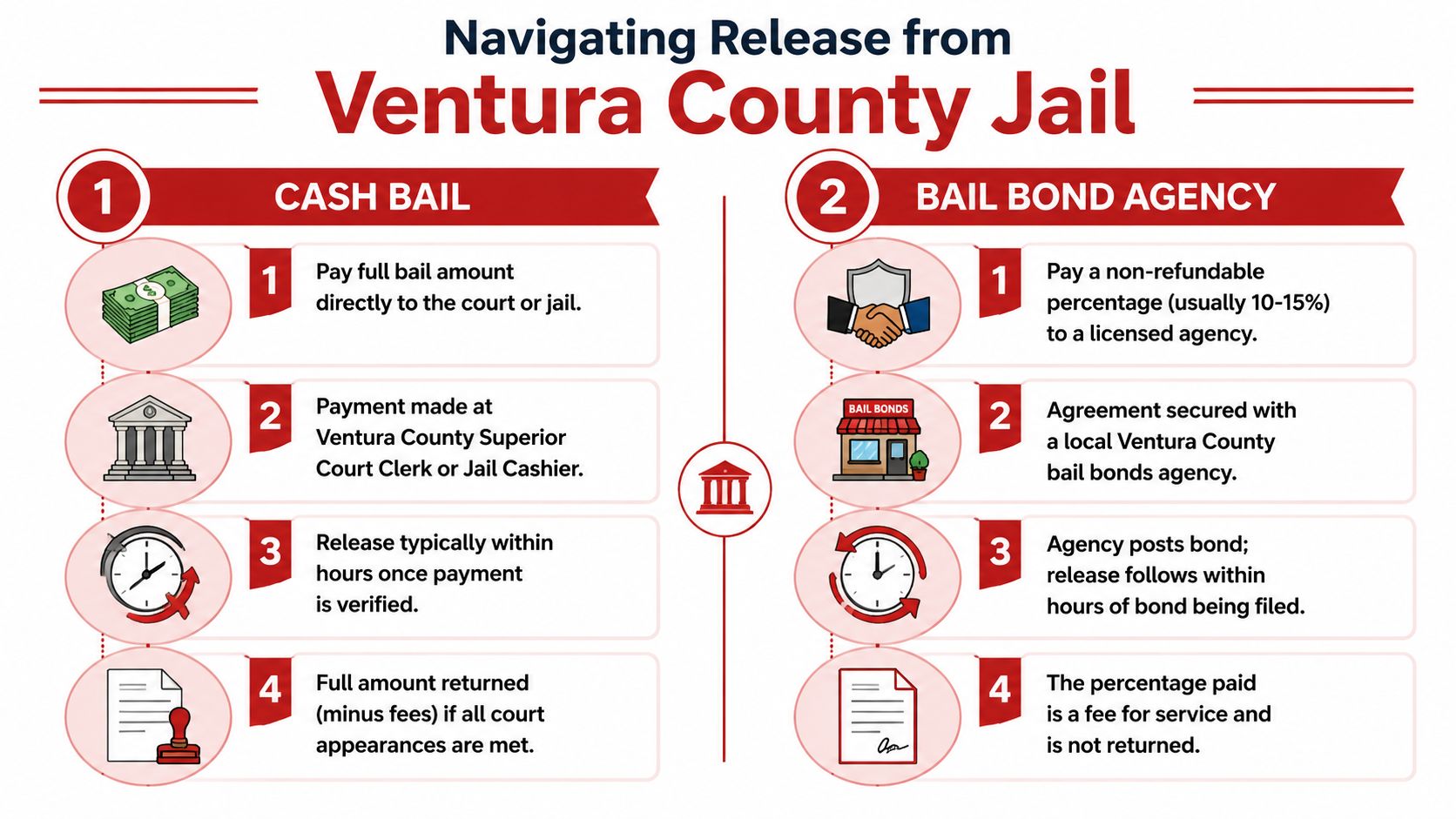
If you pay cash bail
Cash bail means the family pays the full amount required for release. That usually involves confirming the exact bail amount, finding the right payment location, presenting identification, and waiting for the payment to be processed and matched to the booking.
This route can work well when the amount is manageable and the funds are immediately available. The problem is that many families don’t have the full amount sitting in a form they can use right away, especially at night, on weekends, or during holidays.
If you use a bail bond
A bond route usually begins with a call to a licensed bail agent. The family provides the defendant’s information, the facility, and any booking details they have. The agent verifies the case, prepares the agreement, and arranges for the bond to be posted.
That can reduce confusion for families who don’t know where to go, what paperwork is needed, or how local jail procedures move. Someone who works with Ventura County procedures regularly can often help families avoid preventable delays.
What tends to slow release
A few issues commonly create frustration:
- Incomplete booking information can delay verification.
- Changing jail release windows can affect pickup timing.
- Confusion about the bail amount can send families in the wrong direction.
- Paperwork delays can slow down a process that already feels urgent.
For a local walkthrough of procedure and expectations, this page on how bail works in Ventura County helps families understand the sequence before they make a decision.
The Financial Bottom Line Cash Bail vs Bail Bond Premium
This is the section families care about most. Not because they want a finance lesson, but because they need to know what they’ll pay, what comes back, and what never comes back.
The core trade-off is simple. Cash bail usually requires the full court-set amount upfront. A surety bond lowers the upfront cash required, but the premium paid to the bail company is a fee for service and is not refunded.
Cost at a glance
A surety bond usually carries a non-refundable premium of about 10% to 20% of the total bail amount in the U.S., and in California it is typically 10%, while cash bail is generally refundable if court appearances are completed, according to this bail vs. bond cost explanation.
| Metric | Cash Bail | Bail Bond |
|---|---|---|
| Cost at a Glance: Cash Bail vs. Bail Bond for a $20,000 Bail | ||
| Upfront amount | Full $20,000 to the court | Typically 10% in California, or $2,000 as the premium |
| Refundable | Usually yes, if conditions are met | No, the premium is non-refundable |
| Who posts the full obligation | You or your family | The bond company |
| Best fit | You have full funds available and want the money returned if the case is handled properly | You need a lower cash entry point |
The part many families miss
That bond premium is not a down payment on the bail amount. It is payment for the company taking on the obligation to the court.
Paying a bond premium buys access to release without putting up the full bail in cash. It does not build equity in the bail amount.
That distinction is where many misunderstandings begin. A family may feel that paying the premium should mean they “get it back later” if everything goes well. That’s not how a surety bond works.
Hidden costs and risk questions
The quoted premium is only part of the decision. Some bonds may involve collateral. That can matter a lot if the case drags on, if property is tied up, or if the defendant misses court. Those are often the primary stress points for co-signers and families.
A basic article rarely explains that side clearly enough. A more useful discussion of those practical risks appears in this overview of the real cost of bond beyond the premium.
If you’re comparing real payment paths, these bail bond payment options can help you think through what’s manageable before you commit.
Making the Call When to Use a Bail Bonds Agency
There isn’t one right answer for every family. The right choice depends on the bail amount, how quickly you can access money, whether you’re comfortable handling the process yourself, and how much financial risk you’re willing to carry.
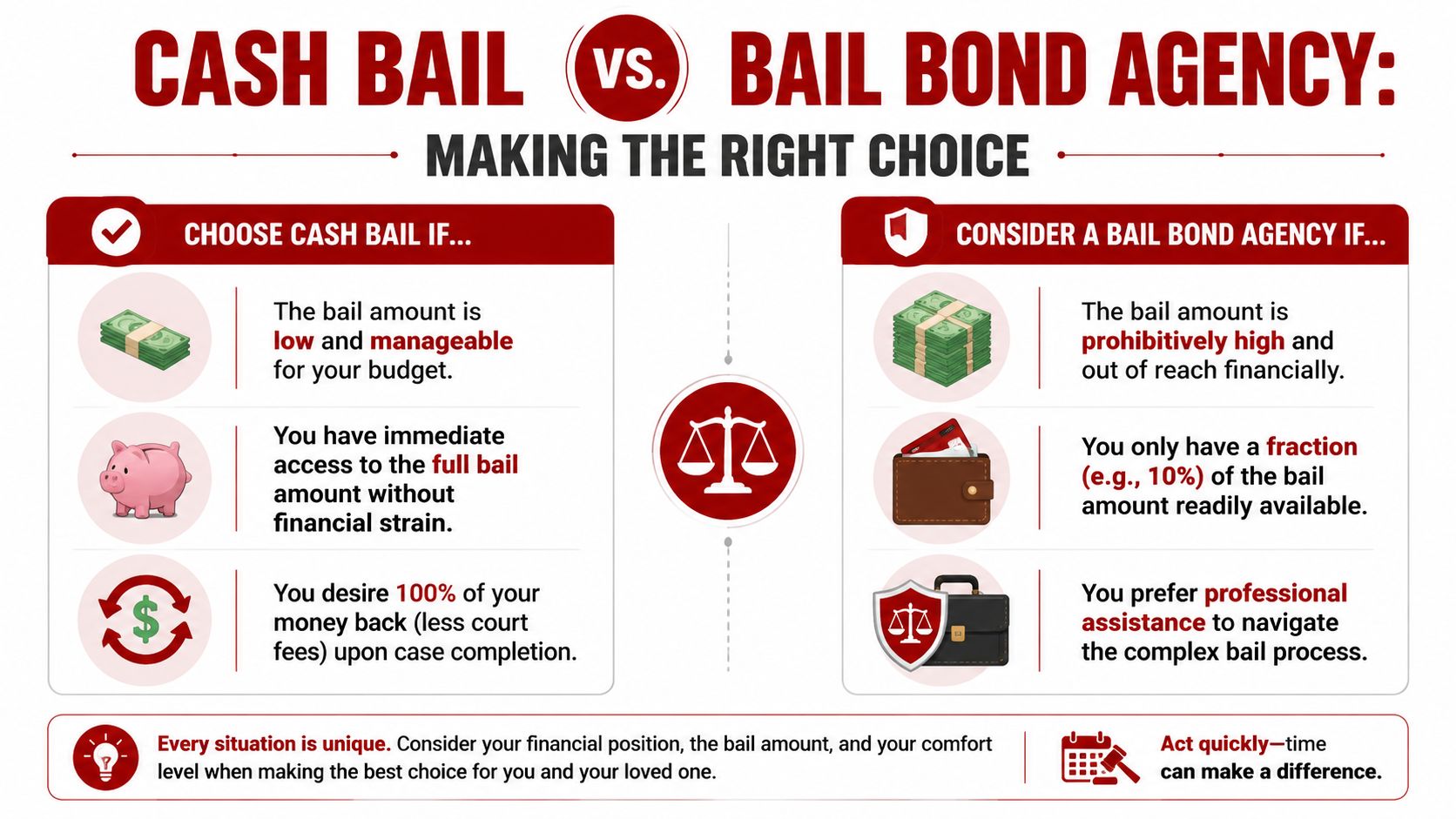
Cash bail can make sense when
Some families should seriously consider paying cash directly.
- You already have the full amount available. If accessing the money won’t create a financial emergency, cash bail may be cleaner.
- You want the possibility of getting the money back. For families focused on long-term cost, that matters.
- You’re comfortable handling the process yourself. Some people prefer direct payment and direct control.
A bond often makes more sense when
It’s usually not because the family loves the idea of paying a fee. It’s because they need a practical way to solve an immediate problem.
- The full bail amount is out of reach. This is the most common reason.
- The arrest happened after hours. Late-night and weekend arrests put pressure on access to funds and logistics.
- You need guidance fast. Families often need help verifying booking details, understanding co-signer responsibilities, and moving paperwork quickly.
Later in the process, the bond choice can still carry pressure. Collateral questions, a long-running case, and missed court dates can all change the picture for the family member who signed.
A short video can help if you’re comparing the two paths under stress:
The best option is usually the one that gets your loved one out without creating a second crisis for the person paying.
How to Secure Fast Bail Bonds in Ventura A Step-by-Step Guide
When families need fast bail bonds Ventura, they usually want the process broken into plain steps. That’s the right way to handle it. The faster you organize the details, the faster a licensed agent can verify the booking and move the bond forward.
Step 1 Call and give the booking basics
Start with the defendant’s full name, date of birth, where they’re being held, and any booking number you have. If you don’t have every detail, provide what you can. A local agent can often verify the rest.
The first practical move is contacting a local service that works those facilities regularly. One option families use is Bada Bing Bail Bonds in Ventura.
Step 2 Confirm the bail amount and conditions
Don’t guess. Confirm the actual bail amount, whether a schedule applies, and whether there are any holds or release conditions that could affect timing.
A lot of stress comes from acting on partial information. One wrong digit in a name or a misunderstanding about the facility can waste time.
Step 3 Review the agreement before signing
Read the premium, co-signer obligations, collateral terms if any apply, and what happens if the defendant misses court. A good agent should explain the paperwork in plain English.
This matters just as much as speed. Fast help is useful only if the family understands what it’s agreeing to.
Step 4 Complete paperwork online or in person
Many families want remote options because they are at home, at work, or driving in from another city like Santa Paula, Ojai, Camarillo, or Santa Barbara. The easier the paperwork, the easier it is to keep the release moving.
Step 5 Stay reachable until release is complete
After the bond is posted, there is still a release process inside the facility. Keep your phone on, watch for updates, and make a pickup plan.
For people who need the release process explained in a more direct how-to format, this guide on how to bail someone out fast covers the practical flow.
Common Misconceptions and FAQs for Ventura County
The same myths come up over and over in Ventura County calls. Clearing them up early saves time and prevents expensive mistakes.
Is the bond premium a down payment on the full bail
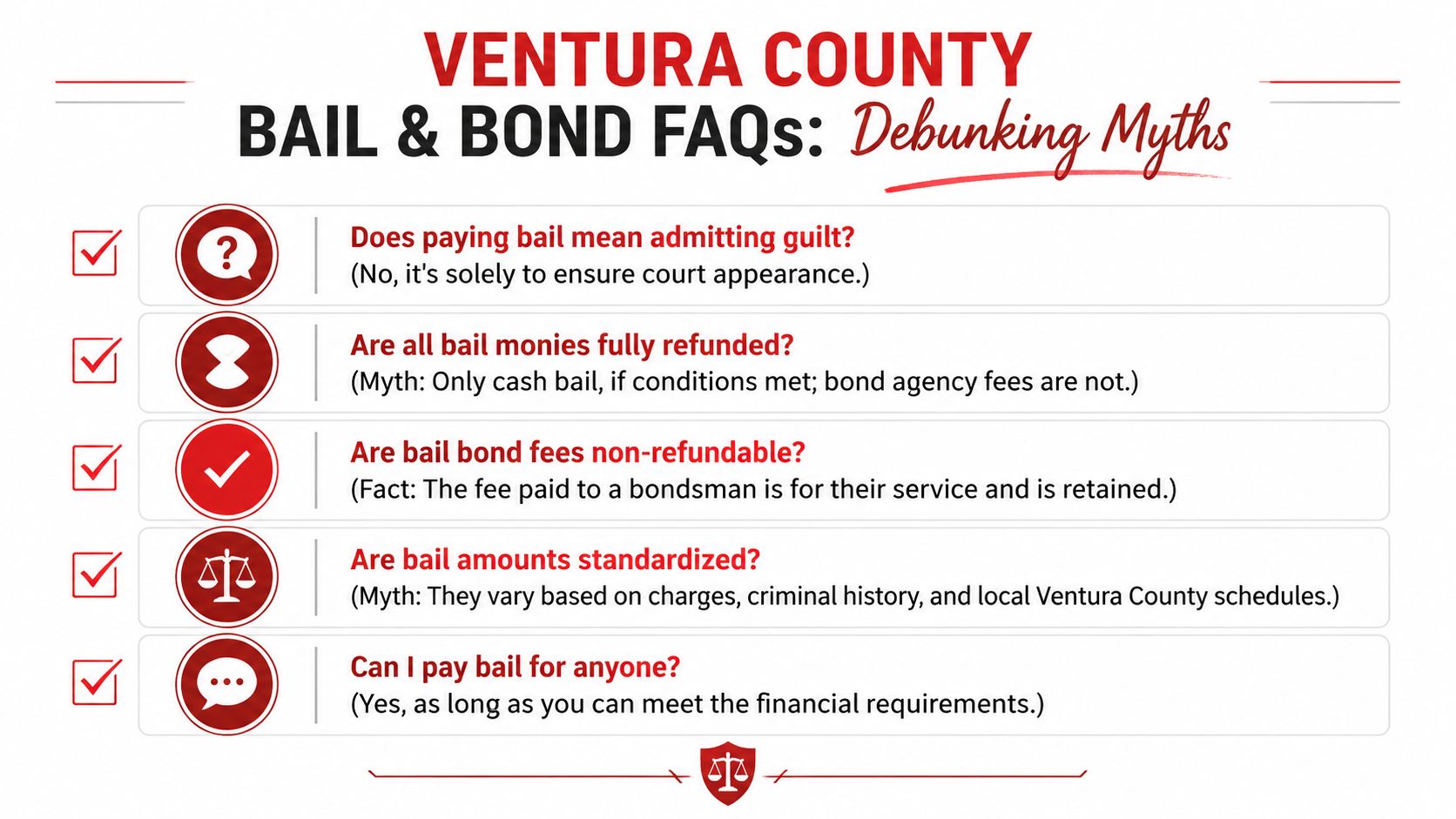
No. The premium is the fee paid for the surety bond service. It doesn’t convert into ownership of the bail amount, and it isn’t refunded because the case ends well.
Do I get the premium back if charges are dropped
No. The fee pays for the bond having been posted and the release process being handled. The result of the case doesn’t turn that service fee into refundable money.
Will I always need collateral
Not always. It depends on the bond, the risk profile, and the specific circumstances of the case. When collateral is required, the family should ask exactly what secures it, when it can be released, and what could put it at risk.
Does paying bail mean the person is guilty
No. Bail and bond are about pretrial release, not a finding of guilt.
Can someone help from another city
Yes. Families often coordinate from Ventura, Oxnard, Camarillo, Moorpark, Fillmore, Ojai, and Thousand Oaks while the defendant is held elsewhere in the county. If your loved one’s case involves Thousand Oaks, this Bail Bonds Thousand Oaks page may be the most relevant local reference point.
Ask the question you’re worried might sound basic. The expensive mistakes usually come from assumptions, not from asking for clarification.
What should I ask before signing anything
Use this short checklist:
- Ask what is refundable. Don’t assume all money paid in the process comes back.
- Ask who is responsible if court is missed. That answer should be clear before any signature.
- Ask whether collateral is part of the deal. If it is, get the terms in plain language.
- Ask what local facility timing looks like. Release depends on jail processing, not just payment.
If you need calm, immediate help sorting out the bail vs bond difference for a loved one in Ventura County or nearby Santa Barbara, Bada Bing Bail Bonds is available around the clock to explain the options, verify booking details, and help you decide whether cash bail or a bond makes more sense for your situation.