Yes, you can often post bail on a California bench warrant — but whether that actually gets you released depends on the charge, the county, and what the judge has ordered. For many misdemeanor bench warrants, an attorney can appear on your behalf under Penal Code §977 and ask the court to recall the warrant without you ever being booked. For felonies and more serious matters, you’ll likely need to surrender in person, post bail, and appear before a judge.
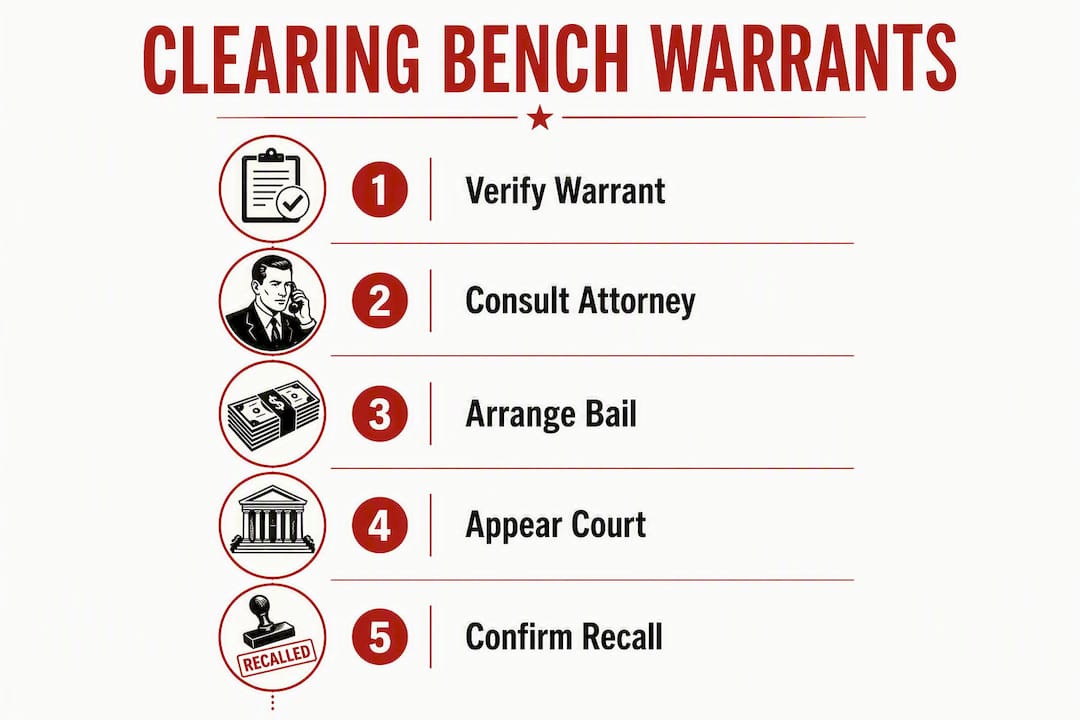
The single most important thing you can do right now: verify the warrant exists, identify the issuing court, and get the case number — without calling the police. Checking warrant status through court lookups or a lawyer avoids the risk of immediate detention that can happen the moment you contact law enforcement.
Two immediate paths:
- Attorney-led recall (many misdemeanors): Counsel appears under PC §977, files a motion to recall, and you may avoid booking entirely. This is the lowest-risk route for eligible cases.
- Controlled surrender with bail (felonies and serious misdemeanors): You or your attorney coordinate a surrender at the issuing court or jail, bail is set, and a bondsman posts it so you’re released the same day.
Pro Tip: Never walk into a courthouse to “just clear things up” without counsel or a plan. Judges can remand you into custody on the spot, and showing up unprepared is one of the fastest ways to spend a night in jail.
Table of Contents
- What is a California bench warrant and why was yours issued?
- Can you post bail on a bench warrant in California?
- Step-by-step plan to clear a California bench warrant safely
- When do you need an attorney vs. a bail bondsman — and who do you call first?
- How much does resolving a bench warrant cost in California?
- What happens if you ignore a bench warrant or handle it wrong?
- How Bada Bing Bail Bonds helps you resolve a California bench warrant
- Key Takeaways
- Why the attorney-first approach is the one worth trusting
- Bada Bing Bail Bonds: fast local help when a warrant is active
- Useful sources and California court resources
What is a California bench warrant and why was yours issued?
A bench warrant is a judicial order issued directly by a judge, not by law enforcement. Under Penal Code §978.5, a court issues one when a defendant fails to comply with a court order — missing a hearing, skipping a mandated program, or ignoring a fine payment deadline. The warrant stays active until a judge formally recalls or quashes it. There is no expiration date.
The key distinction: A bench warrant doesn’t start a new criminal case. It compels someone already in the court system to comply with an order they’ve ignored. An arrest warrant, by contrast, is issued when law enforcement establishes probable cause that someone committed a crime — often before any court proceedings begin. The practical difference matters: with a bench warrant, you already have a case number and an issuing court, which gives you a clear target for resolution.
The most common triggers:
- Probation violations: — Missing check-ins, failing drug tests, or picking up new charges
Because bench warrants are county-specific, you must address the exact court that issued yours. A Ventura County warrant cannot be recalled at an Orange County courthouse. Confirming the issuing court is step one — many defendants waste time going to the wrong courthouse, which costs days and can increase arrest risk.
For a deeper look at how bench warrants compare to other California warrant types, the bench vs. Ramey vs. arrest warrants guide breaks down each one clearly.
Can you post bail on a bench warrant in California?
The short answer is yes — with conditions. How bail works on a bench warrant depends heavily on the charge category and what the issuing judge has ordered.

When posting bail will clear the warrant
For many misdemeanor bench warrants, bail is set according to the county’s standard bail schedule. Once bail is posted — either in cash or through a bondsman — the warrant is recalled and you’re released pending your next court date. Some counties also allow online payment to clear minor traffic or parking bench warrants, though this option is limited to the most minor offenses and varies by jurisdiction.
When it won’t be that simple
Felony bench warrants almost always require a personal court appearance. The judge must see you before setting or reinstating bail. The same applies to:
- Domestic-violence-related warrants (courts often impose no-bail holds or high bail)
- Probation violation warrants (the judge may revoke bail entirely)
- Cases where the original judge flagged flight risk
For these situations, understand what a no-bond warrant means before you act — some warrants carry a “no bail” designation that only a judge can lift.
Cash bail vs. a bail bond
If bail is available, you have two options. Cash bail means paying the full amount to the court; it’s refundable after the case resolves, minus court fees. A bail bond means paying a bondsman roughly 10% of the total bail amount as a non-refundable premium, and the bondsman guarantees the full amount to the court. For many people facing a high bail amount on a bench warrant, paying a bondsman a percentage of the total bail is often more realistic than paying the full bail amount in cash.
Pro Tip: If a bail bond was previously posted on your case and forfeited after a failure to appear, PC §1305 gives the surety 185 days from the notice of forfeiture to produce you before the court and vacate the forfeiture. Miss that window and the bond is permanently forfeited. Contact your bondsman immediately if this applies to you.
The bail basics explainer walks through the full mechanics of cash bail versus bond premiums if you need more detail before deciding.
Step-by-step plan to clear a California bench warrant safely
Speed matters, but so does sequence. Here’s the order that minimizes your risk of unexpected custody.
The action checklist
- Verify the warrant exists — Use your county Superior Court’s online case lookup or have an attorney or bondsman check on your behalf. Do not call the police or a law enforcement tip line to ask.
What to bring to court
- Government-issued photo ID
- Case number and court name
- Any documentation supporting your excuse: hospital records, employer communications, travel records, proof of payment if fines were involved
- Contact information for your attorney and bondsman
Documentary proof of a legitimate excuse materially increases the chance a judge will recall the warrant rather than order custody. A judge who sees a hospital discharge record from the date of your missed hearing is far more likely to recall the warrant without remanding you.
Timeline expectations
Booking and release windows vary by county. Many California county jails process a surrender and release within a few hours once bail is posted, though some facilities run longer depending on staffing and time of day. Court calendar scheduling for a warrant recall hearing can range from same-day (walk-in calendar) to a week or more depending on the court’s docket. The 185-day PC §1305 forfeiture window for previously posted bonds is a hard deadline — act well before it expires.
Pro Tip: Ask your attorney about the issuing court’s warrant calendar. Placing your recall motion on a scheduled walk-in calendar means you control the timing instead of waiting to be arrested in the field during a routine traffic stop.
When do you need an attorney vs. a bail bondsman — and who do you call first?
These two professionals handle different parts of the same problem, and in most cases you need both.

What an attorney does under PC §977
Penal Code §977 allows a defense attorney to appear on behalf of a defendant in many misdemeanor proceedings. That means counsel can walk into court, ask the judge to recall the bench warrant, and potentially resolve the matter without you ever being booked. For misdemeanor bench warrants with low bail amounts, calling an attorney first is almost always the right move.
Felony matters are different. Personal appearance is generally required, which means you’ll need to surrender, get booked, and wait for bail to be set. That’s where a bondsman becomes critical.
The practical rule of thumb: If your warrant stems from a misdemeanor, call an attorney first and ask whether they can handle the recall without your surrender. If it’s a felony, a domestic-violence matter, or a probation violation, call both simultaneously — you’ll need counsel to argue for reasonable bail and a bondsman ready to post it the moment the judge sets an amount.
Concrete scenarios
Misdemeanor with low bail: Counsel appears under PC §977, moves to recall, court sets a new hearing date. You may avoid booking entirely. Attorney fees apply; no bondsman needed unless bail is set and you can’t cover it in cash.
Felony bench warrant: Personal surrender required. Attorney argues for O/R release or low bail at the arraignment. Bondsman posts bail immediately after the judge sets it. You’re released the same day in most cases.
Forfeited bond: Contact the surety (bondsman) immediately. The 185-day PC §1305 clock is running. The bondsman and their recovery team work to locate and produce the defendant before the forfeiture becomes permanent.
Probation violation warrant: These are among the most complex. The judge has wide discretion to revoke bail entirely. An attorney who can argue mitigating circumstances — completed program hours, employment, family ties — is worth the cost. See the probation violation bail guide for specifics on how these cases typically unfold.
For complex warrant situations, a San Diego bench warrant lawyer can walk you through recall options and whether counsel appearance is viable for your specific charge.
What each professional needs from you
| Professional | Information needed |
|---|---|
| Attorney | Case number, issuing court, charge, date of original FTA |
| Bail bondsman | Case number, issuing court, bail amount, defendant’s full name and booking info |
How much does resolving a bench warrant cost in California?
Costs vary widely depending on the charge, the bail amount, and whether you need an attorney. Here’s a realistic breakdown.
Bail and bond costs
The bail amount on a bench warrant is set either by the county bail schedule or by the judge’s discretion at your hearing. Once bail is set:
- Cash bail: You pay the full amount to the court. It’s refunded after the case resolves, minus administrative fees, assuming you make all court appearances.
- Bail bond premium: You pay roughly 10% of the total bail amount to a bondsman. That premium is non-refundable regardless of the outcome. On a $20,000 bail, that’s $2,000 to the bondsman.
Some bondsmen offer low down payment options for qualifying clients, which spreads the premium over time. The California bail bonds financing guide explains payment plan structures in detail.
Additional costs to expect
- Court fines and fees: If your warrant stems from unpaid fines, those amounts are still owed and must be addressed separately from bail.
- Traffic surcharges: California traffic fines carry significant penalty assessments and surcharges that can multiply the base fine amount several times over. Verify the exact total with the court clerk.
- Attorney fees: Vary by attorney and complexity of the matter.
Timeline after bail is posted
- Booking and release: Many California county jails release defendants within a few hours of bail being posted, though some facilities take longer depending on time of day and staffing.
- Court date scheduling: After release, the court sets a new hearing date. Attend every one — a second FTA will result in a new bench warrant, higher bail, and possible additional charges under PC §1320.
- Bond exoneration: Once the case resolves and all appearances are made, the bond is exonerated. The bail exoneration explainer covers what that means for any refund you may be expecting.
County differences
Bail schedules and online payment options vary significantly across California counties. Ventura, Santa Barbara, and Orange County each maintain their own schedules, and what’s payable online in one county may require a court appearance in another. Always verify with the issuing court clerk before assuming any payment method will clear your warrant.
- Online payment: generally limited to minor traffic and parking warrants
- Misdemeanor bench warrants: usually require a court appearance or attorney-led recall
- Felony bench warrants: personal appearance required; no online resolution
What happens if you ignore a bench warrant or handle it wrong?
Ignoring a bench warrant doesn’t make it go away. It remains active indefinitely and the consequences compound over time.
Concrete risks of inaction:
- Arrest during a routine traffic stop, at your workplace, or at home
- Immediate custody when you appear at court without a plan
- Bond forfeiture if a previous bond was posted
- Additional FTA charges under PC §1320, which carry their own fines and potential jail time
- Probation revocation, which can result in the original suspended sentence being imposed
- Higher bail amounts at the next hearing, since judges factor in the FTA history
- A driver license hold through the California DMV for certain unpaid court obligations
Judge discretion is real
A judge may remand an appearing defendant into custody even when you show up voluntarily to clear a warrant. The judge considers your criminal history, the circumstances of the original FTA, and whether you appear to be a flight risk. Showing up without counsel, without documentation, and without a plan is the scenario most likely to end with you in handcuffs.
Procedural mistakes that cost people:
- Appearing at the wrong courthouse (a different county or division)
- Paying a fine to the clerk and assuming the warrant is cleared — paying a fine to a clerk does not clear most bench warrants; a judge must formally recall it in open court
- Calling law enforcement to “check” on the warrant status and triggering an immediate arrest
The safest mitigation: coordinate every step through an attorney or a licensed bondsman before you set foot in a courthouse or jail.
How Bada Bing Bail Bonds helps you resolve a California bench warrant
Bada Bing Bail has spent over 15 years helping families in Ventura, Santa Barbara, and Orange Counties navigate exactly this situation. When a bench warrant is active and bail is required, the process moves fast — and having a local bondsman who knows the issuing courts makes a real difference.
What Badabingbail does for bench-warrant cases:
- Verifies case details, bail amount, and issuing court before you take any action
- Coordinates surrender logistics with the jail and court to minimize time in custody
- Posts bail immediately once the judge sets an amount, so release happens the same day in most cases
- Explains the full premium and payment options upfront, including low down payment plans for qualifying clients
- Provides Spanish-language support for families who need it
- Available 24/7 — warrants don’t wait for business hours, and neither does Badabingbail
For straightforward misdemeanor warrants, Badabingbail can often advise on whether an attorney-led recall under PC §977 is the better first move before any bail is posted. For felonies, domestic-violence matters, or probation violations, the recommendation is always to involve both an attorney and a bondsman — Badabingbail works alongside counsel regularly and can refer you to local defense attorneys when needed.
When you call, have this information ready: the defendant’s full name, the case number, the issuing court, and the bail amount if you already know it. If you don’t have all of it, Badabingbail can help you find it.
The warrant bail bond help page explains exactly how the agency coordinates with courts and jails to get someone released after a warrant surrender.
Key Takeaways
A California bench warrant can often be resolved through bail or attorney-led recall, but the path depends on the charge, the county, and whether you act before being arrested in the field.
| Point | Details |
|---|---|
| Verify before you act | Use court case lookups or have counsel check; never contact law enforcement to confirm a warrant. |
| Charge type determines your path | Misdemeanors may allow attorney recall under PC §977; felonies require personal surrender and bail. |
| Payment alone rarely clears a warrant | Most bench warrants under PC §978.5 require a judge to formally recall them — paying a clerk is not enough. |
| Act fast on forfeited bonds | PC §1305 gives sureties 185 days to produce a defendant before bond forfeiture becomes permanent. |
| Bada Bing Bail Bonds is a local option | Serving Ventura, Santa Barbara, and Orange Counties 24/7, Badabingbail posts bail and coordinates surrender logistics for bench-warrant cases. |
Why the attorney-first approach is the one worth trusting
Most people in this situation want the fastest path out. That instinct makes sense, but it leads to a predictable mistake: showing up at a courthouse alone, hoping the judge will be understanding, and ending up in custody before noon.
The conventional advice to “just go clear it” glosses over something practitioners see constantly: judges have full discretion to remand you, and they use it. A defendant who walks in without counsel, without documentation, and without a coordinated plan is signaling to the court that the original FTA wasn’t taken seriously either. That’s not the message you want to send.
The attorney-plus-bondsman approach isn’t about spending more money. It’s about controlling the variables. Counsel can argue for O/R release or low bail, present your legitimate excuse, and place the recall on a walk-in calendar at a time that works. The bondsman is standing by to post bail the moment it’s set. The whole process can resolve in a single day instead of stretching into weeks of uncertainty or, worse, unplanned custody.
One more thing people underestimate: the paperwork trail after the warrant is recalled matters. Get written confirmation from the court that the warrant has been recalled or quashed. Don’t assume a verbal assurance from a clerk is enough. A warrant that looks cleared in one system may still show as active in another, and that discrepancy can cause problems at a traffic stop months later.
Bada Bing Bail Bonds: fast local help when a warrant is active
When a bench warrant is active and bail is on the table, the gap between knowing what to do and actually doing it is where people get hurt. Badabingbail closes that gap for families in Ventura, Santa Barbara, and Orange Counties.
This isn’t a call center routing you to a stranger. Badabingbail’s agents know the local courts, the booking procedures at county jails, and the fastest legal paths to release. With over 15 years of experience, flexible financing including low down payments for qualifying clients, and 24/7 availability, Badabingbail is built for exactly the moment you’re in right now.
Whether the warrant is a misdemeanor FTA or a more serious matter requiring a coordinated surrender, the process starts the same way: a quick call to confirm the case details and map out the next step. Get help bailing someone out fast and find out what Badabingbail can do for your specific situation today.
This article provides general information about California bench warrants and bail procedures. It is not legal advice. Confirm current rules and procedures with the issuing court or a licensed California attorney before taking action.
Useful sources and California court resources
Use these directly to verify warrant status, look up statutes, and find the right court contact.
California statutes:
- Penal Code §978.5 — bench warrant issuance and authority
- Penal Code §977 — attorney appearance on behalf of misdemeanor defendants
- Penal Code §166 — criminal contempt, one of the common grounds for bench warrant issuance
- Penal Code §1305 — bond forfeiture timelines (185-day surety window)
- Penal Code §1320 — penalties for willful failure to appear
Court self-help and case lookup:
- California Courts Self-Help Center — forms, warrant recall guidance, and court basics
- CR-302 Warrant Recall Form — the standard form used to request a bench warrant recall
- Your county’s Superior Court website — search “[county name] Superior Court case lookup” to find the online portal for your issuing court
Key reminders:
- Always verify the issuing court and case number before taking any action
- Do not contact law enforcement to check warrant status — use court lookups or have counsel check on your behalf
- Addressing the wrong courthouse will not recall your warrant and may delay resolution by days or weeks
- For warrants tied to probation violations, check with both the court and your probation officer’s supervising agency