Your phone rings after midnight. It’s your son in Oxnard, your husband in Ventura, your brother in Camarillo. He says he’s been arrested for vandalism. The booking deputy mentions PC 594. You hear “property damage,” “bail,” and maybe “felony,” and that’s the moment most families go from worried to overwhelmed.
At 2 a.m., nobody cares about a law school definition. You want answers to three things. What does Cal Penal Code 594 mean, how serious is it, and how do we get them out fast? That’s the central question behind most calls about bail bonds Ventura families make in the middle of the night.
In Ventura, Oxnard, Port Hueneme, Thousand Oaks, Santa Paula, Moorpark, Fillmore, Ojai, and Santa Barbara, the first hours matter. Booking has to be confirmed. Bail has to be checked against the local schedule. If the charge is being treated as a misdemeanor, the path may look one way. If it’s being handled as a wobbler, the bail picture can change fast. If you’re trying to understand what happens next, start with the practical arrest timeline in what happens after you get arrested.
What catches families off guard is that vandalism sounds minor until the numbers and charge level come into play. A broken window, keyed car, spray-painted wall, or damaged storefront can create a much more urgent Ventura County Jail bail bonds problem than people expect. That’s especially true when the alleged damage crosses the legal threshold that changes how the case is charged and how bail is approached.
Table of Contents
- The Call No One Wants to Get a PC 594 Arrest
- What Vandalism Means Under California Law
- Misdemeanor vs Felony Vandalism The $400 Rule
- How Bail Is Set for Vandalism in Ventura and Santa Barbara
- Securing Fast Release with a Bail Bond
- After Bail What to Know About Defenses and Your Record
- Frequently Asked Questions About Vandalism Charges
The Call No One Wants to Get a PC 594 Arrest
A PC 594 arrest usually doesn’t come with much context. Families often hear a short version. “There was an argument.” “Something got damaged.” “They’re saying vandalism.” That’s it. Meanwhile, your loved one is sitting in custody, and you’re trying to figure out whether to call a lawyer, a bondsman, or the jail first.
In real life, these arrests often start with a fast-moving scene. Someone allegedly spray-paints a wall in Ventura. Someone keys a car in Thousand Oaks after a breakup. Someone breaks a window during a fight in Oxnard. Officers arrive, take statements, and book for vandalism because the allegation involves damage to property that doesn’t belong to the person arrested.
What families usually need to know first
The legal label matters, but the immediate pressure is practical:
- Where are they being held: Ventura County and Santa Barbara cases can move differently depending on where the arrest happened and where the booking is processed.
- Has bail been set yet: Some families assume they can pay and leave immediately. Sometimes they can’t, because booking and classification have to be completed first.
- Is the case being treated as more serious than expected: That can happen quickly when alleged damage is valued higher than the family expected.
First move: Confirm the exact charge, the booking location, and whether bail is based on schedule or waiting on further review.
That’s why people searching for 24-hour bail bonds Ventura, Bail Bonds Thousand Oaks, or Ventura County bail bonds usually aren’t looking for theory. They need a calm explanation of what the jail is doing and how release works tonight, not next week.
Why PC 594 causes so much panic
Vandalism sounds like a simple accusation. It often isn’t. The amount of alleged damage can change the case from a straightforward misdemeanor into something with much bigger consequences. That affects not just criminal exposure, but also the amount of money needed to get someone released.
For families in Ventura, Camarillo, Moorpark, Fillmore, or Ojai, the stress usually comes from uncertainty. They don’t know whether this is a quick release situation or a major bail issue. That uncertainty is exactly why understanding Cal Penal Code 594 matters in the first few hours.
What Vandalism Means Under California Law
Under California Penal Code 594(a), prosecutors have to prove three things: the person maliciously defaced with graffiti or inscribed material, damaged, or destroyed property, the property was not owned by the defendant, and the damage value fits the legal threshold that affects how the charge is classified, as explained in Shouse Law’s summary of Penal Code 594.

In plain English, vandalism means more than graffiti. It covers defacing, damaging, or destroying property that belongs to someone else. The word “maliciously” matters. An accident and an intentional act are not the same thing.
Common examples families recognize
A lot of people only think of tagging, but PC 594 can be charged in many everyday situations:
- Graffiti on a wall or fence: Spray paint, marker, or etched writing can qualify.
- Keying a car: Even a short scratch can trigger a vandalism allegation.
- Breaking a window during an argument: If it’s someone else’s property, that can fit the statute.
- Damaging a phone, door, or furniture: Property doesn’t have to be public to lead to a charge.
- Scratching or carving into a surface: Defacement alone can be enough, even without total destruction.
What doesn’t get enough attention
Families often focus on whether the person “meant serious harm.” The law isn’t that narrow. If police believe the person intentionally marked, damaged, or destroyed property they didn’t own, they may book on PC 594 even if nobody was hurt and even if the item seems replaceable.
The fight at booking isn’t about whether the damage seems dramatic. It’s about ownership, intent, and how the damage will be valued.
That’s why someone arrested in Ventura or Oxnard can be facing a much more complicated case than the family expected. The jail doesn’t resolve those factual disputes on the spot. The jail processes the arrest based on the reported offense. Questions about consent, ownership, mistaken identity, or accident usually get sorted later by defense counsel and the court.
For anyone trying to make sense of Cal Penal Code 594, the cleanest way to understand it is this: if officers believe your loved one intentionally damaged or defaced property that wasn’t theirs, the case can move quickly into the bail system even before the full story is heard.
Misdemeanor vs Felony Vandalism The $400 Rule
The single number that changes everything in a PC 594 case is $400. Under California law, vandalism is a misdemeanor when the damage is under $400, carrying up to one year in county jail and a maximum fine of $1,000. If the damage is over $400, the offense becomes a wobbler that can be charged as a misdemeanor or felony, and felony punishment can include 16 months, 2 years, or up to 3 years in state prison. If the damage is over $10,000, fines can reach $50,000, as summarized by My Rights Law on California vandalism penalties.
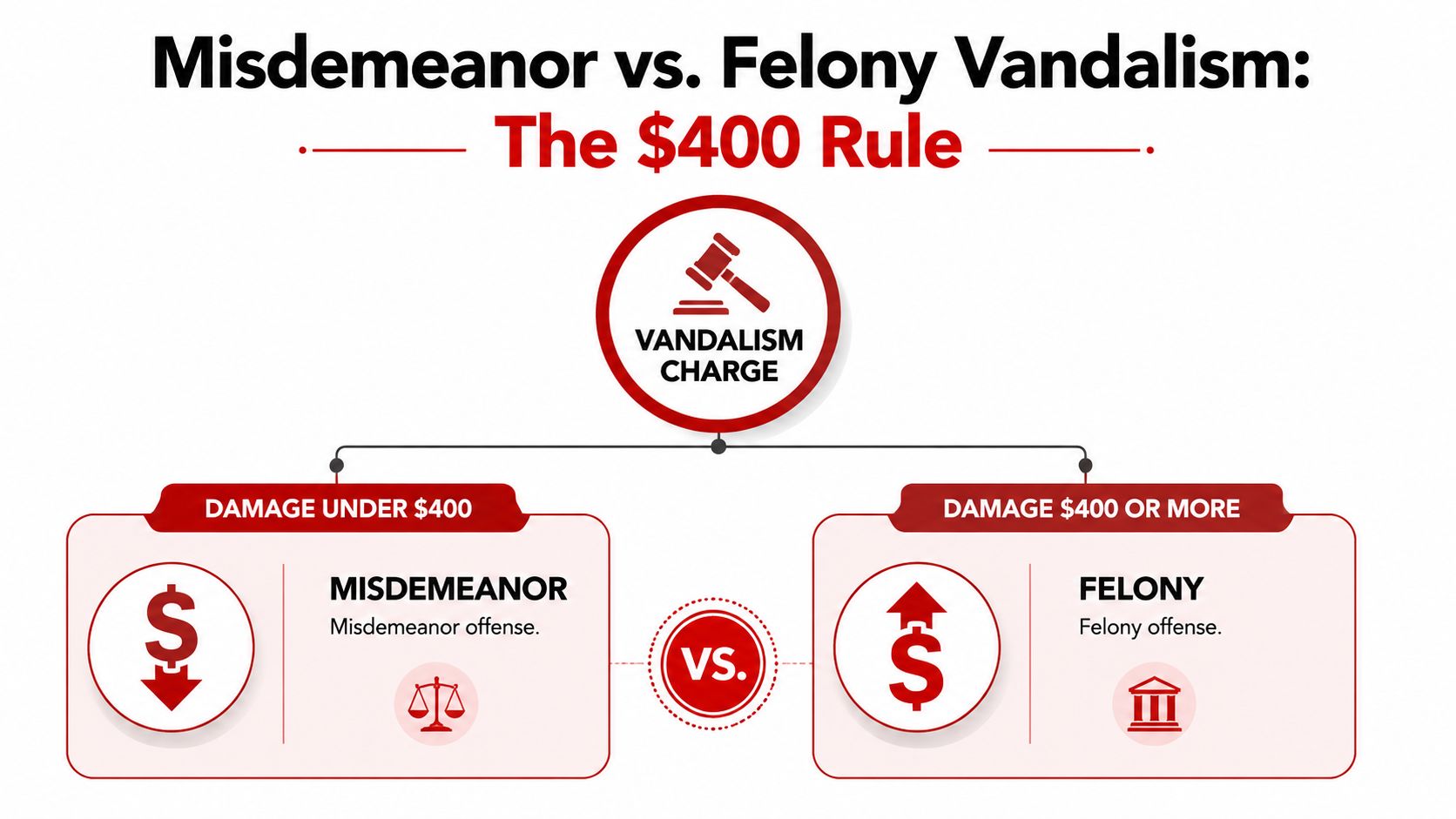
That $400 line is why valuation becomes the first serious issue in many vandalism arrests. A family may think, “It was just paint,” or “It was only a window.” But once repair estimates, cleanup, labor, or replacement are discussed, the case can land in a very different category.
What the $400 threshold means in practice
For release and case planning, the difference looks like this:
| Factor | Misdemeanor (Under $400) | Felony (Over $400) |
|---|---|---|
| Charge level | Misdemeanor | Wobbler, can be filed as misdemeanor or felony |
| Jail or prison exposure | Up to 1 year in county jail | 16 months, 2 years, or up to 3 years in state prison |
| Fine exposure | Up to $1,000 | Up to $10,000 if damage is under $10,000, up to $50,000 if damage is $10,000 or more |
| Bail impact | Often more straightforward | Often less predictable because of wobbler treatment |
If you need a clean breakdown of how charge level changes a criminal case generally, this short guide on felony vs misdemeanor differences helps.
A visual summary makes the line even easier to see.
Why families should care about the valuation early
Damage amount is not just a sentencing issue. It affects the whole tone of the case from the beginning. When booking staff, prosecutors, or the court treat the allegation as a wobbler, release can become slower and more expensive than the family expected.
That’s why people searching for bail bonds Ventura or bail bonds Camarillo after a vandalism arrest often feel blindsided. They expected a low-level charge. Instead, they’re dealing with a threshold that can push the case into felony territory before anyone has had time to challenge the estimate.
Practical rule: In a PC 594 case, never assume the family’s estimate of the damage is the number the system will use at booking.
How Bail Is Set for Vandalism in Ventura and Santa Barbara
Cal Penal Code 594 stops being abstract and starts costing real money. Once the arrest reaches booking, the charge level matters because bail is tied to how the offense is classified. In Ventura County, the 2024 bail schedule sets base bail for felonies at $10,000, other misdemeanors at $2,500, and 17(b) misdemeanors at half the felony bail. It also states that crimes committed while on bail can double standard bail, and probation violations add $5,000 for a misdemeanor or $10,000 for a felony, according to the Ventura County Superior Court 2024 bail schedule.
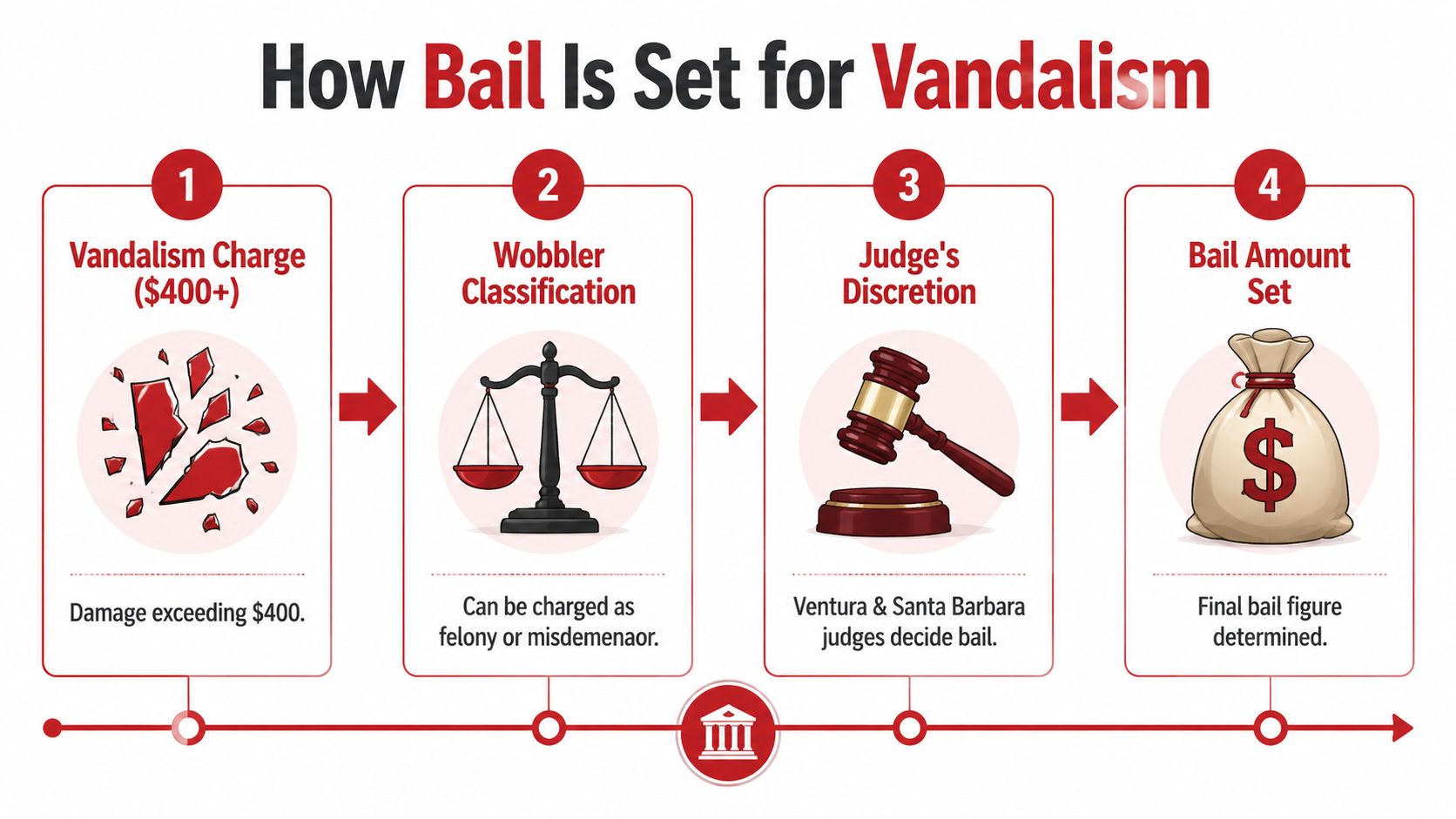
A vandalism case over $400 is a wobbler. That one feature is what creates confusion for families in Ventura and Santa Barbara. It can be treated more like a misdemeanor in one situation and more like a felony in another. For bail purposes, that uncertainty matters immediately.
Why wobblers create bail surprises
A straight misdemeanor tends to be easier for families to anticipate. A wobbler doesn’t give you that comfort. The booking side and the court side may treat the case more seriously while waiting for review, especially when the alleged damage amount is high, there are prior issues, or the arrest happened while the person was already dealing with another case.
The result is that the amount needed for Ventura County Jail bail bonds or Santa Barbara County Jail Bail Bonds can feel inconsistent from one case to the next, even when both are labeled “vandalism.” That’s one reason local experience matters more than generic online summaries.
What to expect at the local level
In Ventura, booking and bail review often move through a familiar pattern:
- Initial booking classification: The charge entered at booking drives the first bail conversation.
- Schedule-based starting point: The court schedule provides a base amount, but that doesn’t end the analysis in a wobbler case.
- Possible added exposure: Being on bail already or having a probation issue can raise the number sharply under the local schedule.
- Family confusion: Most callers don’t know whether they’re looking at a misdemeanor path, a felony path, or something in between.
Santa Barbara families run into a similar problem. The words “vandalism arrest” don’t tell you enough. The actual release cost turns on how the case is being treated right now, not how minor the incident sounded during the phone call home.
Local bail work is about reading the booking reality, not the family’s best guess from a late-night call.
If you’re trying to understand the local process behind 24 hr Ventura County bail bonds, this breakdown of how bail works in Ventura County is a useful companion. It helps explain why two PC 594 arrests can produce very different release numbers depending on the way the case is entered and reviewed.
Securing Fast Release with a Bail Bond
Once bail is set, the next decision is simple in theory and hard in practice. Do you come up with the full cash amount, or do you use a bail bond? For most families, paying the whole bail amount on short notice isn’t realistic.
In California, the bail bond premium is fixed by law at 10% of the total bail, and it is non-refundable. A $50,000 bail means a $5,000 premium, and a $20,000 bail means a $2,000 premium, as explained in Mr. Nice Guy Bail Bonds’ overview of California bail bond costs.
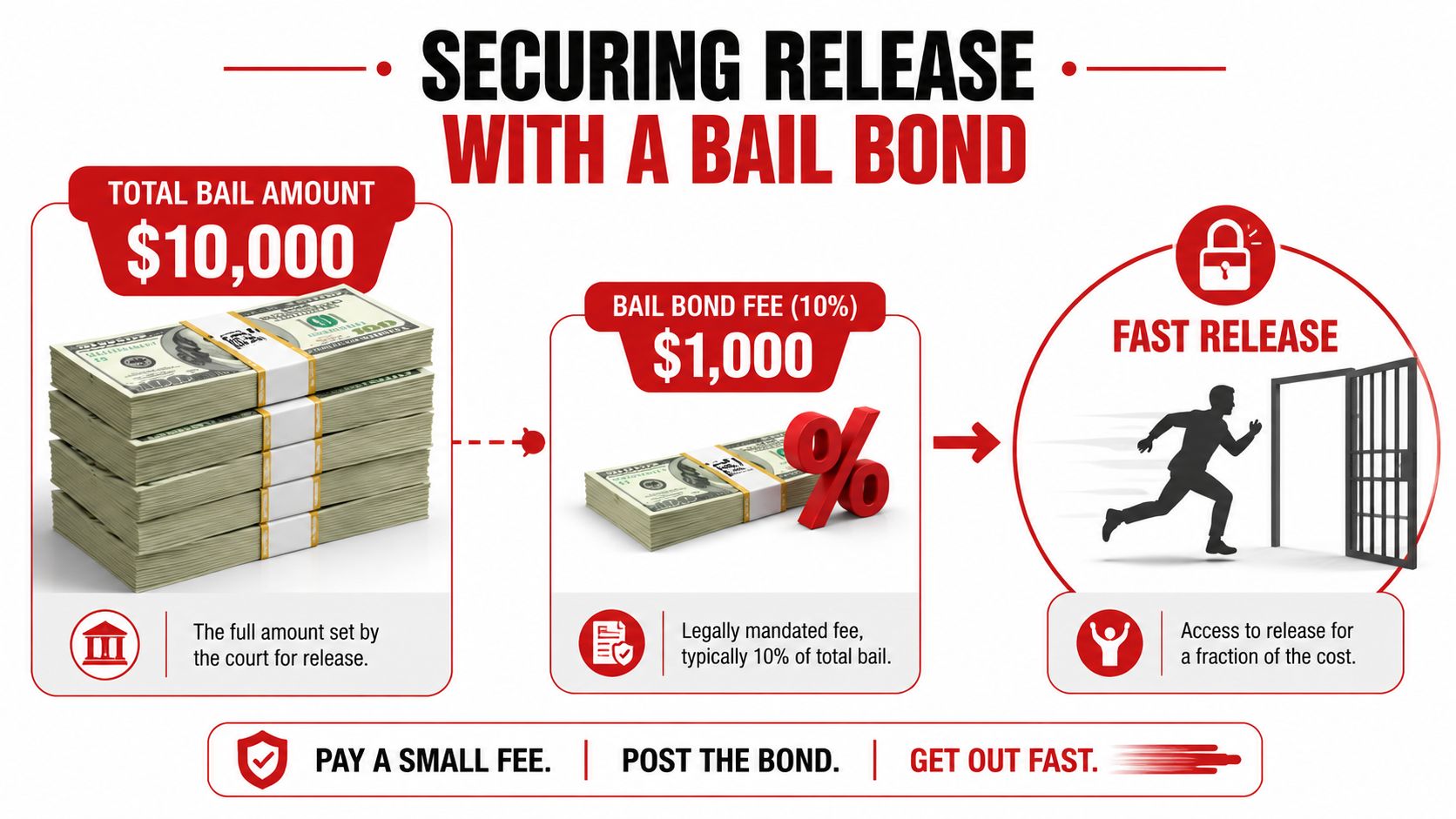
That’s why families usually move toward a bond instead of trying to post full cash bail. The difference between paying the full amount and paying the premium can be the difference between release tonight and staying in custody while relatives scramble for funds.
What works when time matters
The fastest path usually includes a few basic steps:
- Confirm the booking record first. Names, date of birth, and facility details need to match.
- Verify the actual bail amount. Don’t rely on guesses from the arrested person or a witness.
- Understand the premium. In California, that premium is set by law, which keeps the basic fee structure clear.
- Move paperwork quickly. Delays usually come from missing information, not from the concept of bail itself.
If you want a simple primer on the mechanics, how a bail bond works lays out the process in plain language.
What families often overlook
Getting someone out doesn’t end with payment. Release also depends on jail workflow, processing time, and the defendant following court rules afterward. A missed court date can trigger additional financial problems. The UCLA report collected in the Prison Policy archive notes that a minimum fee of $200 may be charged if a defendant misses court, and some contracts impose a minimum penalty of 1% of the bond amount or $250, whichever is greater, in a forfeiture investigation context, as described in The Devil in the Details.
That doesn’t mean families should panic. It means they should treat release as the start of a compliance process, not the end of the crisis.
A bail bond solves the immediate custody problem. Court compliance protects the family from turning one bad night into a longer financial mess.
For Ventura, Oxnard, Camarillo, Port Hueneme, Thousand Oaks, Santa Paula, Moorpark, Fillmore, Ojai, and Santa Barbara families, that practical reality matters as much as the criminal charge itself.
After Bail What to Know About Defenses and Your Record
Release is only the first win. After that, the focus shifts to defending the charge and protecting the person’s future. In a PC 594 case, the prosecution has to prove three basic elements: the defendant maliciously defaced, damaged, or destroyed property, the defendant did not own the property, and the value of the damage met the required threshold. A defense can attack any one of those elements.
Where defenses often start
A few defense themes come up often in vandalism cases:
- No malicious intent: The act may have been accidental, reckless, or misunderstood rather than malicious.
- Ownership or consent issues: If the person owned the property or had permission, the case changes fast.
- Bad identification: Witnesses can be wrong, especially when the event was quick or chaotic.
- Damage valuation disputes: A lower credible valuation may affect how the case is classified.
Those defenses matter because the system’s booking decision is made early, often before all facts are sorted out. What looked clear to officers on scene may not hold up once photos, messages, repair estimates, witness credibility, and timelines get examined carefully.
Why the record still matters after release
Families often relax once their loved one is home. That’s understandable, but it’s not the end of the problem. A conviction can continue to follow a person in job searches, housing applications, licensing reviews, and immigration-related situations. The charge level matters, but even a misdemeanor can create serious stress long after the case leaves the jail calendar.
That’s one reason defense timing matters. Evidence can disappear. Video can be overwritten. Witnesses become harder to locate. If the family is trying to understand how timing affects criminal cases generally, this article on California misdemeanor and felony time limits gives useful background.
Once someone is out, the family’s job changes. It becomes less about release speed and more about protecting the case from avoidable damage.
In practical terms, that means gathering documents, saving messages, identifying witnesses, and getting legal advice early. Bail gets the person home. A defense strategy is what keeps a bad allegation from shaping the next several years.
Frequently Asked Questions About Vandalism Charges
Does a prior vandalism conviction matter if the new damage is minor
Yes. A little-known enhancement under PC 594 means that if a person has two or more prior vandalism convictions, any new vandalism conviction requires mandatory jail or prison time regardless of the damage amount, as explained by DCD Law’s discussion of Penal Code 594. Families often assume low damage means no custody exposure. That assumption can be badly wrong when priors are involved.
Is graffiti treated differently from other property damage
Graffiti is one of the specific forms of conduct covered by the vandalism statute. The legal issue isn’t whether it was paint instead of a broken object. The issue is whether the act was malicious and involved property the person didn’t own.
Can the property owner drop the case
People say “press charges,” but criminal cases belong to the state. An owner’s change of heart can help the defense in some situations, especially on intent, valuation, or cooperation issues, but it doesn’t automatically end the prosecution.
What should a family ask first when calling about release
Ask for the exact booking charge, where the person is being held, whether bail has been set, and whether there are any added complications like probation or an open case. Those details matter more than the short version of the incident.
If your family needs help right now, Bada Bing Bail Bonds is available around the clock for Ventura, Oxnard, Camarillo, Port Hueneme, Thousand Oaks, Santa Paula, Moorpark, Fillmore, Ojai, Santa Barbara, and surrounding areas. Their licensed agents explain the charge, verify booking details, walk you through Ventura County bail bonds step by step, and help with bail bonds Ventura cases quickly and clearly when every hour counts.