If you cosign a bail bond in California, you are legally guaranteeing the full face amount of the bond, plus all recovery and legal costs, if the defendant misses court. That is not a technicality buried in fine print. It is the core of every indemnity agreement you sign, and it can trigger wage garnishment, property liens, and civil judgments against you personally.
Do not sign anything until you receive the statutory cosigner notice required under California Civil Code §1799.91 and you have read the collateral and premium terms out loud. That one step, confirmed in writing, is your strongest legal protection.
Under the 2021 appellate ruling BBBB Bonding Corp. v. Caldwell, California courts held that bail bond premium financing agreements are consumer credit contracts. A licensed bail bond agent is legally required to give you a specific cosigner notice before you sign. If they skip it, enforcement against you may be barred entirely.
Before you sign: Call the bail agent and say, “I need the §1799.91 cosigner notice in writing before I sign anything. Can you confirm you’ll provide that?” If they hesitate or say it doesn’t apply, that is a red flag.
Pro Tip: You can request the cosigner notice in Spanish if that is your primary language. A licensed California bail agent is required to provide it in the language used to negotiate the contract.
Table of Contents
- What cosigner responsibilities actually mean in California
- What happens if the defendant misses court
- What to check in the paperwork before you cosign
- When does your liability begin and end?
- Practical steps to limit your risk before and after signing
- What to do if the bond is forfeited or you are sued
- Questions to ask the bail agent before you cosign
- Key Takeaways
- What 15 years of local bail experience tells us about protecting cosigners
- Rapid bail help with transparent cosigner paperwork
- Useful sources
What cosigner responsibilities actually mean in California
When you sign a bail bond indemnity agreement, you are not just vouching for someone’s character. You are entering a contract that makes you financially liable for the entire bond amount if the defendant fails to appear. The UCLA “Devil in the Details” report found that nearly every bail bond contract reviewed held the indemnitor responsible for all expenses tied to any breach, regardless of whether the defendant had any resources to pay.
Here is what that typically includes:
- Premium (nonrefundable fee): Usually 10% of the total bail amount, paid upfront or financed. You do not get this back even if the defendant is acquitted.
- Full bond principal: If the bond is forfeited, you owe the entire face value, not just the premium.
- Collateral: Real property, vehicle titles, and jewelry are common. The bail company can seize and sell collateral to cover a forfeiture.
- Monitoring obligations: Some agreements require you to confirm the defendant checks in regularly or complies with travel restrictions.
- Recovery costs: Under Penal Code 1299, the bondsman can hire a licensed bail recovery agent (bounty hunter) to locate the defendant, and those costs often land on you.
Watch for open-ended indemnity language like “any and all losses, demands, liabilities, fees and expenses.” That phrase, pulled directly from standard indemnity agreements, means the company can charge you for nearly anything related to the bond.
Pro Tip: Verify the agent’s California license before signing. You can check the California Department of Insurance website in under two minutes. An unlicensed agent has no legal authority to issue a bond.

What happens if the defendant misses court
A missed court date sets off a chain of events that moves faster than most cosigners expect. The court can declare the bond forfeited almost immediately, which triggers your obligation to pay the full bond face amount. From that point, the bail company has legal tools to collect.
- Civil judgment: The bondsman can sue you for the full bond amount plus attorney fees, court costs, and bounty hunter expenses.
- Wage garnishment: A judgment can be used to garnish your paycheck directly.
- Property liens: Liens can be placed on your home or other real property.
- Credit damage: A civil judgment appears on your credit report and can affect your ability to borrow for years.
- Collateral seizure: If you pledged property, the company can move to sell it to satisfy the debt.
“Bail bond companies often pursue cosigners aggressively because they are perceived as more likely to pay than the arrested defendant.” — KQED investigative reporting on class-action filings against California bail companies
News reporting and class-action filings have documented cases where bail companies failed to inform cosigners of these consequences before signing. Plaintiffs in those cases sought refunds and contract voidance based on the missing §1799.91 notice. That ruling is your leverage.
What to check in the paperwork before you cosign
The contract is where your exposure is defined. Read these clauses before you pick up a pen.
| Clause type | What to look for | Why it matters |
|---|---|---|
| Indemnity scope | “All costs and expenses” vs. a defined list | Open-ended language means unlimited liability |
| Collateral description | Exact property ID, condition, valuation method | Vague descriptions allow broader seizure |
| Default triggers | How many days after a missed appearance before you owe | Shorter cure periods leave you less time to act |
| Premium financing | Whether a payment plan creates a separate consumer credit contract | Triggers §1799.91 notice requirement |
| Attorney fees | Who pays them and under what conditions | You may owe the company’s legal fees |
| Exoneration terms | What court action releases your obligation | Defines when your liability ends |
The §1799.91 cosigner notice must be provided before you sign, in the language used to negotiate the contract. If the agent skips it, enforcement of the security interest against you may be barred under California law.
- Confirm the notice is a separate, signed document, not a clause buried in the main contract.
- Ask whether premium financing creates a second consumer credit agreement and whether that agreement also carries the required notice.
- Check whether the collateral description matches your actual property exactly.
Pro Tip: Request digital copies of every signed document at the time of signing. A photo on your phone counts. The Prison Legal News summary of BBBB v. Caldwell confirms that having proof the notice was delivered is one of the highest-value protections a cosigner can hold.
When does your liability begin and end?
Your obligation begins the moment you sign the indemnity agreement, not when the defendant is released. Many contracts include immediate enforceability clauses, meaning the company can pursue collection from day one if a default occurs.
- Forfeiture timeline: California courts can declare a bond forfeited after a missed appearance. The bail company then has a limited window to locate the defendant and move to vacate the forfeiture before the full amount is due to the court.
- Exoneration: Your liability ends when the court issues an order of exoneration, which typically happens when the case is fully resolved and the defendant has appeared as required.
- Substitution: You may be able to replace yourself as cosigner or substitute different collateral, but this requires both the bail company’s agreement and, in some cases, a court order.
For more on how the process works locally, see how bail works in Ventura County.
Practical steps to limit your risk before and after signing
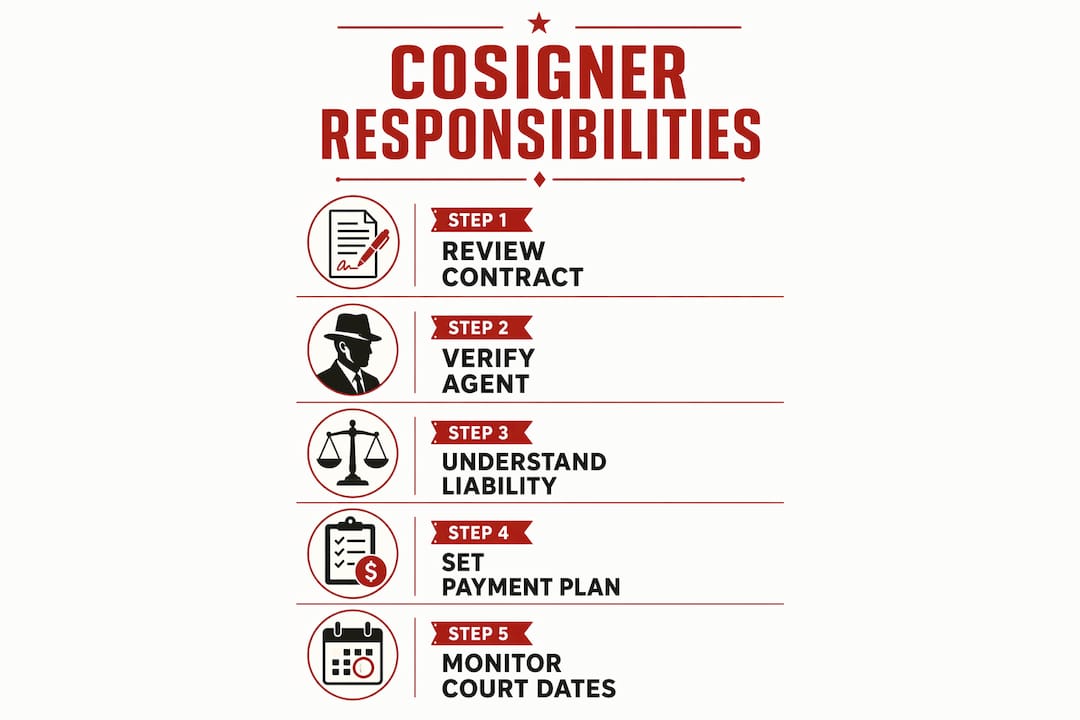
- Demand the §1799.91 notice in writing before you sign anything. If the agent cannot produce it, walk away.
- Read the indemnity and collateral clauses aloud. Hearing them forces you to process the language rather than skim it.
- Ask the agent for a concrete example of what collection looks like if the defendant misses court. A good agent will answer directly.
- Verify the agent’s California license at the Department of Insurance website.
- Negotiate cure periods and collateral valuation. Ask for written notice before any seizure action begins.
- After signing, set calendar reminders for every court date. Send them to the defendant too.
- Get a written agreement from the defendant stating they understand the financial consequences to you if they miss court.
- Ask the bail company about cosigner release or substitution policies in writing, so you know your options if circumstances change.
Pro Tip: A simple one-page written plan between you and the defendant, spelling out who pays what and what happens if they miss court, is not legally binding on the bail company, but it creates a paper trail that can support a civil claim against the defendant later.
What to do if the bond is forfeited or you are sued
Act fast and document everything.
- Demand written proof of the forfeiture and a full accounting of every charge the company claims you owe.
- Pull your original contract and cosigner notice. Confirm the notice was delivered before you signed and that it matches the statutory requirements.
- If the notice was missing or defective, you may have a defense under BBBB Bonding Corp. v. Caldwell. Courts have enjoined bail companies from enforcing agreements where the required notice was absent.
- Dispute collection in writing. If calls become harassing, document them and consult resources on fighting back against debt collectors.
- Answer any civil complaint filed against you. Failing to respond results in a default judgment.
- Contact a consumer attorney or your county bar referral service. Many California legal aid organizations handle bail-related collection cases.
Questions to ask the bail agent before you cosign
Use this list on the phone or in person. Write down the answers.
- What is the exact premium amount, and is any part of it refundable?
- Will collateral be required, and how will it be valued and described in the contract?
- What is the exact default trigger and cure period if the defendant misses court?
- Will you provide the §1799.91 cosigner notice before I sign, in my preferred language?
- What is your California license number, and which counties do you operate in?
- What is your policy on cosigner substitution or release?
Phone script: “Before I sign anything, I need the §1799.91 cosigner notice in writing. Can you confirm you’ll provide that today? I also want to understand the exact collateral terms and what happens if a court date is missed.”
Red flags: An agent who cannot answer the license question, dismisses the §1799.91 notice, or refuses to give you written collateral terms before signing is showing you exactly how they will treat you if something goes wrong.
Pro Tip: If the agent says the cosigner notice “doesn’t apply” to your situation, ask them to explain why in writing. That request alone often changes the answer.
Key Takeaways
Cosigning a bail bond in California means you are personally liable for the full bond amount, all recovery costs, and potential civil judgments if the defendant fails to appear, and the §1799.91 cosigner notice is your single most important legal protection before you sign.
| Point | Details |
|---|---|
| Full financial liability | You owe the entire bond face amount, plus costs, if the defendant misses court. |
| §1799.91 notice is mandatory | Failure to provide this notice before signing may bar enforcement against you under California law. |
| Collateral can be seized | Real property, vehicles, and jewelry pledged as collateral can be sold to satisfy a forfeiture. |
| Liability starts at signing | Your obligation begins the moment you sign the indemnity agreement, not at release. |
| Badabingbail provides written disclosures | Badabingbail delivers the required cosigner notice, Spanish-language forms, and written receipts before you sign. |
What 15 years of local bail experience tells us about protecting cosigners
Most cosigners walk into a bail bond office in crisis mode. A loved one is in custody, the clock is ticking, and the paperwork feels like a formality. That urgency is exactly when mistakes happen, and it is exactly when the §1799.91 notice gets skipped, collateral descriptions get left vague, and cosigners end up exposed to liability they never understood they were accepting.
After more than 15 years working bail bonds in Ventura, bail bonds in Santa Barbara, and bail bonds in Orange County, the pattern is consistent: the cosigners who avoid serious problems are the ones who slowed down for ten minutes, asked for the notice in writing, and got a clear answer on collateral terms before signing. The ones who face the worst outcomes are those who signed under pressure without those documents in hand.
Badabingbail provides the required cosigner notice as a standard part of every agreement, offers Spanish-language forms for Spanish-speaking clients, and gives written receipts for every document exchanged. When callers ask about protections, the answer is always the same: ask for everything in writing, and a reputable agency will hand it over without hesitation.
Rapid bail help with transparent cosigner paperwork
When someone you care about is sitting in a Ventura, Santa Barbara, or Orange County jail, you need a bail agent who moves fast and explains everything clearly, not one who hands you a stack of papers and rushes you to sign.
Bada Bing Bail is available 24/7 and handles the full bail process locally, from the first call through release. Every cosigner receives the required §1799.91 notice, a plain-language explanation of collateral and premium terms, and Spanish-language documents when needed. Financing options with low down payments are available for qualifying clients, so the premium does not have to stop the process.
To get started or ask questions about cosigner paperwork before you commit, visit how to bail someone out fast or call Badabingbail directly. A licensed local agent will walk you through every document before anything is signed.
Useful sources
- BBBB Bonding Corp. v. Caldwell, California Court of Appeal (2021): The primary appellate ruling establishing that bail bond premium financing agreements are consumer credit contracts and that the §1799.91 cosigner notice is required before signing. Failure to provide it can bar enforcement.
- Prison Legal News summary of BBBB v. Caldwell: Plain-language summary of the ruling’s practical effect on cosigner enforceability in California.
- KQED investigative report on bail bond cosigner lawsuits: News coverage and class-action filings documenting aggressive collection practices and failure to disclose consequences to cosigners in California.
- UCLA “Devil in the Details” indemnitor risk analysis: Academic review of standard bail bond contract language and the broad financial exposure placed on indemnitors.
- NotMyRobocalls: fighting back against debt collectors: Practical guidance on documenting and disputing harassing collection calls, useful if a bail company pursues aggressive collection.
This article is general information, not legal advice. California bail law and contract enforceability depend on your specific facts. Confirm current rules with a licensed California attorney or your county bar referral service before making decisions.