
At 2 a.m., the phone rings and the person on the other end is rattled, tired, and asking the same thing every family asks first, “How do we get them out?” That's the right question, but it's only half the job. In a domestic violence arrest California case, you're dealing with three tracks at once, the criminal charge, the bail or release decision, and whatever protective order is already in play.
If you handle those as one problem, you'll get burned. The booking officer records the arrest, the magistrate or judge controls release terms, and the court controls no-contact rules. A bondsman can move the paperwork, verify the jail status, and get the bond posted, but only the court can change the order that says who can be contacted, where someone can go, or whether bail gets raised.
For families in Ventura County bail bonds situations, that split matters immediately. Ventura, Oxnard, Camarillo, Port Hueneme, Thousand Oaks, Santa Paula, Moorpark, Fillmore, Ojai, and Santa Barbara all run into the same basic problem, panic makes people call the wrong person for the wrong fix. A solid first move is to get the booking facts, the bail number, and the order status in front of someone who works these cases at 24/7 speed, while you also start thinking about the court side.
Table of Contents
- What Happens in the First Hours After a California Domestic Violence Arrest
- Booking, Arraignment, and the California Clock
- How California Sets Bail After a Domestic Violence Arrest
- Protective and No-Contact Orders That Travel With the Case
- Cash Bail, a Bail Bond, and Own-Recognizance Side by Side
- Inside Ventura County Domestic Violence Court After Release
- Practical Do's and Don'ts for the First 72 Hours
- Bringing Charges, Bail, and Orders Into One Decision
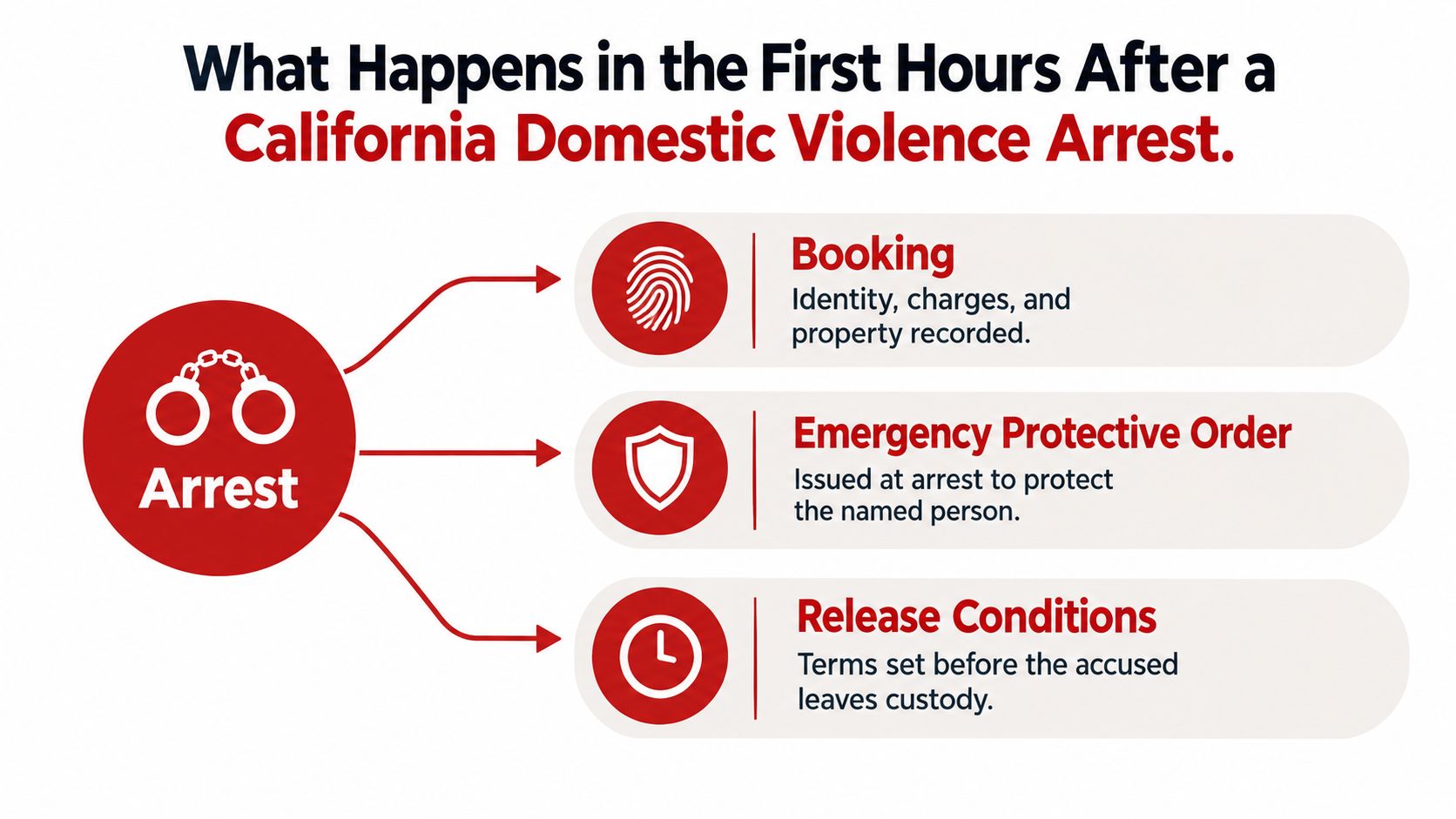
What Happens in the First Hours After a California Domestic Violence Arrest
A 2 a.m. call usually sounds like this, someone says the arrest happened fast, the car is gone, the phone is dead, and nobody knows whether the person is at the jail yet. That's not a single emergency, it's three. Booking, bail, and protective orders move in parallel, and each one has its own clock.
The first call should sort facts, not guess at outcomes
The booking officer's job is to process identity, charges, and property. The bondsman's job is to confirm where the person is held, what the bail amount shows, and whether the jail will accept a bond right away. The defense attorney can start on the legal side, and the prosecutor controls charging decisions later, but none of those people can rewrite the jail's intake record on the spot.
Practical rule: If you don't know the exact charges and whether a protective order exists, you don't really know what release will look like.
A family often thinks, “We'll just post bail and fix the rest tomorrow.” That's how people get into trouble. If there's an emergency protective order or a criminal protective order, posting bail doesn't erase it, and a bad text message can turn a release into a new problem.
For a clean step-by-step primer on what to gather after the arrest, keep what to do when someone gets arrested open while you make calls. If the arrest intersects with a workplace issue too, a separate resource like California workplace violence prevention plan can help employers think through documentation and safety planning without mixing it up with the criminal case.
Booking, Arraignment, and the California Clock
Booking feels slow because jail processing is slow. Fingerprints, photos, classification, and charge entry all have to happen before anyone can see the actual release picture. Families often expect a clean “in and out” flow, but domestic-violence cases are more likely to hit a magistrate review or a hearing requirement before release is finalized.
Booking is intake, arraignment is court
The booking stage is administrative. It's where the jail records the arrest and the case starts to take shape inside the system. Arraignment is the first real court appearance, where the charges are formally put on the record and the court can address release conditions.
The practical mistake I see all the time is this, people treat the jail's first estimate like a final answer. It usually isn't. In some domestic-violence matters, release is restricted until the court reviews the case, and that's where the timing matters more than panic.
A Ventura County family should think in this order:
- The jail finishes intake and posts the initial status.
- The bond amount appears, or a hearing is set.
- The court decides whether the posted number stands, changes, or gets paired with conditions.
- Arraignment locks in the formal court path.
The clock the family feels and the clock the court uses are not the same thing.
If you want a plain-English walkthrough of the jail side of that process, booking process for jail is the cleaner reference. Use that while you wait for the actual numbers, not before them.
How California Sets Bail After a Domestic Violence Arrest
Bail starts with the county schedule, but that number does not always survive first contact with the court. California Penal Code §1269c lets an officer ask for a higher amount when there is reasonable cause to believe the schedule will not protect the victim or secure appearance, and the officer has to submit sworn facts to a magistrate. Ventura also has a domestic-violence enhancement rule that can double bail for qualifying prior convictions on the court's enhancement list, so the number on the sheet can move quickly. For the current listed offenses and the enhancement framework, see the Ventura County bail schedule (Ventura County bail schedule).
The schedule is the starting point, not a promise.
Families get burned when they treat the posted amount like the final word. If no order changing bail is issued within eight hours after booking, §1269c says the defendant is entitled to release on the scheduled amount, but that only matters if nobody has already secured a different order.
Ask one clean question: has bail been modified, and by whom? If the answer is no, the schedule controls. If the answer is yes, the family needs the actual order, not a rumor from the front counter.
§1270.1 adds another gate
Some domestic-violence cases require notice to the prosecutor and an open-court hearing before own-recognizance release or a bail reduction under Penal Code §1270.1. The judge can weigh danger, threats, prior violence, and court-appearance history before changing release terms. So the core question is not just whether someone can pay. It is whether the court will allow release on those terms at all.
For a fuller walkthrough of how domestic violence bail is set in California, see domestic violence bail laws.
The full side-by-side comparison of cash bail, a bond, and own-recognizance release is covered in the next section.
This short walkthrough shows how a magistrate reviews bail in a domestic violence case.
Protective and No-Contact Orders That Travel With the Case
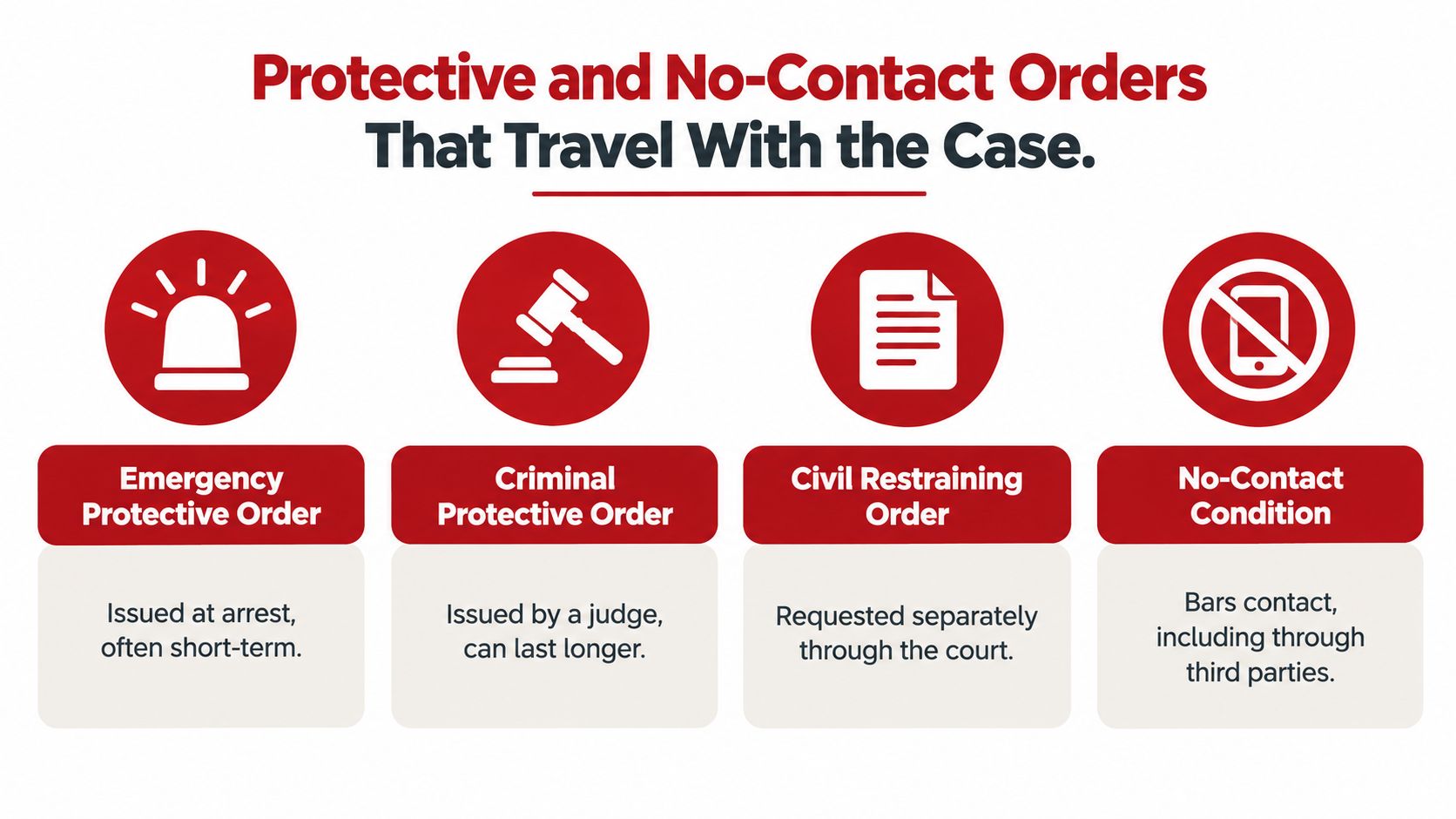
Protective orders are their own track. They don't disappear because bail gets posted, and they don't wait for the family to “work it out.” In California, you can run into an emergency protective order at arrest, a criminal protective order from the judge or magistrate, or a separate civil restraining order in family court.
The order controls contact, not the bond receipt
These orders can bar direct contact, third-party contact, returning home, firearm possession, and certain child-exchange behavior. The written order is what matters, not the mood between the two people, and not whether one side says they're fine now. The court's protective-order system can also carry the restrictions statewide through law-enforcement databases, so a local release doesn't erase the paper trail.
Posting bail doesn't lift a no-contact order. If contact is barred, even a “friendly” text can become a new violation.
Families need to separate the criminal case from the safety order. The criminal court decides custody and conditions. The family court handles a civil restraining order. Those are related, but they're not the same file.
If you need a plain breakdown of the order side, what is a protective order is the right companion reference. Keep that in mind before anyone starts sending messages, showing up at the house, or trying to trade belongings without checking the actual terms first.
Cash Bail, a Bail Bond, and Own-Recognizance Side by Side
A family gets one shot at the first move, and the wrong choice wastes time or ties up money the case does not need. Cash bail, a bail bond, and own-recognizance release all aim at the same outcome, but they work very differently once the jail clock starts running.
What each choice really does
Cash bail means the full bail amount is paid up front, and the jail or court holds it until the case ends. A bail bond shifts the release work to a licensed agent, with California law setting the premium at 10% of the total bail. Own-recognizance release costs nothing at the start, but only the court can grant it when the judge or magistrate decides the person will return without financial security.
A bondsman handles the paperwork, confirms the booking details, and pushes the release process forward. That saves families time in a county jail system where every missing document slows the door opening. The bondsman does not change the charge, the order, or the court's conditions. For the basics on release mechanics, how bail works in California gives the cleanest overview.
| Option | What the family pays | Typical speed | Who controls the money | Missed court date risk |
|---|---|---|---|---|
| Cash bail | Full bail amount | Fast if funds are ready | The jail or court controls the cash | High financial exposure |
| Bail bond | 10% premium, with possible payment arrangement depending on the case | Usually the fastest workable route | The bondsman controls the bond paperwork, not the case outcome | The bond can be forfeited |
| Own-recognizance release | No upfront bail payment | Only if approved by the court | The court controls the decision | A missed date can lead to a warrant |
The contract question is the co-signer. If a family member signs, that person is promising to stand behind the bond and to keep track of the defendant's court dates. Missed appearances, skipped calls, or bad information can put the signer on the hook for the bond's financial loss. That is why the signer should read the agreement like money is already at risk, because it is.
Collateral is different. A house, vehicle title, or other pledged asset is usually there to protect the bond company if the case goes sideways. Once the case closes and the bond is discharged, collateral should be released after the agency clears the file and confirms there is no remaining exposure.
Cash bail still makes sense when a family has the full amount ready and wants the money back at the end, assuming the court returns it under the case rules. A bond makes more sense when speed matters and the family cannot tie up the full bail amount. Own-recognizance release is the cheapest route, but only the court can put that option on the table.
Inside Ventura County Domestic Violence Court After Release
Once the person is out, the case doesn't calm down, it gets more structured. Ventura Superior Court runs a dedicated Domestic Violence Court with centralized case handling, and the court says a single judge monitors participating offenders, confirms enrollment in a 52-week anger-management program, and checks regular probation contact. That's not a release issue anymore, that's a compliance issue.
Release is the start of supervision
A family can do everything right to secure release and still blow it by ignoring the post-release rules. Miss a program meeting, skip probation contact, or treat the order like background noise, and the same judge can see the violation quickly. That's why I tell families to treat the first week like a checklist, not a victory lap.
The Ventura County system pulls in cases from Ventura, Oxnard, Camarillo, Port Hueneme, Thousand Oaks, Santa Paula, Moorpark, Fillmore, and Ojai. If you're sorting documents, the fastest way to stop confusion is to keep the paperwork moving in one place and send the right version to the right person. A clean way to manage that is to use sharing legal documents with clients so everyone is looking at the same release order, not a half-remembered summary from a phone call.
Ventura's setup makes one thing obvious, the bond gets the person home, but the court controls what happens next. If the case lands in this system, the family needs to plan for supervision, not just discharge.
Practical Do's and Don'ts for the First 72 Hours
The first 72 hours are where families either stay steady or make a mess. Start with the exact written order, not what someone thinks it says. Ask for a copy of the release paperwork, note every protected person named, and look for any firearm surrender or residence language before anyone goes anywhere.
What to do right away
- Confirm the exact written order: Read the conditions line by line, because the jail release and the court order are not the same thing.
- Ask for the paperwork: Keep the actual release and protective-order documents in hand so nobody has to guess later.
- Name every protected person: Find out whether children, a partner, or another household member is listed, because that changes the rules fast.
- Clarify pickup and property plans: If belongings need to be retrieved, ask whether a neutral third party or law enforcement escort is required.
What not to do
- Don't call or text to “explain”: If contact is barred, an innocent message can still count as a violation.
- Don't go home on your own assumption: A shared address doesn't mean the person can return there.
- Don't route messages through a friend or relative: Third-party contact can violate the order too.
- Don't ignore child exchanges or reporting rules: Those are often the details that get missed first.
If a child is angry, scared, or acting out after the arrest, a parenting resource like how to deal with an aggressive child can help you think more clearly about safety and boundaries before emotions take over. That matters, because panic makes people improvise, and improvising around a court order is how new charges happen.
The bail bondsman's job ends at speed, paperwork, and getting the release moving. The court, the prosecutor, and the Family Justice Center handle the rest, and families need to keep those lanes separate.
Bringing Charges, Bail, and Orders Into One Decision
Keep the model simple, one arrest creates three tracks, charges, bail, and protective orders. The smartest first call is to a local 24-hour bail bonds Ventura line that can confirm booking facts and the bail amount while the family sorts the court side. After that, the next 30 days usually turn on arraignment, protective-order compliance, and program enrollment.
Bail gets the person home. The court, counsel, and the Family Justice Center handle the rest. If you're dealing with this tonight, call Bada Bing Bail Bonds for fast Ventura County release help, straight answers on the booking status, and a clear explanation of what the bond can do and what only the court can change.