At 2 a.m., the call usually comes from a spouse, sibling, or parent who’s trying to sound calm and failing. Someone has been booked at Ventura County Jail after a domestic violence allegation. The patrol car is still warm in the driveway, a phone cord is tangled across the kitchen floor, and the person in custody may be sitting in a holding cell with nothing but a plastic cup and a booking number.
The first instinct is often the wrong one. Families rush to confront the alleged victim, clean the house, delete angry texts, or ask friends to “smooth things over.” Don’t do that. You can create a new evidence problem, violate a protective order, or trigger an allegation of witness pressure before you even know what the court has ordered.
This guide is the playbook I wish every caller had before reaching for the phone. It focuses on California domestic violence bail laws, Ventura County’s local bail schedule, the difference between ordinary and repeat DV cases, and the protective-order conditions that determine whether someone comes home safely.
Table of Contents
- The Late-Night Call That Changes Everything
- How Domestic Violence Bail Works in California
- Common DV Charges and What They Mean for Bail in Ventura County
- Why Ventura County Doubles Bail for Repeat DV Arrests
- Protective Orders and No-Contact Conditions Explained
- Working With a Bail Bondsman on a DV Case
- Staying Compliant After Release and Avoiding Re-Arrest
- Your First Moves and the One Call to Make Tonight
The Late-Night Call That Changes Everything
A domestic violence arrest creates two separate emergencies. The first is custody. The second is what happens after release. Families usually focus on the first and underestimate the second.
The person arrested may be at Ventura County Main Jail, while relatives are still trying to determine the exact charge, whether bail has been posted, and whether an emergency protective order is active. A booking label such as domestic battery doesn’t tell the whole story. The code section, prior history, injury allegation, protective-order status, and any additional counts can all change the release process.
The mistake that burns the most time
The costliest move is contacting the alleged victim to argue, apologize, retrieve property, or ask that the arrest be dropped. A family member may think a quick call will calm everyone down. Instead, that contact can be treated as pressure, intimidation, or a violation of a no-contact condition.
Preserve what already exists. Don’t delete texts, alter the home, move objects, or coach anyone about what to say. Don’t ask the defendant to explain the incident over a recorded jail phone. Give factual information to the defense attorney and bail agent, then stop improvising.
Practical rule: Until you’ve read the actual order, assume every direct and indirect contact could create a new problem.
What matters in the first hour
Write down the defendant’s full legal name, booking number, facility, listed charges, and any prior domestic violence conviction you know about. Confirm whether the booking is at Ventura County Jail or another facility serving the arresting agency.
Ventura County families may be calling from Ventura, Oxnard, Camarillo, Port Hueneme, Thousand Oaks, Santa Paula, Moorpark, Fillmore, Ojai, or Santa Barbara. The arrest location doesn’t always tell you where the defendant is being held. Verify the facility before driving anywhere, and call a licensed local bondsman before arriving so the paperwork can be prepared while booking information is confirmed.
How Domestic Violence Bail Works in California
Domestic violence bail is the financial amount set for temporary release while the criminal case continues. It isn’t a fine, a sentence, or a finding of guilt. Posting bail gets the defendant out of custody under conditions. It doesn’t end the case.
California uses a statewide framework, including the Uniform Bail and Penalty Schedule, while local superior courts publish schedules that apply within their counties. Ventura County’s court site publishes both the statewide schedule framework and its own local bail schedule, showing that local bail practice operates within California’s broader system rather than being created separately at every arrest. Families can review the basic California process through this explanation of how bail works in California.
The amount is only one part of release
A judge or schedule may establish a dollar amount, but a DV release often includes protective conditions. Those conditions can control where the defendant stays, whether they can return home, whether they can contact a partner or children, and whether they must avoid weapons or alcohol.
Bail may be posted with cash or through a licensed bail agent. Cash posted directly with the court is generally returned at the end of the case if the defendant follows court requirements, although court rules and deductions can apply. A bail bond is a contract with the bond company. The premium paid for that service isn’t the same thing as refundable court cash.
California’s statutory framework also allows courts to examine the source of bail money in circumstances involving concerns that the funds came from criminal activity or were offered to influence testimony. That’s one reason families should answer a bondsman’s questions instead of treating the application like a formality.
Ventura County adds DV-specific treatment
Ventura County’s 2024 bail schedule separately identifies domestic violence-related offenses, including Penal Code 243(e)(1) and Penal Code 273.5. It also contains a special repeat-offense rule that can double standard bail when there’s reasonable cause to believe the arrested person has a prior conviction on the Domestic Violence Enhancement List. The local schedule is the document that matters at the Ventura facility, not an internet estimate based on another county.
Posting bail doesn’t authorize contact with the protected person. Release paperwork and protective orders must be read together. If the order says stay away, the defendant can’t return home because a bond has been posted.
Common DV Charges and What They Mean for Bail in Ventura County
The booking charge controls the starting point. In Ventura County, two code sections appear often in domestic violence bookings.
Penal Code 243(e)(1) generally covers misdemeanor domestic battery involving a spouse, cohabitant, dating partner, or similar qualifying relationship. Penal Code 273.5 concerns corporal injury to a spouse, cohabitant, or parent of a child. Depending on the facts and charging decision, 273.5 may be filed as a misdemeanor or felony.
Charges families commonly see
The Ventura County 2024 schedule identifies these offenses and sets the local figures families may encounter. The amounts below are the typical schedule figures specified in the case information, before any separate enhancement or additional count is considered.
| Charge | Code | Classification | Typical Bail |
|---|---|---|---|
| Domestic battery | Penal Code 243(e)(1) | Misdemeanor | $20,000 |
| Corporal injury to spouse, cohabitant, or parent of a child | Penal Code 273.5 | Misdemeanor | $30,000 |
| Corporal injury to spouse, cohabitant, or parent of a child | Penal Code 273.5 | Felony | $50,000 or more before enhancements |
These figures should be checked against the current booking record and schedule. The Ventura County 2024 bail schedule is the controlling local reference for the schedule treatment, including the separate repeat-DV rule.
Other allegations can appear beside the principal DV count. Penal Code 422 addresses criminal threats. Penal Code 368 concerns elder abuse. Penal Code 273.6 addresses violation of a protective order. Each additional count can affect the total release picture, and the court may consider the overall allegations when setting conditions or reviewing release.
Read the code, not just the label
A jail roster may use a short description that hides important details. Ask for the exact code section and classification. If the booking lists a felony 273.5, a protective-order violation, or a prior-DV indicator, don’t assume the ordinary misdemeanor amount applies. A family comparing assault-related bail can also review how assault bail amounts are calculated, but the Ventura DV schedule and booking record must control the actual case.
Why Ventura County Doubles Bail for Repeat DV Arrests
Repeat allegations change the risk analysis, and Ventura County’s local schedule addresses that directly. The 2024 Ventura County bail schedule provides for standard bail to be doubled when there’s reasonable cause to believe the arrested person has a prior conviction listed on the Domestic Violence Enhancement List. That rule separates a first booking from a repeat case before the family ever reaches the payment question.
California Penal Code 273.5 can also carry consequences based on qualifying prior convictions. The relevant history isn’t limited to a conviction from the same courthouse. Depending on the statute and how the prosecutor pleads the case, the record can involve qualifying convictions from another state and other prior adjudications or dispositions. A bondsman shouldn’t guess from memory. The defense attorney needs to examine the actual record and determine which priors legally apply to the current count.
How the repeat flag appears
Booking records can contain a prior-DV notation, an enhancement indicator, or an internal flag used to alert the jail and charging authorities that the local schedule may require a higher amount. Families sometimes see an “H” flag, a separate prior-DV code, or a notation connected to the prosecutor’s filing. These signals aren’t a substitute for legal review, but they tell the bail agent not to quote a first-offense amount prematurely.
The critical distinction is between a prior arrest and a qualifying prior conviction. An arrest alone isn’t the same as a conviction. A dismissed case doesn’t automatically operate as a qualifying prior because it appears in a criminal-history search. The exact disposition and legal basis matter.
The dollar jump
Using the Ventura schedule figures, a first-offense 243(e)(1) booking starts at $20,000, while the schedule’s repeat-DV doubling rule would make the standard amount $40,000 when the qualifying prior condition is met. A misdemeanor 273.5 amount of $30,000 would become $60,000 under the same doubling treatment.
| Charge | First Offense Bail | With Prior DV Conviction |
|---|---|---|
| Penal Code 243(e)(1) | $20,000 | $40,000 |
| Misdemeanor Penal Code 273.5 | $30,000 | $60,000 |
Those calculations reflect the local schedule’s stated doubling approach, not a promise that every case will receive the same final release terms. Felony exposure, added counts, protective-order allegations, and a judge’s individualized decision can still change the result.
Protective Orders and No-Contact Conditions Explained
A bail bond and a protective order do different jobs. The bond addresses custody and financial security. The order controls contact, distance, residence, communication, and sometimes access to children or property.
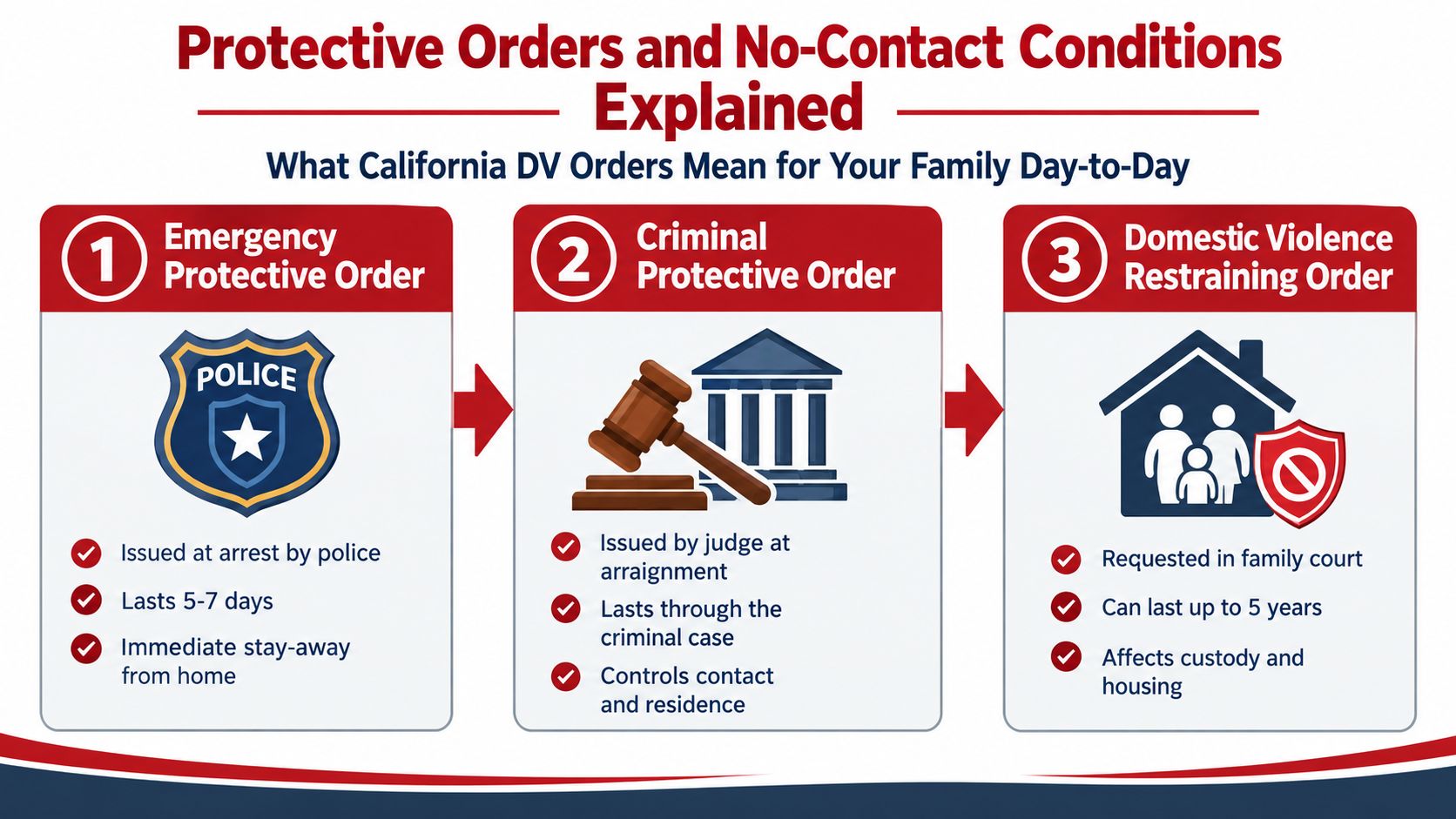
Families usually encounter three overlapping forms of protection:
- Emergency protective order. Law enforcement may request this after the response to an alleged incident. It can require immediate separation and may affect access to the shared home.
- Criminal protective order. A judge can issue this in the criminal case, often around arraignment. Its terms govern the defendant during the prosecution.
- Civil domestic violence restraining order. A protected party can seek a separate order in family court. That order may address housing, custody, and other family-law issues.
The precise duration and wording depend on the order issued. Read every page. A no-contact clause can prohibit calls, texts, emails, social-media messages, messages sent through relatives, and “accidental” contact arranged through a friend. It may cover the protected person’s home, workplace, school, children’s locations, or other listed places.
The protected person usually can’t cancel a criminal order
The alleged victim may want contact restored, but they generally can’t personally erase a criminal protective order. The prosecutor and court control the criminal order, even if the protected person asks for a change. A civil restraining order follows its own process, and changing one order doesn’t automatically change the others.
Violating a criminal protective order can lead to a new arrest and a separate charge under California law. It can also prompt bail revocation or stricter release conditions. That’s why a defendant must not rely on a text saying, “Come home,” when the court order says otherwise.
If a family needs to understand the legal process for challenging or changing an order, this resource on how to start a protection order appeal offers useful procedural context. For the bail side, review the practical guidance on domestic violence bond conditions.
The video below provides additional general context about protective-order issues.
Working With a Bail Bondsman on a DV Case
A Ventura County DV bond moves fastest when the family brings usable information, not guesses. Start with the booking number and exact charges. The bail agent confirms the defendant’s location, checks the amount, reviews the release requirements, and prepares the bond application.
California bond premiums are set by law at 10% of the total bail. For a $20,000 bond, the premium is $2,000. For a $50,000 bond, it’s $5,000. Those figures describe the regulated premium calculation, while payment plans, collateral, and approval requirements depend on the application and risk assessment.
What the bondsman needs
Have these items ready:
- Booking information: Full legal name, booking number, arresting agency, and facility.
- Charge details: The exact code sections, classification, and any prior-DV indicator.
- Order language: Any emergency or criminal protective order information already available.
- Co-signer information: A California ID, stable address, contact information, and proof of income may be requested.
- Collateral details: Larger or higher-risk bonds may require property or another approved form of security.
A payment plan can spread an approved premium over scheduled payments. It doesn’t eliminate the legal obligation, and it doesn’t change the defendant’s court conditions. Collateral is separate from the premium and may be returned after the bond obligation ends, subject to the contract and any outstanding balance.
Where DV bookings slow down
The jail may need to process the criminal protective order before release is authorized. A bondsman can finish the financial paperwork while the facility is still waiting on order language, classification, fingerprints, or court instructions. That’s why a family shouldn’t promise a pickup time before the jail confirms release clearance.
A generalist may know how to write a bond. A local agent experienced with DV bookings understands that the financial part is only one queue. The agent must track the jail’s acceptance of the bond, the order-processing delay, and the conditions that the defendant must acknowledge before walking out.
Families comparing the cash route with a licensed agent can review how to post bail before deciding which option fits their situation.
Staying Compliant After Release and Avoiding Re-Arrest
Release isn’t the finish line. It’s the start of a compliance phase where a single impulsive message can send someone back to jail and make the original release harder to defend.
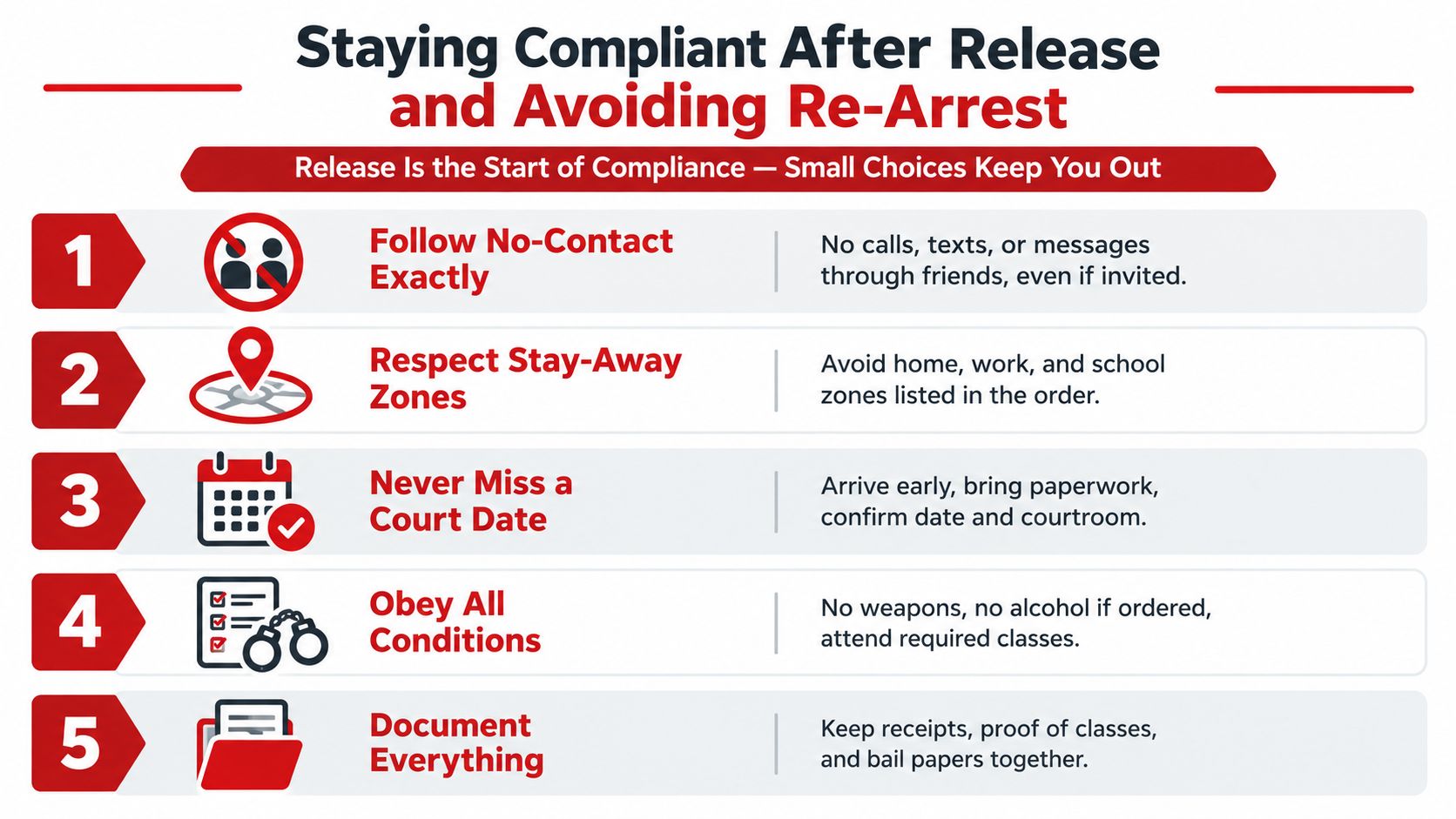
The safest rule is simple: no direct or indirect contact with the protected person unless the written order expressly allows it. That includes a birthday text sent through a friend, a social-media tag, a message asking about children, driving past the protected person’s home or workplace, and walking into the same parking lot to “talk for one minute.”
Replace risky instincts with a written plan
If children are involved, don’t improvise at a school pickup or custody exchange. Ask the defense lawyer about an approved communication method or route child-related communication through counsel or a court-approved co-parenting arrangement. If an accidental meeting happens at a grocery store, leave immediately, avoid conversation, and document what happened.
Follow these rules every day:
- No direct messages: Don’t call, text, email, tag, comment, or react to the protected person’s social-media activity.
- No intermediaries: Don’t ask a sibling, friend, child, or coworker to carry a message.
- Respect locations: Stay away from every home, workplace, school, or other location listed in the order.
- Follow added conditions: Don’t possess weapons or consume alcohol if the release order prohibits them.
- Keep records: Save proof of required classes, check-ins, court dates, and any approved communication.
A violation can lead to a new Penal Code 166(a)(4) allegation, bail revocation, and a much more difficult second release. The protected person’s invitation doesn’t override the court’s order. Only the court can change a criminal release condition.
The safer choice: Treat every condition as active until a judge changes it in writing.
Structured risk assessment can help courts make more individualized pretrial decisions than charge labels alone. Federal pretrial research discusses assessment-guided release and DV-specific risk considerations, while evidence guidance supports relationship-focused screening and survivor notification systems. The federal pretrial research discussion is useful background, but it doesn’t replace advice from the defense attorney or the exact order in the case.
For families trying to understand what happens after a violation, the explanation of what bond revocation means covers the practical consequences.
Your First Moves and the One Call to Make Tonight
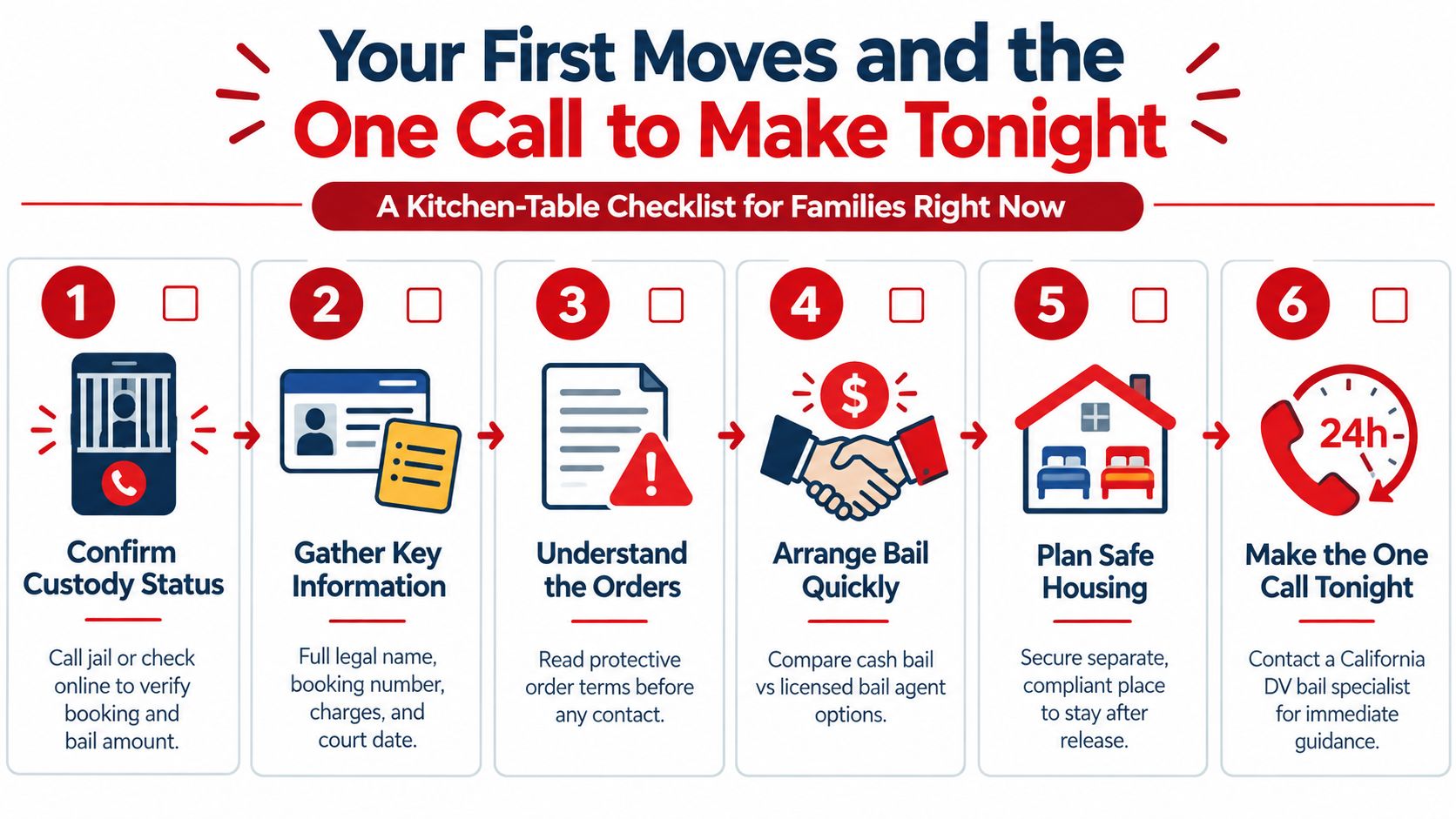
Keep the first hour organized. Use a notepad, not a chain of emotional phone calls.
- Confirm custody: Verify the defendant’s location, booking status, and listed bail amount with the facility.
- Record the case details: Write down the full name, booking number, exact code sections, classification, and case number if available.
- Identify order issues: Ask whether an emergency or criminal protective order has been issued. Don’t contact the protected person to find out.
- Gather application information: Prepare identification, address history, employment details, and any known prior convictions.
- Choose a qualified co-signer: Find a California resident with verifiable income who understands the financial responsibility of the bond.
- Call before driving: Let the Ventura County bail agent coordinate the paperwork and confirm what the jail needs before anyone heads to the facility.
Ask directly whether the booking involves Penal Code 243(e)(1), Penal Code 273.5, a felony, a protective-order violation, or a repeat-DV enhancement. Those details affect the amount, the conditions, and the time required for release.
Ventura County Main Jail accepts cash, certified checks, money orders, credit or debit card payments through GovPayNow, and bail bonds. The facility is located at 800 S Victoria Ave., Ventura, CA 93009, according to the jail information linked through Ventura County Jail bail bonds. Confirm current procedures before going in, because release processing depends on the facility and the case.
The first number to dial is a 24-hour bail bonds Ventura agent who can verify the booking, explain whether you’re dealing with a standard or repeat-DV amount, and coordinate with the defense attorney about no-contact language. Stay calm, stay off the phone with the defendant unless counsel advises otherwise, and don’t let urgency turn into a second arrest.
Bada Bing Bail Bonds provides 24-hour Ventura County bail bonds support, verifies booking details, explains DV charges and release conditions, and offers licensed bond services with payment-plan, co-signer, and collateral options when approved. Visit Bada Bing Bail Bonds now for direct help with bail bonds Ventura, bail bonds Oxnard, and releases connected to Ventura County Jail.