A phone rings in the middle of the night. Someone has been arrested in Ventura, Oxnard, or Thousand Oaks after a domestic violence call, and the family wants one answer first: Can bail still be posted, and what happens after release? The charge may sound like an automatic reason the person must remain in jail. In practice, release often depends on the bail amount, the court’s instructions, and a set of conditions that must be followed immediately.
Domestic violence bond conditions can affect where someone sleeps, who they contact, whether they can return home, and how they handle firearms, transportation, work, and treatment. This guide walks through those rules in plain English for families dealing with Ventura County Jail bail bonds, court paperwork, and a stressful first night.
Table of Contents
- What Domestic Violence Bond Conditions Really Mean
- How Bail Gets Set in Ventura County Domestic Violence Cases
- No-Contact Orders and Protective Orders After a DV Arrest
- Firearm Surrender, GPS Monitoring, and Stacked Release Conditions
- How Bond Conditions Affect Posting Bail and Release Timing
- Practical Steps Families Should Take in the First 24 Hours
- Moving Forward After Release on DV Bond Conditions
What Domestic Violence Bond Conditions Really Mean
At two in the morning, a relative may learn that bail has been set and still ask whether the arrested person can come home. The answer depends on more than the dollar amount. Release may come with a no-contact order, housing limits, firearm restrictions, monitoring, and required check-ins.
Bond conditions are the rules attached to release. Bail provides financial security tied to appearing in court. Conditions govern conduct while the case is pending. Release works more like receiving a keycard that opens only approved doors. The person may leave custody, but access to certain people, places, and activities can be restricted. Violating a condition can put the release at risk.
A theft or DUI arrest may involve standard release requirements. A domestic violence case creates an added planning problem because the accused person and protected person may be spouses, partners, relatives, co-parents, or housemates. Even a person who expects to return home may be barred from that residence or from contacting the people who live there.
The rules can also affect practical details. A defendant may need another place to sleep, a way to retrieve clothing without returning alone, and a plan for work or transportation that avoids prohibited contact. Families often focus on posting bail first. The written order controls what happens after the payment.
The release decision is not the final verdict
Conditions are temporary rules, not a finding that the defendant is guilty. They address court appearance and safety while the criminal case continues. A judge may stack several terms together because one restriction cannot address every concern.
For example, an order may prohibit contact with the protected person, require the defendant to stay away from a shared residence, restrict firearm access, and require check-ins. The person may be released, yet normal life cannot resume that night.
Practical rule: If any condition is unclear, ask the defense lawyer, court, pretrial agency, or bail agent to explain the written order. Do not guess, especially about contact, housing, or firearm access.
A federal study of domestic-violence bookings shows why families should not assume these cases are handled exactly like other arrests. It compared release and detention decisions with later pretrial outcomes, including a new domestic-violence arrest, using the Public Safety Assessment. The federal court study describes those release decisions and outcomes.
Before anyone leaves custody, identify every condition, confirm who has the paperwork, and set up a plan for the first night.
How Bail Gets Set in Ventura County Domestic Violence Cases
Ventura County doesn’t use one universal dollar amount for every domestic violence arrest. Ventura Superior Court maintains local bail-schedule resources, including a Ventura Superior Court Bail Schedule for 2024 and the Judicial Council Uniform Bail and Penalty Schedules for 2025. That means local bail decisions operate through a county-specific schedule layered over California rules, rather than one statewide figure. Ventura Superior Court provides its bail-schedule resources.
The exact charge matters. A misdemeanor violation of a domestic violence restraining order is treated differently from a felony allegation, and prior domestic violence history or aggravating facts can affect the scheduled amount and the conditions considered by the court. Some California county materials list distinct protective-order-violation figures, including amounts such as $25,000 to $50,000, depending on priors or aggravating circumstances. The Kern County felony bail schedule shows how charge categories and prior facts can affect preset amounts.
The special California bail-change process
California law gives peace officers a way to seek higher bail in specific situations. If a defendant is arrested without a warrant for a bailable felony or for misdemeanor violation of a domestic violence restraining order, an officer can file a sworn declaration explaining why the scheduled amount isn’t enough to ensure appearance or protect the victim or family member.
The timing matters. If no order changing bail issues within eight hours after booking, the defendant is entitled to release on the scheduled amount. That doesn’t erase conditions, and it doesn’t guarantee that jail processing will finish immediately. It does give families a concrete legal issue to raise when a higher amount is being discussed. California Penal Code section 1269c describes this sworn-declaration process and the eight-hour rule.
| Factor | Effect on bail amount | Effect on conditions |
|---|---|---|
| Exact charge classification | May place the case under a different schedule category | Can lead to different protective or release terms |
| Prior DV history | May support a higher scheduled or court-set amount | May prompt stricter supervision or stay-away rules |
| Existing protection order | Can affect the review of release | May make no-contact and location restrictions central |
| Alleged safety or appearance concern | May support a request for higher bail | May lead to monitoring, reporting, or housing requirements |
Families should obtain the booking number, exact charge, scheduled bail, and any request to change bail. A plain-language explanation of the domestic violence bail amount can help, but only the current booking and court paperwork will show what applies in a particular case.
No-Contact Orders and Protective Orders After a DV Arrest
Families often use “protective order” and “no-contact order” as if they mean the same thing. They can overlap, but they aren’t always the same document or issued by the same authority. Before anyone posts bail, identify the order in effect and read every restriction.
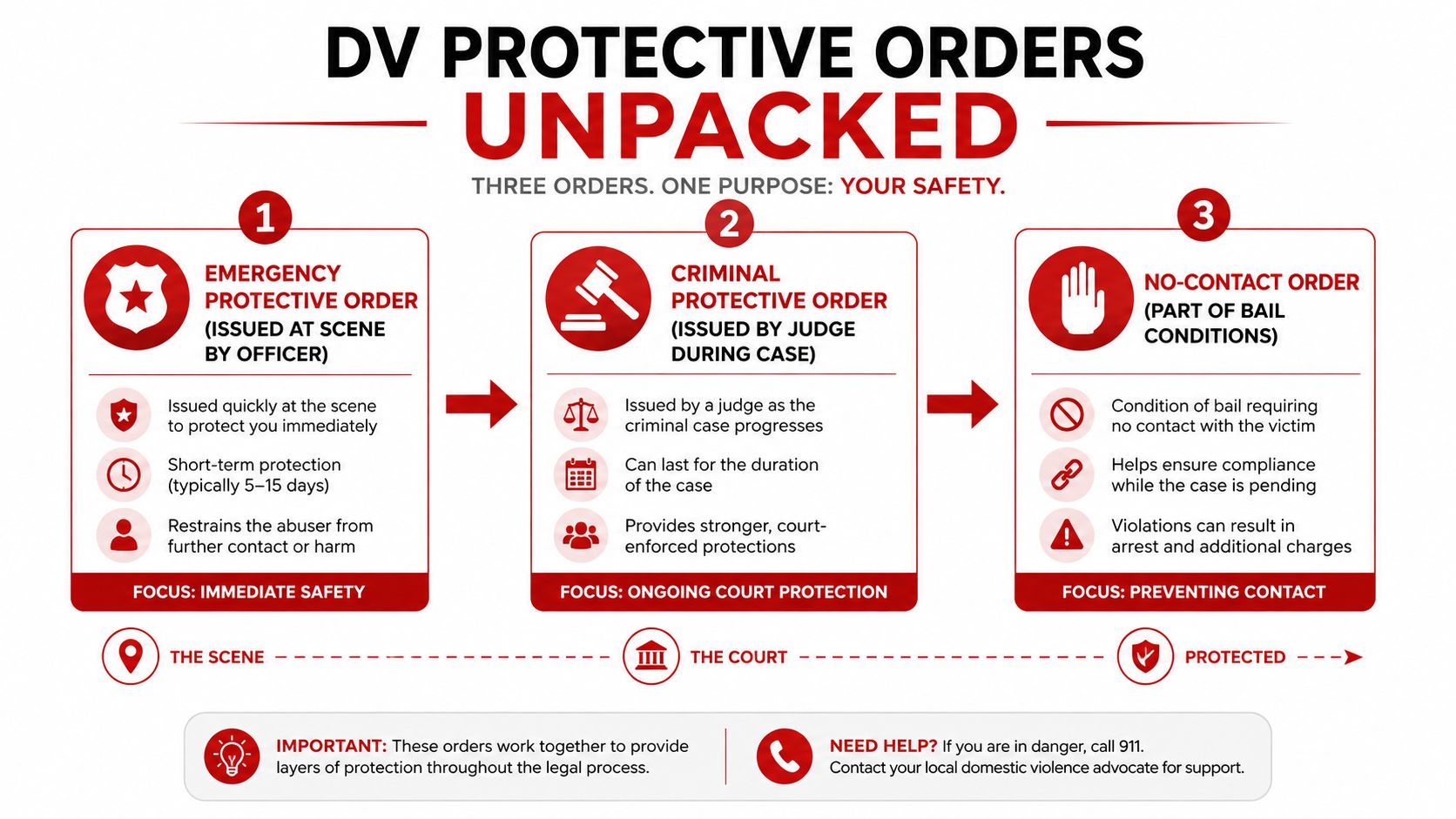
An emergency protective order may be issued after officers respond to the scene. A criminal protective order may follow when the case reaches court. A bond no-contact condition is a release term tied to the criminal case. One person can be affected by more than one of these at the same time.
What each restriction may control
An emergency order may restrict contact or access to a home while immediate safety concerns are reviewed. A criminal protective order may remain in effect during the case and can address contact, residence, children, or protected locations. A bond condition may separately prohibit direct or indirect contact as part of the release agreement.
“Contact” can be broader than a phone call. Depending on the written order, prohibited conduct may include:
- Phone calls and texts: Don’t call, text, email, or send social-media messages.
- Indirect messages: Don’t ask a friend, relative, child, or co-worker to pass along a message.
- Location visits: Don’t return to the shared home or approach a protected person’s residence, workplace, or other listed location.
- Digital contact: Don’t use online accounts to apologize, argue, explain, or ask the other person to change their account.
Why a family agreement may not be enough
The protected person may want to speak with the defendant or invite the person home. That doesn’t automatically cancel a court order or bond term. The defendant remains responsible for following the written restrictions unless a court changes them.
Release decisions are increasingly connected to existing protection orders, prior release conditions, relationship history, and available risk information. That is why a family shouldn’t treat a reconciliation conversation as permission to ignore the order. A guide to California restraining-order types can help families distinguish the documents.
A historical Canadian study also shows why conditions alone aren’t a complete safety solution. Among people issued section 810 recognizances in Winnipeg between 1993 and 1997, 10% committed an offence while subject to those conditions. The Canadian Justice study discusses peace bonds, supervised release, and the limits of conditions alone.
If there is any uncertainty, follow the stricter written instruction until a lawyer obtains clarification or a court changes it.
Firearm Surrender, GPS Monitoring, and Stacked Release Conditions
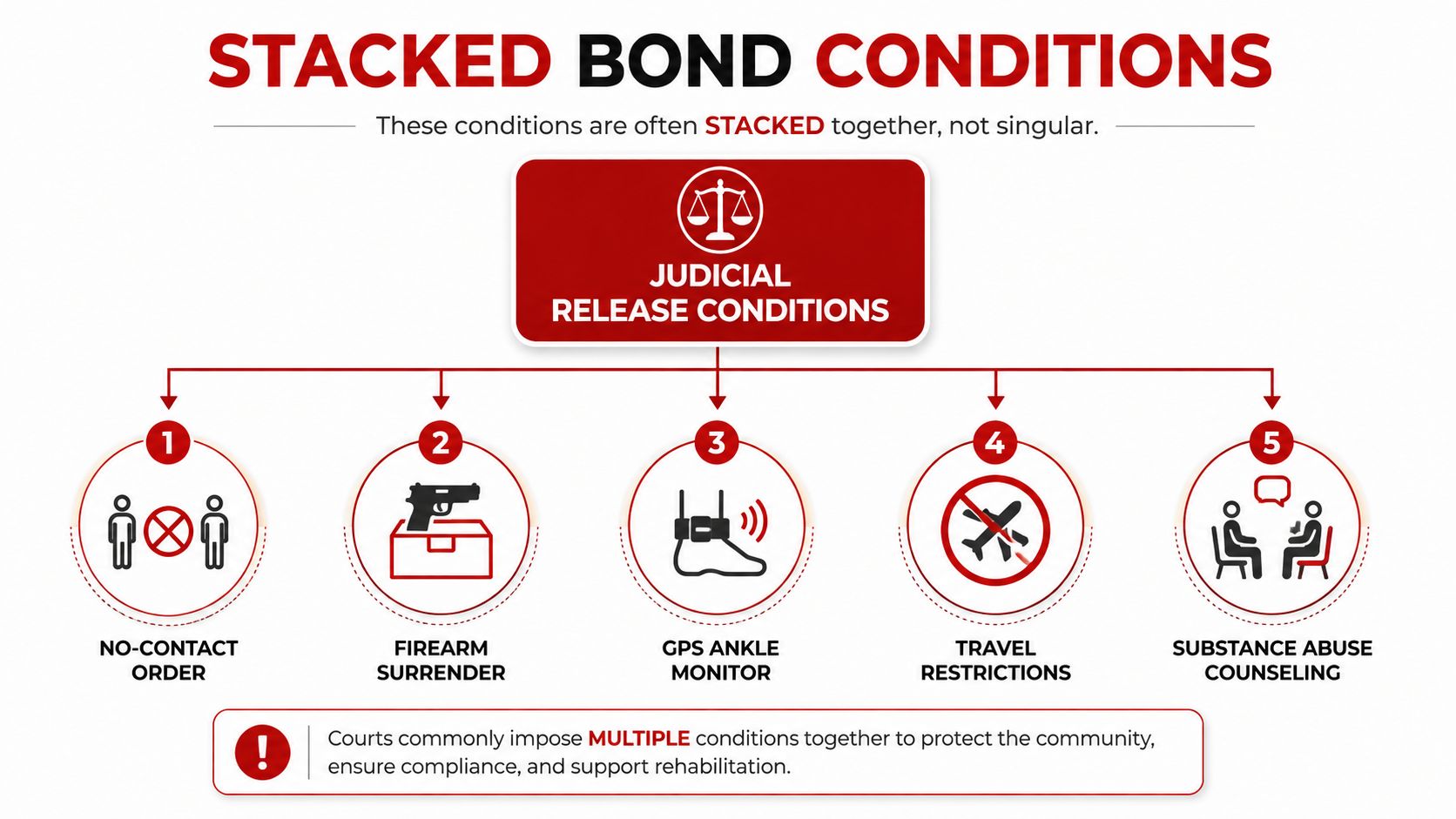
A domestic violence release order often isn’t one rule. Judges may stack several conditions so the release plan addresses contact, movement, weapons, treatment, and supervision at the same time.
Common terms may include:
- Firearm surrender: The defendant may have to surrender firearms and follow restrictions on possession or access.
- Electronic monitoring: A GPS device may track location and alert supervising personnel when a restricted area is entered.
- Curfew: The defendant may need to remain at an approved residence during specified hours.
- Stay-away zones: The order may prohibit travel near a home, workplace, school, or other listed location.
- Evaluation or treatment: The court may require an evaluation, counseling, or a treatment program.
- Housing or employment terms: The defendant may need to maintain an approved residence or follow employment-related reporting requirements.
The first-night problems are often logistical
The hardest condition may not be the one that sounds most severe. A person released late at night may have nowhere to sleep that complies with a stay-away order. A relative’s home may be too close to the protected residence. A work schedule may conflict with a curfew. Firearm surrender may require identifying every weapon and following the approved surrender process before release or immediately afterward.
Electronic monitoring also requires careful planning. Safety guidance cautions that monitoring alone shouldn’t be treated as a complete solution. When used, it may need to be paired with residence or movement restrictions, so the defendant must understand both the device and the geographic rules.
Research from a New York-based review shows how frequently supervised release can appear in DV cases. About 40% of observed bail-eligible supervised-release cases involved domestic violence charges, and in 2022, non-NYC judges released people on supervision in DV cases more often than in non-DV cases, 31% versus 16%. The Vera Institute review examines supervised release practices and domestic violence cases.
Before arranging firearm bail bonds in Ventura and Santa Barbara, the family should ask how the release plan handles weapons, approved housing, monitoring installation, transportation, and the first required check-in. Posting a bond doesn’t solve those logistics by itself.
How Bond Conditions Affect Posting Bail and Release Timing
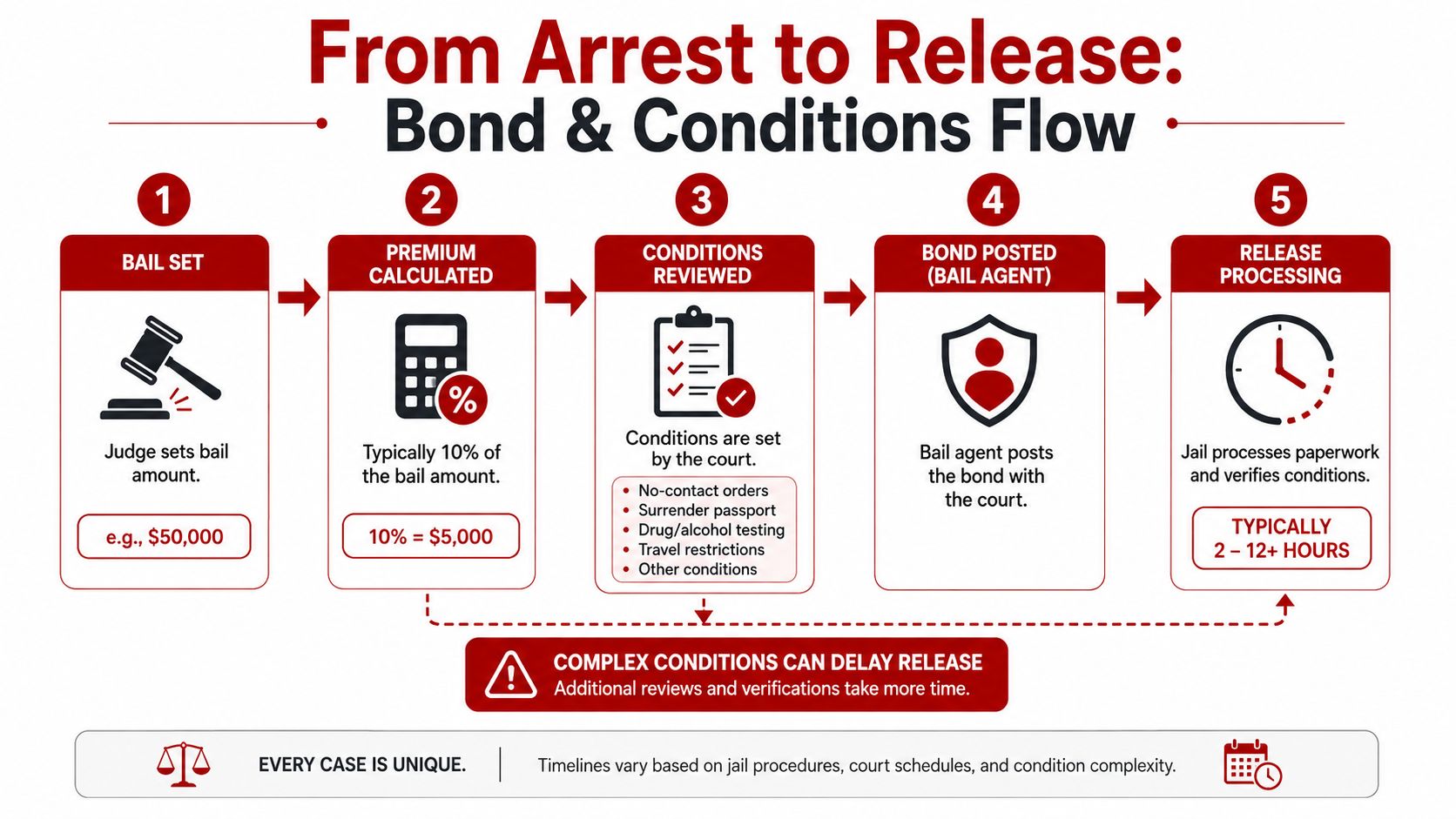
At 2 a.m., a family may hear that bail has been posted and assume the person will walk out shortly. In a domestic violence case, payment is only one part of the release plan. The bail amount determines the financial obligation, while bond conditions determine what must be arranged before release and followed afterward.
In California, the bond premium is set by law at 10% of the total bail. A higher bail amount raises that premium. Conditions can create separate needs, including an approved place to stay, transportation, monitoring arrangements, or firearm surrender.
A payment plan, co-signer arrangement, or collateral may help when the bond is large or carries added risk. A co-signer is doing more than helping with a payment. The agreement may make that person responsible for the bond, with an obligation to remain available if the defendant misses court or violates release requirements.
Existing orders don’t automatically prevent a bond
A protective order or firearm restriction does not automatically prevent posting bail. It changes the release plan. The defendant may need another residence, routes that avoid protected locations, a completed weapon surrender, and transportation that does not pass through a prohibited area.
These conditions can stack together. A residence that fits one requirement may still create a problem under a stay-away order. A release that is financially ready may wait while the jail confirms the address, paperwork, or monitoring instructions.
A bondsman can help with bond paperwork and communicate with the jail. The bondsman cannot cancel a court order or approve contact with a protected person. The bond agent handles the financial release process. The court controls the conditions.
Why release may take longer than expected
Posting the bond starts the jail’s release work. Staff may still need to verify the order, approved address, monitoring instructions, or other documents. A local agent can track the release window and update the family, but the facility and case determine the timing.
Federal research offers context without predicting any Ventura County result. The study reported that 68% of 5,188 domestic-violence bookings were released, compared with 72% of 15,070 non-DV bookings. That difference shows why a DV release may require added review instead of moving through as a routine transaction. The federal study provides the booking and release comparison.
Families reviewing how to post bail should have the booking details ready and ask for two separate explanations: the financial terms and every release condition. That distinction helps prevent a paid bond from being mistaken for permission to ignore the court’s rules.
Practical Steps Families Should Take in the First 24 Hours
Fear makes people move quickly, but the wrong quick decision can create another arrest or delay release. Use a written checklist, keep the conversation calm, and assign one person to collect information.
-
Verify the booking: Confirm the defendant’s name, booking number, facility, and current status with Ventura County Jail or the arresting local police department. If the arrest happened in Oxnard, Camarillo, Port Hueneme, Thousand Oaks, Santa Paula, Moorpark, Fillmore, Ojai, or Santa Barbara, confirm which agency made the arrest and where the person was booked.
-
Confirm the exact charge: Ask for the charge classification, bail amount, scheduled amount, and every listed condition. Don’t rely on a family member’s recollection of what officers said at the scene.
-
Get legal advice: A domestic violence defense lawyer can explain protective orders, challenge unclear conditions, and advise the defendant about communications and court appearances. A bail agent handles the bond process, not the criminal defense.
-
Prepare the premium and paperwork: Gather identification, payment information, co-signer details, and any collateral information. Ask the agent to explain the agreement before signing.
-
Arrange compliant housing: Find an approved place to stay before release. Check the address against every stay-away zone, confirm transportation, and plan for work or childcare obligations without violating the order.
-
Create a compliance file: Keep copies of the bond agreement, protective orders, monitoring instructions, receipts, check-in records, treatment appointments, and court notices. Set reminders for court dates and reporting requirements.
The contact rule deserves special attention
The defendant shouldn’t contact the alleged victim directly or indirectly when an order prohibits contact. That includes asking relatives to deliver a message or using children to discuss the case. If property, medications, pets, or childcare must be handled, ask a lawyer or the court about a lawful method instead of improvising.
For co-signers: Keep the agent’s number, monitor court notices, and report concerns promptly. Don’t wait until a missed appointment becomes a larger release problem.
This is frightening, and no checklist removes that fear. It does restore control by turning a confusing night into specific tasks that protect the defendant’s release and the family from avoidable mistakes.
Moving Forward After Release on DV Bond Conditions
The first night can make domestic violence bond conditions seem impossible. Most families find them more manageable once they separate the rules into categories: contact, location, weapons, supervision, treatment, and court obligations. The defendant should carry the written terms, follow them exactly, and ask a lawyer about any condition that seems unclear or unworkable.
Compliance protects more than a trip home from jail. It protects the release status, the co-signer’s agreement, and any collateral connected to the bond. It also gives the family a stable process while the criminal case continues.
After release, practical support may include court-date reminders, agent check-ins, and guidance about maintaining the conditions until the case resolves. Those services don’t replace legal advice, but they can help families avoid missed dates and prevent confusion about the bond process. Learn what happens after bail is posted.
California also places limits on informal bail changes in domestic violence cases. Under Penal Code section 1270.1, a court must hold a noticed hearing before reducing or raising DV bail, and the defendant cannot be released on their own recognizance or on reduced bail without that hearing. The California statute explains the required hearing process.
That can feel slow when a family wants an immediate adjustment. Patience doesn’t mean ignoring an unworkable condition. It means using the proper legal process, documenting the problem, and asking counsel to seek a lawful modification.
If a loved one has been arrested, Bada Bing Bail Bonds can answer 24 hours, verify Ventura County booking information, explain the bail paperwork and domestic violence release conditions, and coordinate with the jail when a bond is ready. Visit Bada Bing Bail Bonds for immediate help with a Ventura County bail bond, payment options, and a clear plan for the next step.